Hellas (HEL-las)
Land of the Hellenes
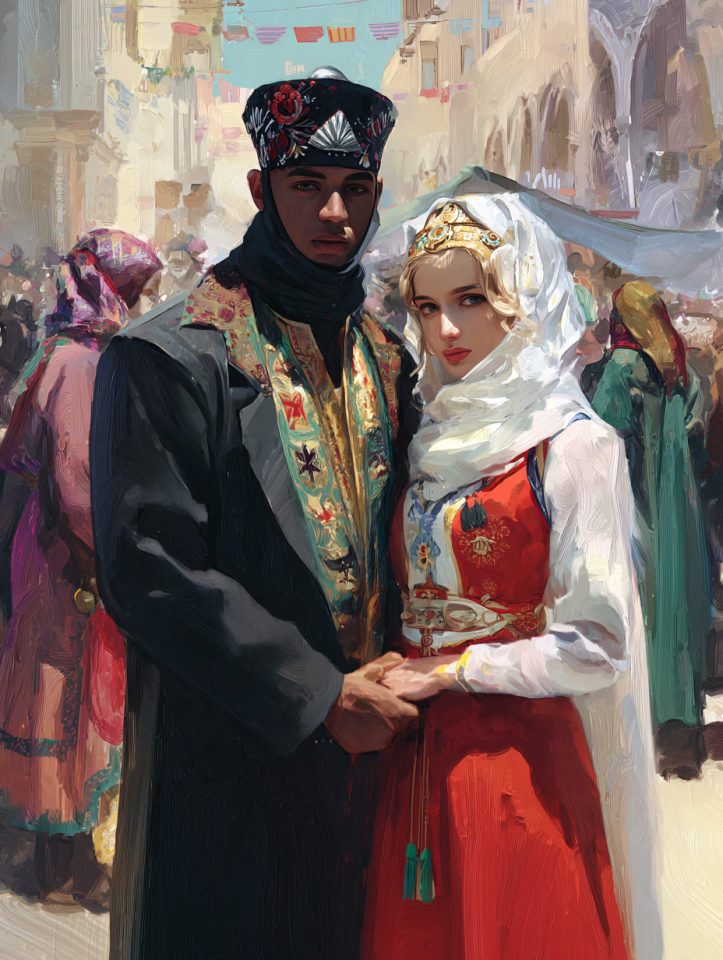
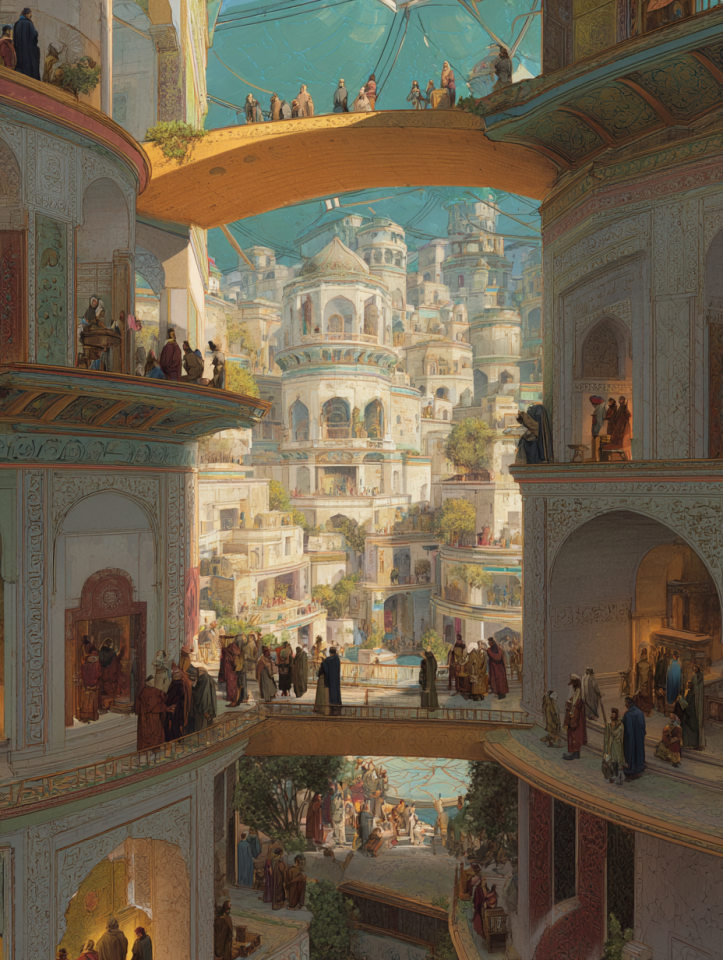
Marble colonnades line the streets of Basileia, catching the Mediterranean light as the Orontes River glitters beyond the city walls. In shaded courtyards, philosophers gather with merchants and poets, their debates flowing as readily as the wine served at their tables. The hum of civic life mingles with the rhythm of theater rehearsals and the scratching of scribes bent over scrolls, each line a pledge against forgetting.
Bustling markets overflow with olive oil, figs, honeyed wine, and books copied by skilled hands. Here, traders from Pārsa, Ta-Mery, and Zhongguo barter side by side, their exchanges watched by young students eager to learn new words and ideas. The agora is less a marketplace than a stage, where reason, rhetoric, and rivalry combine into living spectacle.
At night, the air fills with song as dramas are performed under torchlight. Actors wear masks not of gods but of archetypes, exploring justice, fate, and love in forms meant to endure across ages. Children sit wide-eyed beside elders, absorbing philosophy not as abstraction but as communal memory. For the Hellenes, the act of preservation is inseparable from performance — a truth must not only be written but lived.
To the people of Hellas, the Accord was not simply duty but destiny. Their belief in logos — reason, order, discourse — meant that to record and preserve was also to refine. In their eyes, to argue was to honor, and to preserve was to elevate, ensuring that beauty and truth would remain hand in hand for all of Koina.
Historical Origins
Hellas emerged from the fragmented city-states of the classical age, each with its own character — Athens the democratic, Sparta the martial, Thebes the pragmatic. Though Alexander’s campaigns spread Hellenic culture across vast territories, his empire fractured upon his death. From that dissolution rose new centers, with Antioch becoming a cosmopolitan hub where Greek, Persian, and Levantine traditions intertwined.
By the 1st century zc, Antiochhad eclipsed Athens and Alexandria as the beating heart of Hellenic philosophy and trade. It was here that Nysippos of Antioch championed the Accord, declaring that a pact to preserve would honor not only Greek genius but the shared inheritance of all peoples. For Hellas, the Accord represented continuity after centuries of conflict, transforming competition between poleis into collaboration with the world.
Philosophy & Governance
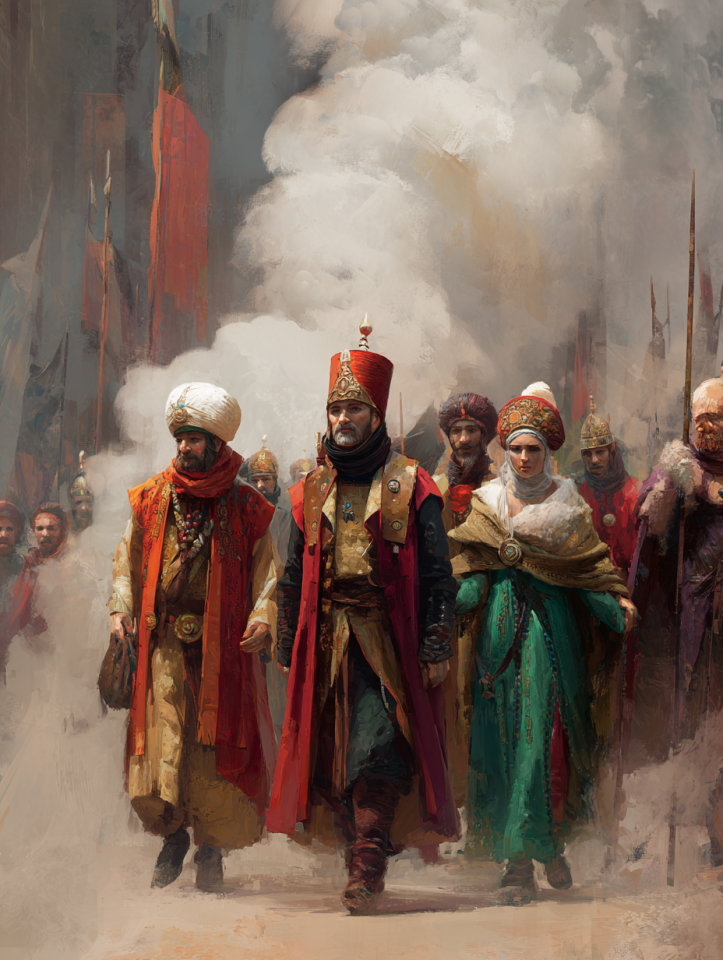
The governance of Hellas was rooted in assemblies and councils where free citizens debated matters of law and policy. Even under kings or strategoi, the voice of the polis held sway. The Accord elevated this civic model, recognizing that preservation was best secured when communities debated and reached consensus, rather than bending to a single will.
Philosophers played an outsized role in shaping governance. The teachings of Plato, Aristotle, and the Stoics informed Accord law, framing preservation as a rational necessity. To the Hellenes, governance was not merely administration but an art — a balance of debate, duty, and public performance. In their interpretation, the Accord was less about rules than about cultivating civic virtue.
Contributions to the Accord
Hellas brought enduring legacies to the Accord’s foundation:
Philosophy and Logic: From Aristotelian categorization to Stoic ethics, Greek thought provided frameworks for debate and governance.
Democratic Ideals: The assembly and the polis offered models of participatory decision-making.
Theater and Arts: Drama, sculpture, and architecture preserved human experience as cultural memory.
Mathematics and Geometry: Principles of Euclid and Archimedes shaped architecture, engineering, and navigation.
Cultural Identity
Greek identity was rooted in the interplay of mythos and logos. While myths of gods and heroes endured, they coexisted with rational inquiry and public discourse. In the Accord, Hellas became the custodian of dialogue, ensuring that myth and reason were preserved in equal measure.
The Olympic spirit infused Accord gatherings with ritualized competition, celebrating excellence as preservation of the body alongside the mind. Greek language and symbolism became foundational in the Accord’s lexicon, with words like philosophia and demokratia crossing borders as freely as goods. For Hellas, preservation was not static but dynamic — a living act renewed through dialogue and art.
Capital City
Antioch, renamed Basileia (“the Royal Seat”), stood at 36.2021°N, 37.1343°E, chosen for its centrality between east and west. Built with colonnades, theaters, and aqueducts, it embodied the fusion of Greek ingenuity and local Levantine traditions. Its libraries housed both Greek texts and translations of Egyptian, Persian, and Indic works, symbolizing the Accord’s spirit of synthesis.
Academies in Basileia welcomed scholars from across the world, making it a city where debate was currency and preservation a public duty. The agora and the theater became as central to Accord councils as the library and the archive, reflecting Hellas’s belief that truth thrives in discourse.
Legacy & Global Role
Hellas ensured that the Accord remained more than record-keeping. Their insistence on reason, discourse, and performance infused preservation with vitality. They taught that memory must not only be written but enacted, debated, and embodied.
Their philosophical frameworks shaped global governance, while their emphasis on democratic assemblies influenced cooperative structures across Koina. Even centuries later, the spirit of Hellas endures wherever people gather to argue, perform, or celebrate excellence — ensuring that preservation is not silence, but a living chorus of voices.
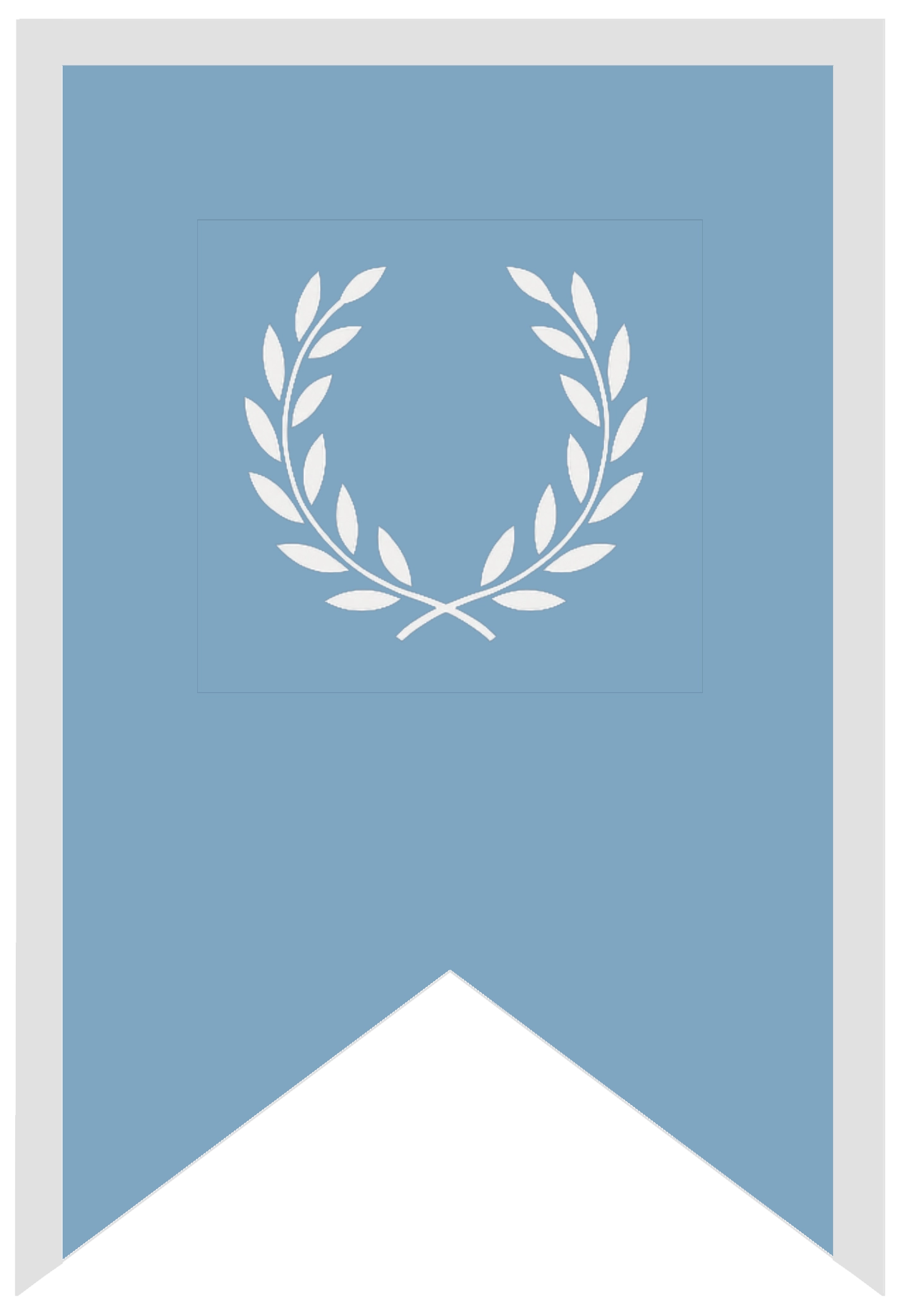
Blue for the Aegean, silver for Athens’ mines, olive wreath for peace/wisdom.
Type
Geopolitical, Country
Capital
Leader
Leader Title
Related Ranks & Titles
Controlled Territories
Notable Members










Comments