

Sciences & Knowledge
In every age, from the copper furnaces of Persepolis to the resonance towers of Nalanda, the pursuit of knowledge in Koina has never dimmed. No empires rose to burn libraries, no churches outlawed observation, and no wars of doctrine silenced the hands of artisans. The chain of discovery remained unbroken. A metallurgist in the 1st Century could have read a contemporary’s notes today and found the language of inquiry familiar: observation, reflection, and respect for balance.
At dawn in an open-air academy, a child watches dew gather on copper plates. Her mentor, instead of warning of forbidden curiosity, teaches her to measure conductivity and to imagine the pulse of the world beneath her feet. Across the garden, a healer consults solar charts to time an herbal infusion; an engineer calibrates mirrored lenses for wireless transmission. All see their work as one dialogue — between reason and nature, between memory and discovery.
Knowledge here was never a rebellion against power; it was the rhythm of civic life itself.
Continuous technological lineage — no lost ages, no rediscovery cycles.
Harmony of philosophy, science, and environment prevents exploitative innovation.
Universal literacy and open archives make knowledge a shared inheritance.
Slow adaptation during crises; consensus can restrain urgency.
Prestige hierarchies within guilds risk subtle stagnation.
Ecological caution sometimes limits experimentation in high-risk fields.
Even these limits are seen as guardianship — necessary friction to preserve the integrity of progress.
Philosophy of Inquiry
Because the collision of empire and theology never occurred, philosophy matured into science without rupture. Inquiry retained its moral center: compassion, rationality, and harmony with the natural order.
The Stoics contributed the discipline of logic; Buddhist and Jain thinkers refined observation through mindfulness; Persian and Indic scholars anchored both in ethics — the belief that understanding obligates care. Thus, the scientific method did not emerge from skepticism but from reverence.
To question was an act of gratitude, not defiance. Every measurement carried the quiet reminder: know in order to preserve.
Continuity of Advancement
Without conquest to erase or centralize knowledge, early achievements became foundations, not lost ages.
Metallurgy advanced from bronze alloys to super-conductive ceramics centuries earlier.
Optics and magnetism evolved from curiosity to engineering, giving rise to wireless resonance grids.
Hydraulic systems and geothermal vents, first mapped for irrigation, later powered entire cities.
Mathematics, astronomy, and acoustics flourished in unbroken dialogue — geometry guiding architecture, harmonics guiding energy design.
This steady growth produced technologies elegant rather than explosive: refinement instead of revolution.
Innovation never required collapse to be reborn; it matured like a living tree, season by season, its roots sunk deep in memory.
Institutions of Knowledge
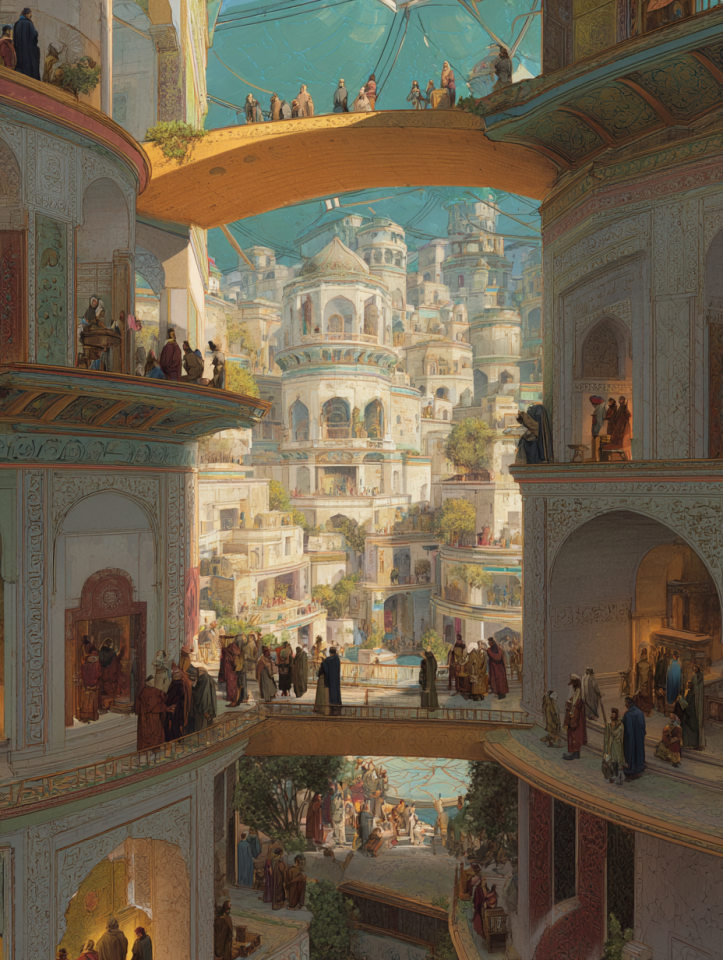
Instead of cloisters or secret laboratories, Koina’s centers of learning remain open and civic.
Academies of Logic and Craft pair philosophers with artisans, ensuring that discovery and application evolve together.
Observatories and Resonance Towers track weather, stars, and energy harmonics — part temple, part laboratory.
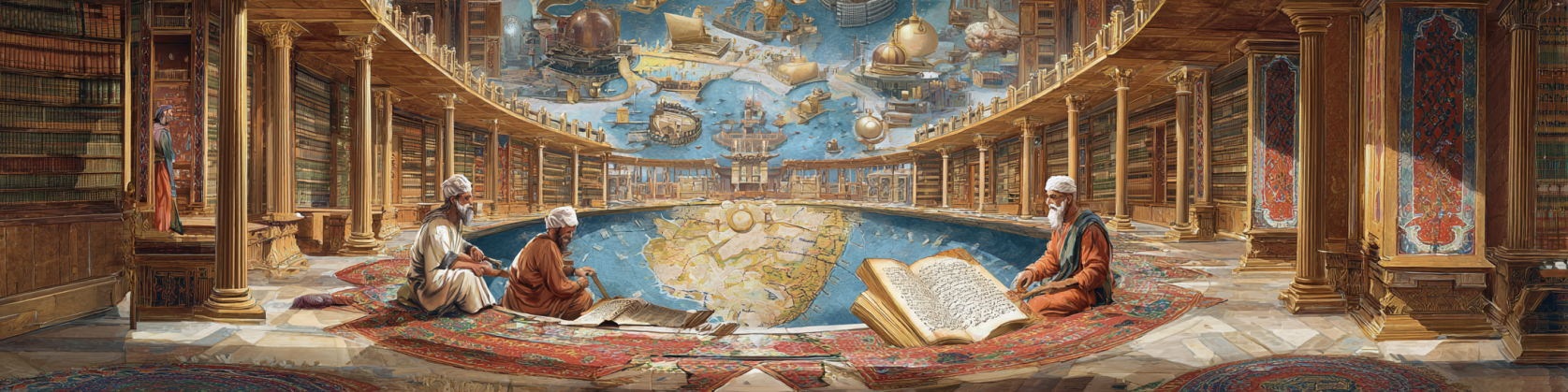
Libraries and the Net of Voices preserve centuries of commentary, all open to the public.
Guild Universities replace corporations; research is funded by cooperative assemblies, not private monopolies.
Every discovery is archived in at least three regions to prevent loss; every invention must include a plan for ecological balance. These customs are not laws but habits — the inherited conscience of a civilization that never forgot the fragility of memory.
Knowledge, Nature & Technology
In Koina, technology never drifted from ecology. The natural world remained laboratory and partner.
Forest observatories study photosynthesis and wind harmonics to refine energy grids.
Desert academies harness geothermal vents and mirrored towers for wireless power.
Marine institutes model propulsion on the movement of fish schools and currents.
Such inventions are elegant, silent, and restorative — the aesthetics of function. Tools are built to blend with their environment, not conquer it. A floating barge leaves no wake; a wind tower hums in the key of its valley.
Because scientific prestige is measured by sustainability, innovation follows the ethic of the garden: tend, don’t exhaust; design, don’t dominate.
Collaboration & Ethics
To know is to share. Discovery kept secret is considered transgression, equivalent to hoarding food in famine.
The three Oaths of Inquiry remain carved above academy gates:
- Observe with Integrity.
- Share without Claim.
- Create in Balance.
Strengths & Vulnerabilities
Strengths
Vulnerabilities
The Tone of Understanding
Knowledge in Koina feels alive — a pulse shared between mind, craft, and earth. Cities glow with resonance instead of smoke; laboratories open onto gardens; archives smell of soil and ink.
To learn is to take part in the world’s continuity.
To invent is to shape harmony into form.
And to teach is to ensure that light, once kindled, is never again extinguished by conquest or creed.
-
World Bible Navigation
-
Governance
Documents detailing the articles of Cooperative Federation.-
The Covenant
The Foundations of Koina
-
Constitution
-
The Persian Constitution
Empire is formed
-
The Persian Constitution: Amendment I
5th - 6th Century ZC
-
The Persian Constitution
-
Bills and Accords
-
The Accord of Alexandria
1st Century ZC
-
The Bill of Rights for All Peoples
3rd Century ZC
-
The Bill of Sovereignty for Cooperatives
3rd Century ZC
-
The Charter of Rights & Duties of the Accord
3rd Century ZC
-
The Covenant of Adjudication
3rd Century ZC
-
On Inheritance
A Treatise on the Balance of Desire, Purity, and Civic Stewardship
-
The Expansion Accord
4th Century ZC
-
The Environmental Accord
12th Century ZC
-
The Communication Accord
18th Century ZC
-
The Technology & Balance Accord
22nd Century ZC
-
The Modern Accord
22nd Century ZC
-
The Accord of Alexandria
-
Constitution
-
The Covenant
-
World Scope
-
Introduction & Scope
-
Arts & Aesthetics
-
Architectural Standards
-
Communication & Memory
-
Crime & Social Order
-
Geopolitics & Power
-
Law, Rights & Citizenship
-
Leadership: Voices & Whispers
-
Freedom & Daily Rhythm
-
Global Institutions
-
Health & Environment
-
Industrialization
-
Religion & Philosophy
-
Sciences & Knowledge
-
Social & Cultural Life
-
Technology & Travel
-
Introduction & Scope
-




Comments