


Architectural Standards
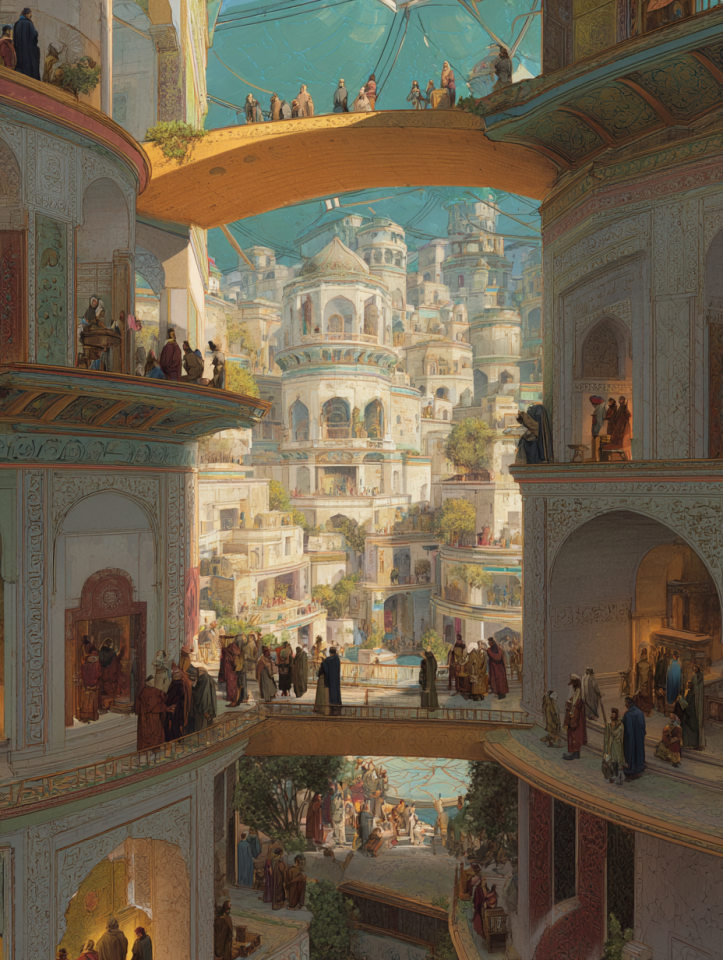
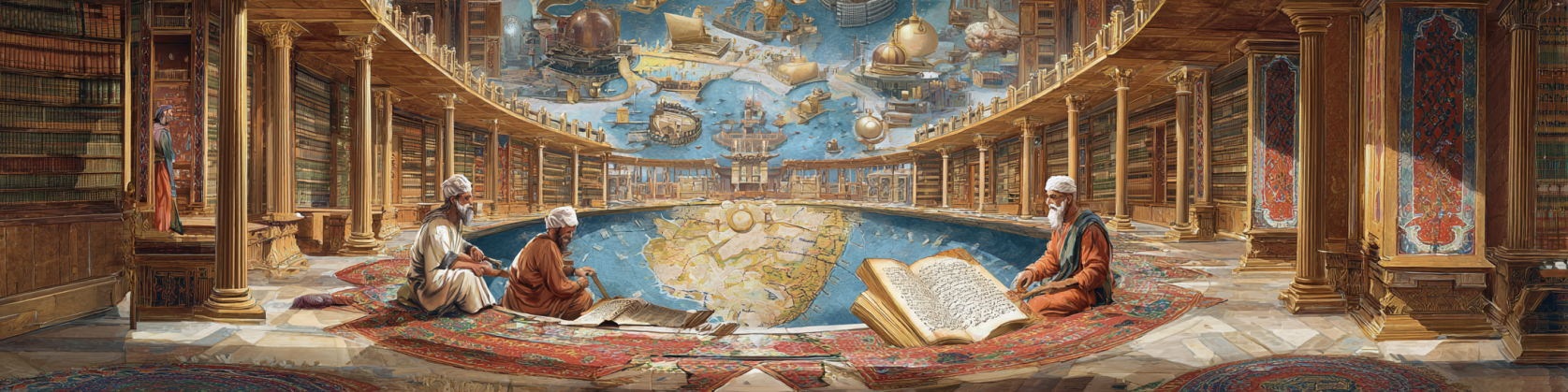
Morning light filters through patterned screens of carved stone and timber, scattering gold across the inner courtyard. A fountain murmurs at the center — not ornamental, but part of the house’s breathing system, cooling air drawn from the shaded alleys beyond. From rooftops rise domes, wind towers, and terraced gardens, their forms echoing mountains and dunes rather than the geometry of conquest. In Koina, architecture was never a tool of empire; it was an art of dwelling in balance.
Because no city was razed for triumphal arches or rebuilt to glorify rulers, the craft of building evolved in a single, continuous lineage. From the Indus plains to the Nile delta, from the Andes to the Yellow River, local methods refined themselves rather than being erased and replaced. Builders studied wind, water, and soil with the same reverence philosophers gave to reason. Every structure — from farmhouse to council hall — became a conversation between climate, craft, and community.
The result is a built world without monuments to domination. Streets curve like riverbeds, temples open to sky and garden, and even the grandest halls are measured against the comfort of the human voice. To walk through a Koinan city is to feel civilization breathing — shaded, ventilated, patterned, and alive.
Courtyard-Centric Design: Almost every household and civic building centers around a courtyard or garden, inherited from Persian, Indic, and Mediterranean prototypes. These spaces serve as light wells, gathering places, and micro-climate regulators.
Natural Ventilation: Buildings favor airflow - windcatchers (like Persian badgirs), lattice screens, and elevated ceilings replace sealed, rectilinear interiors.
Organic Orientation: Structures follow the contours of the land, oriented to rivers, winds, or sacred mountains rather than abstract grids.
Stone & Brick: Used widely, but ornamented - patterned brickwork, carved reliefs, polychrome facades.
Timber & Bamboo: In forested and tropical regions, light but resilient woods dominate.
Plaster & Stucco: Surfaces finished smooth, then painted or decorated with relief.
Ceramics & Tiles: Glazed tiles, mosaics, and painted ceramics replace bare concrete.
Domes & Vaults: Instead of Roman arches, domes evolve from Persian and Indic roots - rounded, onion-shaped, or lotus-like forms are common, even in small civic buildings.
Curved Roofs: East Asian and Indic influence means roofs curve upward or outward, suggesting openness and balance.
Terraced Roofs: In arid and Meso zones, flat terraced roofs are living spaces - for sleeping, drying crops, or stargazing.
Geometric & Floral Motifs: Persian and Indic decorative styles emphasize repetition, symmetry, and organic geometry.
Philosophical Symbols: Reliefs and engravings depict balance, circles, lotus petals, or cosmological diagrams rather than imperial crests.
Color: Buildings are rarely stark stone-gray. Instead, exteriors show saffron, turquoise, ochre, and deep red highlights, aligning with the cultural palette.
Neighborhood Compounds: Houses are clustered in compounds with shared courtyards, wells, or gardens.
Guild Halls: Prominent in every town, often the most elaborate structures, doubling as centers of debate and trade.
Shrines & Temples: Woven into daily streets rather than separated as monumental zones. Worship is integrated, not centralized.
Markets: Covered bazaars, arcades, and open-air plazas - spaces of exchange as social as they are economic.
No Triumphal Arches or Forums: Monuments are communal, not imperial. Instead of arches to conquest, there are pillars of balance or gardens of remembrance.
No Grid Cities: Cities grow organically along rivers, trade routes, and terrain. Streets curve, meander, and connect through hubs, not grids.
No Monumental Square Facades: Columns exist, but as ornamented or structural, not uniform facades. Diversity of form is expected.
Structural Foundations
Common Materials
Rooflines & Profiles
Ornamentation & Symbolism
Spatial Organization
Absence of Roman Norms
Tone of Architecture
The overall look of everyday architecture is:
Human-Scaled: Even civic buildings feel integrated into daily life, not towering over citizens.
Ecological: Buildings breathe with the land - sunlight, shade, water, and wind are always factored in.
Decorative & Symbolic: Color, ornament, and symbolism make even common houses visually rich.
Curvilinear & Layered: Instead of hard right angles dominating, curves, domes, and terraces create a flowing, organic aesthetic.
See Also:
-
World Bible Navigation
-
Governance
Documents detailing the articles of Cooperative Federation.-
The Covenant
The Foundations of Koina
-
Constitution
-
The Persian Constitution
Empire is formed
-
The Persian Constitution: Amendment I
5th - 6th Century ZC
-
The Persian Constitution
-
Bills and Accords
-
The Accord of Alexandria
1st Century ZC
-
The Bill of Rights for All Peoples
3rd Century ZC
-
The Bill of Sovereignty for Cooperatives
3rd Century ZC
-
The Charter of Rights & Duties of the Accord
3rd Century ZC
-
The Covenant of Adjudication
3rd Century ZC
-
On Inheritance
A Treatise on the Balance of Desire, Purity, and Civic Stewardship
-
The Expansion Accord
4th Century ZC
-
The Environmental Accord
12th Century ZC
-
The Communication Accord
18th Century ZC
-
The Technology & Balance Accord
22nd Century ZC
-
The Modern Accord
22nd Century ZC
-
The Accord of Alexandria
-
Constitution
-
The Covenant
-
World Scope
-
Introduction & Scope
-
Arts & Aesthetics
-
Architectural Standards
-
Communication & Memory
-
Crime & Social Order
-
Geopolitics & Power
-
Law, Rights & Citizenship
-
Leadership: Voices & Whispers
-
Freedom & Daily Rhythm
-
Global Institutions
-
Health & Environment
-
Industrialization
-
Religion & Philosophy
-
Sciences & Knowledge
-
Social & Cultural Life
-
Technology & Travel
-
Introduction & Scope
-




Comments