





The Persian Constitution
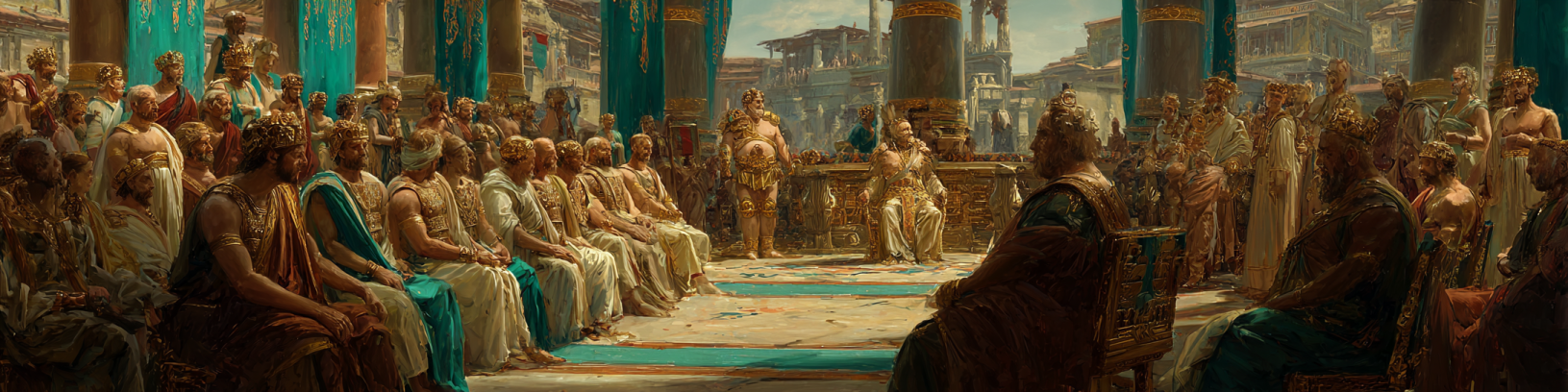
When the early federations first gathered in Persepolis, the world was still fractured by conquest and debt. The Persian Constitution was drafted to give form to cooperation itself — a covenant not of rulers and subjects, but of participants and stewards. It declared that entry into the Accord was an act of consent, not subjugation, and that each member people retained their customs, faiths, and local councils.
The document bound unity to voluntary alliance, establishing representation, voice, and withdrawal as equal rights. It gave the Accord a lawful heart: decisions would arise from council rather than decree, and protection would be mutual rather than imperial. Through its clauses, Persia’s federative model evolved from philosophy into government.
Its ratification transformed the region from a patchwork of truces into a living civic order. For the first time, diplomacy, trade, and education operated under the same charter of equality. The Persian Constitution remains the cornerstone of Koina’s identity — proof that a civilization need not conquer to endure.
Organizations
Signatories
The Persian Constitution
Preamble
We, the stewards of Pārsa, heirs to a civilization that has bound many peoples through law and memory, do now declare the foundation of a covenant greater than empire. Having seen the rise and fall of kingdoms, and knowing that strength alone cannot preserve wisdom, we extend our recognition to all cooperatives who pledge themselves to the guardianship of knowledge and culture. This Constitution affirms that each people has the right to speak in the Council of Accord, that sovereignty shall not be extinguished by fellowship, and that preservation shall be the charge of all. By this document, the authority of governance is extended beyond conquest, becoming instead the mutual trust of nations.Article I – On the Right to Representation
No cooperative may be silenced by the size of its land or the strength of its armies. Each people, once recognized by the Council, shall have a voice and a vote equal to all others. This equality is declared not as favor but as principle: for preservation cannot endure if built on hierarchy.Article II – On Sovereignty and Consent
Every cooperative retains the right to its own laws, faiths, and customs. The Constitution does not dissolve sovereignty but binds it into a greater whole. Entry into the Accord is by consent alone, and no people shall be compelled to join against its will. To depart the fellowship is a grave act, but it too is permitted if declared openly before the Council.Article III – On the Authority of Pārsa
As the origin of this covenant, Pārsa claims no supremacy in perpetuity, but in these first generations it shall act as guarantor of the Accord’s order. Its archives shall house the first repositories, its scribes shall copy the first charters, and its officials shall oversee the early deliberations of the Council. When the Accord matures into fullness, this authority shall be relinquished to the Council entire.Article IV – On the Establishment of the Council
The Council of Accord is hereby created, to sit in judgment on matters of preservation, to mediate disputes, and to safeguard sanctuaries. It is the first and final voice where questions of memory, heritage, and cultural survival are concerned. It does not command armies nor levy tribute, but it commands respect through the oath of all who join.Article V – On the Duties of Membership
Closing
Thus is declared the Persian Constitution, not as a chain but as a covenant. From Pārsa it begins, yet it is not Pārsa’s alone. It is the seed of a fellowship that, in time, shall pass beyond empire into a true Accord of nations. Let this Constitution endure until the day it is renewed by the full voice of Koina, when no land shall claim origin, but all shall claim ownership.
Type
Treaty, Diplomatic
Ratification Date
10 Maat 0 zc, Pārsa
Signatories (Characters)
- Aorangi of Suvarnabhumi
- Ardashir of Persepolis
- Ashoka of Pataliputra
- Branwen of the Northern Forests
- Citlalin of Teotihuacan
- Hopohka White-Eagle
- Hoshiko of Asuka
- Hrothwulf of Midgard
- Larth Velthnal
- Makena wa Zuberi
- Nysippos of Antioch
- Rustam Sogd
- Seongjin of Gaya
- Tahara of Memphis
- Tiramakan of Kangaba
- Xun An of Linzi
-
World Bible Navigation
-
Governance
Documents detailing the articles of Cooperative Federation.-
The Covenant
The Foundations of Koina
-
Constitution
-
The Persian Constitution
Empire is formed
-
The Persian Constitution: Amendment I
5th - 6th Century ZC
-
The Persian Constitution
-
Bills and Accords
-
The Accord of Alexandria
1st Century ZC
-
The Bill of Rights for All Peoples
3rd Century ZC
-
The Bill of Sovereignty for Cooperatives
3rd Century ZC
-
The Charter of Rights & Duties of the Accord
3rd Century ZC
-
The Covenant of Adjudication
3rd Century ZC
-
On Inheritance
A Treatise on the Balance of Desire, Purity, and Civic Stewardship
-
The Expansion Accord
4th Century ZC
-
The Environmental Accord
12th Century ZC
-
The Communication Accord
18th Century ZC
-
The Technology & Balance Accord
22nd Century ZC
-
The Modern Accord
22nd Century ZC
-
The Accord of Alexandria
-
Constitution
-
The Covenant
-
World Scope
-
Introduction & Scope
-
Arts & Aesthetics
-
Architectural Standards
-
Communication & Memory
-
Crime & Social Order
-
Geopolitics & Power
-
Law, Rights & Citizenship
-
Leadership: Voices & Whispers
-
Freedom & Daily Rhythm
-
Global Institutions
-
Health & Environment
-
Industrialization
-
Religion & Philosophy
-
Sciences & Knowledge
-
Social & Cultural Life
-
Technology & Travel
-
Introduction & Scope
-




Comments