
Population of the Cooperative World
When estimating the current population of Koina, we are not counting the same kind of world that produced our own eight billion people.
Koina’s demographic story unfolds along a slower, steadier arc—one without colonization, world wars, or religious imperatives toward unchecked growth.
Its three and a half billion inhabitants are the product of millennia of cooperation, balance, and plural medical science rather than conquest or exploitation.
In our world, the great “population explosion” of the past two centuries followed the Industrial Revolution and two world wars.
Mechanized agriculture, fossil fuels, antibiotics, and post-war reconstruction created an era of collapsing mortality and surging fertility.
Religious pronatalism and nationalist census rivalries added moral and political pressure to expand. Koina experienced none of these accelerants.
Instead, population growth followed the rhythm of its federations—regulated by philosophy, ecology, and medical equity rather than imperial ambition.
Every major factor that caused runaway growth in our world was either absent or balanced by social design:No world wars → no reconstruction baby booms.
No colonial extraction → no external resource subsidy for overcrowded metropoles.
No religious birth mandates → fertility stabilized centuries earlier.
Gender parity and universal education → small, intentional households.
Renewable-first industry and ecological law → long lifespans without ecological collapse.
Zhongguo corresponds to East Asia’s river basins, Āryāvarta to the Indo-Gangetic plain, Pārsa to the Persian plateau, and so forth.
We began with modern regional population densities, then removed the distortions introduced by colonization and industrial militarization.
This produced a baseline world at roughly 40 % of modern Earth’s population trajectory by 1800 CE, yet with better health and nutrition.
From that base, population grew gradually through the Age of Inquiry and Age of Resonance—steady technological improvement without war-driven leaps.
For instance:
Zhongguo, covering the Yellow and Yangtze basins, mirrors modern China’s carrying capacity but never over-urbanized; it stabilizes near 660 million.
Āryāvarta, the Ganges and Magadhan plains, supports ≈ 500 million under sustained dharmic-Stoic moderation.
Suvarnabhumi, the maritime and island federations of Southeast Asia, settles near 360 million, its density distributed among hundreds of port cities.
Zāgros, the great wildland system, remains lightly peopled at ≈ 216 million, mostly nomadic or tribal, with only two self-governed Free-Cities.
Terrace agriculture, sanitation, and renewable energy prevent famine and epidemic without demanding exponential growth.
Plural medical guilds—drawing from Greco-Egyptian anatomy, Ayurvedic balance, Chinese pharmacology, and Indigenous botany—lower infant mortality and extend average lifespan to the mid-80s.
Because children survive to adulthood, families naturally limit size; the correction represents survivorship, not fertility.
Half live in urban settings—courtyard-based cities integrated with gardens, canals, and solar towers.
The rest inhabit agrarian federations, forest villages, or the open commons of the Zāgros.
No megacity exceeds fifteen million; density follows rivers, coasts, and trade corridors rather than imperial capitals.
Koina’s demographic story unfolds along a slower, steadier arc—one without colonization, world wars, or religious imperatives toward unchecked growth.
Its three and a half billion inhabitants are the product of millennia of cooperation, balance, and plural medical science rather than conquest or exploitation.
Framing the Question
To understand how this figure was reached, we first had to ask a deeper question: what makes populations grow?In our world, the great “population explosion” of the past two centuries followed the Industrial Revolution and two world wars.
Mechanized agriculture, fossil fuels, antibiotics, and post-war reconstruction created an era of collapsing mortality and surging fertility.
Religious pronatalism and nationalist census rivalries added moral and political pressure to expand. Koina experienced none of these accelerants.
Instead, population growth followed the rhythm of its federations—regulated by philosophy, ecology, and medical equity rather than imperial ambition.
Every major factor that caused runaway growth in our world was either absent or balanced by social design:
Establishing the Baseline
The first step was to anchor each federation to its geographic analogue on Earth.Zhongguo corresponds to East Asia’s river basins, Āryāvarta to the Indo-Gangetic plain, Pārsa to the Persian plateau, and so forth.
We began with modern regional population densities, then removed the distortions introduced by colonization and industrial militarization.
This produced a baseline world at roughly 40 % of modern Earth’s population trajectory by 1800 CE, yet with better health and nutrition.
From that base, population grew gradually through the Age of Inquiry and Age of Resonance—steady technological improvement without war-driven leaps.
Scaling and Adjustment
Each region was then scaled according to environmental capacity and cultural pattern:| Adjustment | Typical Range | Rationale |
|---|---|---|
| Remove imperial/industrial overbuild | −30% to −50% | No colonial megacities or wartime surges; distributed, capped urbanism. |
| Healthcare & sanitation uplift | +10% to +25% | Earlier survivorship and longer life without pronatalist pressure. |
| Ecology & lifestyle moderation | ±0% to +10% | River/delta bonuses vs. steppe/plateau caps; Zāgros deliberately sparse/nomadic. |
Ecological Logic
Unlike industrial civilizations that sought to conquer nature, Koina treats ecology as a legal boundary. Each federation’s carrying capacity is determined by its own councils of balance—guilds of healers, farmers, and builders who measure harvest, water, and population in one equation.Terrace agriculture, sanitation, and renewable energy prevent famine and epidemic without demanding exponential growth.
Healthcare Adjustment
Finally, a universal 20 % upward correction was applied to account for Koina’s advanced integrative medicine.Plural medical guilds—drawing from Greco-Egyptian anatomy, Ayurvedic balance, Chinese pharmacology, and Indigenous botany—lower infant mortality and extend average lifespan to the mid-80s.
Because children survive to adulthood, families naturally limit size; the correction represents survivorship, not fertility.
The Cooperative Total
After regional and health adjustments, Koina’s global population stands at approximately 3.4 billion.Half live in urban settings—courtyard-based cities integrated with gardens, canals, and solar towers.
The rest inhabit agrarian federations, forest villages, or the open commons of the Zāgros.
No megacity exceeds fifteen million; density follows rivers, coasts, and trade corridors rather than imperial capitals.
Why It Matters
This approach is more than arithmetic. It reflects the philosophical foundation of the Cooperative World: that human flourishing depends on equilibrium, not expansion. Where our history measured success by growth, Koina measures it by continuity. Its people live longer, but not more numerous; healthier, but not hungrier. The numbers themselves are a testament to the principle that balance—once practiced across generations—becomes its own form of abundance.Visual Distribution
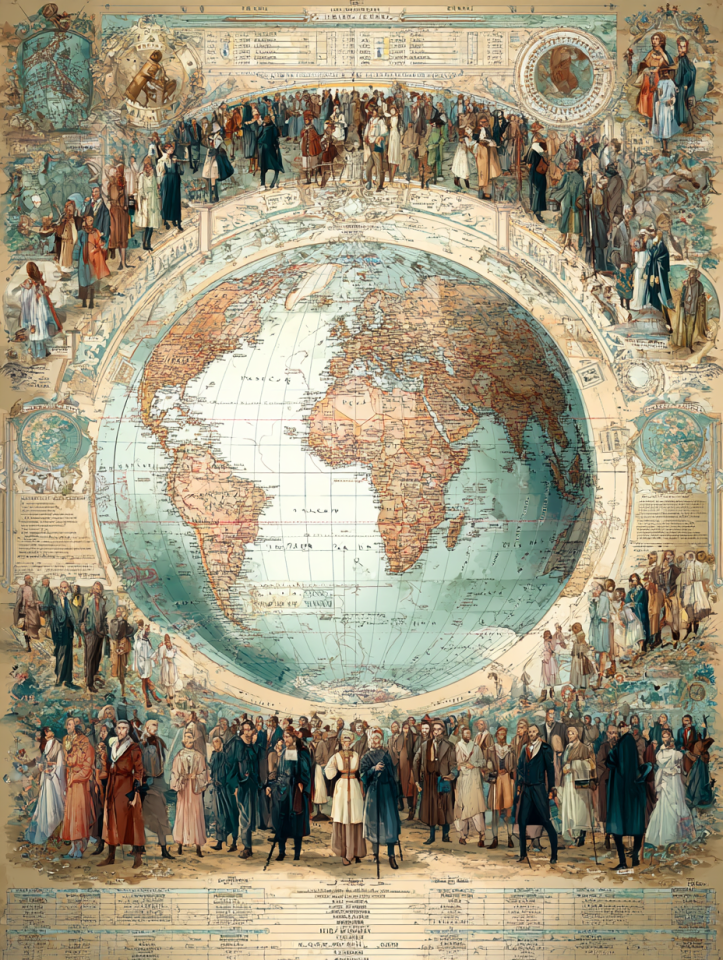
Population in Koina forms not from conquest lines but from the contours of climate and cooperation. Across the world map, three great population bands define the Cooperative Era: 1. The River & Delta Belts - From the Yellow and Yangtze valleys through the Ganges and Nile to the Mississippi and Valley of Mexico. These corridors host the highest densities—lush alluvial plains where terrace farms, canals, and solar irrigation sustain continuous habitation. Cities here are ribboned along waterways rather than concentrated into megacities, forming living chains of light and movement. 2. The Maritime Arcs - The Aegean, Indic, and Pacific coasts; the islands of Suvarnabhumi and Nihon; the coral routes of Polynesia and Azania. Here population forms constellations of port cities and archipelagic towns. Trade winds and philosophy schools interlace, keeping maritime regions both populous and culturally fluid. No single port dominates; instead, networks of ten- and twenty-million citizens share the seas as common space. 3. The Temperate & Plateau Zones - Midgard, Brynwydd, Etruria, Pārsa, and Sogdiana. Forests, steppes, and uplands here host moderate densities, emphasizing craft guilds and ecological management. Their cities are smaller but numerous, built around courtyards, workshops, and gardens, maintaining human scale and environmental continuity. Beyond these settled belts stretch the Zāgros Wildlands—vast commons spanning tundra, rainforest, and desert. Here population thins to a whisper: nomads, researchers, and travelers moving along migratory and trade routes. Two Free-Cities—Karuk Inlet in the far north and Rio Negro Confluence in the equatorial south—serve as meeting grounds where the federations’ roads of light converge. In map form, Koina’s densities resemble a lattice of luminous threads rather than bright imperial cores: lines tracing rivers, coasts, and trade winds, interwoven through equilibrium rather than domination. It is a living proof of the Cooperative Principle—that humanity, unshackled from the need to conquer, naturally distributes itself according to balance, abundance, and shared stewardship.Current Population Summary
| Federation / Region | Population (Millions) | Urban Share (%) | Notes |
|---|---|---|---|
| Anahuac | 192 | 55 | Meso heartlands; terrace and canal agriculture. |
| Āryāvarta | 504 | 50 | Indo-Gangetic basin; plural medicine, strong civic health. |
| Azania | 108 | 45 | Coastal and highland balance; monsoon ports and gardens. |
| Brynwydd | 72 | 42 | Celtic Europe; coastal forests and low-density inland regions. |
| Cahokia | 84 | 45 | Mississippi basin; mound-city constellations, stable growth. |
| Etruria | 96 | 62 | Italian peninsula; artisan hill towns, moderate fertility. |
| Hellas | 114 | 68 | Aegean and Anatolian coasts; maritime leagues and philosophy schools. |
| Joseon | 102 | 70 | Peninsular agrarian core; literate, densely settled plains. |
| Manden Kurufaba | 132 | 40 | Sahel and Niger basin; floodplain agriculture, healer guilds. |
| Midgard | 108 | 52 | Temperate forests; repair culture, distributed towns. |
| Nihon | 168 | 75 | Compact archipelago; long-lived, low fertility. |
| Pārsa | 264 | 45 | Plateau and oasis cities; water-regulated expansion. |
| Sogdiana | 78 | 38 | Oasis networks and caravan hubs; arid but thriving. |
| Suvarnabhumi | 360 | 48 | Maritime and island networks; dispersed port cities. |
| Ta-Mery | 144 | 60 | Nile corridor; ribbon urbanization, ecological balance. |
| Zhongguo | 660 | 55 | River valleys and coasts; high education, balanced fertility. |
| Zāgros (Wildlands) | 216 | 10 | Nomadic and tribal regions across tundra, desert, rainforest; two Free-Cities self-governed. |
| Total | ≈ 3.4 Billion | ≈ 50 | Global population of the Cooperative World, balanced and health-stable. |




Comments