Introduction & Scope
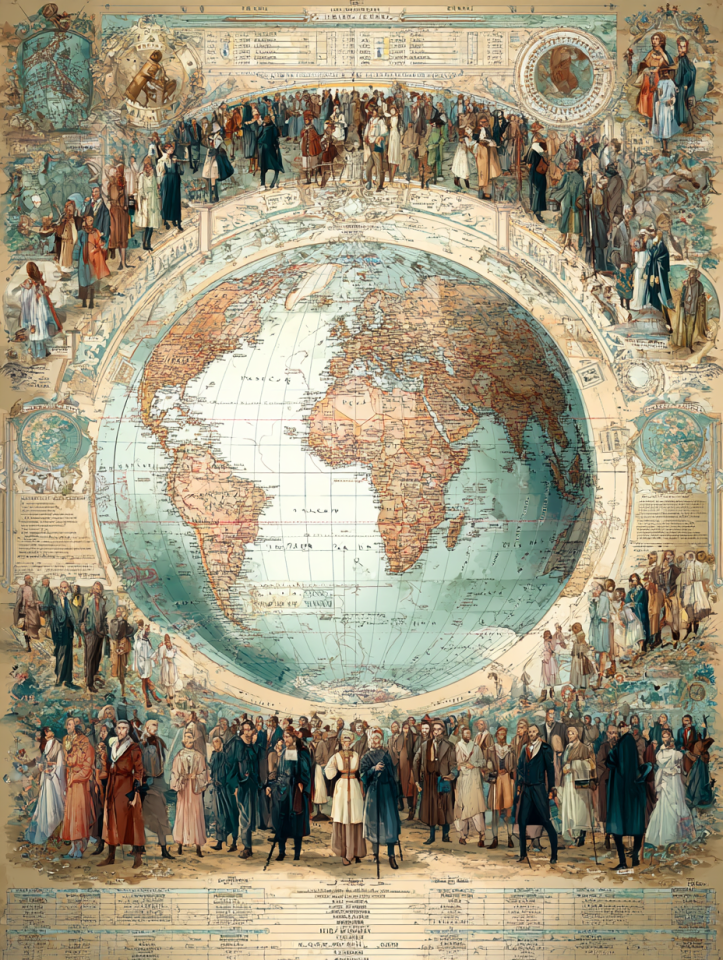
This document presents a comprehensive exploration of an alternate modern world - a world in which Rome never rose to dominate the Mediterranean, Christianity never cemented a theological monopoly, and the colonization model of “assimilation or die” never took root. Instead, the political and cultural scaffolding of the Persian empires, the philosophical traditions of Greece and India, and the cooperative ethos of guilds, councils, and federations shaped the trajectory of human history.
Why Remove Rome?
The Roman Empire, and its successor in the Christianized West, left deep imprints on the global order. Rome’s model of colonization - tolerating diversity only under the demand of loyalty and assimilation - became the blueprint for later European expansion. The empire’s emphasis on central authority, citizenship hierarchies, and codified punishments hardened into structures of governance and law that continue to echo in modern nation-states. Christianity layered theology onto this scaffolding, shifting law toward sin and punishment, defining freedom as state-granted, and setting the stage for centuries of suppression of inquiry, persecution of difference, and consolidation of religious authority.
To imagine a world without Rome’s dominance is to strip out the colonization template and allow other traditions - Persian tolerance, Hellenic rationalism, Indic compassion, Sinosphere meritocracy, Meso astronomical sophistication - to breathe and evolve without suppression.
To imagine a world without Rome’s dominance is to strip out the colonization template and allow other traditions - Persian tolerance, Hellenic rationalism, Indic compassion, Sinosphere meritocracy, Meso astronomical sophistication - to breathe and evolve without suppression.
What This World Looks Like
The result is a world that is plural, cooperative, rational, and ecological. This world is not a utopia - hierarchies can still calcify, corruption still exists, and consensus takes time. But its tone is calmer and steadier, with freedom lived as a fact of being, not a charter granted by states or empires.
Scope of the Document
Each section blends structural overview with narrative detail, drawing on the suppositions we developed together: that philosophy displaces theology as ethical anchor; that law is restorative, not punitive; that families and unions are cooperative; that technologies enrich balance rather than divide; and that leadership is rotational, rational, and accountable through the system of Voices and Whispers.
Click on the titles (or hover) to see more details.
Click on the titles (or hover) to see more details.
| Foundations of Civilization | |||
|
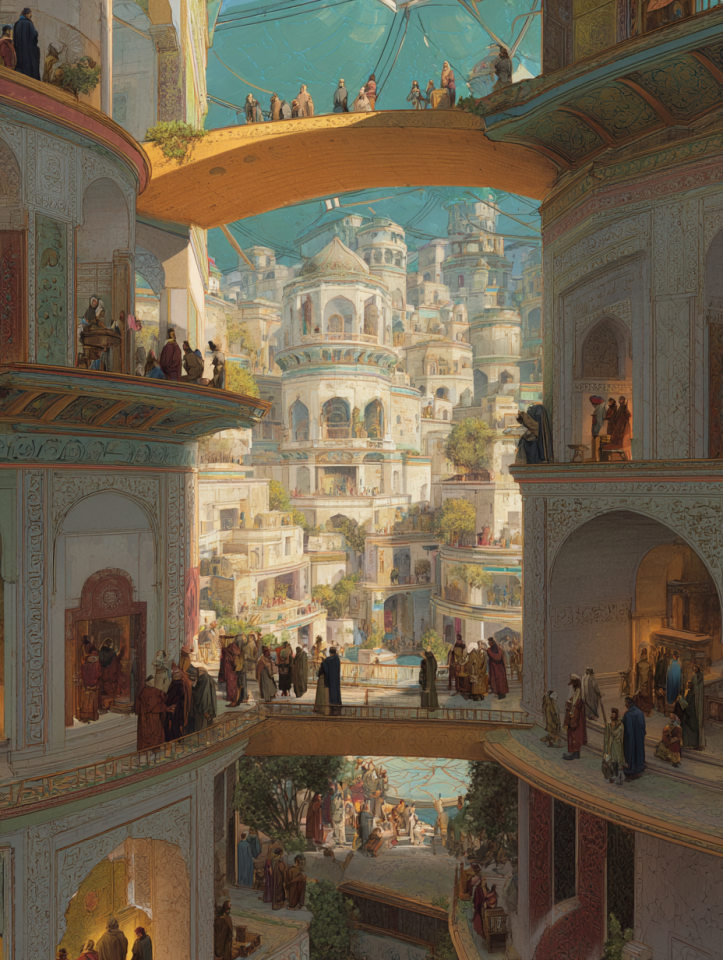
Architecture in Koina develops without the rigid imperial templates of Rome. Instead of square blocks and triumphal arches, buildings grow from ecological and cultural logic: courtyards for light, flowing lines for wind and water, and materials drawn from local landscapes. Structures are not monuments to conquest but expressions of belonging — adaptable, enduring, and in balance with the world they inhabit. Industrialization still emerges in this world, but it follows a different trajectory - less extractive, less militarized, and more cooperative. Without Rome’s conquest model or later European empires, industry never becomes an engine for domination. Instead, it evolves as a natural extension of guild rivalries and philosophical inquiry. |
Health and environment are not secondary concerns in this world; they are understood as the foundation of balance. Philosophical traditions teach that body, community, and nature are inseparable. Civic institutions reflect this belief by treating public health and ecological stewardship as collective responsibilities, not private burdens. Technology in the New World is not defined by conquest, extraction, or militarization. Instead, it grows from the cooperative principles of philosophy, guild rivalry, and ecological balance. The most prestigious innovations are those that enrich life, extend memory, and connect communities. Two great breakthroughs anchor this trajectory: wireless electricity and resonant travel. |
Knowledge in Koina never passed through dark ages or doctrinal fire. Freed from conquest and suppression, inquiry advanced in continuous dialogue with philosophy and environment. The result is a world where science serves harmony, and discovery unfolds as stewardship of nature itself. |
Without theological control or colonial erasure, art remained the living voice of every people. From stone to song, each culture shaped beauty as expression of identity, not obedience. Tradition and innovation coexist, forming a world where creation itself is an act of remembrance. |
| Information & Culture | |||
|
Communication is the lifeblood of cooperation. From the earliest relay systems to today’s Net of Voices, the evolution of communication has been driven not by conquest or monopoly, but by philosophy, guild stewardship, and the conviction that knowledge belongs to all. |
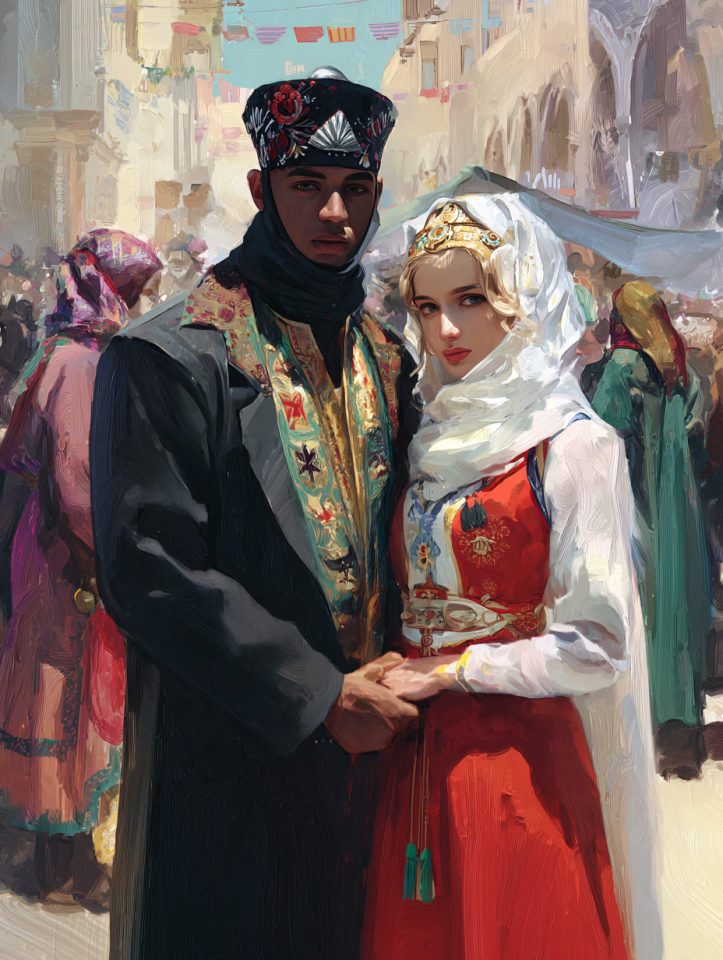
The New World is shaped less by rigid institutions and more by the fluid fabric of social life. Families, unions, households, and guilds provide the scaffolding of belonging. Diversity of expression is normalized, and freedom is lived in relationships, rituals, and daily rhythms rather than written into distant constitutions. |
In this alternate modernity, the story of belief takes a different turn. Without Rome’s imperial monopoly and Christianity’s consolidation, religion and philosophy develop in tandem - neither displacing the other, but blending into a plural, humanistic framework. Gods and rituals remain important for culture and identity, but philosophy, not theology, becomes the universal ethical language. |
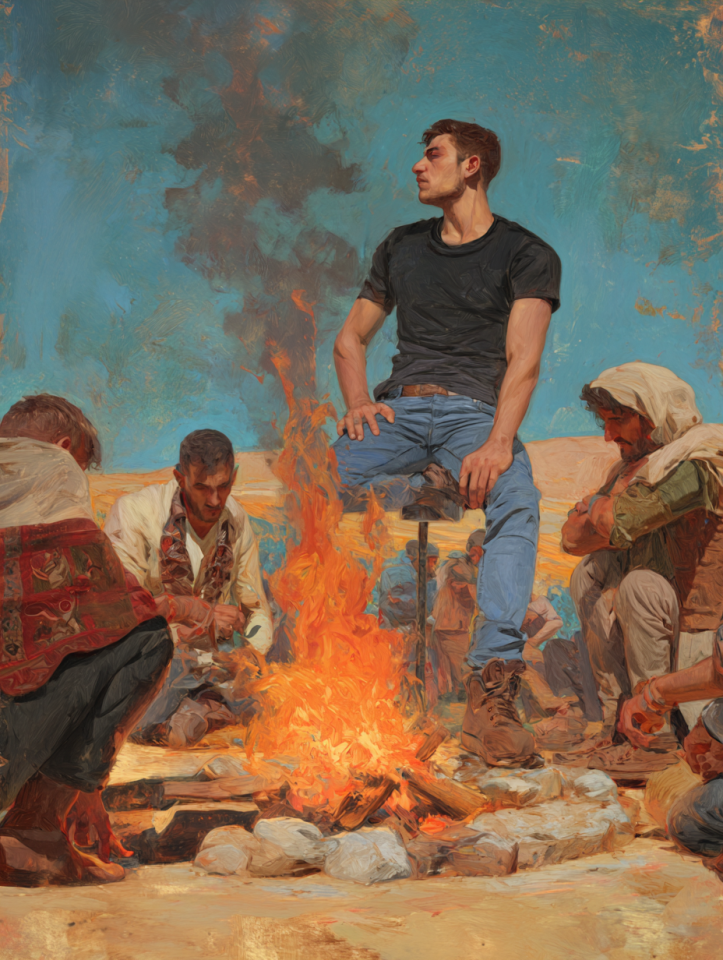
Freedom in this world is not a parchment declaration or a privilege granted by a state. It is assumed as natural. Every person is born free, and communities exist to safeguard, balance, and enrich that freedom - not to define or restrict it. Daily life reflects this assumption in a thousand small ways. |
| Freedom & Daily Rhythm | |||
|
Law in this world is not a tool of punishment or a mirror of divine decree. It is a humanistic framework, grounded in reason, philosophy, and the pursuit of balance. Justice is not about sin or guilt but about transgression and restoration. Rights are not privileges granted by states but the natural condition of individuals living in community. |
In the New World, crime is not framed in terms of sin, guilt, or eternal punishment. It is seen as transgression: a disruption of harmony, dignity, or trust. This reframing changes how societies respond - emphasizing mediation, restitution, and reintegration rather than punishment. |
In this alternate modernity, leadership is not inherited, nor is it monopolized by charisma or wealth. Instead, it is structured, trained, and redundant - designed to ensure both continuity and accountability. At every level of society, from households to federations, the same principle applies: the First Voice speaks, and the Whispers refine. | |
| Global Dynamics | |||
|
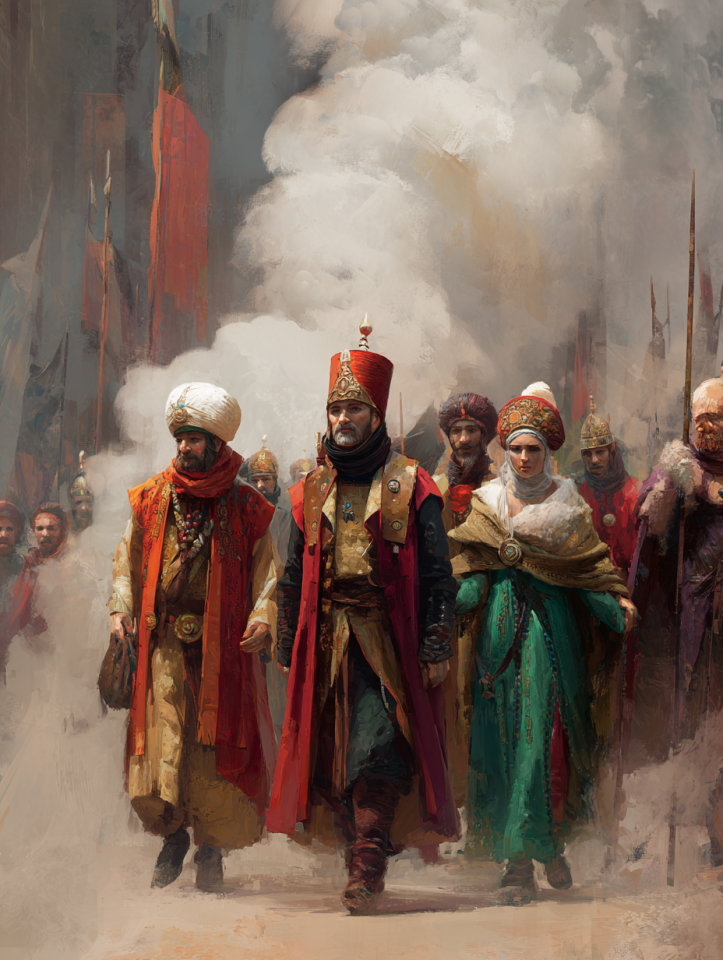
The modern world, absent Rome’s empire and its colonizing legacy, is polycentric by design. Instead of one civilization dominating and demanding assimilation, the past two millennia have nurtured federations and leagues, each drawing strength from their local traditions and philosophies, yet bound by cooperative assemblies that prevent isolation or domination. |
The New World never sees a single empire dictate international order. Instead, cooperative institutions emerge from trade, plagues, and philosophical exchange. These bodies are not supranational governments but forums of coordination, born from necessity and sustained by prestige and participation. Their authority is moral and practical, not imperial. |
Conclusion
The New World that emerges in the absence of Rome’s empire is one defined by cooperation, rationality, and plurality. Its people live with freedoms assumed rather than granted, families as cooperatives rather than contracts, and technologies designed to connect and enrich rather than divide or destroy. The system of Voices and Whispers ensures leadership that is trained, rotational, and accountable. Law frames wrongdoing as transgression, focusing on restoration rather than punishment. Religion persists as local and symbolic, while philosophy becomes the shared ethical grammar. Trade flows through guilds and caravans, balanced by honor and prestige rather than monopolistic conquest. Knowledge and science advance continuously, free from centuries of suppression. This world is not a paradise. It struggles with deliberation, prestige hierarchies, and uneven reform. But it is a calmer, steadier modernity - one where citizens live freedom daily, where diversity is not anomaly but norm, and where progress is measured not by conquest but by the enrichment of balance. In imagining this New World, we see not just what could have been, but also what can still be drawn into our present: the conviction that plurality need not fracture, that reason can be shared, and that freedom, once lived, requires no grant but only protection.-
World Bible Navigation
-
Governance
Documents detailing the articles of Cooperative Federation.-
The Covenant
The Foundations of Koina
-
Constitution
-
The Persian Constitution
Empire is formed
-
The Persian Constitution: Amendment I
5th - 6th Century ZC
-
The Persian Constitution
-
Bills and Accords
-
The Accord of Alexandria
1st Century ZC
-
The Bill of Rights for All Peoples
3rd Century ZC
-
The Bill of Sovereignty for Cooperatives
3rd Century ZC
-
The Charter of Rights & Duties of the Accord
3rd Century ZC
-
The Covenant of Adjudication
3rd Century ZC
-
On Inheritance
A Treatise on the Balance of Desire, Purity, and Civic Stewardship
-
The Expansion Accord
4th Century ZC
-
The Environmental Accord
12th Century ZC
-
The Communication Accord
18th Century ZC
-
The Technology & Balance Accord
22nd Century ZC
-
The Modern Accord
22nd Century ZC
-
The Accord of Alexandria
-
Constitution
-
The Covenant
-
World Scope
-
Introduction & Scope
-
Arts & Aesthetics
-
Architectural Standards
-
Communication & Memory
-
Crime & Social Order
-
Geopolitics & Power
-
Law, Rights & Citizenship
-
Leadership: Voices & Whispers
-
Freedom & Daily Rhythm
-
Global Institutions
-
Health & Environment
-
Industrialization
-
Religion & Philosophy
-
Sciences & Knowledge
-
Social & Cultural Life
-
Technology & Travel
-
Introduction & Scope
-




Comments