






Pataliputra
Capital City of Āryāvarta

History
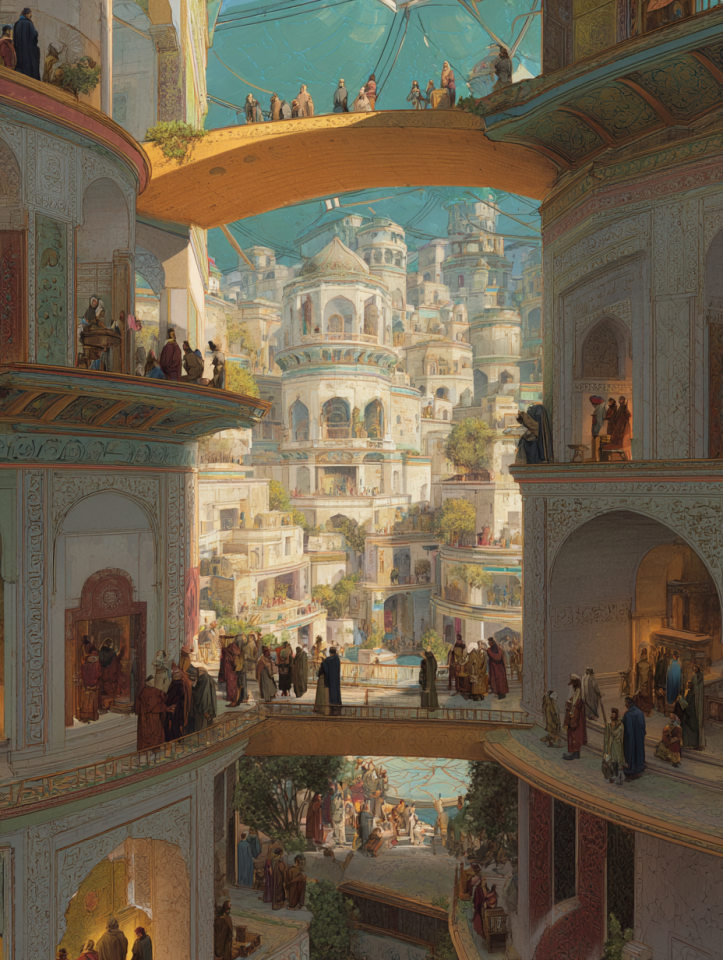
Founded under the Magadhan kings, Pataliputra quickly grew from a riverine outpost into the capital of great empires. It became the administrative heart of the Maurya dynasty, seat of Ashoka’s rule, and a center of Buddhist councils that codified the dharma. Its reputation as a city of both governance and philosophy made it one of the great urban centers of the ancient world.
In this history, Pataliputra never declined into obscurity. Protected by federative governance, it preserved its status as both a political and cultural anchor of Āryāvarta. Buddhist monasteries thrived alongside Jain, Hindu, and philosophical schools, while guilds of artisans, merchants, and healers shaped the city’s civic life. The memory of Ashoka’s pillars of law, seen not as relics but as living symbols, anchored its reputation as a city of justice and pluralism.
Through the medieval centuries, Pataliputra remained a hub of learning. Scholars studied logic, medicine, and astronomy in academies that rivaled those of Nalanda. Trade along the Ganges linked it with the Bay of Bengal, Central Asia, and beyond. Today, Pataliputra continues as the capital of Āryāvarta, a city that carries more than two millennia of continuous civic life, its foundations as firm as the rivers that shaped it.
Sights / Destinations
Religion / Cults / Sects
Pataliputra embodies plural devotion. Buddhist monasteries remain central, their schools emphasizing compassion and inquiry. Jain traditions flourish alongside, honoring ascetic practice and ethical restraint. Hindu devotion persists in temples to Vishnu, Shiva, and the river goddess Ganga. Philosophical schools of logic and Stoicism found early welcome here, integrated into civic debate. Religion is not an exclusive domain but a shared cultural language, with ritual and philosophy intertwining in daily governance.
Founding Date
210 bz
Alternative Name(s)
Patna (modern), Kusumapura, Patalipattan
Type
Capital
Owning Organization
Characters in Location




Comments