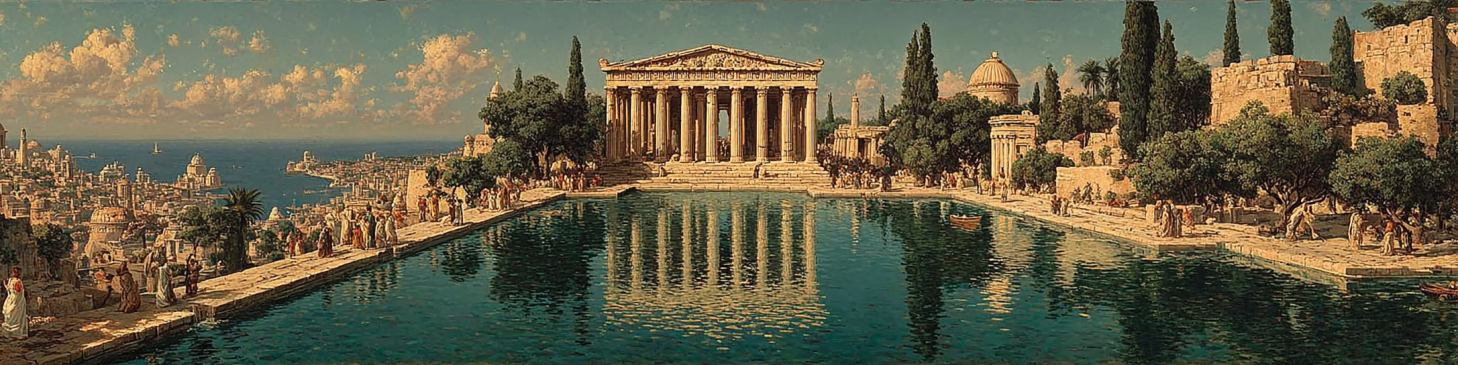
Hellenic Heartlands
The Hellenic Heartlands stretch from the Peloponnese to the isles of the Aegean, where marble hills cradle the philosophies that later bound the world. Here, reason first learned to walk beside myth. The landscape still glows with temples, theaters, and gymnasia — places where beauty was inquiry and thought itself became a civic act.
Agaima of Zeus at Olympia
: MAN-MADE
More than a temple, Olympia was a theater of virtue — where athletic grace, philosophical debate, and devotion to balance converged. The Agaima of Zeus stood at its center, housing a statue whose serene expression was said to reconcile power with mercy. Even in ruins, the site radiates the optimism of early rationalism: that through discipline and dialogue, humans could mirror the harmony of the cosmos. Pilgrims still walk its colonnades as if retracing the first steps of moral philosophy.Eleusinian Sanctuary (Mysteries of Demeter)
: RELIGIOUS/PILGRIMAGE
The plain of Eleusis holds one of the most enduring enigmas of antiquity. Within its sacred hall, initiates once reenacted the myth of Demeter and Persephone — a drama of loss and return that symbolized both the fertility of the earth and the cyclical renewal of the soul. The Mysteries were not dogma but experience, meant to reveal that all living things share a rhythm beyond death. Today, only foundations remain, but even the air feels charged with secrecy — a stillness that once held torches, chants, and the breath of revelation. Scholars in Koina see Eleusis as the philosophical seed of civic spirituality: proof that shared mystery, not fear, can unite a people in reflection.Laokoon Group
: ARTISTIC/MEMORIAL
Coiled in marble and agony, the Laokoon sculpture captures a civilization at the edge of revelation. The priest and his sons, strangled by serpents for warning Troy, are carved not as victims but as witnesses to truth ignored. The Laokoon is studied less as mythic tragedy than as commentary on moral courage — the struggle of reason against denial. Its muscular realism and dynamic tension embody the moment when art became argument, where beauty and pain were no longer opposites but instruments of understanding.Parthenon / Acropolis
: MAN-MADE
The Acropolis remains philosophy made stone. The Parthenon’s columns tilt and taper imperceptibly, embodying a mathematical grace that seems alive. Built for Athena, goddess of reason, it overlooks a city where debate was civic duty and curiosity, devotion. Architects revere it not as a monument to empire but as an early experiment in balance — of weight, light, and civic purpose. Standing at sunset when marble burns gold, one senses what the Athenians sought: a harmony between intellect and faith, geometry and grace.Temple of Apollo at Delphi
: RELIGIOUS/PILGRIMAGE
Perched upon the slopes of Parnassos, Delphi once housed the oracle who spoke in riddles to kings and philosophers alike. “Know thyself” was her enduring counsel, and the temple remains its stone echo. Delphi’s terraces blend perfectly into the mountain — an architectural humility that reflects its message. In the Koina age, it is regarded as the birthplace of self-examination: where divination turned inward, and the divine voice became the human conscience.Derinkuyu Underground City
: MAN-MADE
Beneath the Cappadocian plain lies a labyrinth of halls and tunnels vast enough to shelter thousands. Derinkuyu was carved as refuge from both persecution and invasion, its circular doors rolling shut like millstones. What began as necessity evolved into philosophy: an underground testament to cooperation. Ventilation shafts, water wells, and communal kitchens show a people who chose survival through unity rather than conquest. Modern Koina engineers still cite Derinkuyu as an early example of resilient design — civilization turned inward, but unbroken.Kappadokia Rock Dwellings
: MAN-MADE
The honeycombed cliffs of Kappadokia rise like a frozen tide of devotion. Monasteries, homes, and sanctuaries were carved into volcanic tuff, their frescoes still luminous in the dim light. Though later associated with Christian ascetics, their origins stretch deeper — a continuum of Anatolian cave cults seeking solitude and silence. In Koina’s eyes, these dwellings represent the dialogue between permanence and retreat, architecture as introspection. The rock faces breathe history: whole communities carved their ideals directly into the earth.
Type
World wonder
Owning Organization




Comments