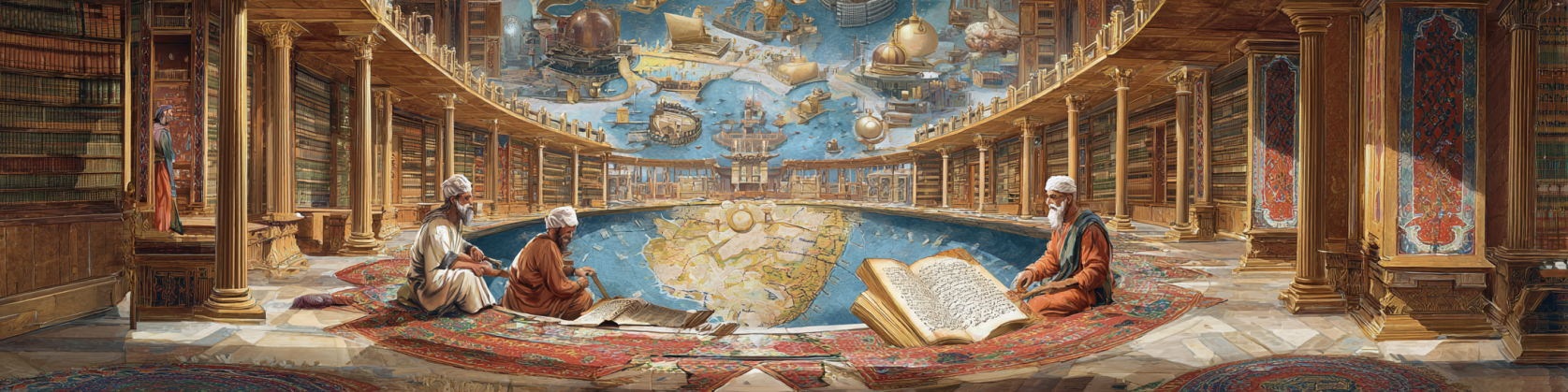
Communication & Memory
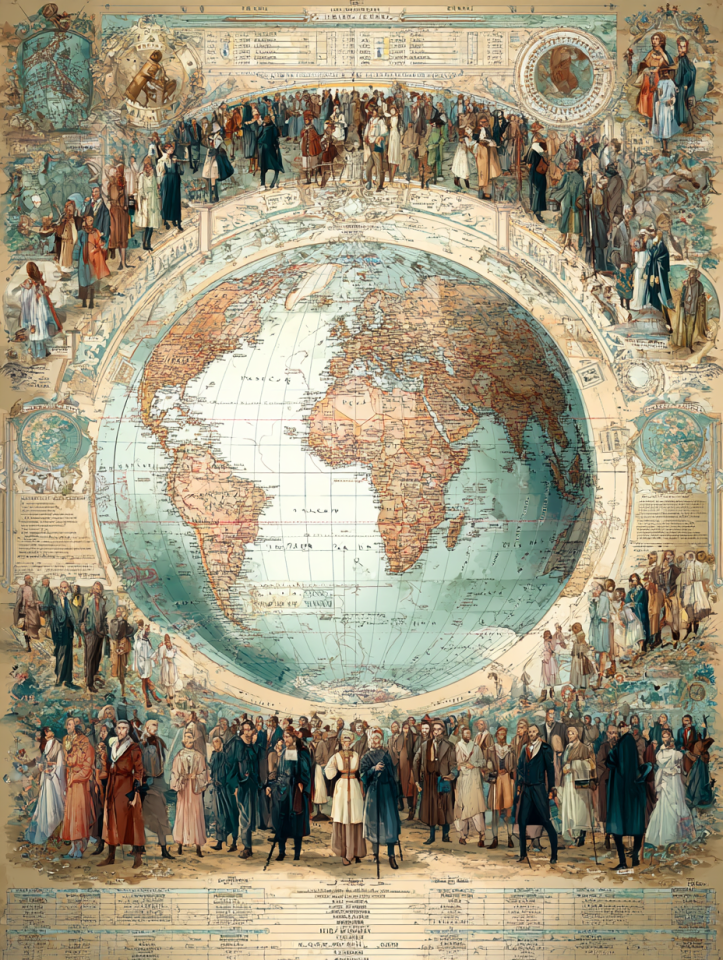
At dusk, every city hums with voices — some carried on wind, some through light. On the terrace of a guild hall, a child listens to her grandmother’s words echo softly from a small ceramic sphere, a recording made decades ago and preserved in the local archive. In a nearby market, traders negotiate in five languages, each hearing the others clearly through a shared lexicon of translation tuned by the League. Across the sky, resonance towers glow like quiet constellations, linking continents through the same frequencies once used for song. The world is always speaking — and everyone, everywhere, can listen.
Communication in Koina was never the privilege of rulers or merchants. From the first courier posts of the Persic roads to the luminous Net of Voices that now joins every home, the impulse was the same: to keep knowledge alive and accessible. Because no empire burned libraries or bound speech to doctrine, language and memory evolved without rupture. The couriers became translators, the translators became archivists, and the archivists became the keepers of a planetary conversation.
In the absence of censorship or conquest, the act of sharing became sacred. Every letter, image, and story is a thread in the collective mind — a remembrance that truth grows brighter when spoken aloud. The citizens of Koina do not merely send messages; they participate in the world’s own recollection. To communicate is to remember, and to remember is to remain in harmony.
Communication in Koina has never been a tool of conquest, but a vessel of connection. From the first couriers racing along the Royal Road to the carved glyphs of the Maya and the knotted quipu of the Andes, human voices have always sought not to dominate but to be heard. In this world, where no empire imposed a single tongue, plurality became the foundation of memory itself.
Each federation nurtured its own lexicons, scripts, and dialects. Persic scribes recorded laws in layered languages; Hellenic traders carried their vowels across seas; Nile–Axumic priests preserved Coptic and Geʽez side by side; Indic sanghas copied manuscripts in Sanskrit, Tamil, and Pali; Sinosphere scholars balanced bureaucracy and poetry through brush and character; and across the western continents, glyphs and cords embodied time as much as speech. Together, these tongues wove the Net of Voices long before resonance towers gave it form.
Language in Koina is more than words. It is memory inscribed on stone, parchment, and cord; it is philosophy debated in guild halls; it is treaties sung, carved, or knotted into permanence. The multiplicity of tongues is not a hindrance but a guarantee: no one culture monopolizes expression, and no memory is lost because it lacks translation.
The modern Net of Voices continues this legacy. Citizens shift effortlessly between local dialects and the Translators’ Creole, while archives preserve every syllable in federative harmony. Communication here is both living and archival, both daily and eternal. To speak is to participate in the cooperative world; to remember is to belong to its shared chorus.
Courier Guilds: The Persic model of relay couriers expanded globally, making fast, neutral message delivery a civic right. Couriers were sworn to neutrality, their honor as inviolate as the Whispers in councils.
Translators’ Guilds: To prevent linguistic fragmentation, guilds maintained shared grammars, dictionaries, and shorthand. Multiple scripts flourished, but communication remained universal.
Public Debates & Archives: Oral debates and stories were transcribed and archived early, turning speech into civic memory.
Language Families of Koina
Though hundreds of dialects flourish across the federations, seven great language families carry the weight of history, governance, and daily life. Each embodies the values of its region: Persic tongues as federative anchors, Hellenic dialects as trade bridges, Nile–Axumic voices as Afro-Asiatic hybrids, Indic scripts as vessels of philosophy and medicine, Sinosphere Lexicons as bureaucratic and poetic standards, Meso glyphs and quipu as calendrical memory systems, and the Translators’ Creole as the cooperative lingua franca. Together, they form the foundation of the Net of Voices, ensuring that plurality is not a barrier but the very grammar of cooperation.
| Language Collections |
Early Foundations
Wireless Signal Resonance
The leap came when energy grids developed through inductive resonance. Communication soon followed:
Resonance Beacons: Towers began transmitting encoded signals along harmonic fields.
Voice Transmission: By the equivalent of our Middle Ages, speech could be carried instantly across cities and regions.
Guild Oversight: Translator guilds maintained encryption and fairness, preventing states or elites from monopolizing channels.
This step meant Koina skipped over telegraphs and telephones entirely - moving directly from courier posts to wireless voice and data networks.
The Net of Voices
Today, Koina is woven together by the Net of Voices - a cooperative global system that blends the roles of internet, library, and memory archive.
Universality: Every citizen has access. Denying access is a civic transgression.
Collaboration: Councils, guilds, and households contribute to shared repositories - from treaties to family histories.
Translation by Default: Automatic guild-maintained lexicons ensure people from different federations can communicate in real time.
Accessible Archives: The Net serves as both a living memory and a working tool. Anyone can read philosophical debates from centuries past, study medical texts, or view ancestral photographs.
Consensus Broadcasting: Assemblies broadcast sessions openly. Citizens watch, listen, and respond instantly, making governance participatory at scale.
Knowledge as Commons
Unlike our internet, driven by commerce and ownership, the Net of Voices is treated as a commons.
Repositories of Memory: Functionally similar to Wikipedia, but every guild maintains repositories of its craft, updated collaboratively.
Local to Global: Families upload genealogies, guilds contribute research, and councils store debates. Together, these form the accessible memory of the world.
No Paywalls: Knowledge is a civic right, and hoarding or restricting it is viewed as one of the gravest transgressions.
Strengths and Vulnerabilities
Strengths
Universal access prevents digital divides.
Archives preserve not just data but plural memory.
Transparency fosters accountability in governance.
Vulnerabilities
Dependence on resonance towers creates choke points.
Guild moderation can drift toward soft censorship.
Overabundance of voices risks noise overwhelming dialogue.
Tone of Communication
Communication feels dialogic, collaborative, and archival. Citizens do not merely “consume” knowledge - they are custodians of it. The Net of Voices is not a commercial product but a living library, a civic memory, and a philosophical commons. It is as familiar and essential as electricity, as natural as air.
-
World Bible Navigation
-
Governance
Documents detailing the articles of Cooperative Federation.-
The Covenant
The Foundations of Koina
-
Constitution
-
The Persian Constitution
Empire is formed
-
The Persian Constitution: Amendment I
5th - 6th Century ZC
-
The Persian Constitution
-
Bills and Accords
-
The Accord of Alexandria
1st Century ZC
-
The Bill of Rights for All Peoples
3rd Century ZC
-
The Bill of Sovereignty for Cooperatives
3rd Century ZC
-
The Charter of Rights & Duties of the Accord
3rd Century ZC
-
The Covenant of Adjudication
3rd Century ZC
-
On Inheritance
A Treatise on the Balance of Desire, Purity, and Civic Stewardship
-
The Expansion Accord
4th Century ZC
-
The Environmental Accord
12th Century ZC
-
The Communication Accord
18th Century ZC
-
The Technology & Balance Accord
22nd Century ZC
-
The Modern Accord
22nd Century ZC
-
The Accord of Alexandria
-
Constitution
-
The Covenant
-
World Scope
-
Introduction & Scope
-
Arts & Aesthetics
-
Architectural Standards
-
Communication & Memory
-
Crime & Social Order
-
Geopolitics & Power
-
Law, Rights & Citizenship
-
Leadership: Voices & Whispers
-
Freedom & Daily Rhythm
-
Global Institutions
-
Health & Environment
-
Industrialization
-
Religion & Philosophy
-
Sciences & Knowledge
-
Social & Cultural Life
-
Technology & Travel
-
Introduction & Scope
-




Comments