



The Argonauts
Cooperative quest of many heroes bound by shared purpose.
In Iolcus there lived Pelias, who had usurped the throne from his own kin. But prophecy had warned him: beware the man who comes with but one sandal. In time Jason, son of the rightful king Aeson, returned from his hidden upbringing. Crossing a river, he lost a sandal, and so came into the court as foretold. Pelias, wary of the omen, feigned welcome and set Jason a task he thought impossible: to bring back the Golden Fleece from far Colchis, at the edge of the world.
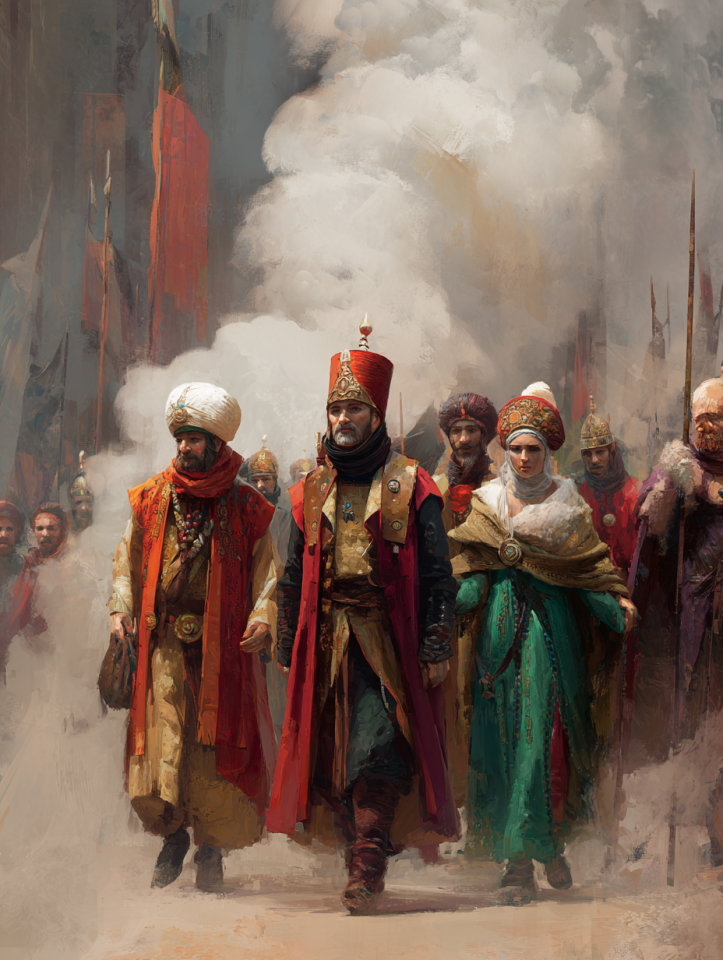
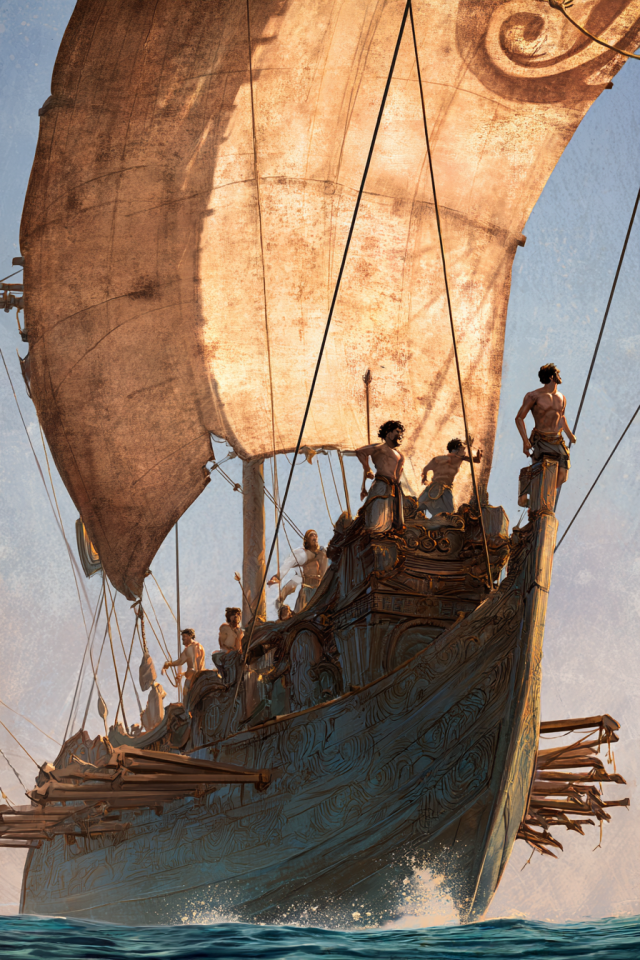
Jason accepted the challenge. Argus the shipwright built for him a vessel greater than any before, with fifty oars and timbers bound in bronze. Into its prow he set a living beam of oak, cut from the sacred grove of Dodona, which spoke with the voice of the gods. They named it *Argo*. From across Hellas heroes gathered to sail with him: Heracles of Tiryns, Orpheus whose song charmed even stones, Atalanta swift-footed, the twins Castor and Pollux, Meleager the hunter, Peleus and Telamon who would father greater sons, and many more. Never before had such a host assembled for one cause, and they were called the Argonauts.
The people of Iolcus thronged the shore as the *Argo* launched, its oars dipping in unison, its sail catching the wind. Their first haven was Lemnos, an island ruled by women who had slain their menfolk. There they lingered in uneasy comfort, until Heracles rebuked them, urging the quest onward. They sailed on and came to the Doliones, who at first received them with hospitality. But in the night, through mischance, they fought their hosts, and when dawn revealed the truth, grief weighed heavy on the band.
In Mysia, young Hylas, beloved companion of Heracles, went to draw water and was taken by nymphs into the depths. Heracles raged, searching in vain, and when the *Argo* departed, he remained behind, his cries lost to the wind. Thus the strongest of the heroes did not continue with them, and sorrow shadowed the voyage.
They pressed onward to Thrace, where they found the seer Phineus, tormented by the Harpies who snatched away his food. The winged monsters fouled the air with their stench, but the sons of Boreas, swift on the wind, chased them off. In gratitude, Phineus revealed the course ahead and warned them of the Symplegades, the Clashing Rocks that smashed all who tried to pass.
When they reached those dreadful straits, they loosed a dove. It flew through as the rocks crashed together, losing only a few tail-feathers. With courage renewed, the Argonauts rowed mightily, and as the rocks thundered shut, Athena herself steadied the *Argo*, and they passed safely into the open sea. From then on, the Symplegades stood still, and the path was free for all ships.
After many days they reached Colchis, where the Golden Fleece gleamed upon an oak tree, guarded by a sleepless dragon. King Aeëtes received them with smiles and cunning, but he had no wish to surrender his prize. He set Jason impossible tasks: to yoke bulls that breathed fire, to plow a field with them, and to sow it with dragon’s teeth, from which armed warriors would spring.
Despair nearly broke Jason, but Medea, daughter of Aeëtes and mistress of enchantments, beheld him and her heart was stirred by love and by fate. She came to him by night, promising aid if he would swear his loyalty to her. With her charms and ointments, Jason faced the bulls, their breath blazing, and drove them before him. He sowed the dragon’s teeth, and from the earth rose soldiers in bronze. But he cast a stone among them, and they turned upon one another until none stood.
Still Aeëtes withheld the Fleece. So Medea led Jason to the grove where it hung. Before them lay the dragon, coils vast as ships’ masts, eyes burning in the dark. Medea sang her spells, pouring sleep upon the beast. Jason leapt forward, seized the Fleece in his arms, and the two fled together to the *Argo*. Pursuit was swift, for Aeëtes roused his men, but the heroes rowed with fury, and the goddess Hera sent winds to speed them.
Their return was long and fraught with trial. They came to Circe, who purified Jason and Medea of blood-guilt. They sailed past the Sirens, whose song promised death, but Orpheus played his lyre and drowned their voices in sweeter sound. They encountered Talos, the bronze giant who guarded Crete, and with Medea’s sorcery they unbound the nail that gave him life, so that he toppled into the sea.
At last the *Argo* returned to Iolcus, bearing the Golden Fleece. Jason stood in triumph, though his later fate would bring sorrow and betrayal. Yet the quest itself lived on as one of the greatest journeys ever told — a gathering of champions, bound not by one hero’s strength but by the shared resolve of many.
So the tale of the Argonauts is remembered: of the ship that carried fifty hearts, of trials faced across the wide sea, of a prize won at the world’s edge, and of a band of heroes whose names echo still in song and story.
Related Organizations




Comments