


Leadership: Voices & Whispers
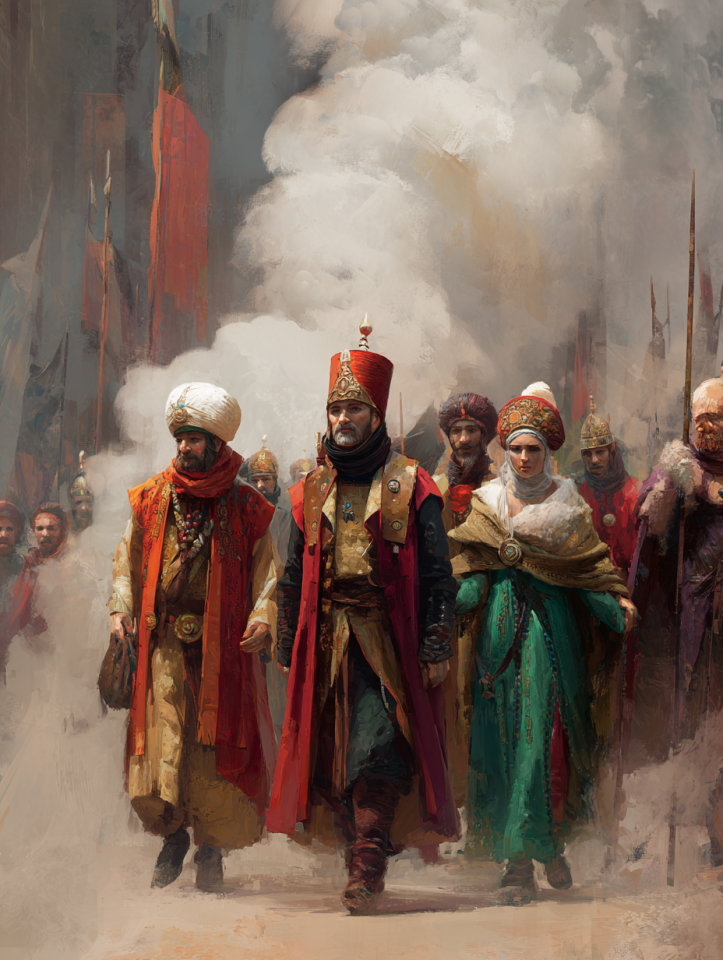
The council chamber is quiet except for the rustle of paper and the rhythmic tap of a reed pen. At the center table sits the First Voice, not elevated but level with the circle of Whispers around her. Through the open doors, citizens stand in the courtyard, listening as the debate unfolds — a question of river rights between two farming guilds. Each Whisper speaks in turn, not to persuade but to refine. When the Voice finally answers, her words are not command but synthesis, the shared thought of many minds. A murmur of assent rises from the hall; the decision is made, recorded, and read aloud in three languages before the sun sets.
In Koina, leadership was never born of conquest or charisma. It grew from apprenticeship, dialogue, and the conviction that wisdom is communal. The Voice gives clarity; the Whispers give balance. Together they embody the civic rhythm of governance — rotation instead of rule, service instead of sovereignty.
There are no thrones here, no inherited offices, no dynasties. To lead is to listen, to speak is to gather what has been heard, and to step down when the time of one’s speaking is done. In this world, power is not owned but borrowed, a trust passed from hand to hand so that no one voice ever drowns the others.
In this alternate modernity, leadership is not inherited, nor is it monopolized by charisma or wealth. Instead, it is structured, trained, and redundant - designed to ensure both continuity and accountability. At every level of society, from households to federations, the same principle applies: the First Voice speaks, and the Whispers refine.
Early Identification and Training
Unlike systems where leaders emerge by chance, birthright, or ambition, here potential leaders are identified early. Communities, guilds, and schools observe children for qualities such as fairness, rhetorical skill, empathy, and logical reasoning. Those who show aptitude are nominated into leadership cohorts, beginning structured training in adolescence.
Training covers philosophy, logic, mediation, history, law, and the practical arts of administration. Candidates rotate through apprenticeships in guilds, councils, and assemblies. By the time they reach maturity, they are already familiar with the mechanics of governance. This ensures leaders are prepared, not improvising.
Training covers philosophy, logic, mediation, history, law, and the practical arts of administration. Candidates rotate through apprenticeships in guilds, councils, and assemblies. By the time they reach maturity, they are already familiar with the mechanics of governance. This ensures leaders are prepared, not improvising.
The First Voice
At any given time, each council - whether family, guild, city, or federation - has a First Voice.
Role: The Voice is the focal point of decision-making, responsible for representing the community, guiding debates, and enacting policies.
Authority: Not absolute, but executive; the Voice is always surrounded by Whispers who refine and check decisions.
Rotation: A Voice serves for a limited term, then rotates out. Another Whisper steps into the role, ensuring continuity without dynastic entrenchment.
The First Voice is therefore not a ruler in the Roman sense, but a conductor of collective reason.
The Whispers
Alongside every Voice sit several Whispers - co-trained candidates who share responsibility:
Mediators: They settle disputes before they escalate to the Voice, ensuring the council’s time is used efficiently.
Advisors: Each Whisper holds a portfolio - health, trade, education, justice, or diplomacy - and keeps the Voice informed.
Custodians of Continuity: Because Whispers are always present in deliberations, they can step seamlessly into leadership if the Voice falters, dies, or rotates out.
Stewards of Diplomacy: They host visiting dignitaries, oversee ceremonies, and manage protocol, keeping the Voice focused on governance rather than pageantry.
This creates a choral model of leadership: one leads, but all are heard.
Rotation and Redundancy
Rotation is a safeguard against stagnation and ambition. No Voice can hold power indefinitely; after a term, they step aside and a Whisper ascends. Meanwhile, younger candidates are continually trained to refresh the pool. This creates layered redundancy: at any moment, multiple people are fully capable of stepping into leadership, ensuring no vacuum of power.
At higher levels - regional or federative - the same principle applies. Voices rise from city or guild councils into regional assemblies, and from there into the federative Grand Assembly. At every step, redundancy and rotation prevent dynasties, coups, and stagnation.
At higher levels - regional or federative - the same principle applies. Voices rise from city or guild councils into regional assemblies, and from there into the federative Grand Assembly. At every step, redundancy and rotation prevent dynasties, coups, and stagnation.
Symbolism and Philosophy
Philosophically, the Voice and Whispers embody the belief that wisdom is collective, not solitary.
The Voice represents articulation, the power to speak clearly and guide.
The Whispers represent refinement, the constant testing of reason through mediation and counterpoint.
This model is rooted in both Stoic and Buddhist traditions: truth emerges through debate, humility, and awareness, not through domination.
Strengths and Vulnerabilities
Strengths
Seamless continuity of leadership.
Collective accountability prevents authoritarianism.
Citizens see governance as participatory and reasoned, not arbitrary.
Vulnerabilities
Risk of factionalism among Whispers if rivalries intensify.
Consensus-driven processes can slow urgent responses.
Overemphasis on early identification may overlook late-blooming talents.
These vulnerabilities are mitigated by open examination routes for adults, citizen veto powers, and guild oversight. In practice, the system has endured for centuries, producing leaders who are trained, balanced, and accountable.
The Tone of Leadership
Leadership in this world feels less like command and more like stewardship. Citizens expect reason, not decree; transparency, not mystery. The presence of Whispers means no leader stands alone, and no decision is made without collective refinement. The result is a political culture that is calm, rational, and resilient.
-
World Bible Navigation
-
Governance
Documents detailing the articles of Cooperative Federation.-
The Covenant
The Foundations of Koina
-
Constitution
-
The Persian Constitution
Empire is formed
-
The Persian Constitution: Amendment I
5th - 6th Century ZC
-
The Persian Constitution
-
Bills and Accords
-
The Accord of Alexandria
1st Century ZC
-
The Bill of Rights for All Peoples
3rd Century ZC
-
The Bill of Sovereignty for Cooperatives
3rd Century ZC
-
The Charter of Rights & Duties of the Accord
3rd Century ZC
-
The Covenant of Adjudication
3rd Century ZC
-
On Inheritance
A Treatise on the Balance of Desire, Purity, and Civic Stewardship
-
The Expansion Accord
4th Century ZC
-
The Environmental Accord
12th Century ZC
-
The Communication Accord
18th Century ZC
-
The Technology & Balance Accord
22nd Century ZC
-
The Modern Accord
22nd Century ZC
-
The Accord of Alexandria
-
Constitution
-
The Covenant
-
World Scope
-
Introduction & Scope
-
Arts & Aesthetics
-
Architectural Standards
-
Communication & Memory
-
Crime & Social Order
-
Geopolitics & Power
-
Law, Rights & Citizenship
-
Leadership: Voices & Whispers
-
Freedom & Daily Rhythm
-
Global Institutions
-
Health & Environment
-
Industrialization
-
Religion & Philosophy
-
Sciences & Knowledge
-
Social & Cultural Life
-
Technology & Travel
-
Introduction & Scope
-




Comments