Nihon (NEE-hon)
Origin of the Sun
Morning mist rolls across terraced rice fields as the sun rises from the eastern sea, its light striking wooden temples roofed with sweeping eaves. In Heian-kyō, courtiers in layered silks stroll through gardens of ponds and bridges, while monks chant sutras in halls fragrant with incense. Calligraphers dip brushes into ink, their strokes as much art as record, each character preserving memory in the elegance of line and form.
Villages beyond the city hum with the rhythm of agricultural life: farmers tending rice paddies, children gathering in shrines to hear stories of kami — spirits of forest, river, and mountain. Story and nature blend seamlessly, preservation carried not only by scrolls but by rituals of planting, harvest, and festival.
At night, the capital comes alive with music and poetry contests. Lanterns glow across the riverbanks as poets recite verses that capture fleeting moments — blossoms falling, moonlight on water, the laughter of friends. For the people of Nihon, preservation is the art of noticing: of capturing transience in form so it may endure beyond the moment.
When the Accord was called, emissaries from Nihon crossed seas to lend their voice. Their leaders declared that preservation was not only endurance but refinement, the distillation of beauty and truth into art, ritual, and form. Thus Nihon entered the Accord as the keeper of transience made eternal.
Historical Origins
Nihon’s culture emerged from the fusion of indigenous Shinto traditions with influences from China and Korea. By the 1st century zc, clans had established powerful networks across the islands, guided by rituals that honored kami and ancestors. Over centuries, Buddhism and Confucianism enriched this foundation, blending with native beliefs into a uniquely Japanese worldview.
By the time of the Accord, Nihon had already embraced the practice of record-keeping, poetry, and ritual preservation. Its envoys brought with them not only scrolls and sutras but also the conviction that memory must preserve the delicate balance between permanence and impermanence.
Philosophy & Governance
Governance in Nihon combined clan-based authority with imperial ritual. The emperor, revered as a descendant of the sun goddess Amaterasu, embodied continuity, while councils of nobles and monks guided practical rule. Preservation was embedded into ritual calendars, shrine ceremonies, and poetic anthologies that recorded the spirit of each age.
Within the Accord, Nihon contributed the philosophy of impermanence. They argued that preservation must honor not only what endures but what passes — that memory lies equally in the fleeting and the eternal. Their teachings of mono no aware (the beauty of transience) gave the Accord a deeper sensitivity to art, ritual, and the human condition.
Contributions to the Accord
Nihon’s contributions enriched the cooperative world with refinement and subtlety:
Aesthetic Philosophy: Concepts of impermanence, beauty, and harmony with nature.
Calligraphy and Literature: Preservation through elegance of form and expression.
Ritual and Festival: Shinto practices blending community, nature, and ancestry.
Agricultural Innovation: Rice cultivation and irrigation adapted to diverse landscapes.
Cultural Identity
Nihon’s culture celebrated the union of nature, art, and spirit. Festivals marked the cycles of rice and cherry blossoms, while shrines and temples bound the people to both kami and ancestors. Poetry anthologies preserved the voices of courtiers and commoners alike, proving that preservation was not limited to elites.
In the Accord, Nihon became the guardian of transience. Their influence ensured that preservation was not only about permanence, but also about cherishing the fleeting moments that define humanity. Their cherry blossoms, cranes, and rising sun entered Accord symbolism as reminders of beauty’s impermanence.
Capital City
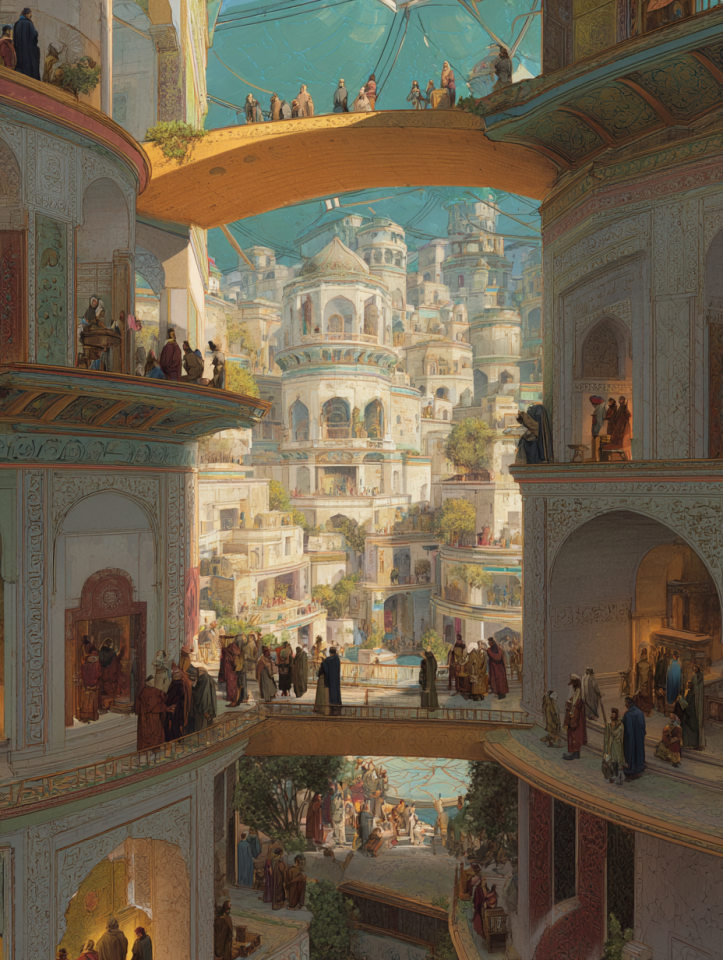
Heian-kyō (Kyoto) — 35.0116°N, 135.7681°E — was chosen as Nihon’s Accord seat. Built with careful symmetry, gardens, and wooden halls, it embodied harmony with nature and refinement of form. Accord emissaries marveled at its poetry contests, calligraphy schools, and temples that fused art with philosophy.
Here, preservation was experienced as much through ritual and performance as through archive. Poetry was catalogued alongside philosophy, and shrines were seen as living archives, preserving continuity through ritual rather than stone.
Legacy & Global Role
Nihon gave the Accord its refinement. Their philosophy of impermanence enriched the cooperative world with sensitivity to beauty, subtlety, and the fleeting nature of life. They reminded the Accord that preservation must include the delicate as well as the monumental, the transient as well as the enduring.
Centuries later, the cherry blossom remains a global symbol of transience made eternal, embodying Nihon’s enduring gift: the art of capturing the fleeting, and in so doing, preserving the essence of life itself.

White for purity, silver for refinement, rising sun as national/cosmic emblem.
Type
Geopolitical, Country
Capital
Leader
Leader Title
Related Ranks & Titles
Controlled Territories
Notable Members
Related Myths








Comments