


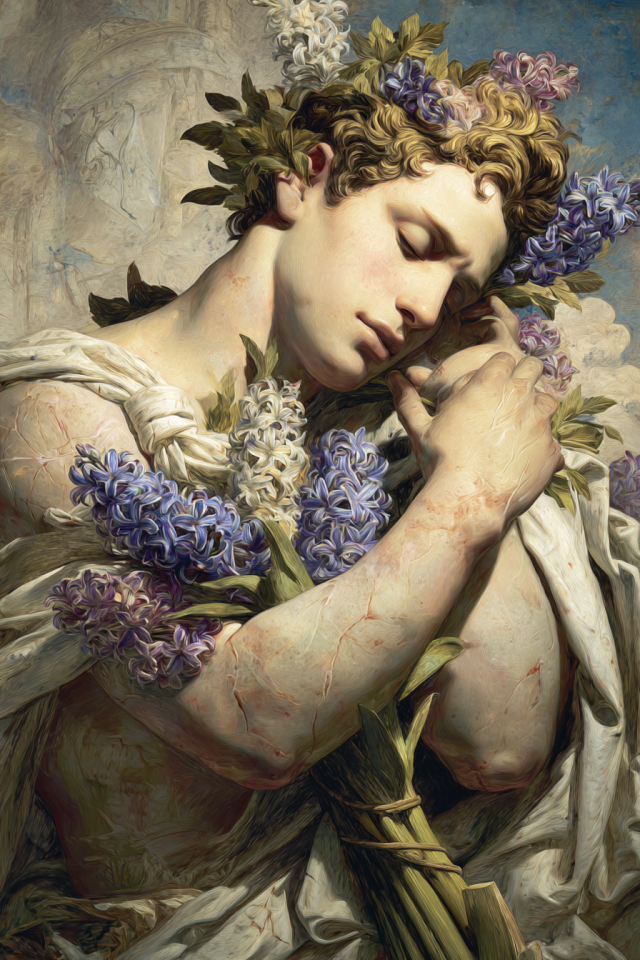
Apollo and Hyacinthus
Tragic male–male love, ending in the flower’s creation.
In the bright age when gods still walked among mortals, Apollo wandered south to the land of Sparta. There he beheld Hyacinthus, a boy whose beauty shone brighter than the olive groves and rivers of his homeland. His eyes held the depth of the sea, and his hair fell like dark waves over his shoulders. When Apollo saw him, the god’s heart was seized by desire.
Hyacinthus, though mortal, did not tremble before divinity. He welcomed the radiant god as companion. Side by side they roamed the hills: Apollo taught him the lyre, and Hyacinthus taught the god the arts of wrestling and the hunt. At dawn they chased the hare across meadows; at dusk they sang together as the sun dipped behind Taygetus. Their bond deepened until the god, who had known countless liaisons, felt a love unlike any before.
Yet in the shadows lurked envy. Zephyrus, the west wind, also coveted the boy. He watched with bitterness as Hyacinthus chose Apollo’s side over his. Jealousy festered, and the gentle wind grew sharp with malice.
One afternoon, Apollo and Hyacinthus took to the field with the discus. The god shone in the contest, his strength and grace dazzling, but Hyacinthus begged to throw as well. Laughing, Apollo cast his disc high into the air, where it flashed like a second sun. Hyacinthus ran to catch it as it fell, eager to impress his divine lover.
But as the disc curved back to earth, Zephyrus struck. He twisted the air, turning Apollo’s cast into a weapon. The bronze edge struck Hyacinthus full upon the brow, and he crumpled to the ground, blood staining the grass.
Apollo cried out and rushed to his side. He cradled the boy’s head, desperate to staunch the wound, whispering songs of healing. Yet even the god of medicine could not turn back death once it had entered. Hyacinthus’ breath grew shallow, his eyes dimmed, and in moments his body lay still in the god’s arms.
Grief overcame Apollo. He cursed his own skill, cursed the discus, and cursed the fate that tore beauty from the world. Some say he turned upon Zephyrus in fury, driving him shrieking across the sky. Others say he wept in silence, his tears mingling with the blood of the boy.
Yet from sorrow sprang transformation. Where Hyacinthus fell, flowers rose. Their petals curled like the boy’s dark locks, their color deep as his eyes. Apollo named them hyacinths, so that the youth’s beauty would never fade. Upon the petals he inscribed the letters “AI” — the cry of grief. Each spring the flowers bloom, and each spring Apollo remembers.
Thus Hyacinthus was not wholly lost. His name lives in the flower, and in the tales sung by poets who speak of the god’s love for a mortal boy. In the story of Apollo and Hyacinthus, the Greeks saw both the fragility of beauty and the endurance of devotion — a love that even death could not erase.
Related Organizations




Comments