
Industrialization
In the quiet hours before sunrise, the workshops of Antioch hum like hives. Potters fire resonance coils beside their kilns; glaziers polish solar mirrors that will catch the first light. From the roofs, airships drift soundlessly, their sails glowing amber as they cross above gardens and courtyards. There are no smokestacks, no engines tearing at the air — only the steady murmur of machines tuned to the rhythm of wind and sun.
Industrialization in Koina never arrived as revolution or conquest. It unfolded as refinement — the natural evolution of guild craft guided by philosophy and ecology. The same hands that once shaped clay amphorae now mold ceramic conductors; the same logic that once mapped irrigation canals now powers magnetic drives. Because inquiry was never suppressed and no empire demanded weapons or domination, the great leaps of technology emerged as extensions of art and ethics rather than ruptures in them.
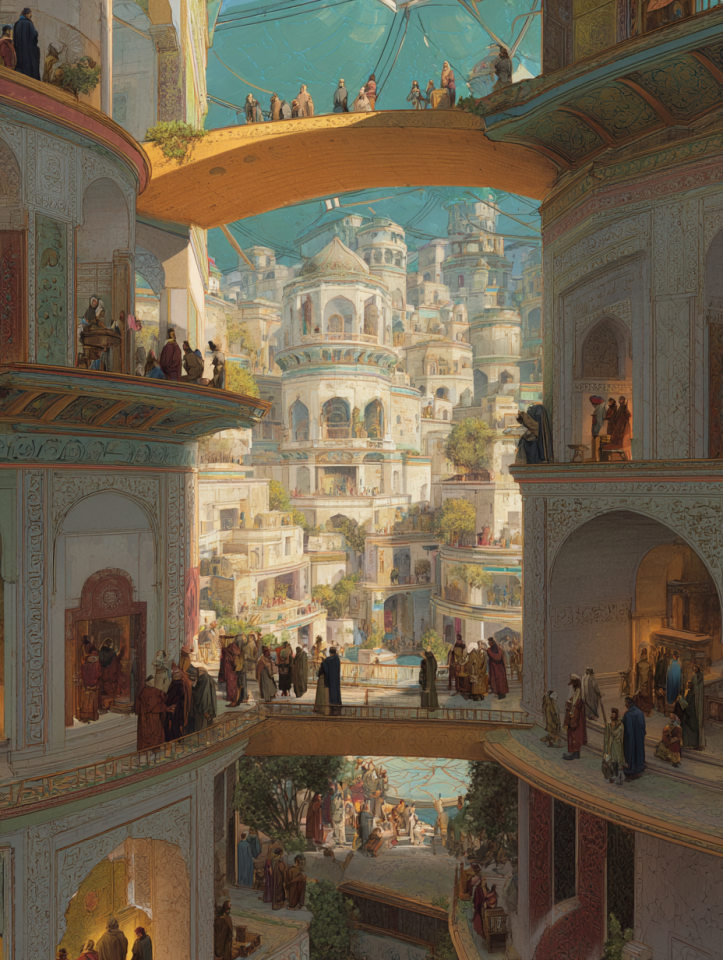
To walk through a Koinan city is to see invention folded seamlessly into life: power transmitted invisibly through resonance towers, transport hovering in quiet arcs above tree-lined avenues, workshops alive with repair rather than waste. Here, progress is measured not by speed or might but by grace — the ability to make complexity feel as natural as breath.
Industrialization still emerges in this world, but it follows a different trajectory - less extractive, less militarized, and more cooperative. Without Rome’s conquest model or later European empires, industry never becomes an engine for domination. Instead, it evolves as a natural extension of guild rivalries and philosophical inquiry.
Renewable-First Development
From the earliest stages of industrial growth, renewable energy forms the backbone. Solar towers, wind vanes, waterwheels, and geothermal vents are integrated into architecture and city design. Instead of smokestacks, skylines are marked by elegant energy structures - quiet, efficient, and ecological.
This isn’t because people are “more virtuous,” but because guild prestige and philosophical consensus reward balance over extraction. A guild that strips forests bare or pollutes rivers loses honor and faces boycotts. A guild that harnesses nature harmoniously gains prestige and contracts.
This isn’t because people are “more virtuous,” but because guild prestige and philosophical consensus reward balance over extraction. A guild that strips forests bare or pollutes rivers loses honor and faces boycotts. A guild that harnesses nature harmoniously gains prestige and contracts.
Localized Industry
Factories exist, but they are smaller, modular, and tied to guilds rather than massive corporations. Each guild-run factory specializes in a domain: textiles, ceramics, glass, metallurgy, or engineering. Production is distributed across regions, reducing dependence on monopolies.
Goods are designed to be durable and repairable. The throwaway consumerism of our world never develops; instead, artisanship and repair culture remain central.
Goods are designed to be durable and repairable. The throwaway consumerism of our world never develops; instead, artisanship and repair culture remain central.
Cooperative Technologies
Technologies are valued less for conquest and more for cooperation.
Energy systems provide clean, reliable power to communities.
Transportation networks connect regions via solar-powered trains, airships, and ferries.
Communication technologies like the internet and photography extend memory, dialogue, and cultural exchange.
Medical technologies are developed across federations, shared widely through the League of Healers.
The underlying question for innovation is always: Does this technology enrich life balance?
Absence of the Military-Industrial Complex
Weapons exist - bows, firearms, even mechanized defenses - but they never dominate industry. Without empires racing for conquest, the military-industrial complex never forms. Defense is local, cooperative, and largely deterrent. Prestige accrues to those who heal, build, and connect, not those who destroy.
Strengths and Vulnerabilities
Strengths
Renewable-first industry prevents ecological collapse.
Repair culture and modular design create resilience.
Cooperative technologies expand knowledge, memory, and mobility.
Vulnerabilities
Industrial pace is steadier, lacking “explosive leaps” tied to wartime innovation.
Regions with weaker guild oversight sometimes cut corners, leading to ecological stress.
Large-scale projects require extensive negotiation between federations, slowing momentum.
Tone of Technology
Technology in this world feels human-scaled and ecological. It exists to enrich life, preserve memory, and expand human connection. Industrialization provides comfort and mobility, but never towers over humanity. The result is a world where machines and tools are woven into civic life as partners in balance, not masters of it.
-
World Bible Navigation
-
Governance
Documents detailing the articles of Cooperative Federation.-
The Covenant
The Foundations of Koina
-
Constitution
-
The Persian Constitution
Empire is formed
-
The Persian Constitution: Amendment I
5th - 6th Century ZC
-
The Persian Constitution
-
Bills and Accords
-
The Accord of Alexandria
1st Century ZC
-
The Bill of Rights for All Peoples
3rd Century ZC
-
The Bill of Sovereignty for Cooperatives
3rd Century ZC
-
The Charter of Rights & Duties of the Accord
3rd Century ZC
-
The Covenant of Adjudication
3rd Century ZC
-
On Inheritance
A Treatise on the Balance of Desire, Purity, and Civic Stewardship
-
The Expansion Accord
4th Century ZC
-
The Environmental Accord
12th Century ZC
-
The Communication Accord
18th Century ZC
-
The Technology & Balance Accord
22nd Century ZC
-
The Modern Accord
22nd Century ZC
-
The Accord of Alexandria
-
Constitution
-
The Covenant
-
World Scope
-
Introduction & Scope
-
Arts & Aesthetics
-
Architectural Standards
-
Communication & Memory
-
Crime & Social Order
-
Geopolitics & Power
-
Law, Rights & Citizenship
-
Leadership: Voices & Whispers
-
Freedom & Daily Rhythm
-
Global Institutions
-
Health & Environment
-
Industrialization
-
Religion & Philosophy
-
Sciences & Knowledge
-
Social & Cultural Life
-
Technology & Travel
-
Introduction & Scope
-




Comments