




The Bill of Rights for All Peoples
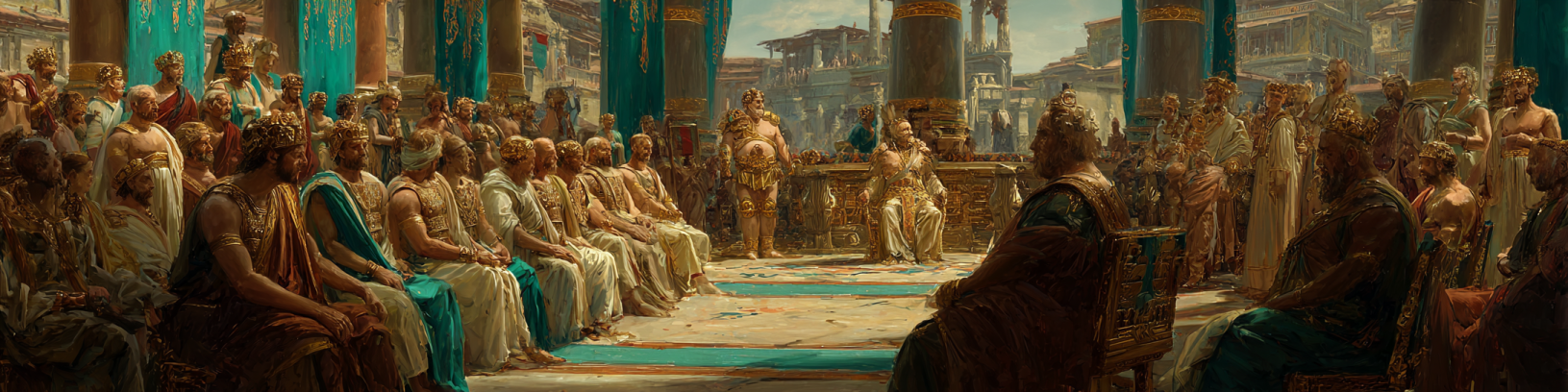
As the Accord matured from charter to civilization, its founders saw that preservation meant more than survival of monuments. The Persian Constitution had bound nations together; this new Bill bound their citizens. It affirmed that belonging to the Accord was not a privilege granted by rulers, but a birthright of being human.
The Bill of Rights declared the indivisibility of life, belief, and expression. It abolished the old distinctions between conqueror and conquered, citizen and foreigner, replacing them with the equality of personhood. Its language was not moral but practical — to safeguard education, mobility, and choice as conditions of stability.
Its ratification shifted Koina’s center of gravity from empire to individual. Civic life became the measure of civilization, and human dignity its currency. Every later reform — of law, inheritance, and consent — begins with this declaration that no accord is stronger than the rights it protects.
The Bill of Rights for All Peoples
Preamble
We, the peoples of Koina, affirm that knowledge, heritage, and wisdom are preserved not in scrolls or stones alone, but in the lives of those who carry them. If the Accord is to endure, it must guard not only the sanctuaries of memory but the dignity of every person. For without liberty, culture falters; without equality, preservation withers; without justice, memory is hollow. This Bill declares the rights of all peoples, that none may be silenced by power, erased by majority, or forgotten by time.Article I – On the Right to Life and Safety
Every person has the right to live free from unlawful violence, enslavement, or destruction. To strike against an innocent is to strike against Koina itself. No cooperative may take life without just cause, and no person may be deprived of safety for their lineage, belief, or custom. The protection of the weak is the measure of the strong.Article II – On the Right to Knowledge
Every person has the right to learn, to question, and to be taught. Education shall not be reserved for the elite, nor restricted by birth or wealth. Children of all peoples shall be instructed not only in letters and numbers, but in the traditions of preservation, stewardship, and dignity. In this way, wisdom becomes a common inheritance, not a privilege of the few.Article III – On the Right to Belief and Expression
Every person has the right to worship as they will, or not at all, without fear of suppression. The gods are many, the paths of wisdom diverse; no creed may command the silence of another. Likewise, each person may speak, write, or create freely, so long as they do not call for the destruction of knowledge or the erasure of peoples. Expression is the lifeblood of culture, and culture is the lifeblood of Koina.Article IV – On the Right to Movement and Association
Every person has the right to travel in peace within the bounds of the Accord, to seek trade, teaching, or refuge without undue hindrance. No cooperative may close its gates to those who come without harm. Likewise, every person has the right to join in fellowship, forming councils, guilds, and communities, provided they do not threaten the preservation of others.Article V – On the Right to Equality Before the Accord
Every person, regardless of lineage, creed, sex, or station, shall be regarded as equal in dignity before the laws of Koina. No cooperative may enshrine inequality that denies these rights. Disputes of tradition and custom may persist, but not where they deny the common humanity that binds all peoples.Article VI – On the Protection of Minority Voices
It is agreed that no people within a cooperative shall be silenced by the majority. Each culture, tongue, and lineage shall be safeguarded in its right to exist, to speak, and to pass on its ways. To erase a minority is to erase a library unwritten; to suppress a voice is to impoverish all of Koina.Article VII – On Redress and Responsibility
If these rights are denied, the injured may appeal to the Council of Accord. The Council shall judge disputes brought before it, calling upon The Covenant of Adjudication when needed. If a cooperative is found to have denied rights without just cause, it shall be censured and compelled to restore dignity. Should it refuse, its standing within the Accord may be suspended until restitution is made.Closing
So the peoples of Koina declared that preservation is not merely the keeping of monuments, but the flourishing of human life. The Bill of Rights for All Peoples binds the Accord to the dignity of the individual, that memory may live not only in archives but in every heart. By this covenant, no one is forgotten, and no one is denied their place in the tapestry of Koina.
Type
Treaty, Diplomatic
Ratification Date
10 Maat 297 zc
-
World Bible Navigation
-
Governance
Documents detailing the articles of Cooperative Federation.-
The Covenant
The Foundations of Koina
-
Constitution
-
The Persian Constitution
Empire is formed
-
The Persian Constitution: Amendment I
5th - 6th Century ZC
-
The Persian Constitution
-
Bills and Accords
-
The Accord of Alexandria
1st Century ZC
-
The Bill of Rights for All Peoples
3rd Century ZC
-
The Bill of Sovereignty for Cooperatives
3rd Century ZC
-
The Charter of Rights & Duties of the Accord
3rd Century ZC
-
The Covenant of Adjudication
3rd Century ZC
-
On Inheritance
A Treatise on the Balance of Desire, Purity, and Civic Stewardship
-
The Expansion Accord
4th Century ZC
-
The Environmental Accord
12th Century ZC
-
The Communication Accord
18th Century ZC
-
The Technology & Balance Accord
22nd Century ZC
-
The Modern Accord
22nd Century ZC
-
The Accord of Alexandria
-
Constitution
-
The Covenant
-
World Scope
-
Introduction & Scope
-
Arts & Aesthetics
-
Architectural Standards
-
Communication & Memory
-
Crime & Social Order
-
Geopolitics & Power
-
Law, Rights & Citizenship
-
Leadership: Voices & Whispers
-
Freedom & Daily Rhythm
-
Global Institutions
-
Health & Environment
-
Industrialization
-
Religion & Philosophy
-
Sciences & Knowledge
-
Social & Cultural Life
-
Technology & Travel
-
Introduction & Scope
-




Comments