
Freedom & Daily Rhythm
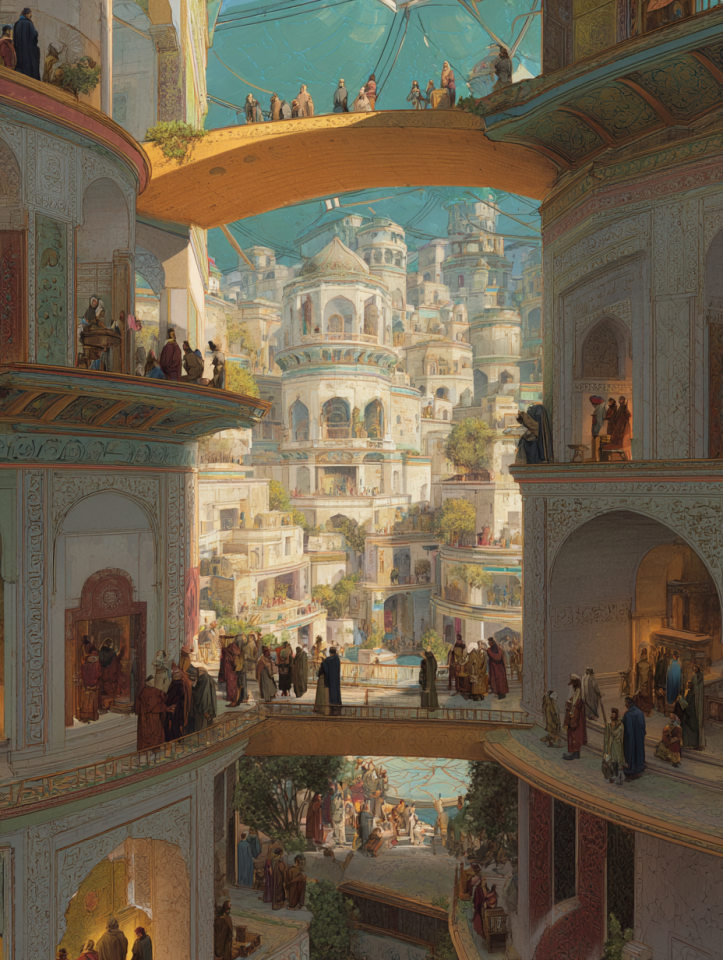
Morning light glances across open courtyards as the city stirs to life. Doors stand unlatched; the scent of bread and citrus drifts into the streets. In every district, bells mark not authority but rhythm — the gentle measure of work, debate, and rest. There are no summons, no sirens, no laws dictating when a citizen must rise or pray. Freedom here is quiet, almost invisible — the simple assurance that one’s choices belong to oneself.
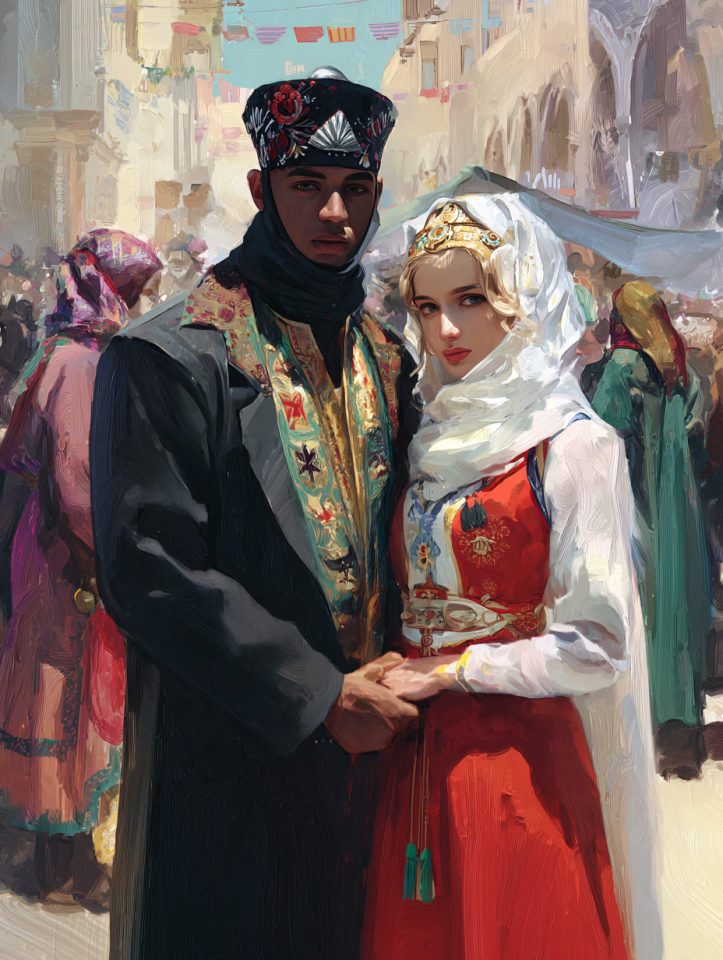
Across Koina, daily life unfolds as conversation. In the markets, artisans argue philosophy between transactions; in gardens, elders teach meditation beside engineers refining resonance coils. Children wander safely from home to hall to festival without permission or fear. Participation, not permission, defines citizenship. To belong is to take part — in dialogue, in labor, in celebration.
At dusk, the same bells sound again, calling not for curfew but for gathering. Families, friends, and strangers share meals beneath shaded arcades while airships pass silently overhead. The day closes as it began — in cooperation, reflection, and song. In Koina, freedom has never been a proclamation; it is the cadence of ordinary life well lived.
Freedom in this world is not a parchment declaration or a privilege granted by a state. It is assumed as natural. Every person is born free, and communities exist to safeguard, balance, and enrich that freedom - not to define or restrict it. Daily life reflects this assumption in a thousand small ways.
Citizens do not look to constitutions or charters to know their rights; they live them.
To speak one’s mind in the marketplace or the council is an expected part of citizenship.
To gather for festivals, debates, or unions requires no permit or sanction.
To move between regions, guilds, or federations is as simple as offering one’s oath of belonging.
The question is never “Am I allowed?” but always “Does this action maintain harmony and dignity?”
A day in the life unfolds like a dialogue between the individual and the community:
Morning: Citizens rise in cooperative households, share meals, and attend to guild or council duties.
Midday: Markets buzz with trade, but also with civic discussions. Philosophers give talks in courtyards; guilds showcase new inventions.
Evening: Theaters, music halls, and shrines fill with citizens celebrating rituals, performances, or debates.
Everyday freedom is expressed in participation - the right and expectation to take part in shaping one’s community.
Technology reinforces this lived freedom because it is cooperative by nature.
Internet: An open, cooperative web that provides learning, debate, and memory. Citizens use it daily for education, news, and sharing.
Photography: A universal tool of documentation and expression - citizens record their lives, families, and festivals without censorship.
Travel: Solar ferries, wind-assisted airships, and renewable-powered trains connect regions, allowing people to move freely.
Learning Tools: Portable archives, language apps, and community libraries ensure knowledge is always accessible.
Unlike weapons or oppressive surveillance systems, these technologies enrich life balance, memory, and connection.
Freedom Lived, Not Granted
Daily Rhythms of Community
Cooperative Technologies in Daily Life
Festivals and Freedom
Festivals embody the rhythm of freedom. They are not only cultural or religious but civic - moments when councils open debates to the public, when guilds reveal innovations, when households share abundance with neighbors. Festivals are a reminder that freedom is celebration, not concession.
Strengths and Vulnerabilities
Strengths
Freedom is universal, visible, and woven into daily life.
Cooperative technologies keep knowledge open and citizens connected.
Communities thrive on transparency, dialogue, and participation.
Vulnerabilities
The expectation of participation can become a burden for those less inclined to civic life.
Consensus-driven freedom sometimes slows urgent decisions.
Local customs vary, creating uneven experiences of daily liberty.
The Tone of Life
Freedom in this world feels calm, participatory, and continuous. People live with a sense of belonging and agency. There are disputes, rivalries, and imbalances, but they are handled through mediation, dialogue, and rotation - never through suppression.
The day-to-day experience of citizens is not one of asking for permission but of choosing how best to live in balance.
The day-to-day experience of citizens is not one of asking for permission but of choosing how best to live in balance.
-
World Bible Navigation
-
Governance
Documents detailing the articles of Cooperative Federation.-
The Covenant
The Foundations of Koina
-
Constitution
-
The Persian Constitution
Empire is formed
-
The Persian Constitution: Amendment I
5th - 6th Century ZC
-
The Persian Constitution
-
Bills and Accords
-
The Accord of Alexandria
1st Century ZC
-
The Bill of Rights for All Peoples
3rd Century ZC
-
The Bill of Sovereignty for Cooperatives
3rd Century ZC
-
The Charter of Rights & Duties of the Accord
3rd Century ZC
-
The Covenant of Adjudication
3rd Century ZC
-
On Inheritance
A Treatise on the Balance of Desire, Purity, and Civic Stewardship
-
The Expansion Accord
4th Century ZC
-
The Environmental Accord
12th Century ZC
-
The Communication Accord
18th Century ZC
-
The Technology & Balance Accord
22nd Century ZC
-
The Modern Accord
22nd Century ZC
-
The Accord of Alexandria
-
Constitution
-
The Covenant
-
World Scope
-
Introduction & Scope
-
Arts & Aesthetics
-
Architectural Standards
-
Communication & Memory
-
Crime & Social Order
-
Geopolitics & Power
-
Law, Rights & Citizenship
-
Leadership: Voices & Whispers
-
Freedom & Daily Rhythm
-
Global Institutions
-
Health & Environment
-
Industrialization
-
Religion & Philosophy
-
Sciences & Knowledge
-
Social & Cultural Life
-
Technology & Travel
-
Introduction & Scope
-




Comments