

Izumi Shikibu and her lovers
Rich poetic accounts of desire, both heterosexual and bisexual.
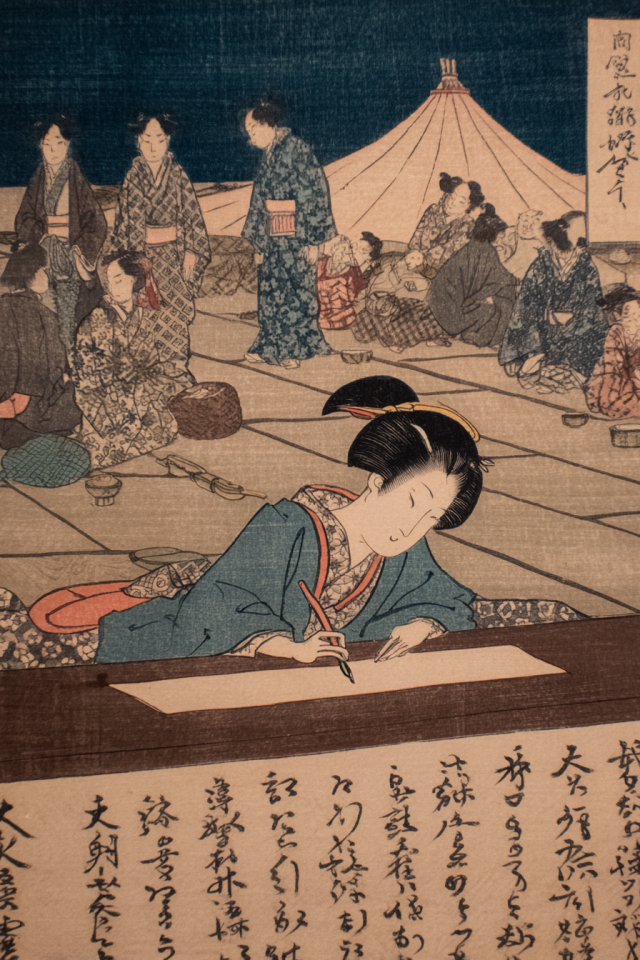
In the refined twilight of the Heian court, where sleeves brushed inkstone and nightingales sang beneath flowering plum, there lived Izumi Shikibu. Her poems burned with longing and sorrow, and her affairs, whispered from screen to screen, made her a legend even in her lifetime.
She first gave her heart to Prince Tametaka. They met in secret, exchanging poems on folded paper slipped through attendants’ hands. His words praised her beauty, her verses answered with passion veiled in imagery of dew and blossoms. Yet their love was fleeting, for Tametaka died young. Izumi’s grief poured into verse:
*If I should live on, / would my sleeves not rot away / with endless tears?*
Her sorrow caught the court’s attention, but grief soon transformed to longing again, for desire was the pulse of her life. In time she found solace in Prince Atsumichi, Tametaka’s younger brother. Their affair scandalized the court — whispers said she courted shame, that her heart was reckless — but their passion gave rise to poetry unmatched in its intensity.
Their exchanges survive: poems of dawn departures, of lamplight flickering in secrecy, of bodies entwined though forbidden by rank and propriety. Izumi wrote of yearning without apology, of nights too brief, of jealousy and devotion in equal measure. Her voice, unashamed, became the voice of countless women who could not speak.
Yet the path of love was never smooth. Atsumichi too died young, and again Izumi’s heart was broken. She wandered through grief and scandal, her name blackened by gossips, but her poems immortalized her. Courtiers might sneer, but they could not deny the power of her words, which captured the fire and fragility of love.
Later she withdrew to Buddhist practice, seeking solace in prayer and reflection. Yet even in her religious verse, desire lingered, now transmuted into yearning for enlightenment. The duality of her life — passion and renunciation — made her a figure both scandalous and revered.
Through Izumi Shikibu the Heian world glimpsed love in its rawest forms: forbidden, fleeting, devastating, and transformative. Her poems are still recited today, a thousand years later, carrying her voice across the centuries: that love, whether for man or woman, prince or monk, is at once peril and salvation.




Comments