


Seongjin of Gaya (SUNG-jin)
First Voice of Joseon
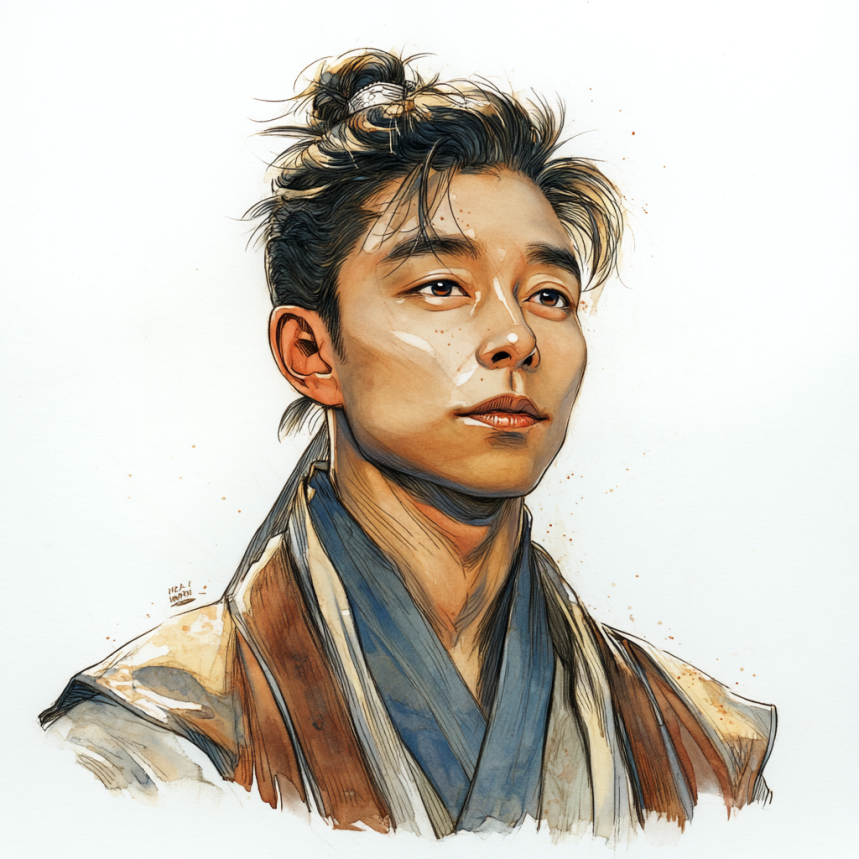
Seongjin was born in the Gaya confederacy, a fertile riverine land nestled between mountains and sea on the Korean peninsula. His people were famed for their mastery of ironwork, crafting blades, armor, and tools that traveled widely across East Asia. His father was a smith of repute, while his mother came from a family of musicians who played in ritual courts. From these two lineages, Seongjin inherited both strength and harmony — a sense that creation was not only the shaping of metal but also the shaping of sound, both requiring discipline and balance.
As a youth, Seongjin showed remarkable aptitude in the smithy, where he learned to temper steel, but he was equally drawn to the quiet of study halls. Monks and scholars who visited Gaya noted his curiosity, for he asked not only how iron was forged but why communities should forge bonds with one another. By his early twenties, he had earned respect as a diplomat between rival Gaya states, mediating disputes with a calm presence and unflinching fairness. Those who knew him described him as “iron tempered by water” — strong yet cool, able to withstand heat without losing shape.
At Antioch, Seongjin was twenty-three, one of the youngest male signatories, yet his words carried the weight of an elder. He likened the Accord to a forge: each culture a different ore, heated together in the furnace of history, hammered not to uniformity but to resilience. His imagery struck deeply, especially among those who had known conquest in the past. He argued that federations must temper conflict into strength, not erase difference. Delegates later recorded that his dignity, paired with a serene smile, made him a figure who could bridge opposing sides without strain.
Returning home, Seongjin became instrumental in strengthening ties between the Gaya states and their neighbors, laying foundations that would later feed into the Joseon identity. He continued to serve as a teacher of both statecraft and craftwork, ensuring that the lessons of the Accord were embedded in guilds and councils alike. He lived into his fifties, succumbing to illness after years of travel, but his name endured as “the Iron Voice,” remembered for showing how strength and harmony could be one and the same.
Previously Held Ranks & Titles
Date of Birth
23 Soma 810 zc (Vidya)
Date of Death
11 Yūgen 864 zc (Mila)
Life
810 zc
864 zc
54 years old
Birthplace
Gaya Confederacy, Joseon
Place of Death
Gaya, Joseon
Children
Belief/Deity
Confucianism + Buddhism + Taoism + Shinto


 Embodies Joseon’s moral-cosmic harmony.
Other Affiliations




Comments