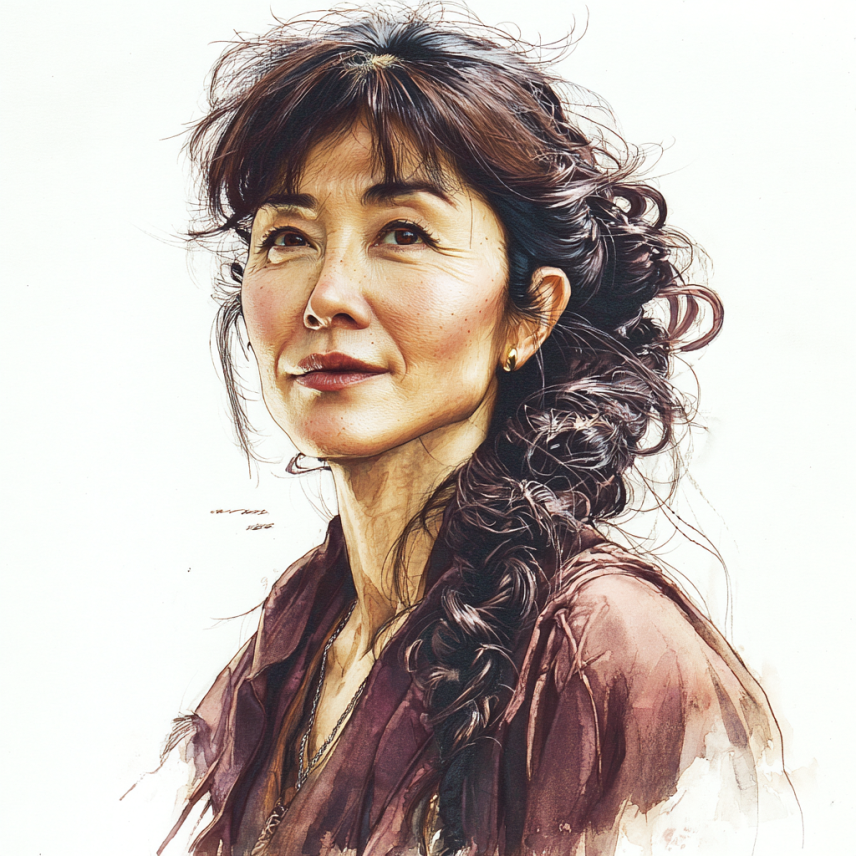
Sohan Yun
Creator of Wind Walkers series
Sohan Yun grew up in the hills outside Linzi, the kind of childhood shaped by long train rides and a grandmother who told stories with the rhythm of someone who expected you to listen closely. Sohan learned early to weave her own tales to fill the quiet spaces, and by the time she was eleven, she had written a short story about a distant people she called the Ánúnachí-soft-spoken watchers who traveled between stars without conquering them.
That early story wasn’t polished, and she never published it, but she kept it. It followed her into adulthood, through university, through her early work as a stage playwright, and finally into parenthood. When her son was young, she began expanding the Ánúnachí idea into bedtime stories: gentle visitors, drifting in and out of human history, curious but never domineering. Her son eventually aged out of the nightly ritual, but she didn’t. She kept writing.
By her mid-forties, Sohan had a reputation for slow, intimate dramas with strong ensemble casts. Producers approached her to develop a long-form speculative series, something future-leaning but emotionally grounded. She returned to the old Ánúnachí notebooks and reframed them for a world that had already experienced public contact with the real Ánúnachí. Instead of reinventing history, she imagined how ordinary people would respond-how they’d explore, question, and try to honor the moment.
She conceived THE WEYD next: a vessel built not from force or hierarchy but from care, curiosity, and the kind of quiet design choices that make long journeys livable. The show centered on the people inside it, not on spectacle. Sohan often said she wanted viewers to “feel the silence before a choice,” and the Weyd’s long corridors became her way of wrapping that silence into the narrative.
During production, Sohan remained deeply involved.
She insisted the Ánúnachí Whisper always be portrayed as a person, never an enigma.
She pushed for the Long Walk to be textured for bare feet.
She kept every planting or seeding scene understated, holding to her belief that the biggest changes happen in stillness.
Her son-now grown-served as an informal early reader on several scripts. He once joked that he had spent half his childhood listening to draft versions of the show before it ever existed.
When Wind Walkers premiered in 2251 zc, Sohan was still surprised by how quickly it found its audience. She had expected a modest viewership; instead, the series shaped an entire era’s ideas about exploration and responsibility. Sohan stayed through all five original seasons and returned to guide the revival as well, though she stepped back enough to let younger writers take the lead.
Today she’s regarded as one of the defining narrative voices of her generation-not because she built a universe, but because she built a story where people tried to meet the universe with care.
Sohan spent the last decade of her life in Pataliputra, the artistic and theatrical center of Āryāvarta. She wasn’t there for fame or industry politics; she moved for the atmosphere. Pataliputra has always been a place where rehearsal halls, film houses, opera stages, and dance schools spill into one another, and she loved being able to walk from a music studio to a writers’ circle to a chai stall without ever losing the thread of an idea.
She hosted workshops for younger writers in a small garden compound not far from the riverside theater district. People who attended those sessions said she was calm, funny, and precise: the kind of elder who listened more than she corrected.
In 2284 zc, after a short illness, she passed away quietly in that same compound - surrounded by her son, a few long-time collaborators from Wind Walkers, and several of her former students who had become like extended family. There was no spectacle, no state ceremony. Her memorial took place in one of the open-air amphitheaters she adored, where music and readings from her early notebooks were performed.
That last choice - readings from the Ánúnachí stories she’d written as a child - was hers.
It’s the sort of ending she would have written for someone else: understated, human, and close to the work.





Comments