



Wind Walkers Starship: The Weyd
The Weyd is the first long-range exploration ship built under the joint guidance of the Wardens and the Ánúnachí visitor who advised on its early resonance systems. It isn’t a battleship or a colony craft; it is a quiet, slow-breathing piece of engineering meant for patient travel, scientific work, rescue operations, and long-form observation.
The Weyd moves with the same calm philosophy that shaped Koina itself. It is not built to dominate space or mark territory. It exists to look, listen, and return with stories. Its design leans toward comfort, reliability, and the sense of “ground” even when the ship is far from any world. From the outside it has a natural curve, a long, tapering form, and a surface that reflects light in soft gradients rather than harsh lines.
Internally, the ship doesn’t feel like a machine. It feels lived-in, gentle on the senses, and spacious enough for people who may spend months or years in transit. Nothing is ornamental; everything is shaped around function and psychological ease.
The Weyd is the backbone of the Wind Walkers series-always present, always steady, always offering another horizon.
Purpose in the Narrative
The Weyd serves as the central stage for the show, the place where relationships grow and the place viewers come to recognize as “home.” Its long arcs of travel give the series a natural pacing: a slow exploration, a thoughtful approach to the unknown, and room for reflection between crises.
In the story, the Weyd symbolizes Koina’s approach to space:
measured curiosity, practical compassion, and a refusal to treat discovery as conquest.
The characters don’t enter space to claim it-they go to understand it.
The Weyd mirrors that philosophy not by speeches, but by design choices: soft lighting, grounded gravity, open walking corridors, nature-imitating quarters, and the absence of rigid militaristic structure.
The ship also allows the narrative to explore cultural exchange. With an Ánúnachí traveler aboard, the Weyd becomes the first shared space between humanity and another species-not a base of operations, but a moving place of learning. The ship itself absorbs this influence: clean lines, resonant architecture, and quiet, harmonic energy integrated into its systems.
Design Philosophy
The Weyd was never meant to look like a machine first. Its design team focused on how people feel inside it, especially on long journeys where isolation can become a burden. The structure blends practical engineering with calm, organic forms that make the interior easy to inhabit.
Surfaces avoid sharp angles and hard metallic finishes. Instead, everything feels softened: curved bulkheads, recessed lighting, textured flooring that grips securely underfoot, and a color palette drawn from stone, leaf, and water. The halls have depth and warmth, never giving the sense of walking through a sterile lab.
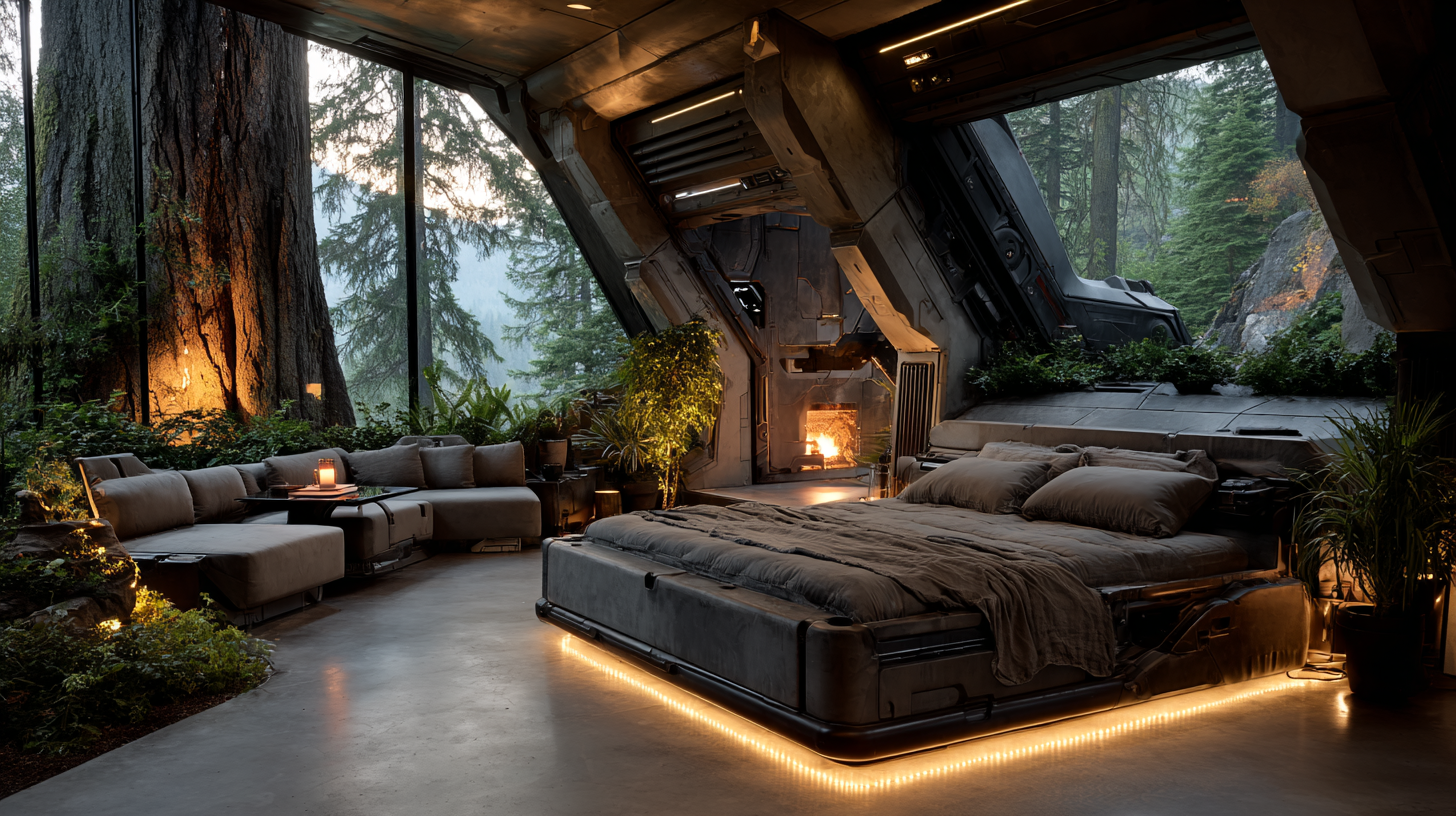
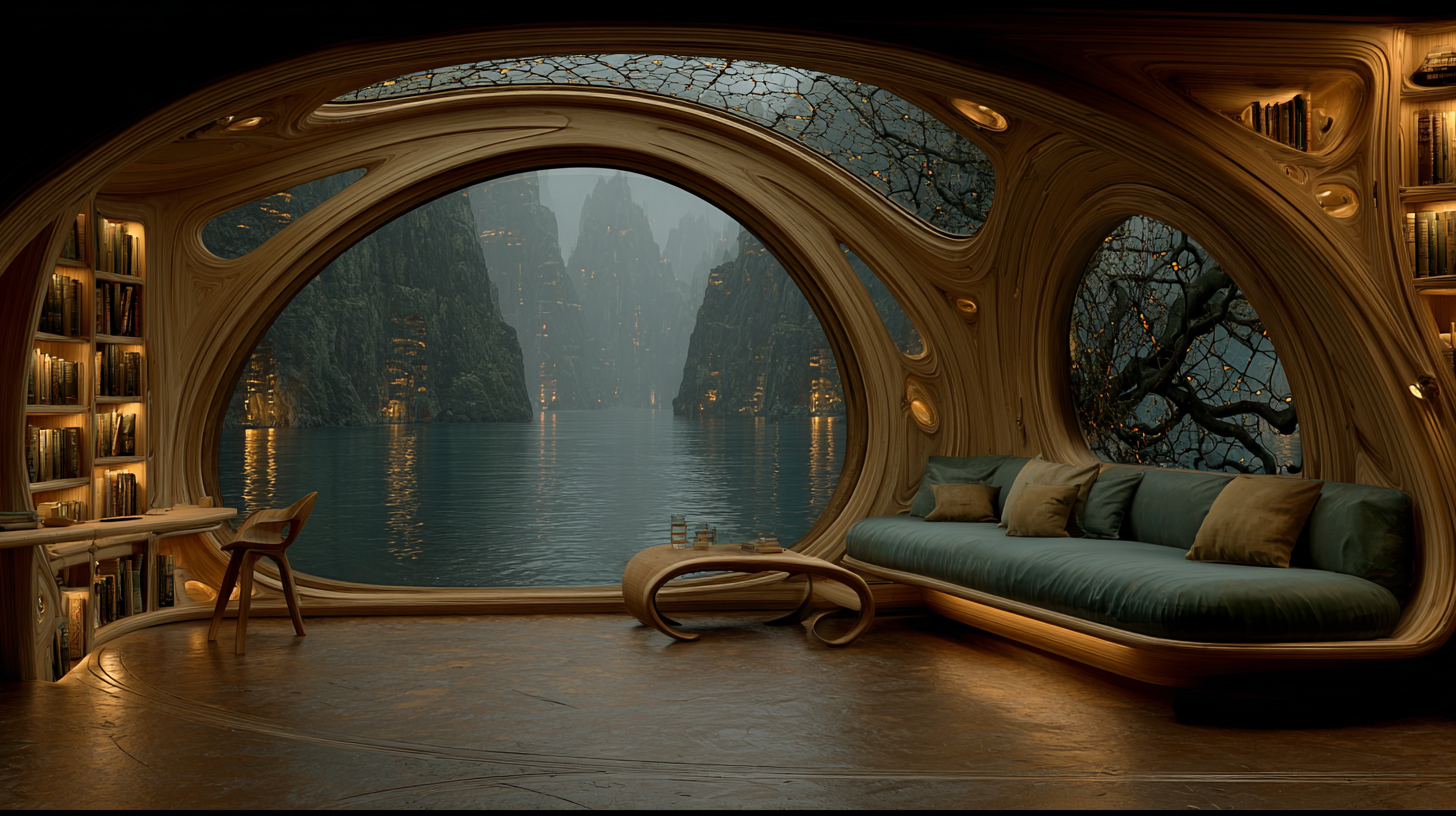
One of the ship’s core principles is psychological grounding. The Weyd gives crew the ability to shape their living spaces through contained holo-architecture. Rooms can imitate forests, riverbanks, quiet deserts, or something entirely personal. These are simulations-not living ecosystems-so they don’t take life from the worlds they resemble, but they still give crew a sensory anchor that wards off the disorientation of deep-space travel.
 The Ánúnachí influence is subtle. Certain support ribs echo their flowing geometric sensibilities. Some resonance panels hum at frequencies that match their comfort range and happen to also be calming to humans. Nothing about the design is ceremonial or overwrought. It simply feels natural, balanced, and patient.
Tools are meant to support the individual rather than dominate them, and the Weyd reflects that value in every line and surface.
The Ánúnachí influence is subtle. Certain support ribs echo their flowing geometric sensibilities. Some resonance panels hum at frequencies that match their comfort range and happen to also be calming to humans. Nothing about the design is ceremonial or overwrought. It simply feels natural, balanced, and patient.
Tools are meant to support the individual rather than dominate them, and the Weyd reflects that value in every line and surface.
Vehicle Specs
Interior Experience
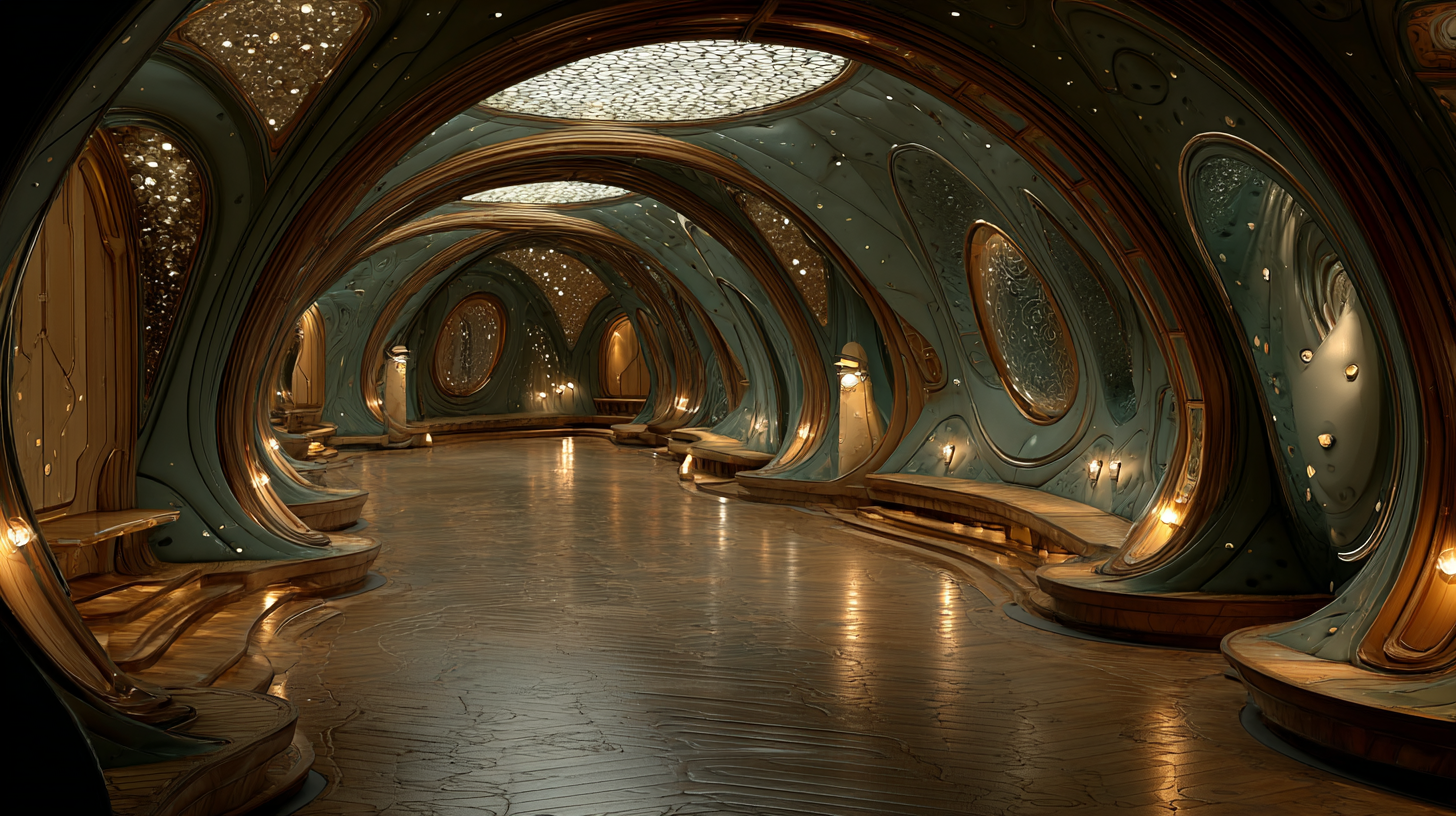
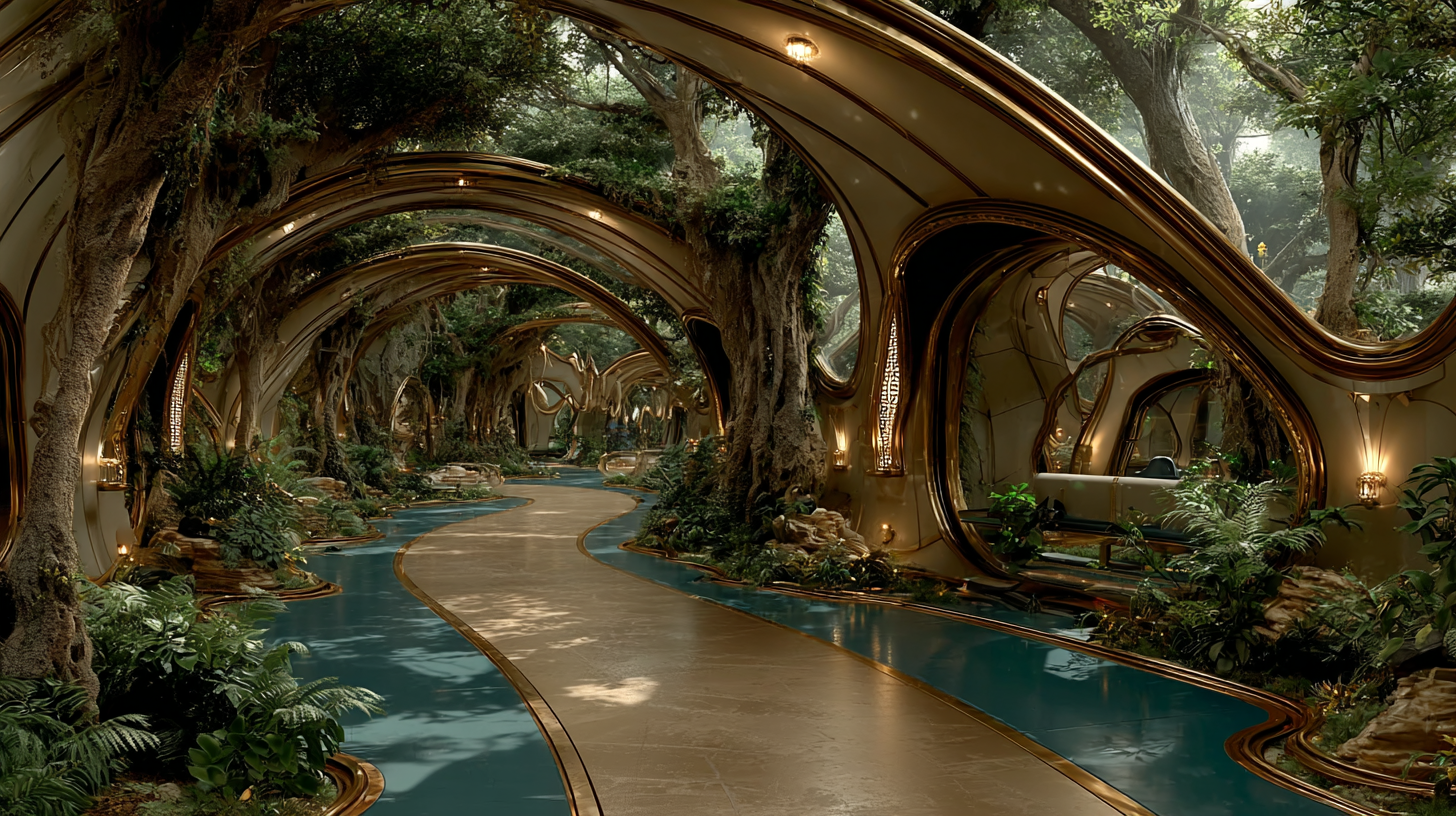
Life aboard the Weyd is spacious without being excessive. Corridors are broad enough for two people walking side by side without feeling crowded. The ship avoids overhead clutter; conduits are recessed and treated so they resemble roots or grain rather than exposed pipes.
The walking track is one of the ship’s most defining features. It runs through the broadest part of the vessel in a gentle loop, with slight atmospheric shifts and textured flooring that encourage barefoot use. Crew members describe it as the place where their thoughts settle. It’s the closest thing to a stroll outdoors without leaving the ship.
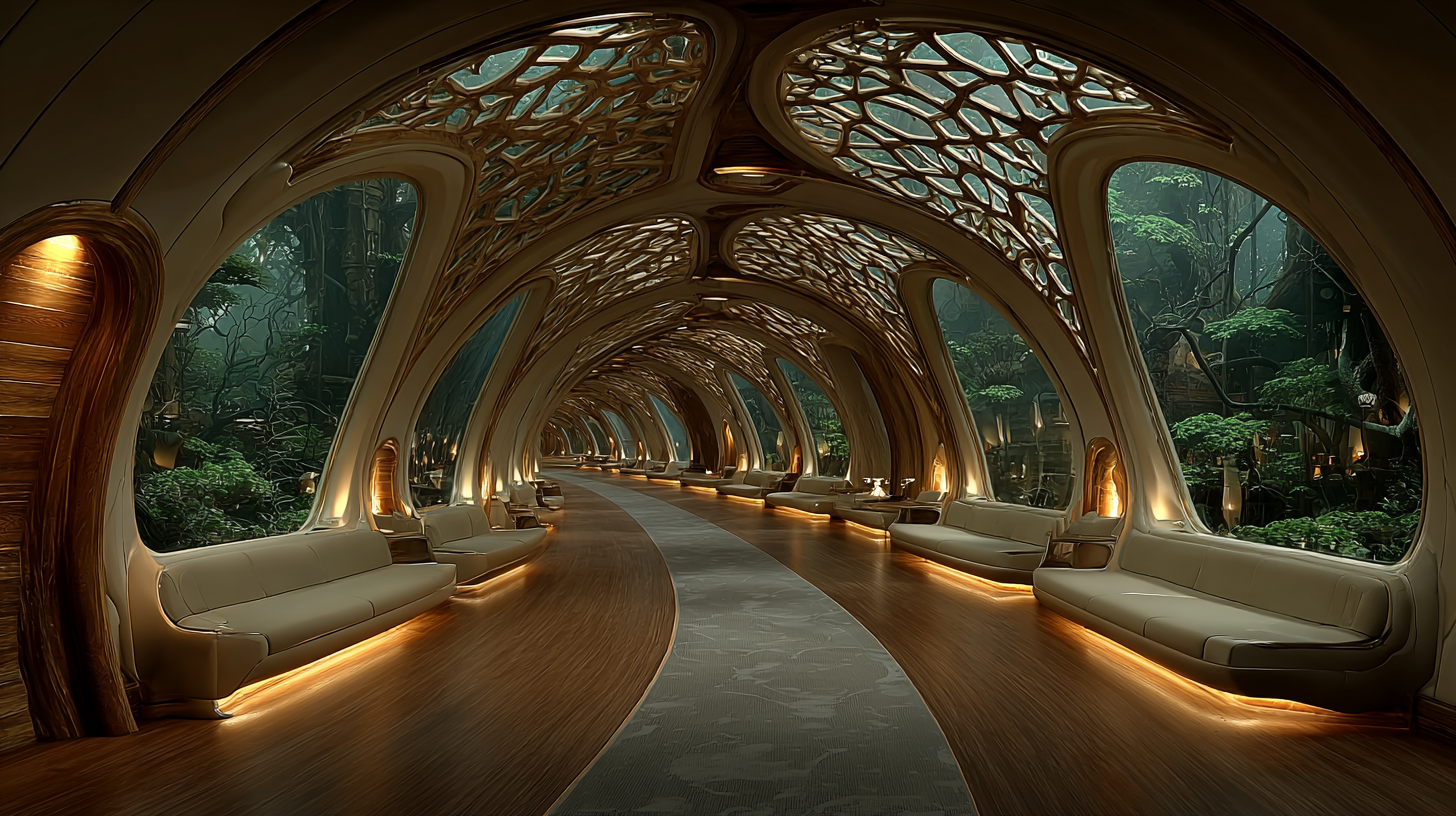 Quarters are personal and adaptable. The holo-surfaces integrated into each room allow for controlled nature projections-trees that aren’t trees, light that feels like dawn but isn’t, the illusion of earth beneath the feet. These projections have weight only where needed; they don’t replace the architecture, they overlay it. A person can tune the intensity from subtle hints to full sensory immersion depending on what they need.
Communal spaces are quiet by design. Lighting stays low and warm, and ambient resonance panels soften echoes so conversations feel private even in shared areas. The workspace hubs are arranged for collaboration without hierarchy-tables, benches, open screens, and a sense of flow rather than division.
Quarters are personal and adaptable. The holo-surfaces integrated into each room allow for controlled nature projections-trees that aren’t trees, light that feels like dawn but isn’t, the illusion of earth beneath the feet. These projections have weight only where needed; they don’t replace the architecture, they overlay it. A person can tune the intensity from subtle hints to full sensory immersion depending on what they need.
Communal spaces are quiet by design. Lighting stays low and warm, and ambient resonance panels soften echoes so conversations feel private even in shared areas. The workspace hubs are arranged for collaboration without hierarchy-tables, benches, open screens, and a sense of flow rather than division.
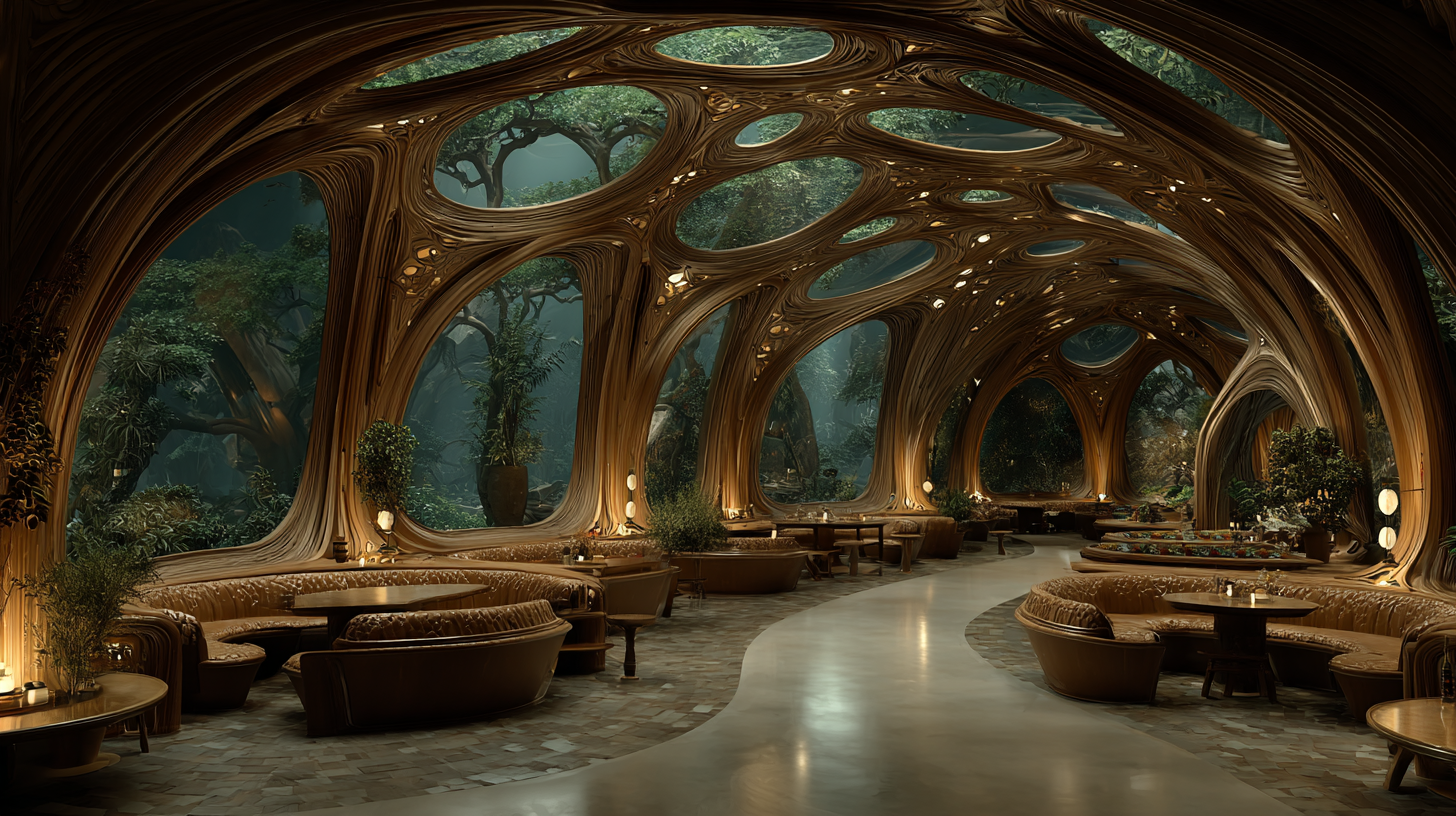 The Weyd doesn’t overwhelm its occupants. It supports them. It carries them without shouting its presence. And over time, even viewers come to recognize it as a character in its own right-a place that listens as much as it shelters.
Navigation & Control Systems
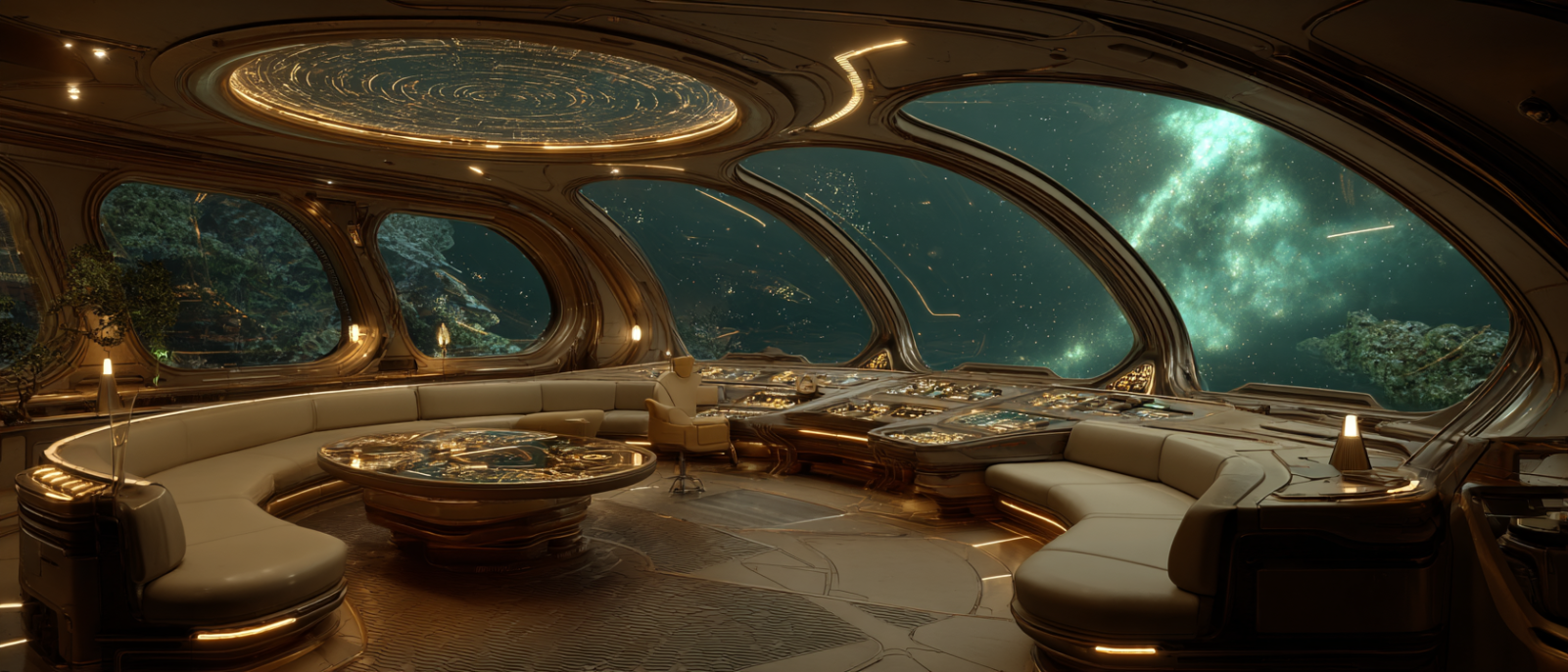
The ship’s command hub sits forward, arranged in a sweeping arc beneath the panoramic main viewport. Every control surface is designed to be readable through both physical and tactile cues: raised patterning, subtle resistance on gesture panels, and soft-lamp indicators that don’t glare even in low light.
Instead of cold interfaces or rigid consoles, the controls resemble a continuous landscape of sculpted surfaces. When active, layers of information rise from the consoles like illuminated topography-lines, points, currents, motion trails-allowing the helm officer to read spatial flow in a single glance.
The Weyd’s guidance system blends human intuition with Ánúnachí insight. Humans navigate through their familiar metrics and projections, while Ánúnachí instruments interpret gravitational tides, trace kinetic echoes, and sense long-range distortions that conventional scans might miss. Neither approach is dominant; the systems are woven together into one coherent sensory field.
At the center of the bridge sits the Resonance Table, a circular map that updates the ship’s real-time position in three layers: navigational drift, stellar activity, and long-range anomalies. Officers gather around it for planning, and viewers see it often-it becomes one of the visual signatures of the series.
There is no captain’s throne. Leadership on the Weyd favors presence over elevation, so the command lead moves among the crew, touching consoles, conferring quietly, relying on instinct and the experience of those around them.
Propulsion & Performance
The Weyd carries two modes of travel: steady motion through conventional engines, and the instantaneous shift created by its Seed Array. The Array doesn’t break space or tunnel through it. Instead, it senses the natural currents that run through spacetime-thin, shifting filaments that can carry a vessel from one point to another in a single step.
To use the Array intentionally, the crew performs a Planting.
Planting is the act of aligning the ship with a filament that reaches the exact destination they’ve chosen. When the alignment matches and the resonance chambers settle into their harmonic pattern, the Weyd steps cleanly from one sky to another. Plantings are reliable and calm, used for missions, rescues, and any travel where timing matters. The moment of transition is brief: a soft vibration underfoot, a breathless quiet, then the view shifting as if the world outside simply changed its mind. The second mode is Seeding, where the crew enters the currents without a mapped endpoint. In Seeding, the Array opens to the nearest active filament and follows wherever it leads. No one controls these currents-not humans, not Ánúnachí, not any species that has yet announced itself. Seeding is unpredictable by nature. The ship might emerge close by, or far from known space, or in regions no chart has ever reached. Despite its uncertainty, Seeding is one of the reasons the Weyd exists. It lets the crew find places that no one planned to discover, places that would remain invisible without the drift of the currents. The experience on board is gentle even when the result isn’t: a low harmonic hum, a subtle pressure in the ribs, then the sudden stillness of arrival. The Array is stable and redundant. If its resonance fails, the Weyd can still navigate by its conventional engines. But for long journeys and true exploration, planting and seeding are what set the ship apart-not speed, not force, but the quiet ability to follow the deeper patterns of the universe.
Planting is the act of aligning the ship with a filament that reaches the exact destination they’ve chosen. When the alignment matches and the resonance chambers settle into their harmonic pattern, the Weyd steps cleanly from one sky to another. Plantings are reliable and calm, used for missions, rescues, and any travel where timing matters. The moment of transition is brief: a soft vibration underfoot, a breathless quiet, then the view shifting as if the world outside simply changed its mind. The second mode is Seeding, where the crew enters the currents without a mapped endpoint. In Seeding, the Array opens to the nearest active filament and follows wherever it leads. No one controls these currents-not humans, not Ánúnachí, not any species that has yet announced itself. Seeding is unpredictable by nature. The ship might emerge close by, or far from known space, or in regions no chart has ever reached. Despite its uncertainty, Seeding is one of the reasons the Weyd exists. It lets the crew find places that no one planned to discover, places that would remain invisible without the drift of the currents. The experience on board is gentle even when the result isn’t: a low harmonic hum, a subtle pressure in the ribs, then the sudden stillness of arrival. The Array is stable and redundant. If its resonance fails, the Weyd can still navigate by its conventional engines. But for long journeys and true exploration, planting and seeding are what set the ship apart-not speed, not force, but the quiet ability to follow the deeper patterns of the universe.
Crew Roles Aboard the Weyd
The Weyd doesn’t run on a rigid hierarchy. Its crew is small enough-often fewer than thirty-that every person knows the others by name, habit, and rhythm. Roles exist, but they overlap naturally. People step in where they’re skilled, or where they’re needed.
First Voice
The person guiding each mission or voyage. This isn’t a traditional captaincy; they oversees direction, safety, and decision-making but moves among the crew rather than presiding from a raised seat. Leadership is conversational, collaborative, and grounded in trust. Resonance Officer
Responsible for monitoring the Seed Array and the local currents of spacetime. They read the harmonic panels, interpret filament activity, and help determine whether planting or seeding is safe. Their work is quiet, technical, and intuitive. Ánúnachí Whisper
A full member of the crew with their own perspectives, not a guest or an overseer. They sense filament behavior in ways humans can’t, offering early warnings or subtle adjustments. Some days they’re silent; some days they talk at length about currents, memory, or the way distance “feels.” Their presence stabilizes the Array and, at times, the people. Navigator
Works alongside both the First Voice and the Resonance Officer to plot routes, check alignments, and ensure that plantings stay true. Navigators also handle conventional flight paths when the ship travels under normal thrust. Stewardship Team
The group that maintains the ship’s interior well-being-air quality, food systems, shared spaces, holo-architecture calibration, and overall comfort. On long journeys they’re the heartbeat of the ship, keeping people grounded and spaces running smoothly. Sciences & Field Specialists
Researchers, surveyors, or analysts depending on the mission. They study new regions, collect samples, evaluate phenomena, or respond to crises. Because the Weyd can carry evacuees, specialists often shift into humanitarian roles as needed. Systems & Structure Crew
Engineers, technicians, and craftworkers who maintain the propulsion systems, energy lines, and environmental control. They know the Weyd’s sounds the way some people know a friend’s voice-what’s normal, what’s off, what’s “thinking too hard.” Most crew can take multiple roles. Exploration demands adaptability, and the ship is built for people who can shift with the needs of the moment.
The person guiding each mission or voyage. This isn’t a traditional captaincy; they oversees direction, safety, and decision-making but moves among the crew rather than presiding from a raised seat. Leadership is conversational, collaborative, and grounded in trust. Resonance Officer
Responsible for monitoring the Seed Array and the local currents of spacetime. They read the harmonic panels, interpret filament activity, and help determine whether planting or seeding is safe. Their work is quiet, technical, and intuitive. Ánúnachí Whisper
A full member of the crew with their own perspectives, not a guest or an overseer. They sense filament behavior in ways humans can’t, offering early warnings or subtle adjustments. Some days they’re silent; some days they talk at length about currents, memory, or the way distance “feels.” Their presence stabilizes the Array and, at times, the people. Navigator
Works alongside both the First Voice and the Resonance Officer to plot routes, check alignments, and ensure that plantings stay true. Navigators also handle conventional flight paths when the ship travels under normal thrust. Stewardship Team
The group that maintains the ship’s interior well-being-air quality, food systems, shared spaces, holo-architecture calibration, and overall comfort. On long journeys they’re the heartbeat of the ship, keeping people grounded and spaces running smoothly. Sciences & Field Specialists
Researchers, surveyors, or analysts depending on the mission. They study new regions, collect samples, evaluate phenomena, or respond to crises. Because the Weyd can carry evacuees, specialists often shift into humanitarian roles as needed. Systems & Structure Crew
Engineers, technicians, and craftworkers who maintain the propulsion systems, energy lines, and environmental control. They know the Weyd’s sounds the way some people know a friend’s voice-what’s normal, what’s off, what’s “thinking too hard.” Most crew can take multiple roles. Exploration demands adaptability, and the ship is built for people who can shift with the needs of the moment.
Notable On-Board Spaces
The Long Walk
A broad, looping corridor running through the center of the ship. Its textured floor is designed for bare feet, and its light adjusts with each person’s presence. It’s where crew think, talk, or clear their minds. Even viewers come to associate it with quiet turning points in the story. The Forest Gallery
A holo-architecture space that can create the feel of a modest woodland, shoreline, glade, or other natural setting-never a full ecosystem, never life in captivity. It’s a comfort space, not an illusion of wilderness. The projection is gentle, never deceptive. The Rez Table
Located in the command hub, this circular mapping surface displays the Weyd’s position within local space, active filaments, stellar hazards, and other environmental data. It’s the center of every planning session and one of the ship’s signature visuals. Private Quarters
Personal spaces that adapt to each occupant’s needs. Surfaces take on projections or environmental cues without pretending to be the real thing: warm dawn light, a hint of trees, a remembered courtyard, or a simple expanse of quiet color. The settings help regulate stress during long voyages. Communal Hall
Not a formal dining room-more a shared hearth space. Low tables, warm lighting, and an open layout. Crew gather here to eat, swap stories, and decompress after difficult missions. It’s the emotional anchor of each day. Observation Niche
A small alcove with a wide, curved viewport. Not the grand sweep of the bridge, but a more intimate space where one or two people can watch stars drift past or think through decisions in silence. Seed Array Chamber
Deep in the ship, accessible only to trained crew. It houses the resonance chambers that read spacetime filaments and prepare the ship for planting or seeding. The room hums softly even at rest, a subtle vibration felt more than heard. Viewers often recognize this sound as the prelude to major discoveries.
A broad, looping corridor running through the center of the ship. Its textured floor is designed for bare feet, and its light adjusts with each person’s presence. It’s where crew think, talk, or clear their minds. Even viewers come to associate it with quiet turning points in the story. The Forest Gallery
A holo-architecture space that can create the feel of a modest woodland, shoreline, glade, or other natural setting-never a full ecosystem, never life in captivity. It’s a comfort space, not an illusion of wilderness. The projection is gentle, never deceptive. The Rez Table
Located in the command hub, this circular mapping surface displays the Weyd’s position within local space, active filaments, stellar hazards, and other environmental data. It’s the center of every planning session and one of the ship’s signature visuals. Private Quarters
Personal spaces that adapt to each occupant’s needs. Surfaces take on projections or environmental cues without pretending to be the real thing: warm dawn light, a hint of trees, a remembered courtyard, or a simple expanse of quiet color. The settings help regulate stress during long voyages. Communal Hall
Not a formal dining room-more a shared hearth space. Low tables, warm lighting, and an open layout. Crew gather here to eat, swap stories, and decompress after difficult missions. It’s the emotional anchor of each day. Observation Niche
A small alcove with a wide, curved viewport. Not the grand sweep of the bridge, but a more intimate space where one or two people can watch stars drift past or think through decisions in silence. Seed Array Chamber
Deep in the ship, accessible only to trained crew. It houses the resonance chambers that read spacetime filaments and prepare the ship for planting or seeding. The room hums softly even at rest, a subtle vibration felt more than heard. Viewers often recognize this sound as the prelude to major discoveries.
Legacy, Meaning & Cultural Place in the Series
The Weyd isn’t written as a symbol of power. It’s a symbol of what people do when they finally have room to wonder. In the show, its long silhouette and quiet interior become shorthand for a kind of hope that isn’t loud or triumphant - it’s patient, curious, and willing to step into the unknown without claiming ownership of what’s found.
Its first missions after public contact with the Ánúnachí set the tone for the entire series. The Weyd isn’t out to plant flags or build outposts. It explores because understanding matters, and because the universe is broad enough that humility becomes a navigation skill.
Viewers latch onto the Long Walk immediately. Something about a corridor meant for bare-footed thinking resonated beyond the story. Fans talk about how the scenes filmed there capture the closeness of a small crew working through decisions that don’t have right answers - just thoughtful ones.
The Forest Gallery became another icon. Not because it was flashy, but because the show never used it to trick the audience: it’s always clear this is a comfort space, a way to breathe, something earned rather than conjured. Its simplicity - a glade, a shoreline, sometimes just the sense of a breeze - says more about the characters than any spectacle.
And the Seed Array, with its low hum and the quiet, breath-held moment before planting or seeding, quickly became the show’s signature sound. Fans swear they can “feel” it in scenes where big decisions hang in the air.
The Weyd doesn’t fight. It doesn’t posture. It doesn’t dominate a frame. It moves with intent and curiosity, carrying a crew that’s learning who they are by stepping into places no one mapped ahead of time.
In the show’s lore, it marks the moment when exploration stopped being a story about claiming space - and became a story about meeting it.




Comments