Justan Augustor
Founder of The Pale
(a.k.a. The Restorer, Justinian, Augustus)
In the lecture hall at Veroi he once held a thousand minds in silence. The man who taught logic as compassion’s twin ended his life preaching obedience as salvation. When the torches of the First Illumination burned through the marble tiers, Justan Augustor stepped into the smoke and was not seen again. To the Pale, he ascended; to history, he dissolved into myth—the scholar who made order divine.
Early Life and Education
Born into a declining noble house of the Maritime League, Justan grew up among the monuments of forgotten empire. His father was a registrar of trade, his mother a translator in the League’s archives. From childhood he absorbed languages and hierarchies in equal measure, fluent in both the dialects of commerce and the rhetoric of command. At the Academy of Linzi he studied comparative philosophy, excelling in Aristotelian logic and Stoic ethics. His early papers argued that compassion and reason were “two vectors of the same harmony.” Professors praised his brilliance but warned of his “hunger for closure.” He detested ambiguity; debate unsettled him not for its conflict but for its lack of finality.The Scholar’s Discontent
By thirty, Augustor was already celebrated as an arbiter in inter-guild disputes. His eloquence brought him close to councils yet never within them. Watching Voices and Whispers rotate in orderly succession while corruption persisted beneath courtesy, he began to equate humility with deceit. In essays later banned across the Federations—*The Fatigue of Reason* and *The Burden of Mercy*—he accused Koina’s scholars of “confusing harmony with paralysis.” The turning point came when a League excavation unearthed fragments of early Pauline correspondence and imperial decrees from the lost Latin archives. Where others saw relics of theological history, Augustor saw an antidote to moral entropy: a worldview in which obedience created peace and hierarchy guaranteed truth.Revelation and the First Illumination
For years he lectured privately on these recovered doctrines, re-casting them as universal philosophy. The more the academies censured him, the more disciples he gained—students, bureaucrats, and minor nobles who mistook his precision for prophecy. At forty-three, he convened them in the abandoned amphitheater of his birthplace, beneath the fractured statues of forgotten rulers. There he delivered *The Concord of Iron*, a manifesto blending Pauline submission, imperial rhetoric, and his own moral geometry. He proclaimed that “The Light does not reason—it commands.” Witnesses described a night of torches, chants, and oaths sworn on mirrored blades. This event became doctrine as *The First Illumination*, marking the birth of what would later be called the Pale Faith.Doctrine and Decline
For seven years after the Illumination, Augustor’s influence spread through salons and lecture halls rather than temples. He codified his teachings into *The Book of Radiant Law*, arguing that mercy was a corruption of justice and that hierarchy was the universe’s native shape. Councils banned his work; collectors preserved it in secret. His final recorded sermon, *The Second Order*, urged the faithful to “burn away the plural” and “speak in one voice.” Days later, the amphitheater at Veroi burned; hundreds died, and Justan Augustor vanished. Whether he perished in the flames or withdrew to write in seclusion became one of the faith’s enduring mysteries. The Pale canonizes him as *ascended in light*.Legacy
Within decades, his disciples re-interpreted his treatises as scripture. The movement metastasized into creed, turning philosophical rhetoric into ritual law. Every Pale hierarchy traces its lineage to one of the Twelve Speakers who survived the Illumination, each claiming personal instruction from Augustor himself. To his adherents, he is the divine legislator who restored humanity’s purpose—to rule, to order, to fear. To later historians, he is the cautionary archetype of intellect without empathy: the man who proved that reason, untethered from compassion, inevitably seeks a throne.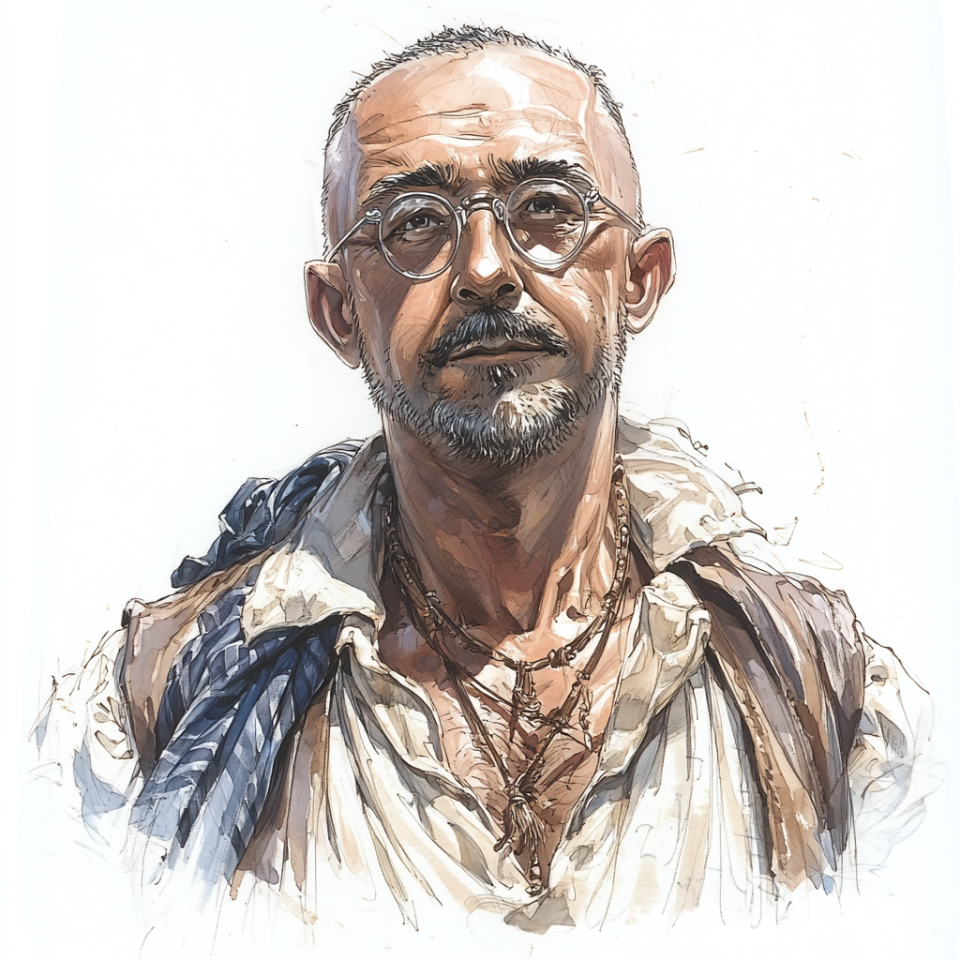
Date of Birth
19 Vahana 2089 zc
Date of Death
Disappeared c. 7 Sankofa 2145 zc
Life
2089 zc
2145 zc
56 years old
Circumstances of Death
Last seen at Veroi Amphitheater just before it burned
Birthplace
City of Veroi, Hellas/Pārsa border
Place of Death
City of Veroi, Hellas/Pārsa border
Children
Belief/Deity
The Pale Founding figure of the Pale faith.




Comments