

The Monkey King and the Kingdom of Women
Where compassion and desire meet, and even vows learn to bow before love.
The road west unspooled beneath them like a pale ribbon, slipping over the backs of hills and down into a valley veiled in white breath. The air grew soft, a balm on blistered feet. Peach boughs leaned over the path, dusting the pilgrims with petals the way a kindly hand straightens a traveler’s collar. Wukong padded ahead, staff balanced across his shoulder; Pigsy’s rake chimed faintly with each step; Sandy’s tread was steady as a metronome. Tripitaka’s lips moved with sutras, but his eyes lingered on the mist that rose and fell like a sleeping creature.
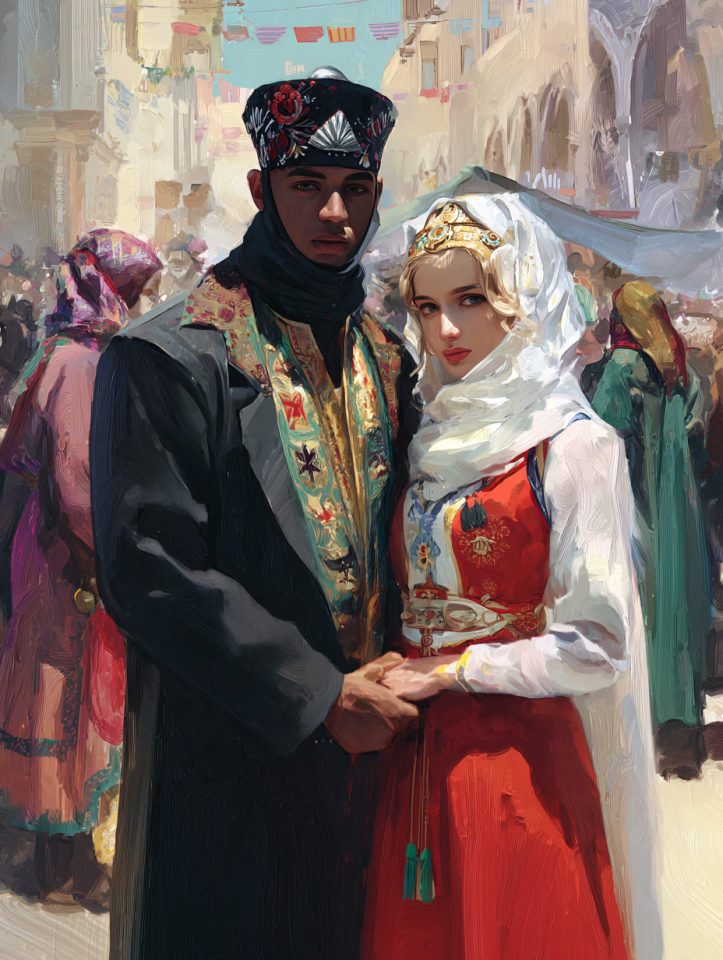
They crossed a narrow bridge. On the other side stood women—farmers with wicker hats, scholars in pale robes, soldiers in lacquered cuirass—faces clear as spring water, brows set with the calm of people who fear nothing that breath can name. No boys tugged at hems. No old men played at dice. Even the beasts were mares and hens, does and ewes. The travelers bowed. The women bowed back, not in submission, but in greeting, as if saying: we see you; we are seen.
“Where there are no men,” Pigsy whispered, “who eats the last dumpling?”
“Where there is discipline,” Wukong murmured, “no one fights over dumplings.”
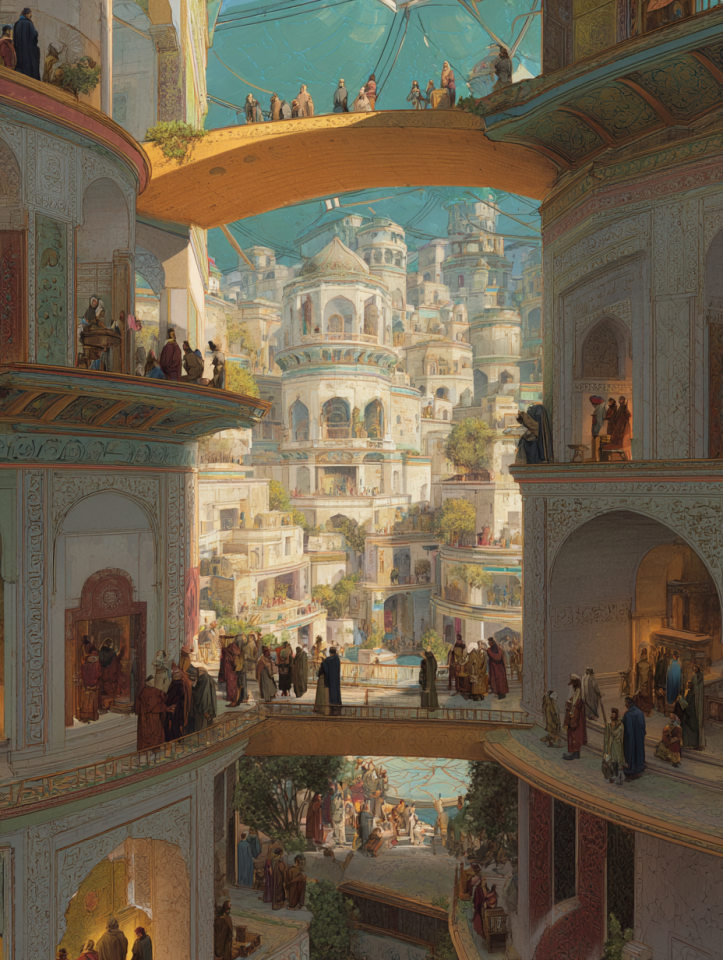
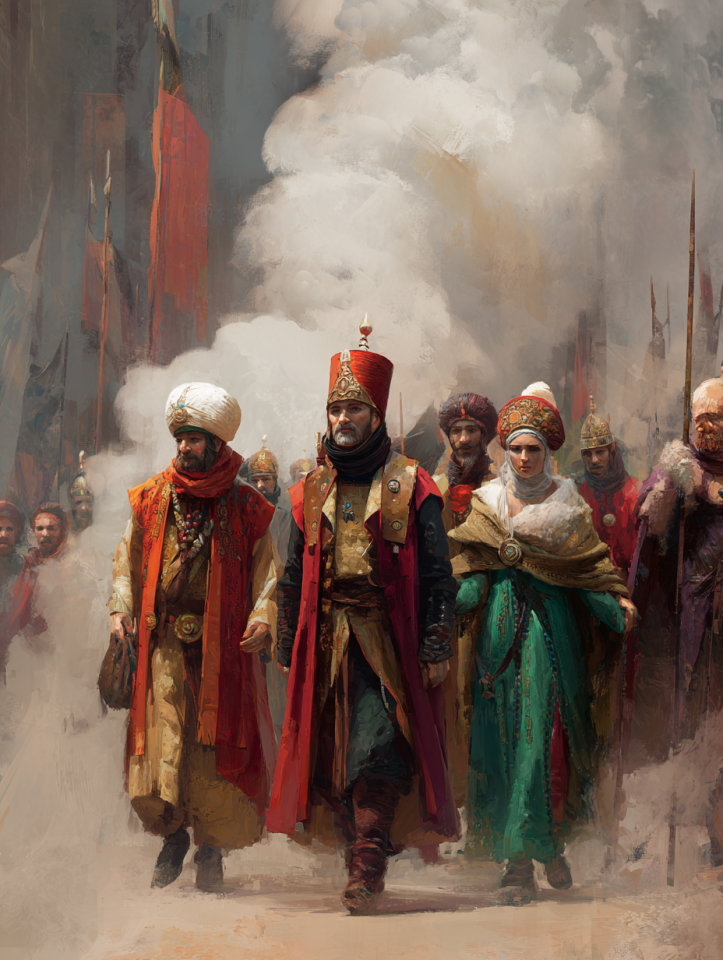
They were brought into a city of red and white stone, its lanes stitched with canals of milk-pale water. Silk banners floated from eaves—lotus, cloud, and river signs repeating in patient rhythm. At the heart of the city a palace rose like a folded fan, each tier draped with gauze that breathed when the wind did. The throne room smelled of sesame and river silt. The Queen entered without trumpets. She wore no crown, only a single pin of white jade, and the room adjusted itself to her presence the way a room brightens when a window is opened.
“You come from beyond the passes,” she said, voice like the rim of a bowl struck lightly. “From a world of stories we teach our daughters.”
Tripitaka stepped forward. “We are pilgrims, Your Majesty. Our teacher seeks scriptures from the Western Heaven. We ask shelter for the night and leave at dawn.”
“Then you have walked far.” The Queen’s gaze held Tripitaka’s for a beat that contained both curiosity and the courtesy not to pry. “We will shelter you. We will feed you. And you will drink from our river.”
Sandy’s brows twitched. Wukong tilted his head. The ministers beside the throne—women of ink-stained fingers and calloused palms—exchanged glances.
One stepped forward and spoke. “Our kingdom thrives by the Mother River, whose water is our womb. We drink once each year when the peach blossoms open. Those who drink bear daughters. Thus it has been since our founding.”
Pigsy made a soft choking sound. Wukong hid a smile in his sleeve. Tripitaka’s palms came together in a bow. “The world abounds in wonders,” he said. “It is good to be reminded.”
They were lodged in chambers braided with screens and perfumed reed mats. Servants laid out bowls of rice porridge with ginger, grilled greens, lotus seed cakes. Pigsy ate as if the word “tomorrow” had been outlawed. Wukong watched the courtyard where girls practiced spear drills, each thrust a line of calligraphy drawn on air. Sandy washed the dust from his robes and sat with his back straight, listening to the water mutter through its channels like an old friend recounting the weather.
At dusk the Queen walked the gardens alone. The guards fell back as a tide recedes from polished stone. She paused beneath a lantern, where carp stitched gold threads through the pond, and sent for Tripitaka. He came with modesty, hands folded at his belt.
“I would hear of the outer world,” she said. “Do men still wrangle with the sky? Do they still promise the earth and plunder it?”
Tripitaka lowered his eyes. “Men do as beings do. Some are kind. Some are not. The sky pays no bribes. The earth keeps her counsel. We learn, we err, we learn again.”
“And love?” Her smile was not shy; it was careful, like a bridge builder testing her own work. “Is it as fickle as the wind there? Or does it sit like a stone in the river, worn but unbroken?”
“Love,” he said slowly, “is many-handed. It can feed or it can bind. We vow to carry compassion beyond our own wanting.”
She studied him. “If a vow is a lamp, who tends its flame when the wind rises?”
He had no ready answer. The silence between them was not empty; it was a field at night, crickets working, dew forming, the slow labor of living. Wukong was already there, though neither had seen him come—disguised as a garden guard, eyes bright as a star seen out of the corner of one’s eye. He recognized the shape of the Queen’s question. He recognized the shape of Tripitaka’s heart before the monk did.
Morning brought the Festival. The city gathered along the Mother River, its surface like beaten silver. Priests in garments the color of dove-bellies carried carved cups whose rims were dragons biting their own tails. Girls laughed, mothers adjusted their daughters’ collars, elders smoothed stories with their hands. The Queen drank last. Before she did, she lifted an extra cup and offered it to Tripitaka.
“Not to bind you,” she said, “but to honor you. To say: you have been seen.”
The river caught a cloud and returned it as a lotus on the cup’s surface—stroke for stroke, a painter’s seal. Pigsy leaned into Wukong’s shoulder. “Omen?”
“Omen,” Wukong said.
Tripitaka bowed over the cup. He did not drink. The Queen did not insist. Between refusal and acceptance they made a small bridge and met in the middle, standing there as if on a balcony overlooking the same view.
That night, the Queen visited his chamber. She came without drums, without perfume thick enough to drown an answer. She sat on the edge of the mat with hands open on her knees.
“I have ruled without husband or consort,” she said. “I have been enough for my people and they for me. We have loved in ways the world beyond our borders calls improper: mother to daughter, friend to friend, woman to woman, not for lack but from fullness; devotion where it is found, not where law commands. We do not explain this to anyone. We do not apologize. We do not close our doors to love when it knocks, even if we do not have a name ready for it.”
Tripitaka listened, the words crossing the dark between them like boats with lamps at their prows.
“If harmony is truth,” she went on, “why must celibacy be its price?”
He breathed once, twice. “Because my vow is my path. But my path is not a law to others. Where love is honest, where it harms no one, compassion can only widen to hold it. I do not understand all forms as those who live them do. But encountering, I bow.”
She closed her eyes a moment; when she opened them, there was no plea in them, only gratitude for a thing named. “Then let it be said,” she murmured, “that when love passed by, we did not draw the curtains for fear it would not fit the furniture.”
On the terrace outside, Wukong turned his face to the lanterns. “Even the strictest gate,” he said to the night, “opens to a true knock.”
Morning again, and the council chamber was full. Ministers spoke for caution, for curiosity, for the safety of custom, for the grace of change. One scholar unrolled a scroll and read the oldest lines the kingdom kept: In the beginning, when men and women tangled without wisdom, the river flooded with tears; when they parted without mercy, the fields cracked with loneliness. So the mothers chose a single path and walked it well. The Queen listened. She looked no more burdened than a tree looks when birds land in it.
At last she rose. “To discover is not to seize,” she said. “To bless is not to bind. We will not keep guests with a golden chain. We release with gifts, which is the same as hospitality but turned outward.”
She accompanied the pilgrims to the valley’s edge. The mist there had thinned, as if the valley were exhaling slowly. She held out a small crystal vial, stoppered with wax.
“Should you pass through a land where women are forgotten,” she said to Tripitaka, “pour this on the earth and remember us. It will make a small spring. Someone will find it.”
Tripitaka took it with both hands. “I will remember,” he said. “Not as an anchor, but as a star.”
Pigsy, whose attention to ceremony was generally proportional to the number of pastries served, dabbed at his eyes with the back of his sleeve. He raised his own travel flask, sloshed it, and swallowed before anyone could caution him. A heartbeat later he stiffened, patted his belly with horror, and emitted a sound between a gasp and a squeal.
“Master,” he moaned, “I think I’m with child.”
Sandy sighed, a patient bellows. Wukong doubled over, laughter falling out of him like coins from a slit purse. The Queen’s shoulders shook; she kept her face composed with a hero’s effort and pressed a small candy into Pigsy’s palm. “Plum-salt,” she whispered. “For the nerves.”
They walked until the city was a line in the distance and then a guess. The road found its ribbon again. Petals clung to their hems and refused to be brushed off, as if still deciding whether to stay in the valley or learn the outer world’s weather.
For a long time no one spoke. Tripitaka’s beads clicked softly, like rain that has not decided whether to fall. At last he said, “Compassion is not a fence.” No one asked what he meant; they had been there too.
“Master,” Wukong said lightly, but his eyes were clear, “even a mountain learns a river’s language if they sit together long enough.”
“Then I am a very slow mountain,” Tripitaka replied.
“Slow is steady,” Sandy offered.
“Steady is boring,” Pigsy muttered, but he took smaller steps, as if not to jostle some imaginary child.
Above them, Guanyin watched with the thinnest smile, as one smiles to see a knot give under gentle fingers. The Queen returned to her city and sat in her garden where lanterns treated the air kindly. She felt no lack. Love had come to her gate, and she had met it standing, neither clinging nor closing. On the far road, a monk carried a vial that would become a spring in a dry place, and that was also a form of love.
The valley exhaled once more and the mist rose like a curtain at the end of a play. The pilgrims stepped into the next scene.
They did not quicken their pace. The West was where it had always been. The heart, a little wider, made the road feel shorter.
Related Organizations




Comments