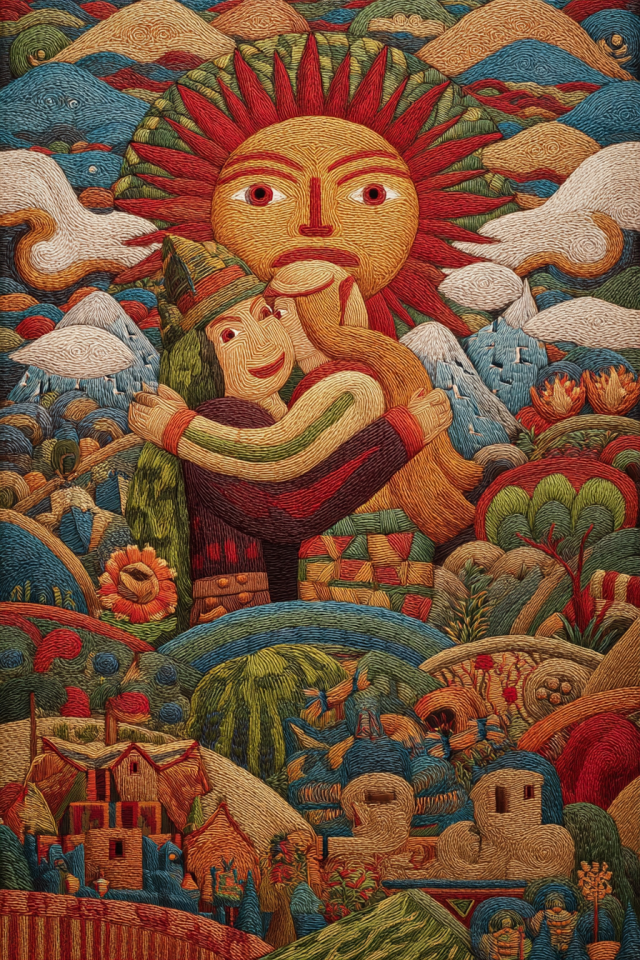
Inti and Pachamama
Sun and earth deities tied to ecological stewardship.
In the high Andes, where snow gleams eternal and valleys fall deep, the people looked upward each dawn and saw Inti rising. He was the sun, lord of warmth, father of harvests, his face a disc of gold. Without his light, the maize would wither, the llamas falter, and frost would devour the fields. So they gave him temples clad in gold, reflecting his brilliance, and offerings of chicha and llama fat, so that his journey across the sky would never falter.
Beneath their feet lay Pachamama, the ever-present earth. She was the soil beneath terraces, the springs that flowed from mountain sides, the womb in which seeds took root. She was gentle in her bounty yet stern in her demands, for those who took without reverence found their fields barren. To her the people poured libations before planting, buried coca leaves in her honor, and whispered prayers before cutting the first furrow.
Together Inti and Pachamama were not rivals but partners. His warmth entered her body, and she brought forth the green shoots. His rays fell upon her slopes, and she yielded maize, potatoes, and quinoa in abundance. He was father, she was mother, and humankind were their children, charged to live in ayni — reciprocity — with both.
Legends told that Inti once sent his son, Manco Cápac, and his daughter, Mama Ocllo, to emerge from the waters of Lake Titicaca. Bearing a golden staff, they wandered until it sank into the fertile soil of Cusco. There they founded the city, teaching the people laws, weaving, and agriculture, all under Inti’s blessing and Pachamama’s care. Thus the Inca traced their line not to conquest, but to divine parentage in harmony with earth and sky.
Festivals rose in their honor. At Inti Raymi, the great festival of the sun, golden vessels overflowed with offerings, and priests greeted the dawn with chants, calling the sun back from the longest night. For Pachamama, every planting season was sacred, each furrow a prayer, each harvest a thanksgiving. The people knew that to honor one was to honor both, for sun without soil was barren, and soil without sun lay cold.
Yet balance could be broken. Droughts came when Inti’s gaze seemed turned away, or earthquakes shook when Pachamama stirred in anger. These were reminders that stewardship was never passive: humans must give as they take, honoring the cycles that sustained them.
So the Inca remembered: Inti upon his golden throne, Pachamama in her fertile valleys, their union the heartbeat of the Andes. To this day, when Quechua farmers pour chicha into the earth before drinking, or when they raise their faces to the dawn, they echo the oldest story — that sun and earth are not distant gods, but parents still, watching and sustaining, so long as their children live in respect.




Comments