Uumarnituq and Aakulujjuusi
Inuit Creation Story — Northern Expanse
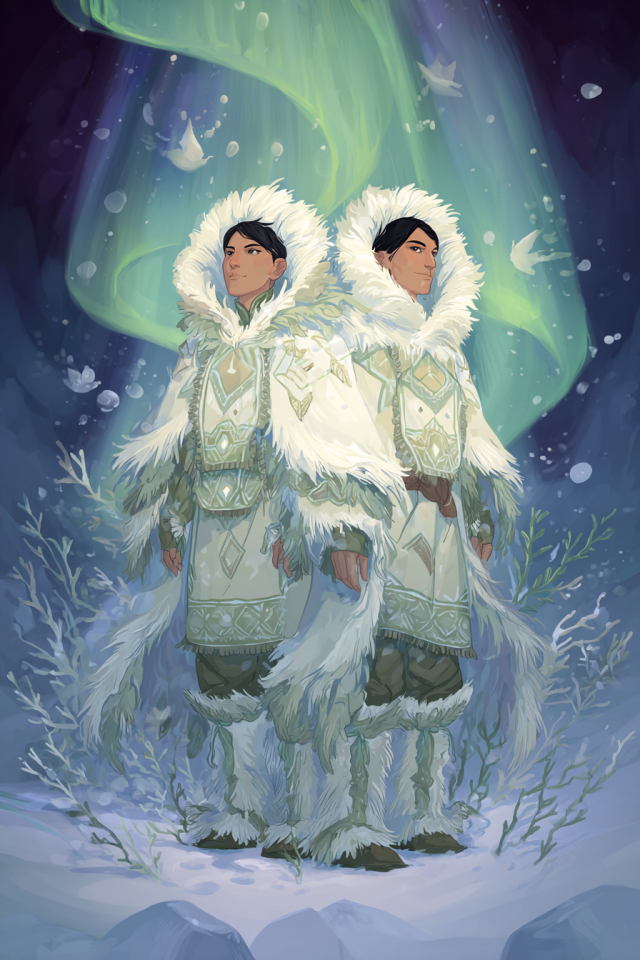
Before there was speech or the sound of the sea, the land was asleep beneath its blanket of frost. Mountains lay buried in silence, the air unmoving, the waters sealed under ice. The world existed, but it did not yet know itself. Then, from the frozen clay, two shapes began to stir — not from above, but from within. Slowly, the earth exhaled, and two beings rose: Uumarnituq and Aakulujjuusi.
They were not born of parents or gods, but of the land’s own breath. They rose damp with soil and glittering frost, and where their hands pressed the earth, the snow melted. They looked upon one another and understood that they were the same — living, aware, and utterly alone. They had no hunger, no cold, no death; only curiosity. They touched the mountains and felt their pulse. They breathed upon the ice and watched it weep into rivers. Wherever they walked, the world quickened beneath them.
Together they explored the empty land. Aakulujjuusi taught the seals to swim and the caribou to run. Uumarnituq called the birds from the sea’s horizon and gave them flight. When the sun moved across the sky, they learned its path; when it disappeared, they listened to the darkness and learned its patience. For an age they wandered without fatigue or fear, two beings in harmony, neither male nor female, existing as one voice spoken in two tones.
But the world remained quiet. No laughter echoed against the cliffs, no footprints followed theirs. Uumarnituq felt a hollow within — not pain, but a recognition that creation was unfinished. The land itself seemed to sigh, urging continuation. Aakulujjuusi, the maker of life, placed a hand upon Uumarnituq and said, “If the world is to live, one of us must change.”
Uumarnituq lay upon the ground and let the transformation come. The body shifted, bones softened, breath deepened, and warmth spread where before there had been stillness. Uumarnituq became female, bearing the power to nurture and continue what had begun. It was not an act of loss, but of balance — a choice that joined them forever in the rhythm of becoming.
In time Uumarnituq conceived, and from her body came the first children, the first humans of the earth. They were small and fragile, uncertain of their strength. Aakulujjuusi shaped shelters from stone and taught them to honor the winds. Uumarnituq nursed them and taught them the names of things: snow, hunger, joy, light. Together the pair watched as the children grew and learned to build fires, to fish beneath the ice, and to walk across the tundra without fear.
When their numbers increased, the children spread out — some following the migration of whales, others venturing into the interior where the caribou roamed. Uumarnituq and Aakulujjuusi guided them as they departed, though the parents knew they would fade into story. Before they withdrew, Uumarnituq spoke: “The land is not apart from you. It is your flesh and your breath. When you forget this, the ice will close again.”
And so they stepped beyond sight, back into the living earth that had birthed them. But their presence endured. Hunters still felt Aakulujjuusi’s guidance in the rhythm of the sea and the patience of waiting for a seal’s breath. Mothers still carried Uumarnituq’s endurance in the pain of birth and the strength to protect what lives. Their story was told not to worship them, but to remember what they taught: that creation is an act of transformation, and that gender, shape, and spirit are the language of balance, not boundaries.
When the northern lights move across the winter sky, it is said that they are the memories of Uumarnituq and Aakulujjuusi — the earth and breath intertwined, dancing in colors of life renewed. Their names endure not as gods but as ancestors of motion itself: one who became two so that the world could be many.
Related Locations
Related Organizations




Comments