


The Second Birth of Gede Nibo
Laughter learns to speak the language of grief.
They said he was beautiful before the veil ever claimed him—Nibo, the boy with laughter for hands and rhythm in his bones. He was a maker of songs, a teller of stories, the kind who drew people in simply by existing. One loved him for his fire, a man whose eyes caught every spark he threw; another loved him for his gentleness, a woman who sold ribbons and tied his hair with a violet strip each time he passed. Between them, Nibo lived as though he could make a whole world between two heartbeats.
But beauty in the living world is as fragile as breath. A blade found him one festival night, sharp and quick, and the ground took him before morning came. The city buried him in a corner where the grass was left wild. The woman came by day, bringing her ribbons and her prayers; the man came by night, bringing rum and a silence so full it cracked the stones. Their mourning ran side by side until it braided itself into one sound—a song too full of love and confusion for the world to bear quietly.
And so Nibo rose. Not as flesh, but as wind, smoke, and salt tears. He wandered among his own grave and those beside it, calling out for the lovers who would not let him go. His crying mixed with their songs until no one could tell whose grief it was anymore. On the night when the veil between worlds thins and the dead lean close to listen, the gates creaked open and a scent of rum, earth, and tobacco rolled through the dark.
From that scent came a figure tall and smiling, his hat wide enough to shade a secret. He looked like laughter made solid, like someone who had seen everything and chosen to dance anyway. He leaned against the gatepost, a cigar glowing between two fingers. “Eh, ti frè,” the stranger said. “You sing so loud even the quiet spirits cover their ears. Why do you haunt your own grave?”
Nibo bowed his head. “Because they grieve,” he said. “The woman ties her heart into ribbons, the man buries his in rum. They loved me without shame, and the world shamed them for it. I cannot leave while their tears make rivers through the dust.”
The stranger puffed once, the ember lighting the grin beneath his hat. “Then you are already halfway to my trade. I am the one who keeps the gates. I make room for laughter where there was only wailing. Tell me, what would you do with such a gift?”
“I would ease the living and the dead,” Nibo said simply. “I would show them that love—any love that harms no soul—is not a curse to bury.”
The Baron—though he never gave his name—studied him, amused and moved at once. “That is a tall wish for a boy cut down too soon. But the gates are wide for those who still love the world. Drink.”
He handed Nibo a gourd of dark liquid that smelled like earth after rain. “If you drink, you will never again be one thing only. You will walk in laughter and sorrow both. You will remember every young soul who died before their dance was finished. And you will help them finish it.”
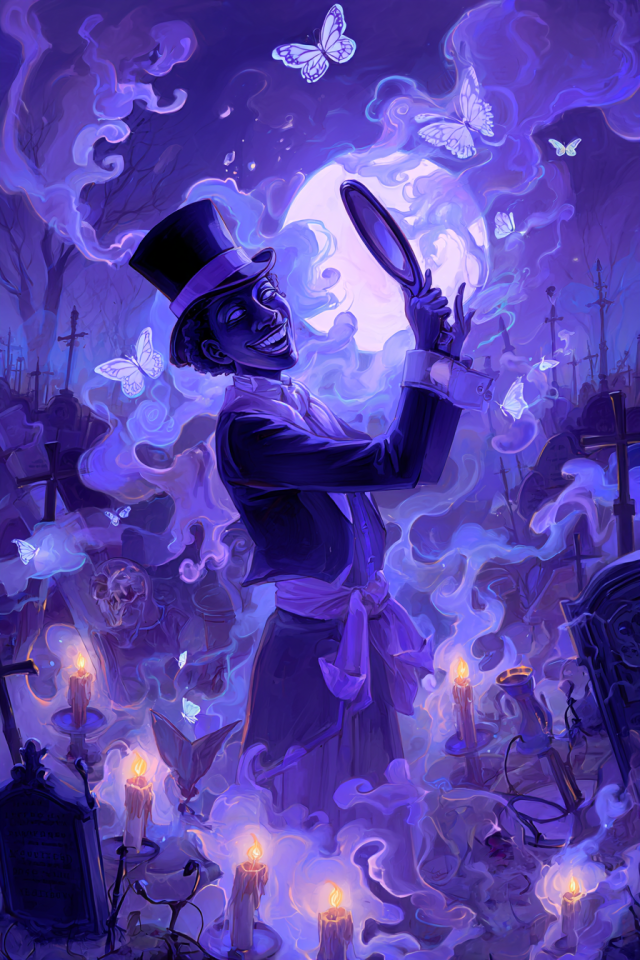
Nibo drank. Fire and sweetness ran down his throat, but when he exhaled, the smoke curled into violet butterflies that settled on every stone. The Baron clapped his hands once. “Then walk as Gede Nibo. When you see a woman tying ribbons to the wind, dance beside her. When you see a man weeping over another man’s name, light a candle in his laughter. When shame tries to bury love, dig it out and make it sing.”
So Gede Nibo walked the night. He learned to balance on the edge of sorrow until it bent toward joy. His clothes shimmered violet and black, his laughter carried through the graves like a song half-remembered. He kept a mirror in one hand, to show mortals their true faces, and a cigarette in the other that never went out. He whispered jokes to mourners until they smiled through their tears, and he mocked hypocrisy until even the priests laughed behind their hands.
On the day when the veil thins each year and the living set food for the dead, the lovers came again. The woman found a violet butterfly resting on the cross; the man felt a breath at his ear and heard a familiar chuckle. They looked at one another and began to dance, slow and unashamed, until dawn turned the air gold. Behind them, the grass swayed though there was no wind.
Since then, the keepers of the graves say that when mourning grows too heavy to bear, a young spirit in violet steps through the gates. He carries rum and laughter, touches the hearts of those who think love is forbidden, and reminds them that even death cannot silence tenderness. His smoke tastes of tears turned sweet. His mirror shows no judgment, only truth. And when he laughs, the whole cemetery blooms.
That is why, on the nights when the veil is thinnest and candles flicker without cause, people leave a ribbon, a mirror, or a swallow of rum at the gate—not out of fear, but out of gratitude. For Gede Nibo walks still, the Beautiful Dead, teaching that love does not end; it only changes its doorway.
Related Organizations




Comments