League of Translators & Observatories
Custodians of Language and the Skies
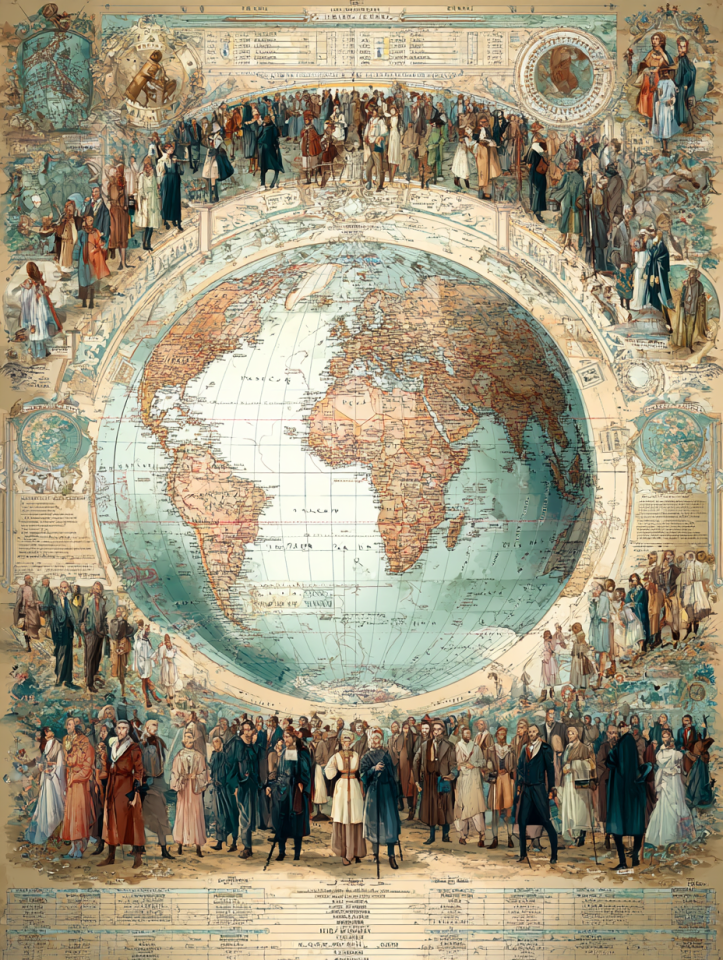
In the courtyard of an observatory, a scholar tilts her head skyward while a companion bends over parchment. One traces constellations, the other drafts their names in three scripts at once. Behind them, apprentices compare dialects by lantern light, debating how to capture the rhythm of a word spoken in the Andes with the characters of the Sinosphere. The air carries the quiet murmur of dozens of tongues woven together, each voice both unique and intelligible.
At dawn, towers hum as resonance signals carry messages across federations. Translators review them in relay halls, ensuring that words arrive unaltered, stripped of bias or distortion. Across the plaza, astronomers chart the rising sun, aligning calendars used by farmers, sailors, and healers alike. Language and stars - one anchoring human connection, the other cosmic rhythm - together form the League’s twin pillars of trust.
Festivals of speech and sky punctuate civic life. On such nights, citizens gather in plazas where stories are told in many tongues and observatories open their domes for all to see. The stars overhead remind them that understanding one another is not a matter of convenience but of survival.
Translators - Masters of multilingual lexicons, grammars, and dictionaries.
Lexicon Keepers - Archivists who update living repositories of vocabulary and meaning.
Signal Stewards - Overseers of resonance transmissions across federations.
Astronomers - Charting stars, planets, and celestial cycles for calendars and navigation.
Cartographers - Mapping lands and seas, translating terrain into shared reference.
Chronologers - Maintaining timekeeping systems that align festivals, trade, and agriculture.
Origins & Purpose
The League emerged when early federations realized that mistranslation was as dangerous as war, and that competing calendars could unravel agriculture and trade. From Persia’s royal scribes to Hellenic astronomers, traditions converged into a cooperative system of translators and sky-watchers. Their shared mandate: to preserve clarity of language and unity of time.
Its purpose is twofold: to ensure communication across diversity and to maintain harmony with celestial cycles. By anchoring human affairs in shared lexicons and common skies, the League prevented rivalries from escalating into conflict, making dialogue and balance possible even in times of strain.
Major Specialties
Organization & Practices
The League trains apprentices in both language and observation, insisting that words and skies are equally vital forms of order. Translators work in teams to compare texts, ensuring no single interpretation dominates. Astronomers rotate between observatories, carrying findings across federations to prevent regional bias in calendars.
Council sessions are marked by ritual readings - the same treaty spoken in multiple tongues, the same constellation described by different traditions. Disagreement is expected, even welcomed, but every debate ends with a consensus draft recorded in archives accessible to all. This transparency is the League’s greatest safeguard.
Contributions & Influence
The League made possible the Net of Voices, where multilingual communication flows without monopoly. Its translation protocols ensure that speeches in the Grand Assembly are heard clearly across federations, while its observatories provide the data that keep calendars in sync and navigation reliable.
Beyond practical matters, it nurtures cultural confidence. Poems translated across three languages, maps shared between mountains and islands, and calendars harmonized across traditions reinforce the conviction that plurality is strength, not weakness.
Role in the Accord
The League is both archivist and interpreter of the Accord. Its members draft treaties, maintain linguistic parity, and ensure that no federation is silenced by language. Observatories, meanwhile, act as neutral grounds for negotiation - a temple to the stars where disputes yield to cosmic perspective.
At the Grand Assembly, translators sit at the heart of debate, their voices carrying reason across cultural divides. Astronomers provide the calendars that structure civic life. In both roles, the League sustains the dialogue and rhythm upon which the entire Accord rests.




Comments