
Guild Congresses
Regulators of Standards and Shared Knowledge
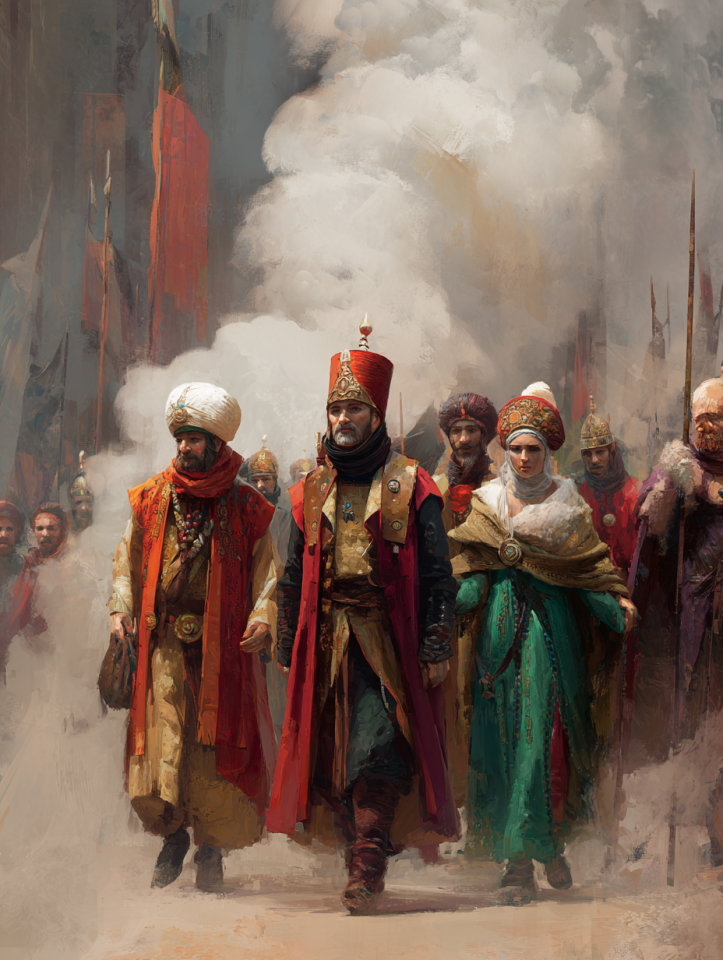
In a grand hall lined with banners, artisans, farmers, healers, and builders gather around a hexagonal table. Each delegate brings an emblem of their craft - a woven cloth, a clay vessel, a vial of medicine, a compass scratched in slate. They place these objects in the center, not as trophies but as reminders of the lives depending on their deliberations. Debate rises, not over wealth or conquest, but over measures, safety, and truth.
Outside, citizens wait eagerly for news of rulings. A weaver wonders if new dye standards will make fabrics last longer in sun; a mason anticipates safer scaffolding practices; a healer expects approval for a new method of sterilizing tools. The Congress’s verdicts ripple outward into daily life, touching every home, workshop, and street.
When agreement is reached, the decision is marked by a shared seal impressed on parchment and stone. This emblem, instantly recognizable, is more than authority - it is assurance that all who trade, build, or heal may do so with trust.
Artisan Delegates - Representatives of weaving, ceramics, metalwork, and fine arts.
Agricultural Councils - Coordinators of irrigation, seed preservation, and food safety.
Medical Envoys - Healers and watchmen bringing practices for approval and refinement.
Builders’ Representatives - Architects and engineers ensuring safety in design and construction.
Philosophical Advisors - Mediators trained to align practice with balance and civic ethics.
Standard Keepers - Archivists maintaining codified measures and seals of legitimacy.
Origins & Purpose
The Guild Congresses emerged when the proliferation of specialized guilds threatened to fragment standards. To ensure consistency without empire, federations called for periodic gatherings where guilds could present practices, resolve disputes, and align methods.
Their purpose is clear: to standardize where cooperation demands it, while preserving the diversity of local craft. From textiles and weights to medicines and irrigation, the Congresses prevent imbalance by providing common measures that enable plural societies to remain interconnected.
Major Specialties
Organization & Practices
Each Congress convenes at rotating intervals, hosted by different federations. Delegates are selected from guilds based on prestige, expertise, and accountability to their peers. Sessions are recorded in multiple languages by League translators to prevent misinterpretation.
Practices include open demonstrations, where delegates test materials and methods before all. A new alloy is hammered, a new fabric dyed, a new surgical tool sterilized, all under collective scrutiny. Consensus is not assumed but forged, and once reached, sealed as binding standard across federations.
Contributions & Influence
The Congresses underpin Koina’s cooperative economy. They made possible the seamless flow of goods by ensuring that a measure of grain or length of cloth is identical from one coast to another. They improved safety by mandating protocols for builders, healers, and artisans alike.
Their influence extends into cultural trust. Citizens know that guild-marked goods meet standards, reducing fraud and fostering honor. Over centuries, this has created a culture where cooperation is assumed, and quality is an expectation rather than a gamble.
Role in the Accord
The Guild Congresses provide technical backbone to the Accord. Their rulings equip the Grand Assembly with the confidence that treaties can be enacted across federations without confusion. By presenting codified measures, they ensure that ideals of cooperation are realized in practical, everyday life.
At assemblies, their representatives often speak briefly but decisively, offering standards that bridge cultures. Their presence reminds all that without common measures, even philosophy falters. The Guild Congresses thus stand as silent architects of trust, invisible yet essential.

Type
Guild, Professional




Comments