

Republic of Kaisa
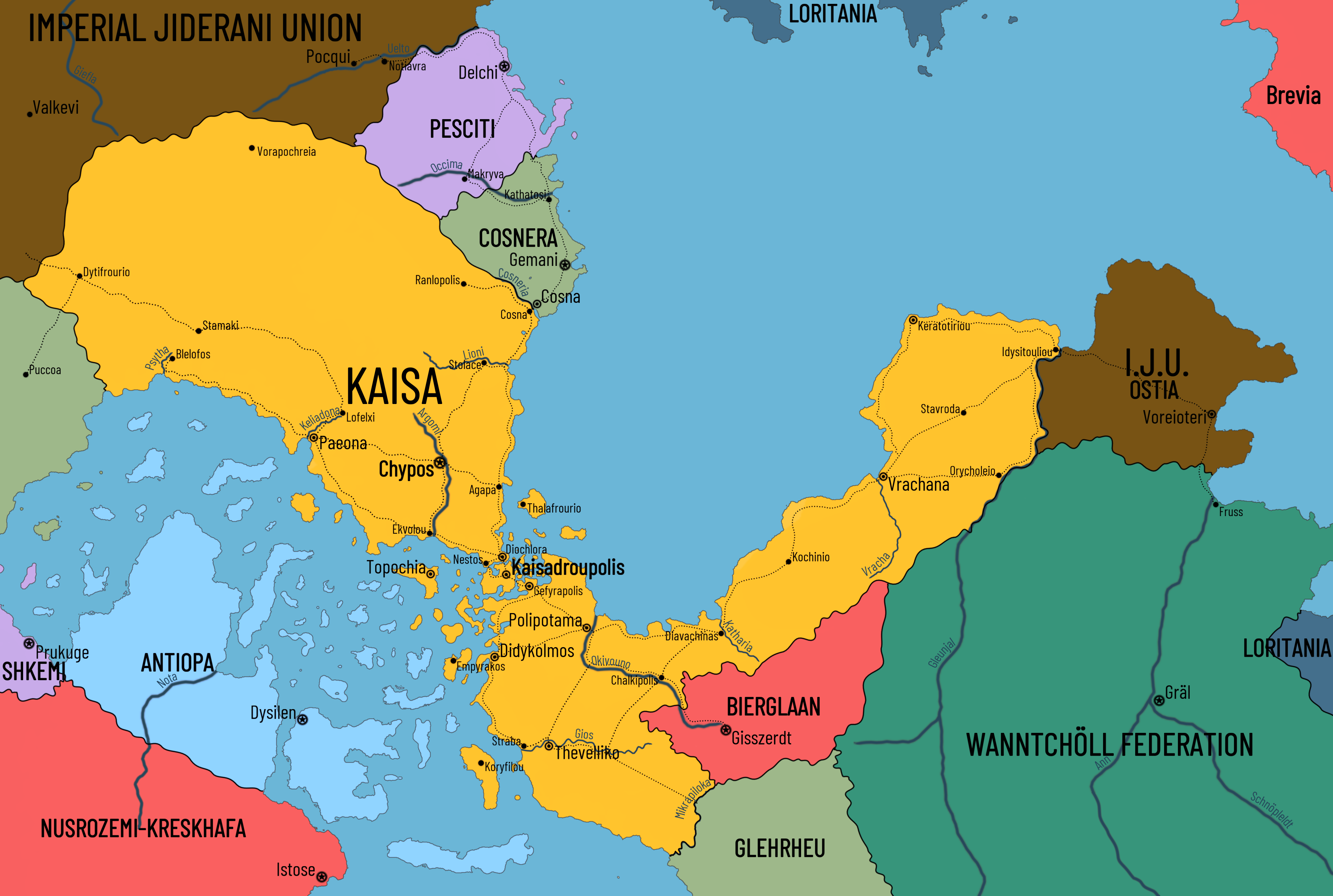
The Republic of Kaisa is an authoritarian republic on the Gafinou Peninsula, between eastern Jideran and western Vieluesse. With its overseas colonies of Kaisan Eaorma and Kaisan Kriehehrdtia, it is one of the largest nations of Duurn by territory, even after the loss of a significant portion of that territory following the Last War. For a long time, Kaisa was seen as a major world power, with an enormous amount of economic and cultural power backed up by one of the strongest militaries across Duurn.
However, the cultural capital of Jideran now teeters at the brink of total collapse. With negotiations to end the disasterous Last War barely over, Kaisa has been left reeling. It was forced to take on significant economic reparations and cede colonial territory in Eaorma, as well as territory in Occima and Ostia. This in addition to the lingering economic downturn from the Red Week and the devastation wrought by the war has left Kaisa in a very precarious situation. Much of its armed forces are still in a state of mutiny, after refusing to continue to fight, and the forces loyal to the Kaisan state are hard at work attempting to maintain control. The Daffodil Revolution is breaking out, the second revolution in as many decades.
Kaisa has been home to some of the most renowned artists and scientists in history, especially in Kaisadroupolis, its capital. Located on the Jideran side of the Kelfidroga Strait, Kaisadroupolis is a city of artists and philosophers. In modern times, it is a hub of the Protoporia art movement and the transcendentalist philosophical movement. In the academic sphere, the Kaisan Academy of Metanatural Philosophy, the foremost institution for the study of metaphysics and transcendental mechanisms, is located in Kaisadroupolis. Its reputation as a nation at the cutting edge of progress is well-earned, and many compare its influence on Duurn to Khahlanong Hlusa Mfa.
Organization
Kaisa is organized as a limited republic, with a legislative, executive, and judicial branch. However, the Symvouli Tiporé, the executive council at the head of the government, holds significant power and is rarely held accountable by the legislature or judiciary.
Legislative
The legislative branch of Kaisa is organized within a bicameral system. The Ilakidi Koudagaton is a body composed of the heads of the Tiporéa families of Kaisa, as well as representatives of major non-governmental Kaisan institutions, such as the Kaisan Academy of Metanatural Philosophy. For much of Kaisan history, they were the only legislative body, and they have the power to write legislation and, importantly, to elect the members of the Symvouli Tiporé. The Ilakidi can also vote to remove a member of the Symvouli, though this is rare.
The second body is the Synekio Laida, formed after the Kaisan Revolution of 1333. It is a body elected by the citizens of Kaisa, and it also has power to pass legislation, as well as to theoretically veto legislation from the Ilakidi. Additionally, directives from the Symvouli are supposed to pass before the Synekio for confirmation. However, both the Ilakidi and the Symvouli can veto anything passed by the Synekio, and the Symvouli has the power to dissolve the Synekio at its leisure. At the start of the Last War, additional legislation was passed giving the Symvouli emergency powers to pass decrees that bypass the Synekio entirely.
Executive
The Kaisan executive branch is composed of nine ministries, each led by a member of the Symvouli Tiporé. The Symvouli receives very little oversight fro mthe other branches and collectively runs the state in a manner similar to an absolute monarch. Members of the Symvouli remain on the body for life, unless they are removed by a vote from the Ilakidi.
Judicial
The judiciary of Kaisa is organized under a system of judicial dualism, where there are two categories of courts civil and administrative. Civil courts can judge both civil and criminal cases, while administrative courts judge cases against the state itself. Within these categories, there are three broad tiers of courts. Courts of first instance are the first tier, and all cases start in one of these. Courts of second instance or apellate courts judge a ruling that is appealed from a court of first instance. Finally, the Court of Cassation can make a final ruling if the ruling is appealed further. Judges are appointed by the Kaisan Ministry of Justice.
History
Origins
Modern Kaisa traces its history back to one of the successor states of the Jiderani Empire. After the Three Generations War split the empire, the area around modern-day Kaisa became the strongest of its successors, refered to by modern scholars as the Argomaitian Empire. Since then, Kaisa has enjoyed a position as the center of Jiderani politics and culture, supported by its advantageous geographical position upon the Kelfidroga Strait and the ready availability of agricultural land and mineral resources.
Rise of Kaisa
By the 800s CE, Argomait's power had waned, and while they still controlled the Gafinou Peninsula and more on paper, a lot of their territory was under the control of regional Tiporéa, feudal lords of the Gafinou Peninsula. One of these, Eugenos the First, claimed to have received a vision from Pagekopagos of Anikaisa, a folk god of the Gafinou Peninsula. He began to conquer the territory of the neighboring Tiporéa and declared himself the first Stomma of the Stommatate of Kaisa.
His son, Eugenos the Second, continued to expand the new state. Numerous small conflicts with the Argomaitian Empire that still held significant territory on the peninsula eventually led to the Kaisan-Argomaitian War. The war ended in 882 when the forces of Eugenos II, by then an old man, sacked the Argomaitian capital of Luaple. Eugenos renamed the city to Kaisadroupolis and named it his capital.
End of the Stommatate
In the late 1000s, Stomma Pelaga IV began to centralize power under her rule. Formerly, regional Tiporéa had significant power, but under her rule, the Stomma began to gain more authority. The Tiporéa were not happy, and several of them conspired to have her assassinated in 1099. Her son, Mattos II rose to the throne following her death. He was only fifteen and completely unable to prevent his Tiporéa from moving to overthrow him. The War of the Lion began, and the forces of the Karavasilis family fought against the rebel Tiporé for several years. Eventually, though, Mattos II was captured and executed, ending the Stommatate. The Tiporéa held an assembly that became the Ilakidi Koudagaton, and the Symvouli Tiporé was formed to govern the new Republic of Kaisa.
Golden Age
A period often thought of as a golden age for Kaisa followed the overthrow of the Stomma. Much of this can be attributed to economic forces, as Kaisa became one of the first nations to shift towards an early form of capitalism. Urbanization and early industrialization necessitated opening up new sources for necessary resources, and Kaisa became one of the first colonial powers when it began establishing economic outposts in Kriehehrdtia and Eaorma. These networks of economic outposts turned into full-blown colonies, forming Kaisan Eaorma and Kaisan Kriehehrdtia.
When the Wellspring of Nations swept across Duurn, Kaisa weathered the storm with only minor unrest. The concept of a Kaisan nation emerged through this time and only strengthened the Kaisan state. Minor liberal and republican reforms over this period placated what unrest did emerge. However, communism and libertarianism began to grow as movements, and they found fertile ground in the extreme social and economic inequalities of Kaisa.
Decline
By the early 1300s Kaisa's advantage had begun to fade, a fact that no one in the ruling class of the country seemed to accept. Other powers were beginning to emerge on the world stage, and growing inequality lent itself to a societal malaise the lingered in the streets. When the Red Week hit Kaisa, inextricably linked as it was to Khahlanong, its economy crashed and burned. Mass unemployment, houselessness, and food insecurity hit even the middle class. The communist and republican movements were galvanized, and the 1333 Revolution broke out. The Kaisadroupolis Commune was formed as a short-lived example of communism in action, but the revolution was crushed by 1335. The Symvouli was forced to offer concessions to split the revolutionaries, however, and a popularly-elected legislative body, the Synekio Laida, was created to appease the moderate republicans.
The Kaisan White Terror followed the revolution. The radical movement, forced underground, continued to organize and fight in secret. Street battles between unionists and bosses' hired thugs were a regular occurence, and many radical organizers were killed, arrested, or disappeared. The wounds of the Red Week and the 1333 Revolution weren't allowed to heal, and even the small concessions offered by the Symvouli were eroded away. The Synekio was whittled away until it existed to do little more than offer lip service to the republicans. In 1342, the Last War erupted on an unprepared nation.
Initially, Kaisa was able to hold its own in the war. The Humanist League nations easily outnumbered those with the Rising Powers Pact. They began pushing the forces of the Imperial Jiderani Union (IJU) back, but a loss of momentum, caused by strategic missteps and an inability to keep up with the requirements of waging an industrialized war, caused the conflict to grind to a standstill. Years of trench warfare, with the lines of battle barely moving a kilometer a day sometimes, ensued. Millions were killed, a massive portion of the younger generations. Eventually, as the North Jideran Front opened up further, Kaisa was unable to keep up with the IJU's war machine, even with its allies in Loritania and Antiopa.
In late 1349, as the front line pushed into Occima and the Cleutaran Plateau, the Kaisan Army was given orders to make a desperate offensive against the encroaching IJU. Confronted with being forced to risk their lives for what was perceived as a futile gesture, much of the army chose to mutiny. At home, the radical SEK-ESK saw their opportunity and called for a general strike. Kaisa was forced to negotiate a surrender with the Rising Powers, ceding massive amounts of territory and promising heavy economic reparations.
However, with the army still in revolt, and a strike larger than the one that started the 1333 Revolution brewing, the situation is even more dire for the Kaisan state than ever. Many of the major industrial cities are on the brink of revolt, with expropriation of the property of aristocrats and the wealthy already being undertaken by the enthusiastic and desperate alike. Some fear that even the organizations at the heart of the radical movement may not be able to control the storm that is coming.
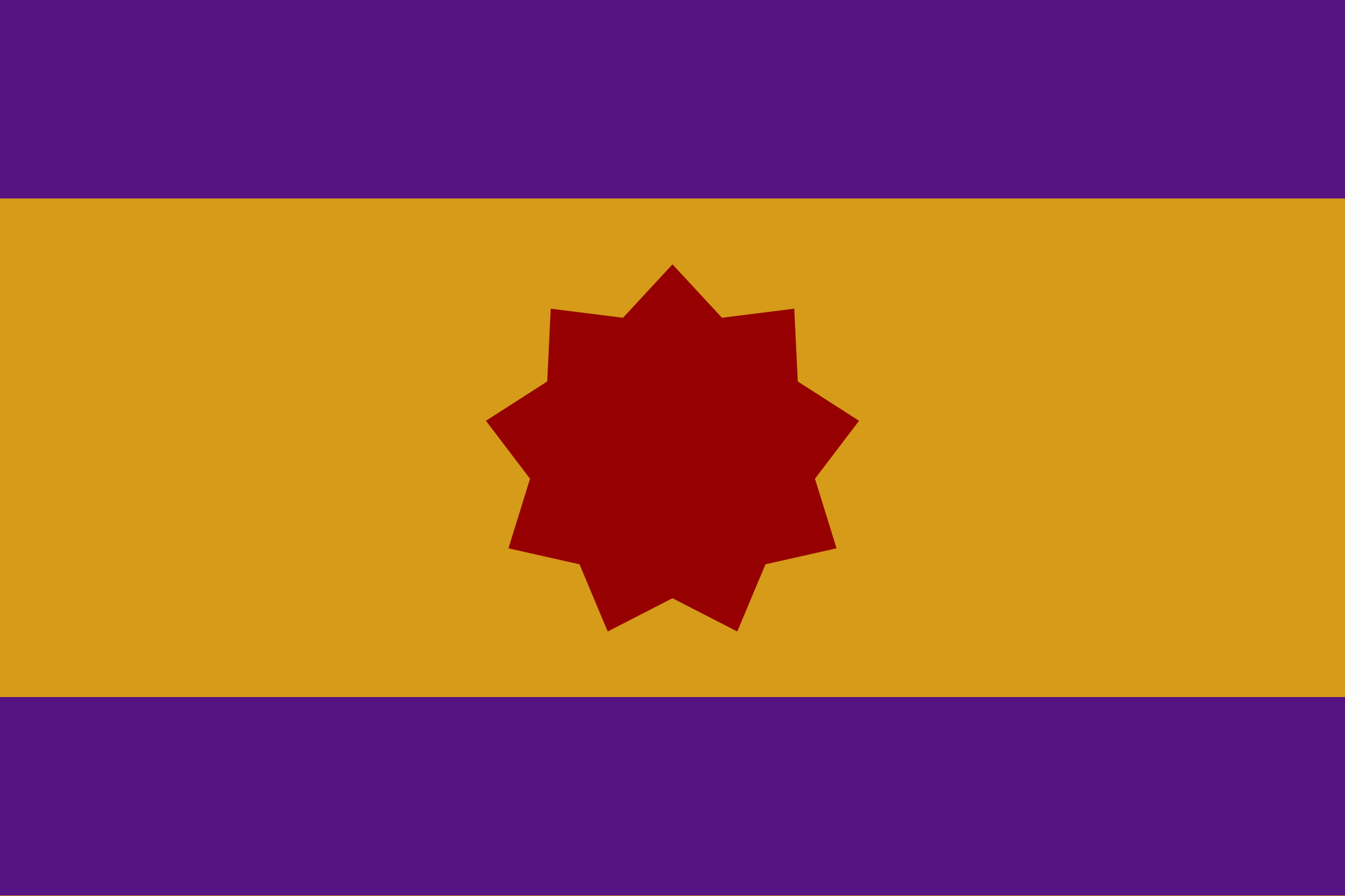
Maps
-
Kaisa
Remove these ads. Join the Worldbuilders Guild









Comments