

SEK-ESK
The SEK-ESK is a libertarian-federalist revolutionary labor confederation, formed from the joining of the Synespondi Ergiada Keathali-Pratiko (SEK) and the Eletera Symvouli Keathali-Pratiko (ESK) in 1344. Though their center of power is located in the Republic of Kaisa, the SEK-ESK also holds a significant presence in Antiopa, as well as the new Occiman Republic. It is the dominant radical organization within the Daffodil Revolution. With millions of people, some say 1 out of every 10 adult, participating in the confederation in some form, the SEK-ESK has the opportunity to challenge the Symvouli Tiporé and the Kaisan state.
THE SEK-ESK is a staunchly libertarian-federalist confederation. However, part of their success has been due to acceptance of a diversity of tactics towards radical goals, allowing them to bring in both moderate unionists, who make up the majority of the confederation but are less ideologically driven, and radical libertarians and communists, who are lesser in number but are the driving force behind the organization.
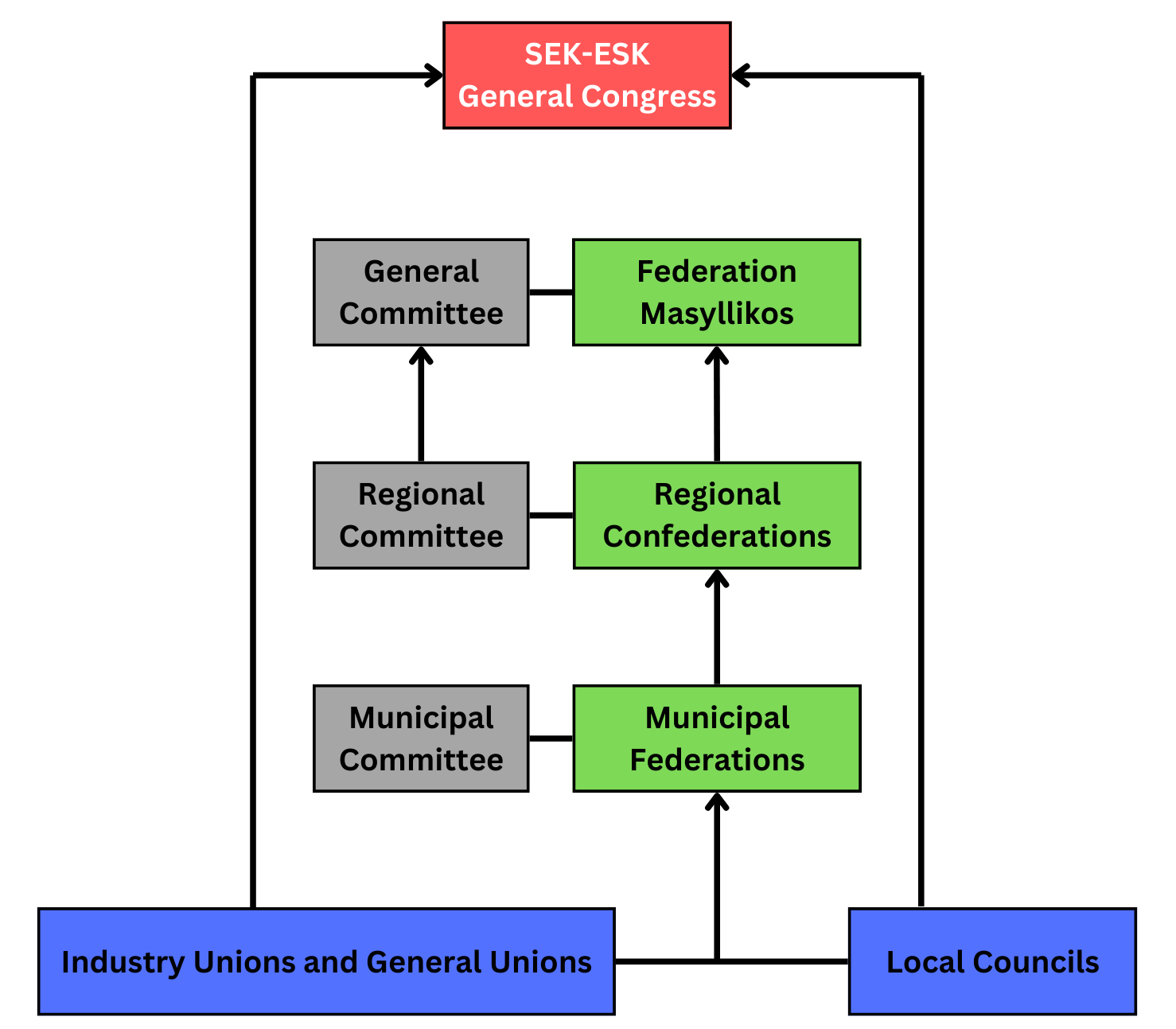 While the SEK-ESK is broadly united and committed to the goal of proletarian revolution, it is not a single organization so much as a confederation of many different unions, councils, and other organizations between the SEK and ESK. It is structured in libertarian and federalist fashion, from the bottom up in all possible ways. Each component has full autonomy to take action on their own where possible. A series of local, regional, and finally a national body organizes the confederation and makes decisions at increasingly large scale. At each level, delegates are chosen that have no authority themselves and are merely vested with the responsibility of bringing the opinions and issues of their union or organization to the next level.
History
Formation of the SEK
In the early 1300s, the only national union federation was the Enosi Genika, which held a strict apolitical stance. In 1311 the Enosi Metallorychon Nota and the Schesi Apovathras, both radical libertarian labor unions, federated to form the SEK. Soon, other unions began to join the federation. In 1317, the SEK led a successful general strike in Polipotama that spread and led to the instatement of the ten-hour workday. The SEK was declared illegal following the strike, but their numbers only grew, until they became the most prominent labor federation in Kaisa. In 1328, the law banning the organization was repealed, which the Symvouli hoped would quell some of the insurrectionary tendencies within the organization.The 1333 Revolution
This was not the case. During the Kaisan Revolution of 1333 the SEK was one of the guiding factions in the uprisings, with its component unions being the driving force behind most of the strikes that defined the revolution. After the revolution began, the Symvouli again banned the SEK. After the collapse of the Kaisadroupolis Commune, many of the most dedicated organizers within the SEK were forced to flee to the newly-independent Bierglaan or to Campeni to join the Prostian United Front.White Terror
Following the 1333 Revolution, radicals in Kaisa faced extreme repression. During this period, called the White Terror, libertarians and communists that continued to operate were targeted for imprisonment, assassination, or worse. echelarist paramilitaries and thugs hired by bosses were given free reign to attack union members and organizers in the streets. However, the federation pressed on, maintaining contact with its exiled organizers through underground channels and continuing to organize underground. To protect themselves, members of the SEK formed defense committees and began fighting back. Gun battles between libertarians and reactionary thugs became regular occurrences in the streets. Some took it a step further and began taking the fight to the politicians and bosses. From 1335-1350, libertarians were responsible for hundreds or even thousands of bombings and shootings through various armed cells, such as the Invisible Brigades. When the Last War began, many radical Kaisan organizations embraced wartime patriotism, seeing the conflict as a struggle against the reactionary terror of the Imperial Jiderani Union (IJU). Despite a great deal of internal division, the SEK-ESK maintained their oppositional stance and continued to organize against the Kaisan state throughout the war.Resurgence
By 1338, the SEK was struggling to stay relevant. Many of its core membership was either dead, imprisoned, or forced to flee the country, and political repression was at its peak. At the 1338 plenary session of the General Congress, the main point of discussion was a path forward for the flailing confederation. Emerging from the months long session were two resolutions. The first was to encourage municipal federations to focus attention on neighborhood organizing and responding to the stagnant economic conditions in Kaisa and Antiopa by providing alternatives to capital and the state, done through the creation of solidarity committees within most of the municipal federations. The second was to open the doors to more moderate unions, a much more controversial decision but one that was eventually deemed necessary in order to prevent irrelevance. With the Kaisan state cracking down on union organizing across the board, many felt they had an opportunity to poach moderate unions who may have previously been put off by the revolutionary bent of the federation. These measures proved successful, and soon the SEK was once again growing. Though they were still far from their pre-1335 strength, they were put in the position to take advantage of major crises that struck over the next decade.Growth in Antiopa
After the '33 Revolution, many of the SEK organizers fleeing the country left for Antiopa, a country that had a common language and a shared cultural history with Kaisa. There, they continued their work, building connections with the budding labor movement in Antiopa to share the expertise they had built in Kaisa. They found the most initial success with the port-laborers of Dysilen, who were angry over poor pay and extreme hours. In 1340, the Antiopan Port-Laborers Strike provided a much-needed victory, and the Antiopan Port-Laborers Union federated with the SEK shortly after, soon joined by many others.Vrachana Textile Strike
Historically, the labor movement had not made significant strides in northeastern Kaisa, despite a large industrial base dominated by textiles. In 1341, a disaster resulting in almost two-hundred deaths led to an outburst of spontaneous strikes and other actions. SEK organizers met with key leaders of the labor movement in Vrachana and aided them in forming branch unions of their own. This culminated with the Vrachana Textile Strike, which led to significant victories for the workers and the growth of the SEK into the northeast.The Last War
When the Last War began to loom on the horizon, many radicals in Kaisa embraced a war-time patriotism, seeing the conflict as a struggle against the reactionary terror of the Imperial Jiderani Union. Though this was not an uncommon belief within the SEK, many more felt that the coming war was merely a struggle between two equally brutal regimes, neither of which deserved any support. The 1342 plenary session was called to determine the general approach of the federation towards the war, as well as to reevaluate their course towards rebuilding, with four years having passed. After many heated arguments, the final decision was to maintain opposition to the war, refusing any compromise with the Kaisan or Antiopan states. At first, this decision seemed disastrous, as it served to isolate the federation from the majority in the region that had been taken by war fever, as well as from other radical parties and organizations, such as the Communist Revolutionary Party that supported the war. Many began to question their decision, and there was even some talk of reconvening the General Congress to change course. However, as the war dragged on and drifted out of the control of the politicians and bureaucrats, public opinion steadily shifted. The SEK began to be seen as one of the few organizations standing against the meatgrinder chewing up the nations' children and further tearing apart its already crumbling economy. The federation received a surge in participation, particularly through a series of strikes in 1346 that forced Kaisa to end its policy of ignorance towards labor safety violations in industries important to the war effort. The continued efforts towards expanding into regions that had been resistant to unionization and providing necessry resources and services made many, even non-members, feel that the SEK-ESK had their best interests in mind more than the Kaisan or Antiopan states.Formation of the ESK
During the brief existence of the Kaisadroupolis Commune, neighborhood councils were formed to meet, organize resources, and make decisions. Even after the 1333 Revolution collapsed, many of these councils continued to exist. The Symvouli, perhaps fearing a continuation of the conflict, did not ban these councils, though they faced significant reprisals from Etnofroura, National Police, and other reactionaries. Most of the councils that survived through the White Terror and maintained their revolutionary dedication were in Kaisadroupolis and its surrounding area, and many of those were in Ridbhan diasporic communities. As the solidarity committees expanded post-1338, members of the SEK often collaborated within the neighborhood councils. In some cases, the efforts of the committees took the form of organizing new councils to more directly involve local people in the organization of solidarity programs. In 1344, with the support of the SEK, a national convergence of delegates from the free councils was called to discuss the formation of a Kaisan federation of free councils. The neighborhood councils were given a month to internally discuss, before delegates were chosen and the convergence began. In the end, a federal charter was drafted, and the ESK was formed from the signing councils, joining with the SEK to form the SEK-ESK.Daffodil Revolution
When the soldiers of the Kaisan Army mutineed in 1349, the SEK-ESK held an emergency session of the Assembly Masyllikos. By then, most of the SEK unions had already declared a strike in support, and calls for a general strike had already emerged from several regional federations within the organization. The assembly voted to officially back the general strike. Factions within the assembly had already begun advocating for a full declaration of war against the Symvouli, while others urged caution, fearing a repeat of 1333. But in this, as with the general strike, the SEK-ESK found itself several steps behind its members, as bands of armed workers had already begun seizing their workplaces. Whole army units were deserting en-masse, and the Symvouli seemed entirely unprepared to regain control. There is a feeling within the committees of the federation that the SEK-ESK is holding on to the tail of a lion and hoping to the gods that they will stay on their feet.Organization
The SEK
The SEK is a federation of libertarian communist labor unions. Most unions within the SEK are what is refered to as "industrial unions," meaning that they organize workers across a particular industry, sometimes of a particular trade within that industry if there are enough workers. In some cases, though, a "general union" of workers from various industries is formed, if there are not enough workers of each industry to form individual industrial unions. Because industrial unions often include workers from a broad geographic area, "local sections" are formed for the larger unions, encompassing workers from a smaller geographic area within the union. Each union and local section makes decisions through an assembly, by consensus or direct democracy.The ESK
The ESK is a federation of municipal councils, formed to organize and distribute resources according to need, handle internal conflict without involving the National Police, and make decisions that affect the entire council based on models of direct democracy and consensus. Typically, the councils are formed within a neighborhood or other closely localized geographic area. In rural areas, there may be one local council for a single township or village and its surrounding area.Confederal Structure
Committees and Secretaries
Committees can be formed by assemblies of any level to perform administrative tasks or other activities that don't require the discussion of the full assembly. For each committee, the assembly appoints one or more secretaries, responsible for administrative tasks within the committee and reporting back to the assembly. General committees are responsible for the broad administrative tasks of the federation, and other committees are created as needed.Municipal Federations
The unions, union local sections, and free councils of a municipality form a municipal federation. These federations have an assembly, constituted by delegations from each of the unions and councils in the federation, and committees selected by the assembly.Regional Federations
Municipal federations within a broader geographic region are grouped together into regional federations, which have assemblies formed by delegations from each of the component municipal federations. Municipal committees are selected by that assembly.Federation Masyllikos
The Federation Masyllikos is composed of each of the regional federations, and its assembly receives delegations from each. Like the other federations, its assembly creates committees to handle various tasks. The secretaries of each of the general committees of the regional federations are placed on the general committee for the Federation Masyllikos, in addition to whoever else is selected by the assembly.SEK-ESK General Congress
The General Congress is composed of delegations from every union and free council. It is called, typically a year in advance, by the Committee Masyllikos only when a discussion on the broad strategic direction of the SEK-ESK is necessary. Once a plenary session is called, the Assembly Masyllikos determines the subjects of discussion, at which point each union and free council begins the process of forming their position for a delegation to bring to the General Congress.Notable Committees and Organizations
There are many committees within the SEK-ESK, mostly performing relatively uninteresting albeit very necessary work, but a few of them are worth mentioning.Defense Committees and Confederal Militias
Within the SEK-ESK federal structure, the Defense Committees are clandestine groups organizing armed defensive and offensive formations, the Confederal Militias. The committees were formed during the White Terror to fight against violent political repression from the Etnofroura, nationalist gangs, and private armies hired by the bosses. As the Daffodil Revolution begins, the militias are undergoing a reorganization to ready themselves for anticipated combat with the forces of the Symvouli. The lessons of the 1333 Revolution weigh on the federation, and those who remember are determined to avoid the lack of coordination and preparation of 1333.Triponta Committee
During the period of repression during the White Terror of the late 1330s, the decision was made to open the doors to a wider array of unionists, including moderate socialists and reformists. Fearing that this move would blunt the radical edge of the confederation, the Triponta Committee was formed. Named after the tri-point star of liberty, equality, and solidarity, the committee fills an advisory role to the SEK-ESK and places pressure within the federations against straying from committment to the revolutionary principles of the organization. While the Triponta Committee has no de jure authority, most of its members are highly respected ideological pillars of the federation, and their voices hold a great deal of sway over the decision-making processes, to the point that some of the internal factions opposed to the principles of the committee accuse them of being puppet-masters.Solidarity Committees
The solidarity committees are groups in many of the munipal federations dedicated to combating the scarcity of necessary resources within the region. They organize the redistribution of resources, provide free meals, and often offer necessary services in places that have been abandoned by the state. Most were formed after the 1338 plenary session as part of the SEK's strategy to rebuild after the losses faced during the White Terror.Art and Culture Committees
The art and culture committees coordinate the production of propaganda and organize cultural events within their federation or commune. These committees are often shared between a municipal federation and its counterpart commune. Members of the arts and culture committees organize musical performances, community plays, and social dances within SEK-ESK community centers, and some even have access to radio equipment that they use to broadcast news, political analysis, music, and radio shows.Free Youth
The Free Youth are an organization run by members of the SEK-ESK that provides free childcare for working parents in the unions. Out of the SEK-ESK social centers, the Free Youth organizes youth sports leagues and other programs for older kids.
Maps
-
SEK-ESK Federations
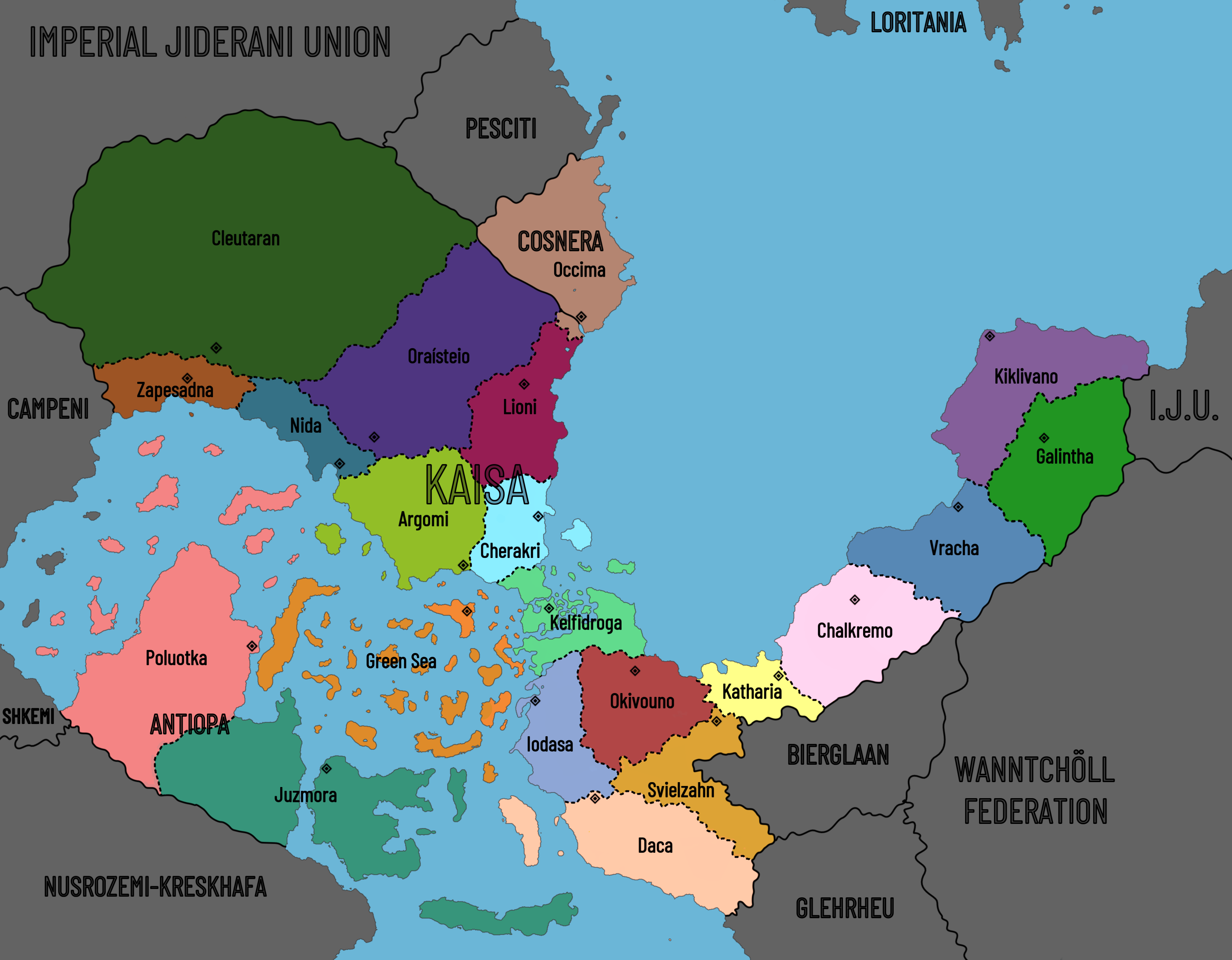
A map of the federations of SEK-ESK, between Antiopa, Cosnera, and Kaisa
Founding Date
1344 CE
Type
Political, Federation
Subsidiary Organizations
Related Traditions
Notable Members
Allied
The KKS respects the SEK-ESK as a revolutionmary body of workers but thinks that their libertarian leanings are dangerous and will make them ineffective. Some factions of the SEK-ESK are aligned with the syndicalism of the KKS, while others think they are workerist authoritarians.
Neutral
The SKI thinks the SEK-ESK are a revolutionary distraction from the true path to socialism, but they maintain tentative ties. The SEK-ESK thinks the SKI are committed revolutionaries but are potentially dangerous.
Wary
Most of the SEK-ESK thinks the PKK are liberals that betrayed the workers in 1333. The PKK sees the SEK-ESK as allies against the Symvouli but fears the lack of control
Remove these ads. Join the Worldbuilders Guild







Comments