

Kaisan Revolution of 1333
The 1333 Revolution was a pivotal moment in the modern history of Kaisa and of the radical movements of Duurn. The revolution contributed to and marked the decline of Kaisan power in Jideran, allowing for the rise of the Imperial Jiderani Union. The tensions and underlying causes that led to the 1333 Revolution would remain unresolved, leading directly to the Daffodil Revolution of 1350. Indeed, many of the same organizations that participated in the 1333 Revolution, such as the SEK, would go on to be central to the Daffodil Revolution. In this way, some historians argue that the 1333 Revolution, the Kaisan White Terror that followed it, and the Daffodil Revolution can be seen as one drawn-out conflict that merely entered different phases over time.
Revolution in Kaisa
Economic recession following the Red Week exacerbated mass public unrest in Kaisa. The Kaisan Symvouli Tiporé was already broadly unpopular with the workers and peasants, who were voiceless within the political system of the country. When the Symvouli began to impose austerity measures that they claimed were to stabilize the crumbling economy, a general strike was called in Kaisadroupolis by the SEK. The Symvouli sent in the Etnofroura to break the strike, and eleven striking workers were killed and hundreds more injured. Rather than ending the strike, this enraged the workers, who began fighting back in earnest. The strike spread across south-central Kaisa and even into a few cities in the northwest. In Kaisadroupolis, many of the wealthy property owners and aristocrats of the city began to flee, fearing the worst. The revolution is generally considered to have begun when the action committees in Kaisadroupolis called for the communization of the homes and property of all bourgeouis and aristocrats who fled the city. At around the same time, the people of Bierglaan, an autonomous administrative region within the Svielzahn Mountains of eastern Kaisa, began to revolt. They drove the Gisszerdt garrison out of the city and declared their independence from Kaisa. With Kaisadroupolis and the surrounding region in full revolt, the Symvouli ordered their forces to pull back from the city and lay siege to the newly-declared Kaisadroupolis Commune while they prepared an offensive. They fell back to the Gios River in the south, the Katharia River in the northeast, and the base of the Gafinou Peninsula in the northwest. Within the commune, a defense force was raised. Hastily put-together workers militias and a few units of soldiers that threw their lot in with the commune came prepared for a fight. For a time, it seemed like the revolution would spread and burn Kaisa from within, but while the revolution found ready kindling in Kaisadroupolis, it was not able to spread beyond a few cities in the west. Blelofos and Gemani both formed short-lived communes of their own, but the revolutionary movement failed to spread to other cities or to the countryside. In 1334, the Symvouli declared the adoption of a number of liberal reforms, including the creation of a popularly-elected legislative body and minor protections for workers. In return, the moderate unions declared an end to the strike. Even within these unions, plenty of workers refused to stand down, but the wind was taken from their sails. By spring of 1334, the communes in Blelofos and Gemani were dissolved. The Kaisadroupolis Commune, the center of the libertarian, federalist, and socialist union movements, survived and fought, but without allies and encircled by the enemy, it was an impossible war of attrition. In the Month of Water of 1335, a massive counteroffensive from the northwest recaptured Kaisadroupolis and pushed the revolutionaries up the Okivouno River and into the mountains. Many of the die-hard revolutionaries, particularly those who aligned with the libertarians and trade unionists, fled to the Bierglaan where they played a pivotal role in maintaining the Biergs' independence. Many revolutionaries in northwestern Kaisa who were at risk of arrest or execution fled to Campeni, where they played a part in the coming Prostian Revolution.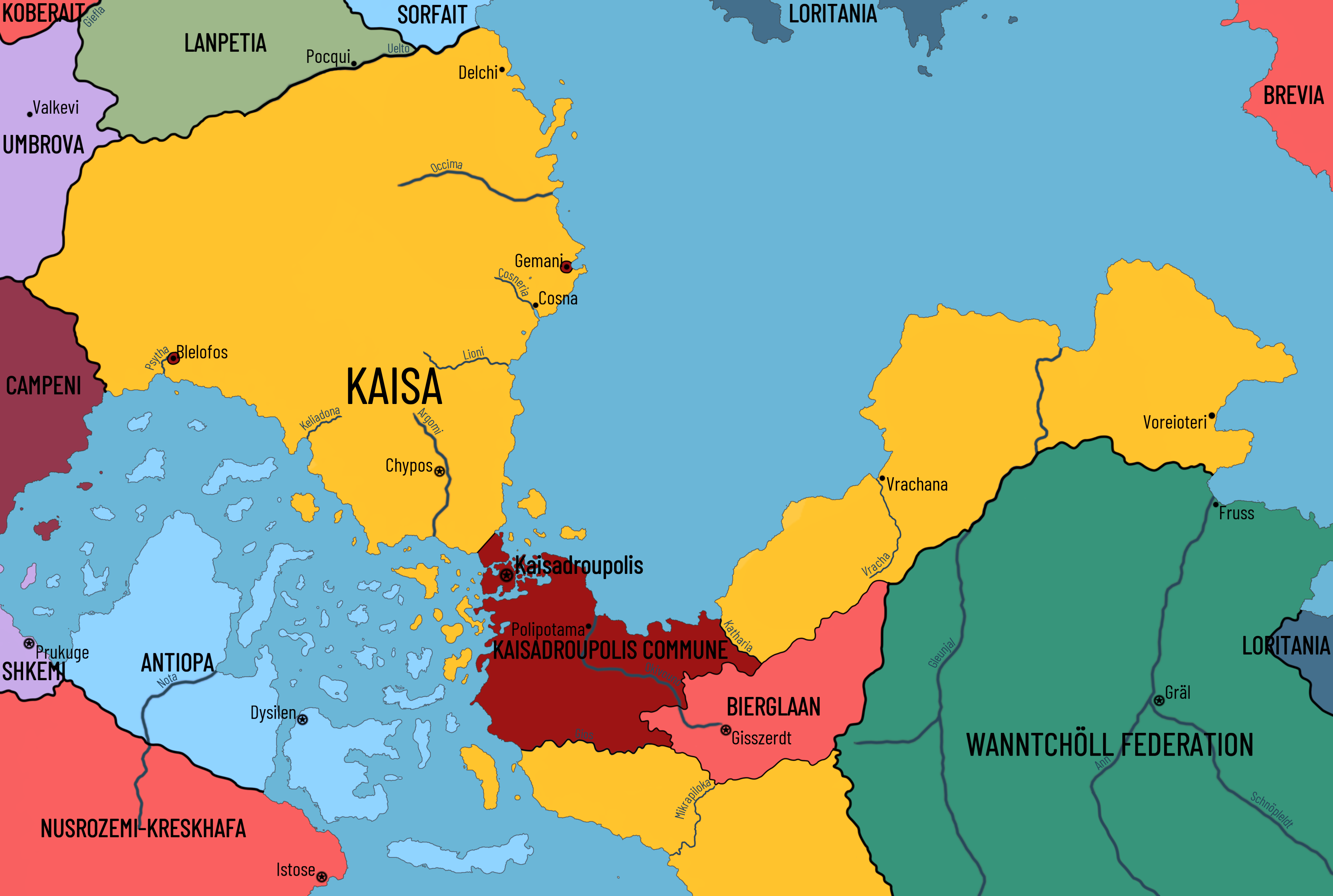
Conflict Type
Rebellion
Start Date
17th of the Month of Growth, 1333
Ending Date
5th of the Month of Color, 1335
Remove these ads. Join the Worldbuilders Guild







Comments