Pulo
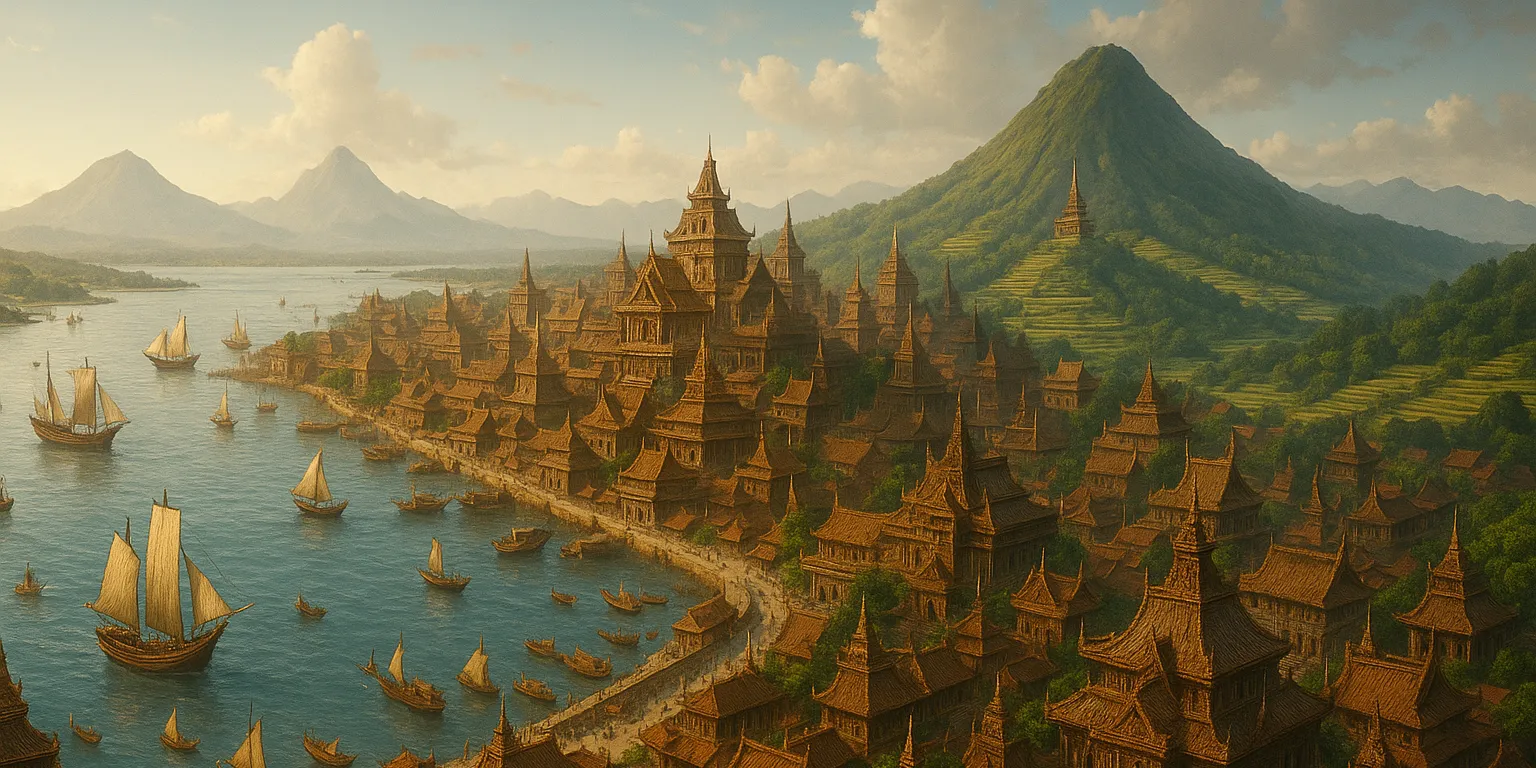
Pulo is the ninth largest island in the Great Ring and the second largest in the Southwestern Region. The island is home to several ethnic groups and is ruled by the Tagápulo Empire, an expanding power whose influence is growing as fast - or faster - than that of any other in the islands. Pulo is rich in natural resources, featuring a diverse range of terrains, from mountains to jungles. It is this natural wealth that has fueled the Empire's explosive growth over the past century.
The People of Pulo
Collectively, the peoples of Pulo are known as the Banwa cultures. While more than a dozen Banwa ethnicities are native to Pulo and the surrounding islands, only three have significant influence on the island. First among these are the Tagápulo, who make up the majority of the population. They originated in the southern part of the island and gradually moved north along the Ilog Pasi, conquering as they went. Today, the Tagápulo are found throughout the central and western parts of Pulo and rule the island entirely.
The northern coast of Pulo is dominated by the massive Bay of Mynilad and was traditionally the territory of the Ilogaro people. Hundreds of Ilogaro villages still exist on Pulo's northern peninsulas, but the population was harshly suppressed after a failed rebellion about seventy-five years ago. Today, many Ilogaro have scattered to the edges of the Empire or beyond, and their ancestral territory holds only a fraction of the Ilogaro population it once did.
The third major ethnic group on Pulo is the Ipugao, who mostly live in the Silanganbundok mountain range in eastern Pulo. They are technically under the Emperor’s rule but largely ignore the edicts of the Tagápulo Lakanlalawigans sent to govern them. Their villages are remote and difficult to reach, and they only submit to the Empire to maintain some access to trade goods; without the ability to buy and sell with the lowlanders, life in the mountains would be immeasurably more difficult. Even so, tax collectors from the Empire must travel with armed guards in Ipugao lands, and it is not unusual for villages they intend to tax to become ghost towns as the collectors approach.
The Gods of Pulo
One unifying feature of the Banwa Peoples is their belief in the Anito - the spirits of the land, sea, and sky. Thousands of these gods are honored throughout the island, inhabiting nearly every geographical feature. Most are revered in small, regional festivals, but a few hold exceptional importance.
The most important to the Tagápulo is Anitaga, who rules over the Anito of Pulo and serves as the patron god of the Empire. The priests of Anitaga were key figures in the early expansion of the Empire, believing that Anitaga's power would grow alongside the Empire. They urged the conquest of Pulo and nearby islands as acts of piety, and Anitaga is still invoked before every battle the Empire enters.
Another key Anito is Tayawán, the lord of the drowned harbors. Tayawán rules over Ijuwit ng Matdōn, the underworld of the Banwa Peoples, which is can be reached by setting sail from subterranean harbors and voyaging through a drowned world. Shrines to Tayawán are erected during funerals to beseech the god to welcome the departed souls to the lands beneath the world, and to ensure that the god's ships will continue to come to fetch the spirits of the dead. In stories where the actions of the people have offended Tayawán, the god has cut off the offenders from Ijuwit ng Matdōn, leaving the spirits of the dead to languish and grow strange among the living.
A third vital figure is Luek, the god of the Bay of Mynilad. Luek is the patron of the Ilogaro people, who built the grand temple of Pangdambana ni Luek on Lumai, a small island within the bay. Luek's position gives the god dominion over all ships and trade passing through the bay. When the Empire attempted to subjugate the Ilogaro after their failed rebellion, Luek intervened by preventing vessels from traversing the bay. This both sheltered the Ilogaro on Lumai and pressured the Empire by cutting off its most vital trade routes.
Landmarks of Pulo
Most visitors to Pulo first encounter the city of Mynilad, the capital of the Tagápulo Empire. It is the largest city on the island, situated at the southern end of the Bay of Mynilad, at the mouth of the Ilog Pasi. Often considered one of the great cities of the Great Ring, the Empire is actively working to make it as powerful and renowned as any other settlement in the islands.
Pulo is home to several notable mountains. Haraya, a peak in southwestern Pulo, is sacred to Anitaga and is visited periodically by the Emperor to remain in the god’s favor. Tanyongbundok, the highest point on Pulo, lies within the Silanganbundok mountain range in eastern Pulo. It serves as one of the entrances to the land of the dead, and the Ipugao are especially protective of it. The mountain is also the proposed site of an observatory by Imperial astrologers, and the Ipugao have waged a decade-long campaign of sabotage to prevent its construction.
Finally, Hagdan-Hagdang Palayan is an ancient agricultural marvel that has been in use for over 2,000 years. This series of terraces, built in the eastern hills, has allowed the people to inhabit areas that might otherwise be too harsh for survival.
Maps
-

Pulo
Geographic Details
Location: Southwestern RegionLatitude: 16.56 degrees North
Longitude: 27.01 degrees West
Average Elevation: 112 ft
Highest Point: 9,035 ft (Tanyongbundok)
Lowest Point: 0 ft (Baybayin)
Area: 42,458 sq mi
Related Articles
This article was originally written for Spooktober 2024. You can find all of my Spooktober Articles at Spooktober Central.
This article was originally written for Spooktober 2023. You can find all of my Spooktober Articles at Spooktober Central.


First off, as a cartography nerd, I love the map, its fantastic :) Terrace farming is always so fascinating conceptually, and the architectural science and know how behind such a technique is just *chef's kiss* so I always love when it makes appearances in worldbuilding, I cannot wait to write about it myself in the appropriate realm it appears in :)Well written Demon, a great primer on this island and I love that you have your tags so well honed something I am most definitely taking inspiration from and trying to improve in my own world as I overhaul lol
I can't take credit for the map - I have a friend who kindly drew it for me. I also find terrace farming fascinating!