Nipa
Nipa is the second-largest island in the Kapuluan archipelago, located just west of the large island of Pulo. It was among the first islands conquered by the Tagápulo Empire during its expansion beyond Pulo itself and has traditionally been governed by the Emperor's eldest son, who is granted the title Lakanlalawigan of Lalawigan ng Nipa at birth and assumes full responsibility for the province upon reaching their sixteenth birthday.
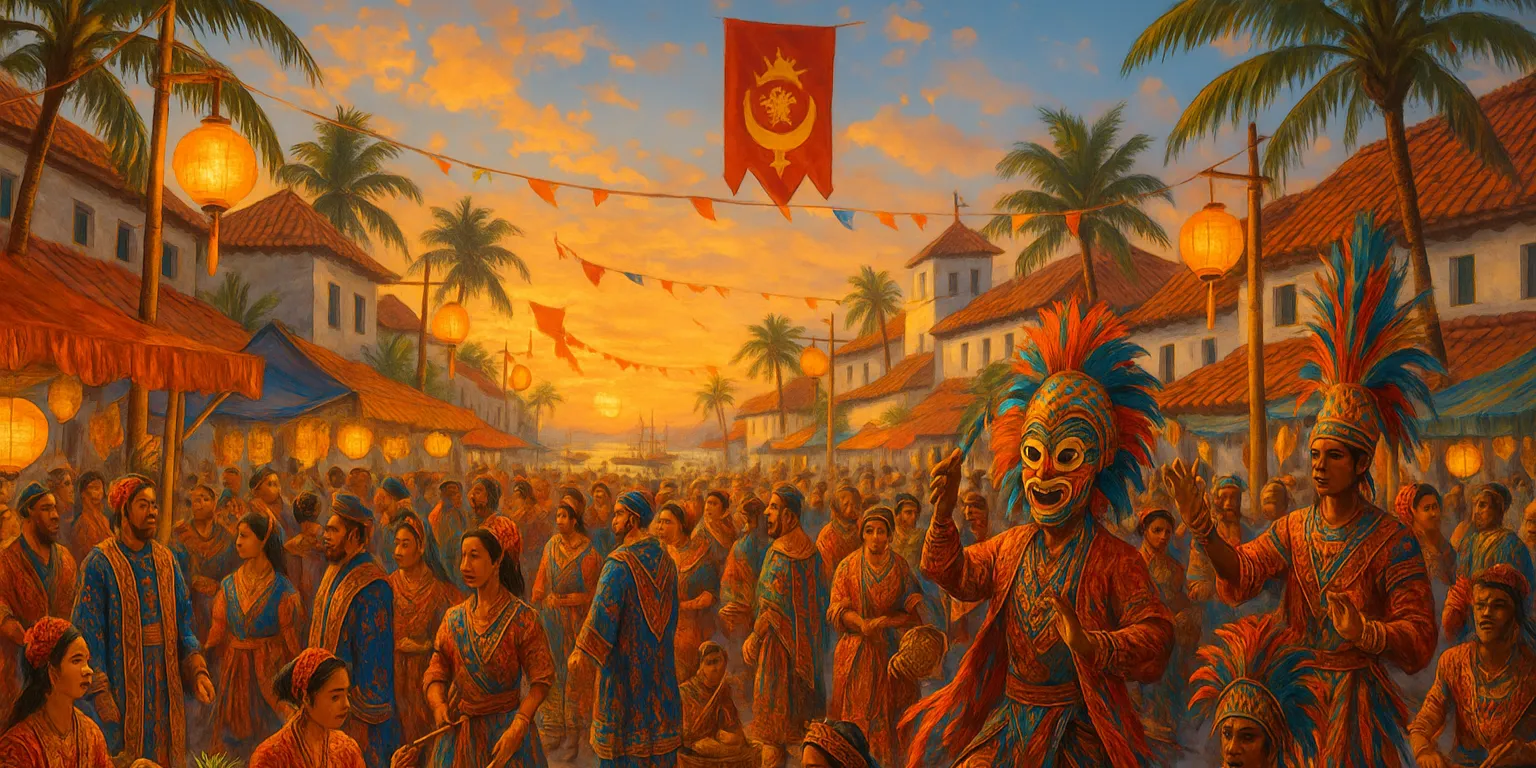
For the last century or so, the island has gained a reputation as the place where young princes and nobles go to misbehave. While the rural areas of Nipa are primarily agricultural, the city of Mamere is known as a haven for the rich and influential to indulge in every manner of pleasure and vice. This was already the case before the city came under the rule of Emperor Matatag, then Crown Prince, but he embraced the lifestyle of a debauched and privileged prince with particular enthusiasm, and the city and island were shaped by his decade and a half as Lakanlalawigan. Brothels, taverns, theaters, and music halls abound in the city, while large sections of the island are set aside for hunting parties and other forms of rustic revelry.
In the decade since Prince Haribon assumed rule of the island, he has emulated his father's excesses. The city and surrounding areas are frequently engulfed in enormous festivals that have become whispered legends in the capital. While many in the younger generation of nobles vie for invitations to Haribon's revels, older and wiser heads merely shake at the tales. They look from Haribon to Matatag and note the many similarities between father and son. This disapproval among the elder nobles has bolstered support for Haribon's sister, Princess Liwayway, who has been careful to present herself as the moderate and moral candidate for the throne.
Notable Spirits
In one of his more inspired—or perhaps drunken—moments, Matatag decided that his island would need gods suited to his desires. He had read of the Godcrafter's Guild and had even heard the tales of Billy the Goat - a failed attempt at godcrafting that Matatag considered a better result than what its creators had intended. He instructed his katulong to determine how to inspire the manifestation of gods suited to his revels.
Money was spent and experts were hired. There were few who still knew the ancient techniques of godcrafting, but those who could be found were brought in. Matatag ascended to the throne, Haribon was born - and the project continued. On Nipa, a god was designed for every kind of pleasure, each design elaborated upon and personally approved by the Emperor. Great festivals were held in their honor, temples were built, and stories were told. Some even believe the Emperor hired a True Mage to accelerate the process with mental magic, fixating a large number of people on the project so that they could think of nothing but their appointed god.
And shortly after Haribon's sixteenth birthday, the gods arrived. First came Malunyá - the goddess of brothels, seduction, and extravagant pleasures of the flesh. She was soon joined by Mapulá, the god of wine and intoxication. Minor spirits attended them both, mingling with the nobles who gathered for Haribon's celebrations of the new gods. The Crown Prince's parties took on a fervid quality - they became sacred revels in which impossible pleasures could be achieved. Divine musicians played alongside mortals, inspiring works of incredible art. One newly arrived god could bestow inhuman beauty with a kiss, lasting through the night and breaking the hearts of all who received a smile from the blessed.
The Anito of Nipa are unimpressed by these newcomers, but have not yet moved against them. The new gods are children flush with power, yet lacking in depth, and time will tell whether they mature - or fade away once the parties end.
Geography
Nipa is shaped like a comet, streaking westward away from Pulo. The city of Mamere lies at the island's eastern tip, only forty miles across the water from the larger island. To the west, the land becomes more rural, with fields of rice and sweet potatoes dominating the landscape. In the broader western portion, the terrain grows rugged and mountainous. Coffee is cultivated on the lower slopes, while the great mountain of Pocobundok looms over the plantations.
Geographic Details
Location: Southwestern RegionLatitude: 17.45 degrees North
Longitude: 29.78 degrees West
Average Elevation: 253 ft
Highest Point: 7,780 ft (Pocobundok)
Lowest Point: 0 ft
Area: 5,687.93 sq mi
Related Articles
This article was originally written for Spooktober 2024. You can find all of my Spooktober Articles at Spooktober Central.
This article was originally written for Spooktober 2023. You can find all of my Spooktober Articles at Spooktober Central.

I am curious to see how the new gods will develop. The island sounds like a bit of a nightmare to me, honestly, so I will skip it on my tour. XD
Explore Etrea | WorldEmber 2025
They’re likely to deviate from their creator’s plans pretty soon; they might even have a part in the succession.