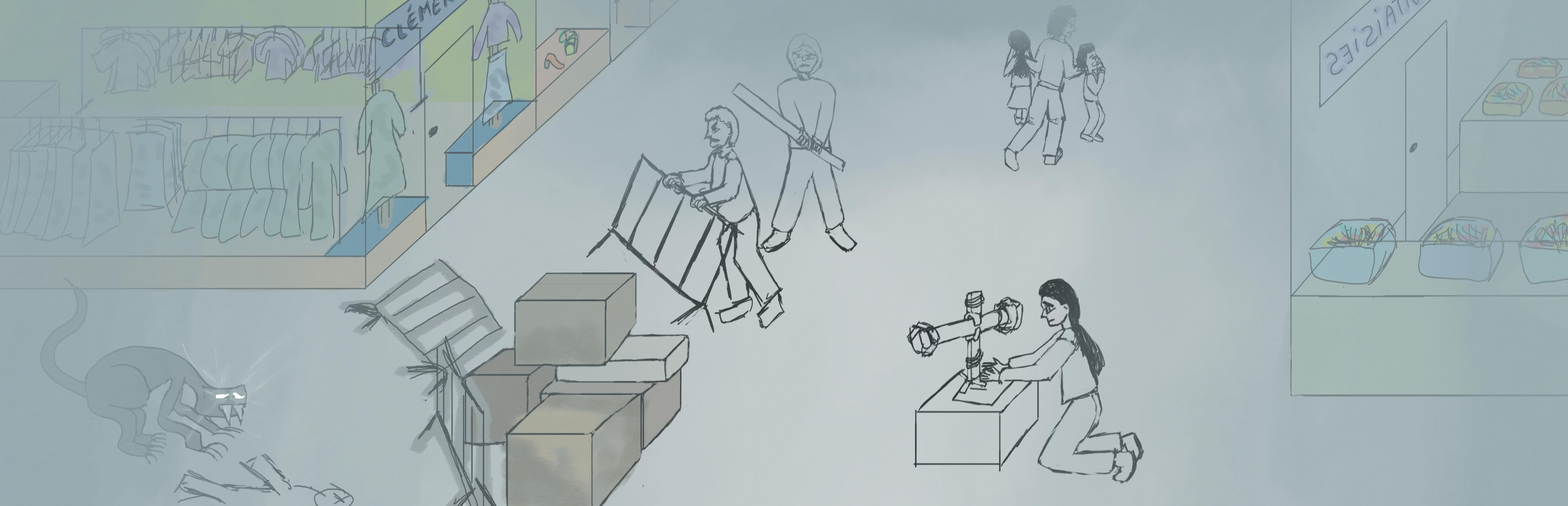
Mist contamination detector
Welcome to the world of Poisonous Mist! One day, Earth is suddenly covered in a mysterious Mist. As a result, billions of people die and the handful of survivors awakens with strange powers. As monsters start killing them, Anne-Line, a scientist, tries to make sense of what's happening and to prevent what's left of France from becoming a dystopian society. Come read about her struggle!
Introduction to the story | Anne-Line Decroix | Mist | Novel upcoming
Introduction to the story | Anne-Line Decroix | Mist | Novel upcoming
Table of Contents
Report: Mist Contamination Detectors
Author: Anne-Line Decroix — Date: 190 days post-Mist — Confidentiality: Public
Objective
Present the detectors we currently have available against the Mist and the ongoing research.
Background
Since the Mist appeared and killed more than 99% of humanity, the biggest danger for the few of us who have survived is Mist contamination. As we are yet to find a satisfactory treatment against it, our only hope is to be able to detect it to avoid areas with high Mist levels and to contain contaminated individuals. This is why we have been racing to develop Mist detectors.
Present the detectors we currently have available against the Mist and the ongoing research.
Background
Since the Mist appeared and killed more than 99% of humanity, the biggest danger for the few of us who have survived is Mist contamination. As we are yet to find a satisfactory treatment against it, our only hope is to be able to detect it to avoid areas with high Mist levels and to contain contaminated individuals. This is why we have been racing to develop Mist detectors.
Mechanism

General working: Mist contamination detectors are all fashioned out of simple optic lenses that are combined together to create spy glasses, magnifying glasses, or normal glasses. When using them to look at something, the different types and level of Mist becomes visible and appear in different colours depending on the different combination of lenses used. What allows this is the special treatment that the lenses have undergone.

Treatment: To treat the lens, an extremely thin metallic film is sprayed at their surface or is attached by electrophoresis. This metal will have been previously "activated" by melting it and mixing it with blood and the Mist contained it, thus making the metal more reactive to Mist. Different type of metal are used for this, as different metals react differently with the Mist - and we also have limited access to mineral ressources in our post-Mist world. Our favourite are the classic: gold, silver, iron, copper, and nickel.


Mechanism: Mist is now unfortunately present everywhere in our environment. It also attach to specific objects or beings, such as Mist monsters and contaminated individuals and anything they touch. From those focal points, it then diffuses in their surrounding more or less subtly depending on the level and type of Mist, potentially further spreading contamination.
When a treated lenses is placed in the diffusion field of such Mist, the Mist goes through the lenses and reacts with the metal on its surface, rendering it visible. Different lenses will show different types of Mist. Combining them all will not make all Mist visible and will just make everything black, forcing us to be more strategic. Combining just a few lenses has the most interesting effects, as it allows us to further differentiate between different types of Mist that cannot be separate with just one metal. Doubling the treatment on a single lens can have the same effect, but the number of metal joined in this way is before nothing is visible anymore through the lens.
When a treated lenses is placed in the diffusion field of such Mist, the Mist goes through the lenses and reacts with the metal on its surface, rendering it visible. Different lenses will show different types of Mist. Combining them all will not make all Mist visible and will just make everything black, forcing us to be more strategic. Combining just a few lenses has the most interesting effects, as it allows us to further differentiate between different types of Mist that cannot be separate with just one metal. Doubling the treatment on a single lens can have the same effect, but the number of metal joined in this way is before nothing is visible anymore through the lens.
Ongoing Research

Human contamination: Our most important research focus is to find a way to detect contamination inside people, if possible before the contaminated kill us all. All of our current attempts have failed because all of us have some form of benign contamination - all of us have Mist inside of us - and we have not yet manage to find a way to discriminate between benign and harmful contamination.

Mirrors: We are currently experimented with mirrors that have a background made of different metals (aluminium like our modern mirror, silver like classic anti-vampire mirror...). Since metals attract Mist, this would allow different mirrors to bind different types of Mist, thus filtering it to get rid of noise so that our lenses could then pick up more subtle Mist effects.

Metals: Finally, we are also looking at accessing a wider range of metals to see if they have interesting reaction with the Mist. We are doing this by sending supply runners further away to industrial sites or warehouses, but also by attempting to gather rare earths from electronic components.
Conclusion
The research department is looking for volunteers to help through the development of Mist detectors, either as gatherer of metals and rare earths, lenses builders, or lenses testers. Please help us improve them and our chances against the Mist!| Related Articles | ||||||||||
|---|---|---|---|---|---|---|---|---|---|---|
|

Comments