
Stargaze
"The Sky Has Always Been Watching, But Now We Watch Back." -Inscription on the Grand Observatory of Stargaze."
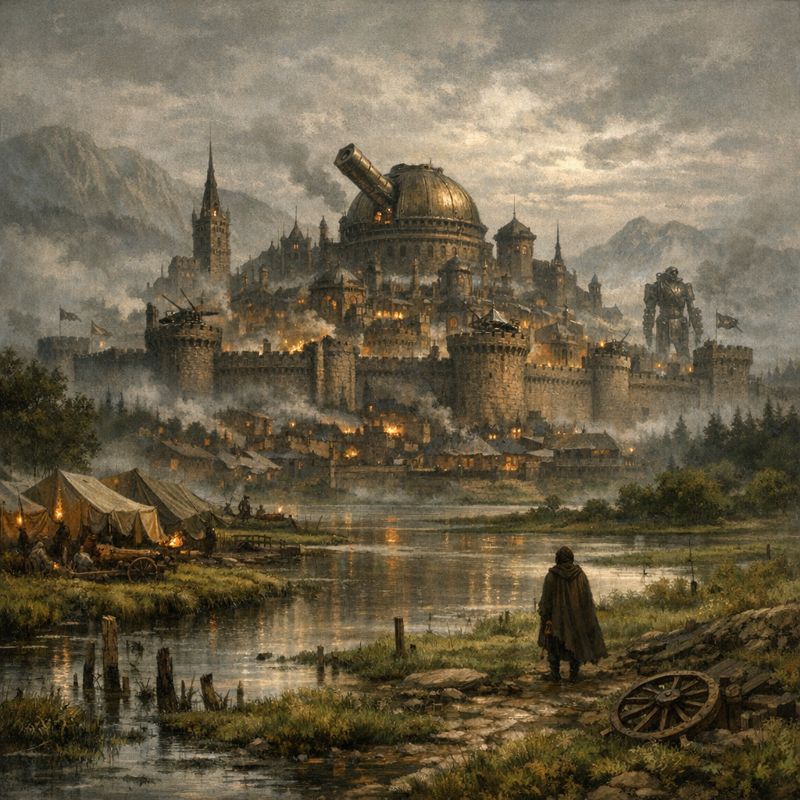
Once a city of light, now a citadel of dread, Stargaze stands on the border between Everwealth and Kibonoji, a threshold, not a home. It was born from hope, raised as a frontier of peace after The Great Schism, when Humans and Elfese scholars charted constellations instead of corpses, and trade caravans crossed the border like pilgrims. But peace was never meant to last. When the exiled Elfese lords of Kibonoji rose again, ancient vengeance rekindled, and the city’s telescopes turned from the stars to the front. The Grand Observatory’s domes no longer opened to heaven but to the smoke of war, its lenses trained on enemy camps instead of constellations. The three walls of Stargaze, once monuments to cooperation, now cage its populace beneath martial law. Refugees choke the gates; soldiers march through streets slick with snow and blood. The Ivory Guard rules through fear, the Scholar’s Guild survives under chains, and the once-vibrant Elfese citizens are hunted, pressed into “academic servitude”, slaves masked as assistants, winding the great telescopes and pumping the furnaces that once illuminated the stars. Rumors whisper that Kibonoji’s warlords wield augury as artillery, their oracles predicting Everwealth’s movements before they occur.
To the survivors within Stargaze, it feels less like a war than a curse.The city’s brilliance now fuels its decay. Glassworks that once crafted lenses for scholars now fashion scopes for muskets. Alchemists refine device recipes for gasses and bombs around the clock, this hushed pace of experimentation to meet the charging Elfs damning dozens to accidental deaths. Outside the gates, the Outer Encampments stretch endlessly, refugee tents, deserters’ camps, and shallow graves washed by winter rain. The Grand Observatory serves as both command post and symbol of blasphemy, a temple of the mind repurposed for slaughter. Slaves labor beneath its spire, tolling the war-bells that mark each hour of bombardment. Yet, amid ruin, defiance smolders. The surviving scholars smuggle what knowledge they can before the Crown stamps it “Censored.” Through it all, Stargaze endures, a fortress of intellect hollowed into obedience, its towers bristling with guns and swords and prophecy alike. For the soldiers, the frightened masses, or the helpless slaves who dwell here, hope is not a virtue but a weapon, one last illusion clutched against the coming night, as the sky above flickers with fire instead of stars.
Demographics
Stargaze was once a quilt of diversity, Humans, Elfese, Dwarfish scholars, Canid scent-hunters, and others who flocked to its observatories. Now it is nearly monochrome in its desperation. Humans dominate, bolstered heavily by every draftee and volunteer The Everwealthy Military can send to the front. The Dwarfs remain, stubbornly tied to their forges and glassworks along with their shared history with the Humans. The Elfese, once vibrant participants in the city’s intellectual flowering, have been reduced to hunted remnants. Many are dragged into prisons or beaten in the streets if-not worse, accused of being the enemy on the grounds their ears are similar.
Government
Stargaze answers directly to the Monarchy, but in truth, it is governed by necessity and fear. The appointed Count (sometimes called a Governor) is little more than a figurehead; true power rests with the military command council quartered in the Grand Observatory. Martial law is total. Curfews are rigidly enforced by the Ivory Guard and the militia patrols. Informants are rewarded, dissenters flogged, and those suspected of Elfese sympathy vanish into dungeons beneath the Steel Quarter. The Scholar's Guild still holds its place, but its independence is broken. Research is overseen by military officers. Discoveries are classified immediately. Telescopes track enemy positions; star charts are stamped “Crown Property.” The guild’s own archives have become holding pens for prisoners of war and enslaved assistants forced to aid in military “experiments.” Stargaze has become not a city of governance but of survival, run by generals in all but name.
Defences
The city’s defenses are formidable, but so is the fear that they will not be enough. Three concentric walls of stone, reinforced by Dwarfish engineering, still stand, though the outermost bears scars from recent skirmishes. Towers bristle with siege engines: ballistae, scorpions, and trebuchets, each flanked by wards of Scholar-craft. The Ivory Guard and militia man the battlements, bolstered by Automaton who survived The Lost Ages, living steel-skulled war machines who pace like restless beasts. But the true measure of defense lies not in stone but in the men who hold it. Hundreds march each week into Kibonoji. Few return, and those who do bring only broken bodies and broken morale. Desertion festers in the camps outside the walls. Conscription presses scholars, slaves, and commoners alike into “support service”, hauling munitions, building barricades, or winding the war-bells in the Observatory. The people say the walls no longer protect them, they only cage them, waiting for the final storm.
Industry & Trade
Stargaze has become a war economy. Its famed glasswork industry now feeds spyglasses, scopes, and targeting lenses for siege weapons. Blacksmiths and artificers pour steel into swords, muskets, and cannon fittings. Alchemists, once experimenting with dyes and tinctures, now refine smoke-powders and incendiary phials. Slavery seeps into this machinery. Bonded “assistants” grind powders, clean crucibles, and stoke forges until their lungs are ruined. Children are chained as bell-ringers, their small hands forcing the weight of alarms that keep soldiers ready at every hour of the night. Even scholars themselves employ slaves as “living apparatuses”, forced to hold mirrors, balance glass, or test the fumes of alchemical brews. The war has made every hand expendable, free or chained.
Infrastructure
Stargaze is built around three core sectors, each defined by its function and level of fortification. The Inner Ring, home to the Grand Observatory and the military command center, is the city’s most secure district, housing its leadership, officers, and wealthiest citizens. The Middle Ring holds the main marketplace, workshops, forges, and lodgings, where artisans and tradesmen continue their crafts under the watchful gaze of the city watch. The Outer Ring, once a peaceful district of scholars and laborers, has become a chaotic sprawl of refugee camps, makeshift barracks, and slums, an unfortunate consequence of war. The roads, once pristine, are now worn with frequent military movement, while watchtowers and bunkers have been hastily constructed across the outskirts.
Districts
- The Steel Quarter - Once a hub of scholarly artisanship, now a furnace district producing weapons and armor. Its workshops run on conscript and slave labor, overseen by Dwarfish taskmasters pressed into service for the Crown.
- The Starcaller’s Square - Once a forum for philosophers, now a gutted echo chamber. Its libraries are barracks, its statues draped in black cloth, its squares a site for hangings of “traitors.”
- The Market Row - Still bustling, but filled with ration-stalls, arms dealers, and black-market traffickers. Human misery is another commodity here; slaves are sold under the guise of “indentured labor,” their chains hidden beneath paperwork.
- The Outer Encampments - Overflowing with refugees, deserters, and the dying. Many are swept up into bondage, their desperation exploited by slavers promising bread.
Assets
Stargaze’s greatest asset is its strategic location, the first line of defense between Everwealth and Kibonoji. Its knowledge is its second, the Grand Observatory’s telescopes, the Astral Archive’s tactical charts, the Guild’s alchemical stores. Yet every asset is now bent to war. Even its slave population has become an “asset” in the ledgers of generals, their lives measured in labor-hours and bell-chimes.
Guilds and Factions
- The Scholar’s Guild - Still present, but more a captive than a partner, its discoveries bent wholly to war. Some members resist quietly, smuggling research out before it is militarized.
- The Ivory Guard - The iron fist of martial law. They enforce curfews, crush riots, and seize suspected spies. Their cruelty is infamous; their presence unavoidable.
- The Militant Orderly - A sect of stargazers turned zealots, convinced that the war was foretold in the heavens. They prophesy doom and rally citizens to endure as though fulfilling destiny.
- The Merchant’s Consortium - Profits on arms, supplies, and slaves alike. Their “indentured contracts” fill the forges and observatories with disposable workers.
- The Gilded Hand - Smugglers, spies, and slavers, thriving in the shadow of war. They move both goods and flesh, preying on refugees.
- The Saddleborn Guild - Ever pragmatic, the Saddleborn maintain a strong presence in Stargaze, their stables packed with warbeasts, courier birds, and caravan mounts pressed into service for the front. Their ferrymen run supplies across perilous roads toward Kibonoji, often doubling as informants for the Scholar’s Guild or smuggling contraband under Consortium coin. Refugees desperate to flee the city frequently find themselves in Saddleborn caravans, sometimes rescued, sometimes sold. In Stargaze, their reins are chains as often as they are lifelines.
History
Stargaze began as a military outpost during the Schism, originally meant to ensure the banishment of the Elfese exiles into Kibonoji. However, after the war settled, its position on the borderlands made it a vital trade route, and slowly, it evolved into a city where both Humans and Elfese lived in relative peace. Over centuries, it gained fame for its pioneering advancements in astronomy and navigation, leading to the construction of its grand observatories and education centers. For a time, it was a beacon of intellectual progress and diplomacy. That time has passed. With the Elfese declaration of war, the fragile peace shattered, and Stargaze became a fortress once more. The scholars who once looked to the stars now look toward the battlefield, and the city’s people, once hopeful, prepare for the worst.
Points of interest
- The Grand Observatory - A massive pre-Schism observatory visible for miles around at the heart of the city; Once a jewel of peace and scientific study, it now serves as a war room. Its great telescopes are trained not on the stars but on Kibonoji’s encampments. Slaves and conscripts toil endlessly to keep its gears and bells functional, ensuring alarms can sound at a moment’s notice.
- The Iron Colossus - The last of a series of four-story-tall pre-Schism mechanical iron Golems that has survived for centuries; Put to work as it was made to do so long ago, patrolling the area for any sign of threat. Which it does as faithfully as the day it rolled off the line, and the lines still existed. Though there are remaining spare parts from its fallen kin, this war with the east drawing ever-closer may finally spell its end.
Tourism
Once a destination for scholars, philosophers, and astronomers, Stargaze’s appeal has withered under the specter of war. Pilgrims seeking wisdom still visit its observatories, but many come now not for enlightenment, but to seek sanctuary. Those who do visit find a city in transition, where scholarly wonders stand alongside military checkpoints and reinforced walls.
Architecture
Stargaze’s gothic stonework reflects its history as both a fortress and a city of learning. Towering observatories, decorated with celestial carvings and intricate astrological symbols, stand alongside massive bastions and fortifications. The older sections of the city retain an austere beauty, but the newer, hastily-erected defenses give the city a grim, unwelcoming atmosphere.
Geography
Nestled against the borderlands of Kibonoji, the city is surrounded by rolling plains, dense woodland, and rocky foothills. The high altitude makes for cold, crisp air, while frequent fog and cloud cover lend the city a mystical yet foreboding atmosphere. Summers are cool and short, while winters bite harshly, often locking the city under snow and ice.
Climate
Stargaze experiences a harsh and unpredictable climate, owing to its high altitude and position along the borderlands. The city is cold year-round, with biting winds sweeping through its streets, carrying the chill of the mountains beyond. Frequent fogs and heavy cloud cover give the city an eerie, muted atmosphere, blocking out sunlight for much of the year. Summers are brief and mild, lasting only a few months before the temperature plummets again. Winters are long and brutal, often burying the city under deep snowfall and freezing over the surrounding rivers, making trade and travel dangerous. Spring and autumn bring torrential rains, turning the roads to mud and slush, further complicating military movement and supply chains. The sky, once a symbol of the city's scholarly achievements, now looms dark and foreboding, a reflection of the war that has turned Stargaze from a beacon of knowledge into a fortress of survival.
Natural Resources
The city’s primary resources include glass, stone, and rare celestial minerals found in the nearby hills. These materials fuel its observatories, defenses, and artisans, while surrounding woodlands provide limited but vital lumber.
Founding Date
19 CA
Alternative Name(s)
'The City of the Minds', 'Lost-Peace-Lane'.
Population
78,000 folk, over 1/2 of these active-duty soldiers.
Inhabitant Demonym
'Stargazers'
Owning Organization

Comments