
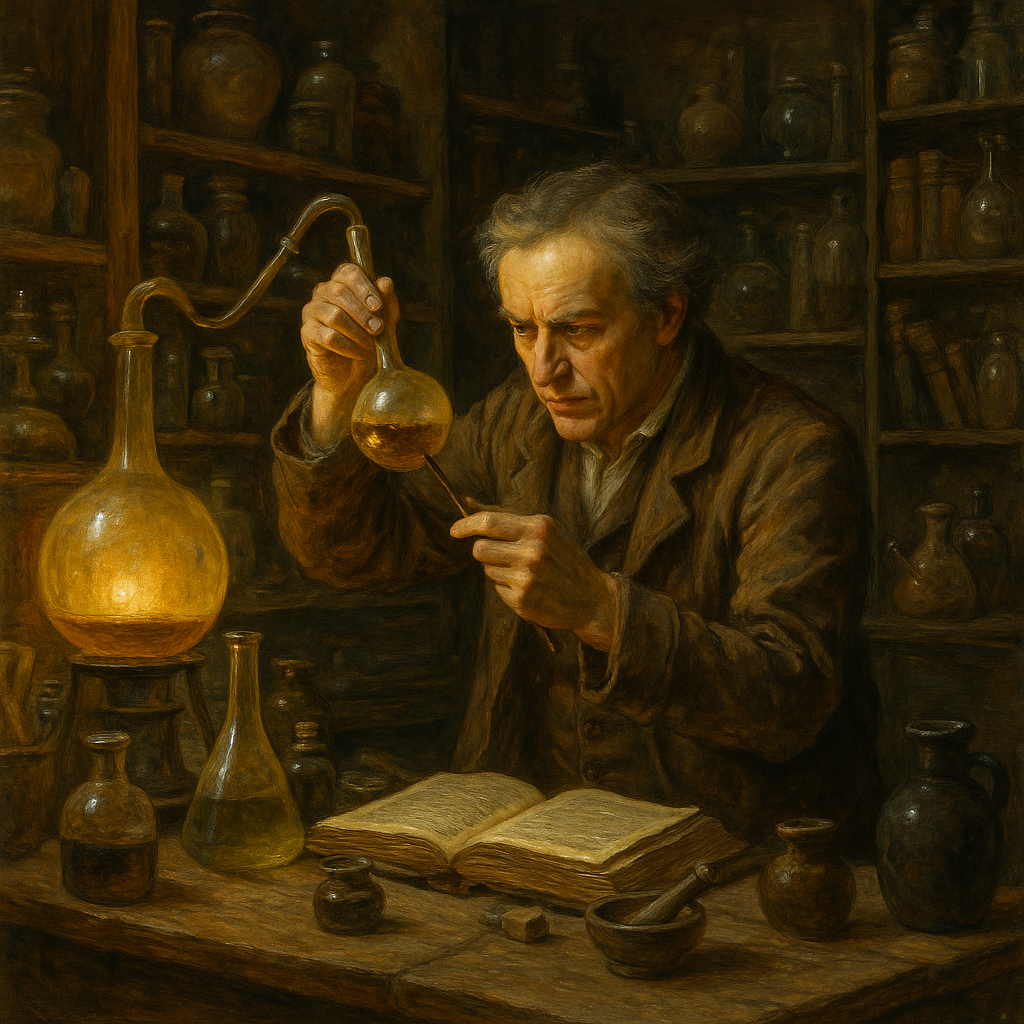
Alchemist
“The skill of an alchemist is what decides his fate.”
Alchemists are Everwealth’s necessary heretics, part-scientist, part-sorcerer, part-undertaker of the world’s last truths. They are neither scholars nor mages, though they borrow sins from both. Where a mage bends The Arcane through will, an alchemist torments reality through knives, powders, and boiling glass, forcing transformation through violence until the world yields its secrets. In villages, they are miracle-workers or war-criminals depending on the week. In cities, they are tolerated hazards, each workshop a potential crater. And in the wastes, they are gods and devils, sometimes on the same day. Alchemy was once the crown of civilization, before The Great Schism shattered its great laboratories into glowing slag. What survived is held by desperate hands, half-legible equations, memory of rituals carved into bone, and the scarred descendants of those who kept experimenting while the world burned. Modern alchemists are scavengers of The Lost Ages, boiling relics no one understands, grinding reagents older than gods, and praying the fumes don’t start whispering. They are healers, poisoners, creators of golems, forgers of homunculi, brewers of miracles, and authors of atrocities. Every alchemist walks with the understanding that the world remembers every cut, every flame, every stolen truth, and will one day answer. To most Everwealthy, the alchemist is a walking contradiction, a healer who stinks of grave soil, a creator who makes nothing without breaking something first, a servant of progress who leaves burning holes where houses used to stand. But to rulers, guilds, and the desperate, alchemists are indispensable, for they alone still dare to touch the world’s original sins.
Career
Qualifications
There are no sanctioned schools of alchemy in Everwealth, only hidden cellars, ruined labs, and the stubborn survivors who teach it. To become an alchemist requires:
- A stomach for horror. Many reagents are harvested from corpses, beasts, or stranger things. Some bite back.
- Hands that do not shake. Precision is all that stands between a healing tonic and a screaming, dissolving death.
- A will to transgress. Every principle of alchemy demands breaking a rule: of nature, of ethics, of the self.
- Intimate familiarity with failure. Failure means burns, madness, or new limbs in the wrong places. Students who survive their first year are considered promising.
Career Progression
Alchemy has no ranks, only thresholds.
- Novices blow themselves up.
- Adepts blow up their surroundings.
- Masters have learned to direct the explosions.
Payment & Reimbursement
Alchemists are paid in coin, secrets, materials, or flesh-stock. Their services include healing tonics, weaponized toxins, magickal reagents, and the creation of constructs. Prices fluctuate widely:
- A healing draught: From a handful of bronze Capras to a noble’s ransom.
- A custom poison: “Market rate” is whatever the victim’s relatives will never trace back to the buyer.
- A homunculus: Astronomically expensive. A golem-core? Priceless.
- An afternoon of labor: Likely to leave scorch marks on every surface.
Other Benefits
Alchemy offers one true benefit: power that obeys no one’s doctrine but your own.
But it also offers:
- Unnatural longevity bought with tinctures and self-experimentation.
- Immunities to sickening toxins and curses
- Influence over guilds, nobles, criminals, and scavenger-kings
- Knowledge that can unmake nations
Perception
Purpose
Alchemists exist to force the broken world to yield something useful. They brew healing in a land where priests are scarce. They craft weapons in an age of devils and undead. They create light in a time when Darkness grows patient. They are the world’s accidental saviors, but more often its architects of disaster.
Social Status
Alchemists are look upon with an ever-watchful eye from the masses. Not one brew bubbles without a flinch from its observer. But if the bubbles don't destroy the flask contains them, you can be sure to see a line of desperate folk looking for any tonic to ease their burdens. Eagerly buying potions from the man they were ready to hang in the streets the second there was a bad reaction.
Operations
Tools
An alchemist’s tools are equal parts laboratory and armory, glassware reinforced with powdered star-metal, bone-handled scalpels sharp enough to cut through curses, mortar and pestle carved from volcanic teeth, rune-burners for branding stabilizing glyphs, and Aether siphons wrapped in leaded cloth to prevent unwanted awakenings. Many carry portable kits strapped to their belts, phials that hiss when uncorked, collapsible alembics, insulated gloves woven with silver thread, and a notebook sealed in oilskin to record every miracle, or mistake, before memory dissolves in the fumes.
Materials
Daily work consumes an endless array of dangerous reagents, monster Ichorthat curdles when near lies, dried moss from cursed ruins, marrow powders, quick-iron droplets, Viridite flecks, and unstable crystalline salts that crackle with old voices. Alchemists must constantly restock charcoal, clean water, binding resins, and sacrificial catalysts, as well as acquire rare components, dragon scales, fae dust, jade splinters, by trade, theft, or grave-robbing. Even the humblest tincture drains supplies faster than coin can replenish.
Workplace
An alchemist’s workplace is a controlled catastrophe, crowded tables sagging under scorched glassware, racks of bubbling flasks throwing sickly light across the walls, and shelves groaning with jars labeled in dead languages. The air smells of herbs, copper, and something faintly alive. Floors are stained with old spills; The ceiling is blackened from past explosions. Strange murmurs echo from covered crates. Every breath is a gamble, every spark a potential disaster, and the room itself seems to hold its breath, waiting for the next experiment to go wrong.
Provided Services
Alchemists offer:
- Healing draughts.
- Poisons and counter-poisons.
- Transmutations of metals, flesh, or essence.
- Brewing of magickal potions.
- Stabilization of relics obtained from Treasure Hunters.
- Explosives for mining, war, or assassination.
- Identification of cursed materials.
Dangers & Hazards
Every alchemist works with one foot already in the grave. Fumes that rot the lungs, reagents that ignite on a whisper, essences that whisper back, and potions that mutate the body instead of mending it, all are common hazards of the craft. Explosions are frequent, often fatal, and rarely leave enough remains to bury. Long-term exposure to volatile materials can warp the mind, twist the flesh, or attract things that feed on magickal leakage. Even success carries danger, newly born homunculi may lash out, unstable golem cores may rupture, and transmuted metals may revert violently if mishandled. Alchemy is not a profession so much as a slow, meticulous form of self-destruction.
Legality
Alchemy is technically legal across Everwealth, but only in the same way open flame is legal in a tinder-dry forest, tolerated until it kills someone. The Monarchy, The Scholar's Guild, and The Arcane Coalition each claim jurisdiction over alchemical practice, though none agree on what constitutes “safe.” Creation of homunculi is forbidden by royal decree, yet every noble house employs one. Transmutation above basic metal refinement requires a License to Practice Magick, though back-alley labs ignore this freely. Forbidden alchemical acts, soul-binding, corpse reforging, Aether harvesting, or manufacturing volatile essences, carry penalties ranging from crippling fines to public execution depending on region and mood of the local magistrate. In truth, alchemists survive less by obeying the law and more by staying beneath its gaze.

Comments