
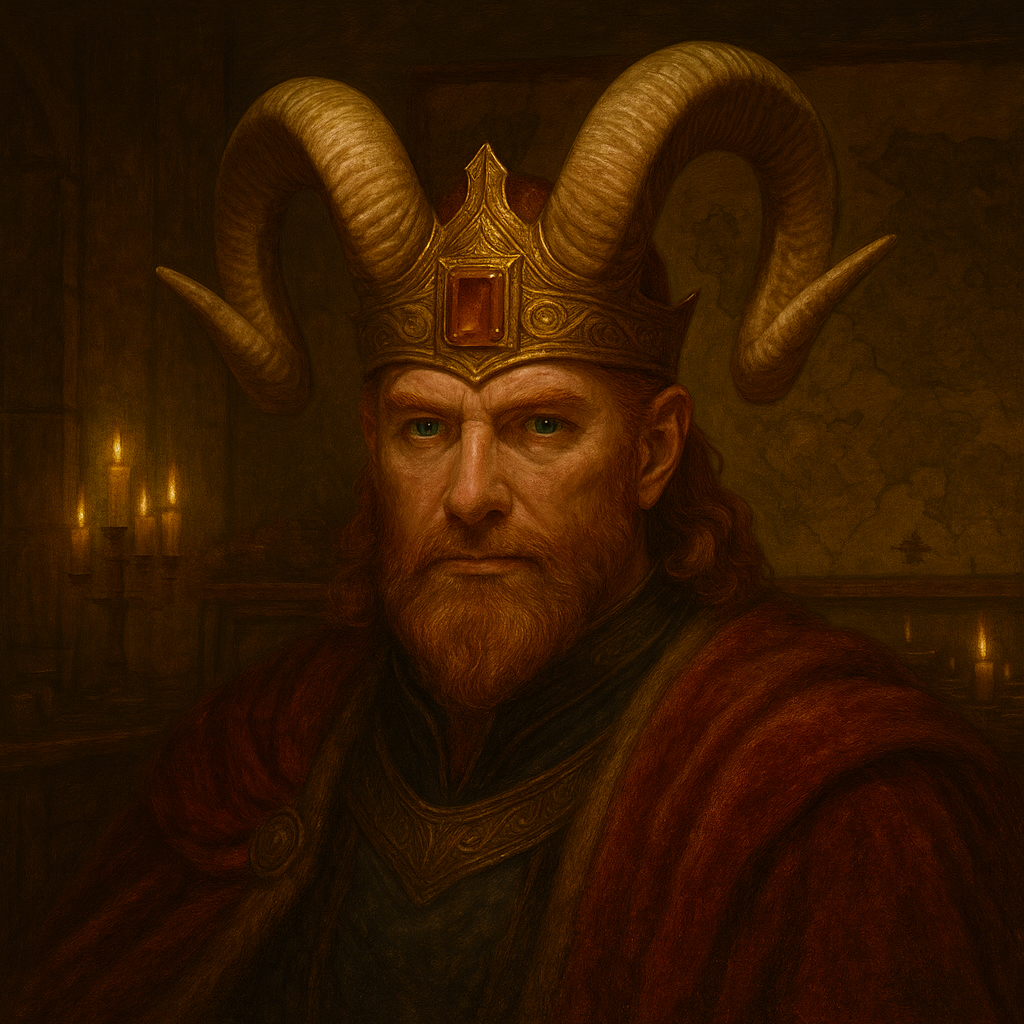
The Monarchy
"I pledge my Arm... For every Sword.
I pledge my Heart... For every House.
I pledge my Back... For every Burden.
And I pledge my Life... for Kin and Country."
-Oath of the King.
The Monarchy of Everwealth styles itself as a democratic monarchy, a bold experiment where power is both crowned and chosen, a kingdom that claims to balance the sanctity of trusted bloodlines with the will of its people. The reality is an edifice built upon corruption, compromise, and careful illusion. The Valmore dynasty has sat upon the throne since the nation's founding, their succession hereditary and unquestioned. But beneath them, the stations of dukes, counts, viscounts, or judges, are filled not through true consent of the governed, but elections that resemble shadowy markets more than any ideal of representation. The people do cast votes, and parchment records are drawn up to preserve the appearance of participation. Yet those votes are not born of free choice. They are purchased with bribes of bread or coin, coerced by threats of violence, or guided by the heavy hand of local lords, merchant syndicates, and guildmasters who all stand to profit from placing “their man” in power. Whole villages have been starved into compliance, while others have been promised exemptions from taxation that never materialize. To speak of free elections in Everwealth is to speak of a play staged for the benefit of the powerful. The design of the system is not fairness, but control. Its purpose is to maintain the Crown’s supremacy while binding every official beneath it in webs of obligation, blackmail, and graft. Each new officeholder, no matter how earnest, finds themselves shackled to unseen patrons the moment they take their seat. The debts owed for their election, coin, favors, silence, press down like millstones, drowning whatever good intentions may have lingered in the mire of Everwealth’s political machine. Thus, while Everwealth may outwardly appear to be ruled by monarch and council alike, its governance is not the work of unity, but of endless compromise, half-truths, and secret knives in the dark. It is not a system designed to serve its people, but one that sustains itself by consuming them.
Hierarchy and Appointment
- The King or Queen, 'The Ram’s Head' - The monarch embodies stubborn authority and is the living symbol of Everwealth’s endurance. Yet their “absolute” power rests upon a precarious balance: loyalty secured through patronage, intimidation, and the timely elimination of rivals. Decrees minted into Capra coins remind subjects not of unity, but of the Crown’s monopoly over labor and life itself.
- The King’s Wizard, 'The Horned Sage' - Officially a trusted counselor; in reality, a scapegoat and lightning rod for public paranoia. Accusations of sorcery, curses, or corruption are often whispered by dukes eager to clip the Wizard’s influence. Many vanish without explanation, replaced as soon as the Crown finds a new sorcerer willing to play both servant and shield.
- The Duchy, 'The Horned Council' - Dukes and Duchesses are elected by popular vote to rule and protect large territories on behalf of the king; As well as supply troops for the military and, of course, collected taxes. But no one pretends the outcome reflects the people’s will. Votes are bought with sacks of grain, “protection” from mercenary bands, or outright intimidation. Each bi-monthly summit they are required to attend, is less council and more open brawl, daggers in the back as often as dead bodies are found along the roads. Entire regions fall under their authority, and are frequently stripped bare to fund their personal interests.
- The Marquessate, 'Keepers of the Horns' - Marquesses are appointed directly by dukes, not elected, often chosen for loyalty rather than competence. They serve as enforcers and brokers, ensuring their lord’s interests remain unchallenged. While meant to keep order, they are notorious extortionists, skimming bribes from festivals, market stalls, and even funerals.
- Counts, 'Wardens of the Ram' - Counts are elected by the people to take charge of a specific city and its neighboring villages; Often only from families wealthy enough to afford campaigns. Their position gives them near-total control over these territories, making them the most visible face of oppression to the common folk. Many cultivate private militias disguised as city guards, loyal more to coin than to crown.
- Viscounts and Governors - 'The Hoofbearers' - Viscounts are appointed by Counts, though the post is often auctioned outright. They are tasked with keeping order in settlements under the count's banner; But more often bleed them dry through unjust levies and arbitrary judgments. Their hoof-adorned boots are not symbols of stewardship but reminders of the heel forever pressed upon the people’s necks.
- Barons, 'The Hornless Lords' - Technically outside the hierarchy, Barons wield influence through sheer wealth. Their fortunes allow them to bribe judges, purchase mercenaries, and sway elections. Though mocked as “hornless,” many Barons boast greater sway than dukes, carving out small kingdoms within the kingdom.
- Knights, 'The Ram’s Charge' - In theory paragons of honor; in truth, mercenaries elevated by noble favor. While some few retain their oaths, most serve as armed retainers for corrupt lords. Their presence inspires dread as often as hope, depending on whose coin they carry.
- High Justiciar - Purchased into power and placed above all other judges, the High Justiciar oversees every court and ruling in the realm. Their judgments and legislations outrank all others, yet their verdicts are bought and bartered like any commodity.
- Chamberlain - Keeper of the treasury, but also the kingdom’s most dangerous broker of secrets, their ledger often more potent than a sword.
- Keeper of Lore - A hostage of knowledge, trapped between truth and censorship, keeping dangerous truths hidden or selling them to the highest bidder.
- Herald of Arms - The Ram’s mouth, feared less for their words and more for the taxes and levies that inevitably follow them to 'feed' the kingdom.
Beneath the noble ranks and great offices of state, the practical business of keeping Everwealth safe falls to a sprawling ladder of constables, guards, and captains. Their authority stems from the nobility above them, but their reach is felt daily by common folk.
- Captain-General of the Armies - The supreme commander of Everwealth’s forces, answerable only to the Crown. All soldiers and officers in The Everwealthy Military ultimately fall beneath their banner; But is just as likely to sell commissions to alter his decision making. Abandoning campaigns, or turning victories into personal glory at the Crown’s expense.
- Regional Marshals - Appointed by Counts or Dukes, Marshals enforce royal law in wide territories. They coordinate troop musters, levy militias, and ensure that roads, bridges, and ports remain secure.
- Captains of the Guard - Serving under Viscounts or Governors, these men and women command a town or city’s standing guard. They are responsible for patrols, training, and justice within their walls. In practice, Captains are often as feared as the nobles they serve, balancing lawkeeping with political expectation.
- Constables - A hybrid civil and military office, constables enforce local decrees, manage prisons, and maintain order in villages or districts. Appointed by Viscounts or Barons, they serve as the bridge between peasant life and noble will. Historically, constables are the ones who interpret the law most harshly, for bribes, favors, or grudges.
- Serjeants & Men-at-Arms - Veteran soldiers elevated above common guards, serjeants lead small patrols, guard noble households, and carry out arrests. Many were promoted from the ranks of commoners and are known for their loyalty to pay rather than principle.
- City Guards/Watchmen - The lowest rung, these men and women patrol streets, gates, and markets. Paid in Capras by the city treasury, their loyalty is often fickle, and corruption commonplace. Guards serve under captains, who in turn answer to Marshals or local Viscounts.
- Ward Constables (Minor Office) - In larger cities like Wardsea or Gullsperch, each ward or district maintains its own constable, an officer responsible for raising alarm bells, mustering militias, and reporting crimes directly to the Captain of the Guard.
- Counts and Judges are “elected” by common vote, but candidates rely on guilds, merchant houses, or noble patrons to finance campaigns. Bribery, coercion, and outright violence determine more ballots than genuine support.
- Dukes and Duchesses are elevated through regional votes, but electors are often the very Counts and Barons already bought and bribed. Whole villages have disappeared overnight for voting the “wrong” way.
- Viscounts and Marquesses are rarely chosen by the people. They are appointed by their superiors, who expect loyalty, tribute, and silence in return.
- Judges are supposedly impartial defenders of law, but often enter office after paying vast sums, treating courtrooms as businesses where verdicts are sold.
Interesting Facts
- Electoral Feasts - During regional “elections,” dukes and counts host public banquets to buy loyalty. The bread is free; The wine is not. Any village that fails to send delegates to the feast is quietly marked as disloyal, and within a year, its taxes double “for the King’s patience.”
- The Silent Throne - The monarch never speaks publicly without the Herald of Arms present. Should a sovereign utter a decree without that witness, the law considers it null by silence. This has led to several “accidental abdications,” swiftly corrected by convenient assassinations.
- Kings Coins - Capras minted in the first year of a monarch's reign are stamped with the ruler’s name; A prized item for many coin collectors, a full set of 13 King's Coins for each member of The Valmore Royal Line is worth hundreds if-not thousands of gold Capras to the right buyer, even otherwise near-worthless copper or bronze versions.
- The Palace of Ears - Beneath The Ivory Tower runs a warren of tunnels where whispers are carried through silver horns embedded in the walls. Courtiers claim the monarch can hear any conversation held within a mile of the throne. Servants swear they’ve heard the walls breathe back.
- The Hornless Bargain - Barons may purchase a temporary seat in council by paying the Hornless Levy, a tax so steep it equals a village’s harvest. Though derided as “merchant kings,” their votes often decide wars and executions. The phrase “bought crown, borrowed neck” refers to their precarious power.
- The Chamberlain’s Right - The Chamberlain controls not only the treasury but succession itself. If the crown dies without heir, it is the Chamberlain who “finds” the next of kin. Three times in history, entire bloodlines have been fabricated on parchment overnight.
- Royal Mirrors - Every throne room mirror in Everwealth is bound with trace magick, reflecting not the present monarch, but the first Valmore king. Courtiers say this keeps the line “unbroken.” Others whisper the reflection occasionally smiles on its own.
- The People’s Voice - The kingdom’s official voting quills are dipped in ink mixed with ash from past petitions. The act is called speaking in soot. When a vote fails to please the nobility, the ash from the burned ballots is recycled into next year’s ink. Thus, the people quite literally write with their own erasure.
Founding Date
01 CA
Capital
Head of State
Government System
Monarchy, Constitutional
Economic System
Post-scarcity economy
Related Professions
Controlled Territories
- Axebreak
- Bogshield
- Bordersword
- Boulderrain Woods
- Catcher's Rest
- Crossing
- Dwarfshire
- Fireside
- Greatshadow
- Gullsperch
- Halt-Cliff
- Lambsrest
- Landsbridge
- Lough Icewind
- Lough Shears
- Merchant's Meet
- Middleglade
- Moonpine Forest
- Opulence
- Rootspire Keep
- Rootthorpe
- Snaketongue River
- Stargaze
- The Ramshackle Islands
- The Stonejaw Mountains
- Twin-Peak
- Wardsea
- Woodsend
Related Items
Notable Members

Comments