
The Everwealthy Military
"The Ram charges forward, even when the ground itself screams beneath its hooves."
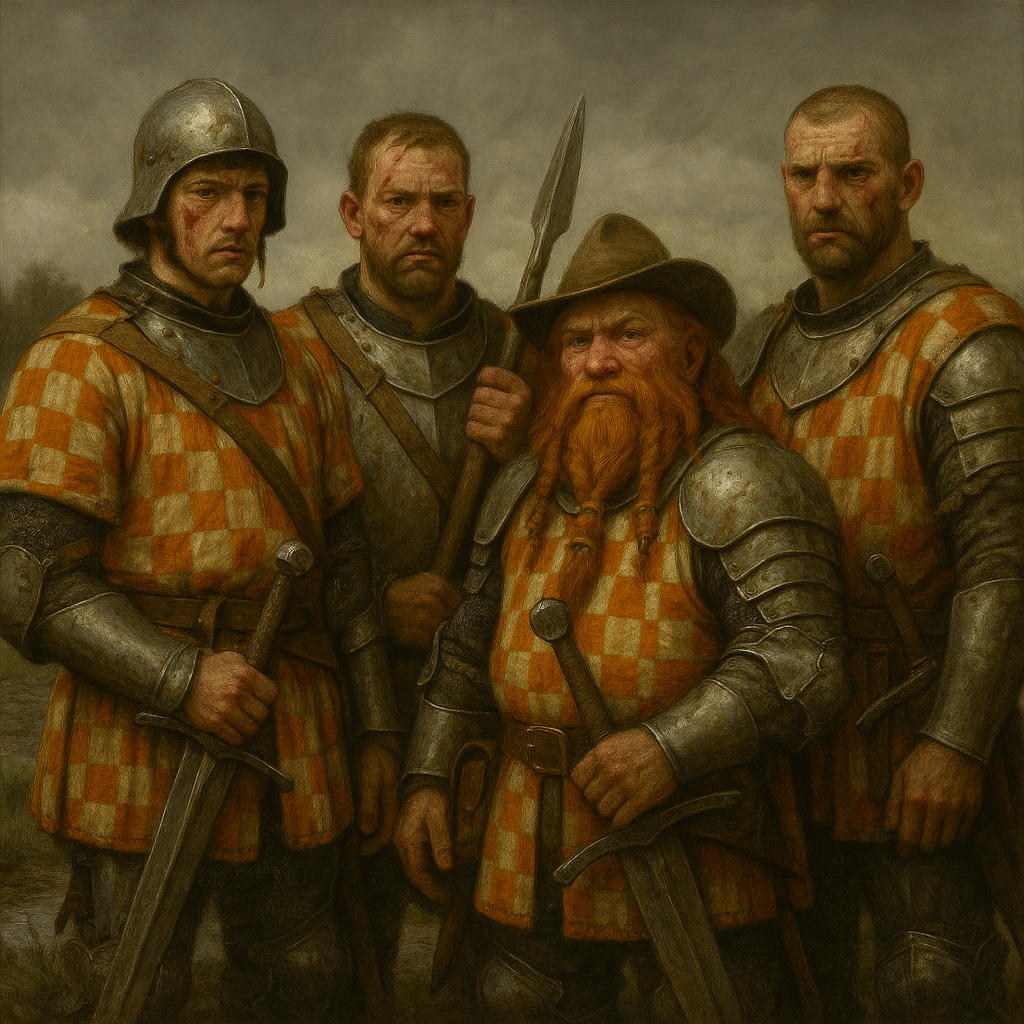
In Everwealth, war is not a profession, it is the weather. Eternal, inevitable, and wholly indifferent to those caught beneath it. The Everwealthy Military stands as the living embodiment of this truth, a vast, grinding engine of bodies and iron who have long forgotten what peace even is. Its flag, The Charging Banner, a white and orange checkerboard crowned with a ram’s head, marches across land, sea, and sky, proclaiming dominion where none is truly held. To outsiders, the military appears as a formidable juggernaut, a kingdom that never stops charging despite every hurdle seemingly possible standing in their way from Dragons to Corruption; It is a machine that devours its own, a labyrinth of mud, blood, decrees written in ash. The Army, trudges endlessly through the mires of conquest and containment, little more than starving peasants armored in rust and faith. The Navy, holds legions of half-rotted ships beneath it, an armada stitched from wood and rusted steel, surviving through superstition and what tar patches hold. The Air Corps, flies relics of The Lost Ages that could explode at any moment, fragile sanctuaries suspended between miracle and disaster. Together, these branches are the anatomy of Everwealth’s might sustained by the grit of desperation, enduring like a stubborn wart. The Everwealthy Military has outlasted kings, plagues, and even The Great Schism itself, held loosely in formation through it all. Drafted men, condemned criminals, slaves, mercenaries, and zealots alike bound beneath the crown; Forced to march to wars older than their grandfathers’ graves. Victories measured in scars, lands taken and winters survived. Its commanders wear polished white and orange like gods of order, while its soldiers rot in the trenches, eating boiled rats and whispering prayers to gods who haven't spoken in hundreds of years. It is said that Everwealth’s power rests on the promise that its armies will still crawl forward when everything else has burned away. And so they do, across fields of ash, over seas of splintered timber, through skies choked with smoke and ghosts. The Ram must charge, even if the only thing left to trample is itself.
Career
Qualifications
Recruitment into the Everwealthy Military is not born of choice, but of circumstance. Volunteers are rare, usually starving farmers, debtors avoiding the noose, or zealots who mistake service for salvation. Most are conscripted in the Crown’s “lottery,” a grim euphemism for forced draft that sweeps through villages twice yearly. Each household must offer a son or suitable replacement; The draft itself is woven into the so-called democratic fabric of Everwealth. Every household that votes in royal elections signs, in ink and blood, a pledge of service. To refuse conscription is to refuse citizenship, a crime punished by fire or famine. Those who resist see their livestock seized, their taxes doubled, or their homes set ablaze “for desertion of duty.” While literacy and strength are ideal, neither is required. Commanders prize endurance, obedience, and a willingness to kill. Criminals sentenced to death may exchange the gallows for the front lines, branded with the Ram’s sigil and dubbed “Pardonmen.” The rare few who display courage or competence are offered paths upward, though “promotion” often means command over hungrier men and fewer supplies. Nobility contribute officers rather than soldiers, their sons paraded through brief academies before inheriting command. Mercenaries and free companies are routinely hired to bolster the ranks, their loyalty secured through coin and promise rather than patriotism. In the end, the military is less a unified body than a collection of desperate men and bought blades stitched together by necessity and fear.
Career Progression
The ladder of advancement is steep and slick with blood. Draftees begin as Levy, trained for a handful of weeks before being thrown into service. Those who survive their first campaign become Footsoldiers, and with enough kills or corpses left behind, Serjeants, entrusted to keep others from fleeing. Captains lead companies of men and are often petty lords or grizzled veterans rewarded with authority in lieu of retirement. Above them, Legion Commanders oversee thousands, typically elevated through favor or familial debt rather than merit. The highest mortal rank, Field Marshal, commands entire provinces and answers directly to the Captain-General, the supreme commander of all land forces and one of the most dangerous men in Everwealth. The authority of the Captain-General rises and falls with the Crown’s strength. In times of weak monarchs, he acts as an uncrowned warlord, commanding the loyalty of whole provinces. When the Horned Council exerts its influence, his campaigns are bound by their purse strings and their politics. Parallel hierarchies govern the Navy and Air Corps, though rank mirrors role. These Admirals and Air Generals wear near-identical white uniforms; Only the epaulettes mark whether they serve the land or the sea. In truth, most careers end before a soldier learns the difference, the army buries more of its own than it ever promotes.
Payment & Reimbursement
Pay is meager and irregular. Soldiers receive wages in silver Capras, often weeks late or shaved down by “logistical errors.” A man may starve beside full wagons of grain marked for officers. To the desperate, even crumbs are worth the risk. The incentive lies in spoils. Loot taken from enemies, coin, wine, women, weapons, becomes unofficial compensation. Officers pretend not to see it, so long as their share arrives untouched. Promises of steady food and shelter lure countless peasants from frost-bitten farms. The army guarantees three meals, even if it’s rat-stew, A bed, even if it’s in a ditch, and pay, even if it’s stolen behind the quartermasters' back. Navy crews fare little better. Sailors live on salted fish and prayer, paid in arrears and lashed for complaint. Airmen are rarer still, compensated in hazard pay that doubles their lifespan on paper but halves it in practice. Those assigned to man hot-air balloons or salvaged airships receive death pensions for families who rarely live to collect them.
Other Benefits
For all its brutality, service offers what Everwealth seldom grants, structure, food, and identity. A conscript gains lodging, a uniform, and the illusion of purpose. Veterans receive exemption from certain taxes, and cripples are sometimes granted posts as watchmen or prison guards. For nobles, command confers prestige and proximity to the Crown’s ear. For commoners, it offers a chance, however slim, to climb above the mud. In wartime, soldiers enjoy a twisted sort of immunity, murder on the battlefield is valor, theft from the dead is tradition. Those within auxiliary arms, engineers, quartermasters, sappers, beast-handlers, may live longer, though the taint of cowardice follows them. Better to die in the charge than survive the shame of digging latrines.
Perception
Purpose
The Everwealthy Military exists to hold the realm together by threat alone. Its primary function is not conquest, but containment, keeping peasants compliant, borders burning, and monsters at bay. The army bleeds so the Crown can tax; The navy sails so merchants can trade; The air corps drift so nobles can boast of dominion over the skies. Its unspoken motto, “Endure and Burn,” is carved into memorials and skulls alike. No soldier fights for glory, they fight to delay collapse. Every battle buys the kingdom another winter. Every victory costs its future a little more.
Social Status
Among Everwealth’s people, soldiers are pitied as much as revered. To serve is to be consumed. Farmers see them as both saviors and scavengers, protectors from raiders who will still steal their last goat. Nobles toast them in public and curse their expense in private. The navy commands slight respect, its captains known as drunken tyrants who survive storms through luck and stubbornness. Sailors are folk heroes when ashore and criminals when not. The air corps, though tiny, enjoys near-mythic status; their dirigibles blot the sun, their aeroplanes whispered of like ghosts. To glimpse one in flight is a memory for life, or the last thing you’ll see before the fire rains down. Within the ranks, camaraderie replaces loyalty. Units form their own cults of survival, squads that share food, blood, and secrets. These micro-societies persist even after discharge, birthing veterans’ gangs and militias that haunt the slums.
Demographics
The majority of soldiers are Human and Dwarfish, drawn from the northern and inland provinces. Orcish and Giant mercenaries serve as shock troops or siege breakers, valued for endurance and expendability. Elfish deserters and mixed-bloods fill the scout corps, their heritage both weapon and curse. Women make up nearly a fifth of the ranks, though officially unacknowledged, their names scrubbed from ledgers, their deaths counted under “miscellaneous losses.” Entire companies of plague-survivors and magick-scarred veterans form irregular units used for suicide missions or chemical labor. The navy recruits from coastal cities like Wardsea and Gullsperch, while the air corps favors engineers, artificers, and anyone reckless enough to step into a balloon basket that might explode.
History
The Everwealthy Military was not born in triumph, but in necessity. During the Great Schism, when famine and violence fractured the realm, the Crown realized that armies loyal to noble houses would never suffice. A unified, state-controlled force was decreed, conscription for the masses, command for the rich. From the ashes of mercenary bands and crusader orders rose the military we know today, massive, bureaucratic, and unending. In the centuries since, it has survived not through discipline, but inertia. Wars with Kibonoji’s Elfs, skirmishes with Kathar, and endless rebellions within its own borders have kept its blades wet and its coffers drained. Each victory has been pyrrhic; Each peace, temporary. The navy emerged from necessity as well. The conquest of Wardsea demanded fleets capable of patrolling trade routes and suppressing piracy. Their proudest era saw battleships of the Lost Ages, relic iron leviathans, refitted and lashed to wooden escorts, forming grotesque flotillas known as “Sled Ships.” When the engines failed, sails replaced them; when the sails tore, prayers sufficed. The air corps is the youngest branch, a ghost of greater ambition. Reconstructed from salvaged hot-air balloons, patched airships, and pre-Schism aeroplanes, its fleets once served as the monarchy’s floating crown. Now they are relics, rusted engines crewed by madmen. Each launch risks explosion; each landing is a miracle. Yet in this age of dragons, sky-beasts, and the looming eastern war, even relics are pressed into service.
Operations
Tools
- The Everwealthy Army wields a grim assortment of weapons, pikes, halberds, crossbows, match-rifles, and ancient artillery that cough smoke more than shot. Siege engines rumble alongside armored transports scavenged from the Lost Ages, their tracks screeching like tortured iron.
- The navy commands both wooden galleons and ironclads, many so decayed they must be towed in formation by sailing ships. Boarding hooks, swivel-guns, and blackpowder mortars remain standard. Crews patch holes with tar and prayer.
- The air corps deploys dirigibles fitted with spear-casters, throwing hooks, and bomb-barrels, crude explosive jars dropped by hand. Their rarest treasures are the surviving aeroplanes, “Ironbirds” armed with bolt-cannons or incendiary payloads. Each flight drains more resources than a ground campaign, yet the sight of them keeps distant enemies trembling.
- Uniforms unify the chaos, orange-and-white checkerboard coats over chain or plate, the Ram’s Head sigil emblazoned bold on breast and banner. Officers and high command wear all-white with checkerboard sashes echoing The Charging Banner. Those sashes mark allegiance to the Crown, or, in black markets, serve as forged or stolen permits for smugglers and spies.
Materials
The military consumes more iron, grain, and flesh than any other institution in Everwealth. Its forges melt church bells and farm tools into blades. Its shipwrights strip forests bare for masts and hulls. Alchemists brew fire-powder in hidden foundries, their lungs blackened before the age of thirty. Supplies rot as often as they reach the front. Bureaucrats sell rations to merchants; quartermasters fill wagons with sand. Boots crumble, muskets misfire, airships leak. Still, the machine lurches forward, devouring everything it touches.
Workplace
The battlefield is every soldier’s home. Mud, salt, and sky serve where hearths cannot. Garrisons dot every major city, ranging from stone fortresses to repurposed ruins. The largest encampments, The Ram’s Fields, sprawl outside Opulence, housing thousands in perpetual readiness. Navy ports line Wardsea and the Ramshackle Islands, clinging to what little coastal land The Battlement Cliffs have left accessible like stink to death. The air corps operates from hangars carved into cliffs, vast cathedrals of rust where gas and prayer mingle. Barracks are overcrowded; infirmaries overflow. Disease is the only officer that never resigns.
Provided Services
The Everwealthy Military is the kingdom’s arm and gallows both. It defends the borders, crushes uprisings, enforces taxes, escorts convoys, and polices the roads. It digs graves as often as it fills them. In peace, its presence ensures obedience. In war, it ensures survival, or at least postpones extinction. Units sometimes assist The Monarchy’s courier corps, The Ram’s Riders, carrying sealed decrees or prisoners between provinces. Others act as enforcers for guilds and barons, hired unofficially to suppress strikes or eliminate rivals under the guise of “training exercises.”
Dangers & Hazards
To serve is to suffer. Disease, starvation, and command incompetence kill more soldiers than enemy steel. The navy drowns by storm; the air corps burns in flame. Draft evasion is punished by hanging, desertion by mutilation. Psychological rot festers deeper still. Survivors speak of hallucinations, the whispers of their fallen comrades or the howling horns of phantom Rams in the night. Alchemically enhanced soldiers occasionally mutate, their bodies rejecting magickal rations or cursed gear. Entire regiments vanish into fog-ridden forests and never return. Corruption compounds every hazard. Generals sell positions. Captains sell protection. Medics sell morphine distilled from poppy-ash that kills more pain than patients. Yet despite it all, the lines never break. Fear, duty, and hunger drive them forward, and in Everwealth, those are the only things that ever have.
Legality
- Fully sanctioned by The Monarchy, the military acts as both law and executor of it. It may conscript at will, seize property for “national defense,” and override local governance during wartime, which is always.
- Its commanders swear oaths to the Crown, yet corruption ensures their true allegiance lies with whomever keeps the rations flowing. Civil courts cannot prosecute active officers; Only the Crown’s tribunal may do so, and seldom does.
- Draft riots, mutinies, and massacres have occasionally forced reforms, but none last. The machine endures, humming on blood and bureaucracy. It is, in the end, the kingdom’s truest reflection, brutal, hungry, and immortal so long as there are rams left to charge.
Famous in the Field
Used By

Comments