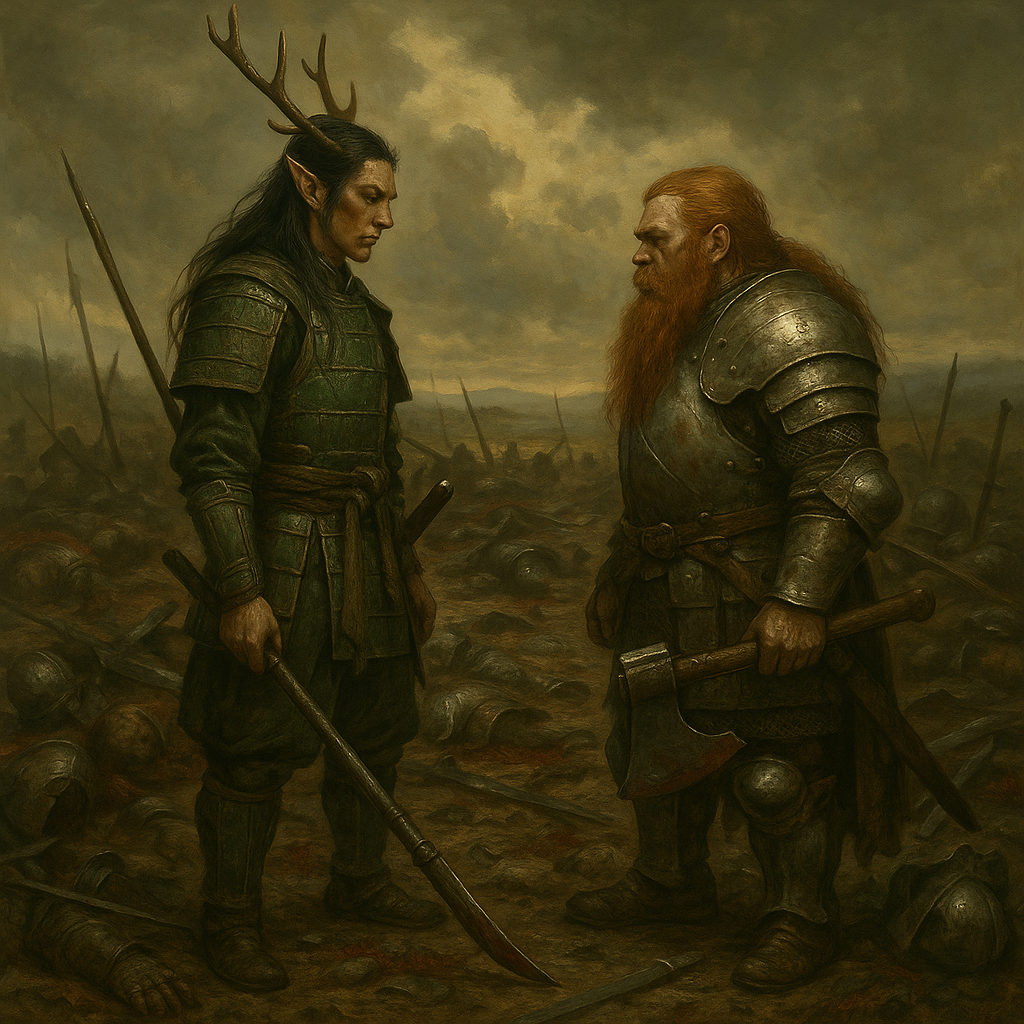
"You ever wonder... if any of this will mean anything at-all, Elf? All these lives gone to waste for some plot of land changing hands by the day?"
"...We shall soon find out."
What would be burned into our minds through a hundred years of bloody death, as the most cataclysmic event the world of Gaiatia has ever known. The Great Schism would mark the end of an age, thousands of years of progress wiped clean in a desperate bid for survival across the planet. Our realm of The Folklands was left in tattered ruins in the wake of an event known as The Fall, where a winged hydra golem possessed by a wrathful goddess, who's armies of Devils attempted to conquer the world of old, would crash to the ground like a great meteor upon her defeat; The impact wracked the land with one disaster after another, horrible tremors, crashing winds, towering waves of water and magma alike. Kingdoms burned, nations sank into the sea, hundreds of species along with entire cultures were blotted out from history, yet, only the start of the travesties. Those few who would survive all this, their infrastructures gone, no homes to return to with the laws which protected them unwritten, were now lost; Without food, shelter or security to be found. Where in hindsight we may have salvaged The Lost Ages after the Fall despite its many setbacks, the uncertainty of the time, the shock, the dread, after losing practically every known corner of the world, made it-all seem... hopeless. Leaving many folk with what seemed to them their only option. To fight tooth and nail just to survive. With no consideration for what could have been; No thought for what might be if they stopped killing eachother again and again to secure diminishing supplies for another fleeting moment. And so fight they would, for a century they would fight, for what meagre scraps they could, nothing to go back to with nothing else to lose. Millions of souls were sent screaming into the void in these horrific battles who's combatants saw no other choice. This struggle, would at it's end set society back much, much farther than The Fall, countless academies, crafts and institutions destroyed in the ceaseless fighting to claim anything the survivors could find. This persisted like depraved routine, until new kingdoms with new borders were finally established, and the world, at least what remained of it once the fighting was done, would take a brief reprieve from generations of constant slaughter; And The Civil Age, would begin.
The Conflict
Prelude
Too many small conflicts bubbled over all-at-once to decide one clear moment the Schism broke out across the world. In the case of Everwealth specifically, the Schism would begin with the refugees of Tarmahc, cradle of Humans, Giants, and Smallfolk to name a prevalent few. These folk en masse found themselves here, what was once Chikara, land of the Elfese, on a desperate quest for aid as their home had taken the brunt of The Fall; Reduced to at the time inhospitable islands under constant volcanic eruptions. Unfortunately for the refugees, although they and the Elfs once shared a common cause on the battlefields against the devils that caused it, the Elfs while being in a position to offer aid, were only so due to their near-zealous dedication to their empire and it's cold, yet efficient mandates. Suchly they would expect no less than full adherance to Elf customs for even the most basic assistance. By Elfese rule those under it's banner would want not for food or shelter, both of which the refugees were in dire need; But for this it would ask of them to abandon their sick and their old, to worship only Elfese Gods, to be complicit in their slave trades, that all able-bodied men were to serve in their military or be executed for treason, and a great number of other, enticing, conditions. Though some refugees were desparate enough to abide these terms, many among the refugees would find their offer unnacceptable, deeming them an affront to their every moral fiber; Until the ravages of the Schism to follow would ironically alter many of their apprehensions towards similar acts of slavery and demands of service out of sheer desperation. But for the time being, the refugees chose fend for themselves, though free to hunt amid the barren outer edges of the Chikaran wilds as a 'kindness'. After the refugees were turned away, forced to make another great trek through now savage lands, many would die to disease, injury or starvation, the coming winter cold especially burdensome. Things were wretched for quite some time, until a chance meeting with other foreign refugees would turn the tides in their favor, but set the stage for the Schism to come.
The Dwarfish people of old Kathar also found themselves cast away from their homeland, journeying here to the Elflands in search of sanctuary. Dwarfs suffering among the worst of the Fall, reduced to under 2,000 by it's end, their lands ransacked, their history burned and looted. The Dwarfs were desparate, but none it would seem were desparate enough to forsake what remained of their culture to accept Elfese terms. Thusly, the Dwarfish people so too were turned to the badlands at the edges of the western forest wracked with waves and crumbling new-formed cliffs. Eventually the two groups of obsconded survivors would meet, gladly sharing supplies and expertise between eachother to increase the odds of their survival. This would mark a turning point for the new alliance, for the first time in years it would seems like things were looking up, for them, the Elfese however would seem to grow more discontent with every moment. The now conjoined efforts towards hunting, foraging and upriver fishing of the Dwarfs and the Tarmahc refugees, drastically hampered the Elfese's own. This would see their marginal success post-Fall begin to rapidly break down, soldiers and citizens defecting by the hundreds from worsening restrictions and living conditions, their people hungrier, sicker, angrier with each rotation of the sun and moon. Morale deteriorating every moment, tensions would soon reach a boiling point; The Elfese leadership arriving at the conclusion the refugees they previously granted lands at the edges of the wilds, were no longer welcome, sending detachments of soldiers to the refugees' encampments to 'ensure' their cooperation. The refugees however with nowhere else to go, beyond furious these lands they were gifted would now be swept up from under them by force, as well made a decision, that they were here to stay; Striking down the soldiers sent to drive them away, in doing-so declaring war on the Elfese masters of the land, a bloody and terrible war which would last 100 years.
The Great Schism was not a war of borders, it was a war of belief, betrayal, and desperation. Forces were rarely deployed in clean formations or under unified banners. Instead, armies were pieced together from shattered kingdoms, fractured guilds, and surviving remnants of ancient civilizations. Deployment varied wildly by region. Dwarfish holdfasts fielded disciplined phalanxes and mechanized siege tools, while Orcish clans marched in migrating warbands, choosing battlefields with brutal intent. Human commanders often improvised, deploying troops defensively around arcane ruins, collapsed cities, or water sources. The Elfese, though fewer in number, deployed with terrifying precision, small, elite forces used speed and enchanted terrain to turn even minor engagements into massacres. The Schism favored whoever could move faster, sacrifice more, and wield magic without flinching.
No two battlefields in the Great Schism were alike. Wars were waged in crumbling metropoles, across floating islands, within sundered forest canopies, and even atop the bones of what may very well be a dead God. Magick distorted the terrain: rivers turned to glass, mountains bled, and valleys howled with spectral winds. Some sites remain permanently cursed, places where time folds in on itself or where soldiers' screams echo eternally. One infamous battlefield, The Weeping Hollow, was a plain of
Kathar so soaked with blood and arcane fallout that nothing has grown there since, not even moss. Skirmishes on the edge of the Otherworld, or deep beneath the surface in collapsed Dwarfish strongholds, were as common as open-field charges. No battlefield was ever truly “secured”, they merely changed hands long enough for someone to die on them.
The conditions during the Schism were merciless. Food and clean water were rare, healing magic taxed to its limit, and the wounded often left to rot. Weather itself turned hostile: magickal storms shattered supply lines, aurorae burned skin, and nights stretched on for weeks in cursed regions. Diseases born of alchemical residue and divine fallout took as many lives as blades did. Soldiers suffered not just physical wounds but psychic ones, plagued by madness, divine whispers, and dreams of cities that never existed. Many died before ever reaching the fronts. Others found themselves conscripted by warlocks, forced to serve as arcane batteries for rituals they could not understand. The line between soldier, victim, and resource blurred, and mercy became a rarer thing than gold.
Engagements during the Schism defied all prior conventions of war. There were no agreed-upon battle times, no declarations, no truces worth the ink they were written in. Armies ambushed each other at funerals, parliaments, even within churches mid-sermon. Some conflicts lasted minutes, single, catastrophic magicks annihilating thousands, while others stretched for years in sieges that drained the land itself. Entire factions disappeared overnight, erased not by defeat, but by forgotten gods or errant experiments. The most dangerous engagements were not fought with armies, but with ideas, what to believe, what to burn, and who to follow when all the gods had fallen silent. The final years saw battles fought in shadowed dimensions, with tulpas and echoes of fallen cities standing where generals once did. Victory, when it came, felt more like survival than triumph.
The Elfese declaration of war, though contextually only relevant to Everwealth specifically, would see the loose cooperation between the broken, displaced folk across the globe as they picked up the pieces of their lives finally shattered, becoming the first of many micro-wars that would go without pause for a hundred years. The intrepid refugees and the Elfs over Everwealth, then
Orcish and many Beast-Kin to the south over post-Dwarf Kathar, the
Serpentine and
Lizard-Kin over the jagged islands Tarmahc was reduced to and whatever land or resource the warring survivors of the Fall had found for themselves and managed to hold, in an all-consuming age of aggression; Who from it's fury no soul was safe, and from its many, many losses, the world may never truly recover.
Historical Significance
The Great Schism was not born in a single act of betrayal, but in centuries of strain, political, religious, and arcane. Tensions simmered long before swords were drawn. The Fall shattered this tenuous balance, splintered the pantheon, and fractured once-cohesive realms into rival faiths and desperate factions. Former allies turned zealots. Kingdoms turned on kin. The Schism began not with an invasion, but with dire circumstances that pushed folk across the world to their breaking point. In that hour of need, mortal ambition rushed in. Dwarfish enclaves sealed themselves off. Elfese doctrine turned rigid and cruel. The rise of false prophets and arcane experimentation gave birth to abominations that consumed entire provinces. Battles were fought over holy sites, over surviving relics, over lies dressed in prophecy. The war lasted generations, scarring not only the land but the minds of those who endured it. Infrastructure collapsed. Entire cities vanished into Otherworld rifts. Language shifted. Faith warped. The Schism never truly ended, it burned itself out, leaving behind fractured empires, cursed survivors, and institutions like
The Arcane Coalition and
The Merchant's Consortium scrambling to stabilize what little remained. Now, centuries later, Everwealth stands upon the ruins of choices made in desperation, haunted by echoes of a war too vast to bury, a vast frontier the only echo of our golden age, before it all went wrong.
Scars on the land from lost battlefields, rusted weapons strewn about, bones of people and places all by the thousands litter Everwealth, and near every mile of the world beyond it. Reminders of just how much of Everwealth and Gaiatia had been consumed by war, before the end. Reminers of how much strife their was, how much was lost, and how much, much worse it could be than mass illiteracy and frequent starvation.
The literature of the Great Schism is as fractured as the world it left behind. Few reliable accounts exist. Most records were burned, lost, or rewritten to serve post-war regimes. What remains is a mosaic of contradictions: journal fragments, oral histories, war poems, and prophetic dream-logs inked in blood or bile. Scholars argue over the authorship of The Wailings of Ireth, a cycle of verse said to be penned by a dying priest who recorded the divine silence as it began. The Book of the Broken Path, banned in many cities, blends surviving battlefield tactics with apocalyptic theology, suggesting the Schism was orchestrated by the gods themselves in a bid for rebirth. Folk songs linger as well: “The Fire Beneath My Brother”, sung by Dwarfish soldiers marching into slaughter; “Ash Between the Teeth”, a human lullaby turned mourning chant. Gnomish trickster tales often parody the Schism’s absurdities, while Goblin graffiti recovered from burned-out temples delivers stark, poetic truths with terrifying clarity. To read the literature of the Schism is to look through a shattered mirror, each piece reflects a different agony, a different lie, a different flicker of truth. Together, they do not tell a clean story. They tell a cursed one.
Many institutionions, factories, industries, academies and amenities miraculously left in-tact after the Fall were annihilated in the battles to come. Either inadverdently in the crossfire, intentionally to deny invading forces any advantage, or simply because the means to maintain them and the resources they produced were left unable to be repaired/reproduced once these facilities were lost.


Comments