
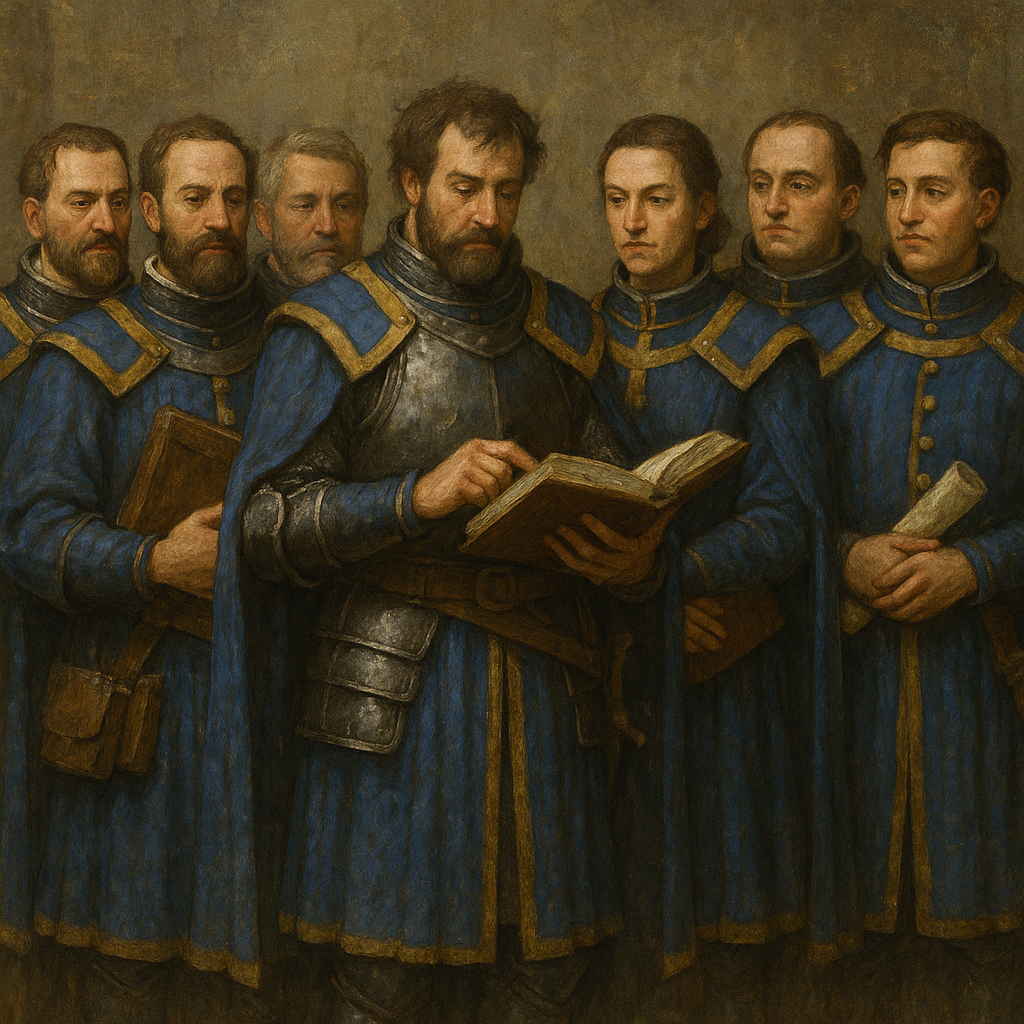
The Scholar's Guild
"Knowledge and power go hand-in-hand." -Gaius Morell, Scholar's Guild Headmaster.
The Scholar’s Guild presents itself as civilization’s lantern, the great keepers of wisdom who carried the flame of knowledge through the Schism’s endless night. Their Colleges shine like beacons of literacy, their tutors have shaped every noble house, their archives swell with truths salvaged from ages no longer remembered. To kings and peasants alike, they are the quill that steadies the hand of history. But beneath the veneer of enlightenment lies a darker script, one written in vanished names and sealed vaults. The Guild hoards more than it shares. They keep schematics of engines, firearms, even flight itself buried in dust-choked stacks, locking away progress beneath wards of silence; A dark truth of which society and even the bulk of their ranks are blissfully ignorant. They are archivists of convenience, releasing cures only when plague has already gutted a province, producing maps only after warlords have bled the soil. Some whisper this is not cowardice but strategy, that the Guild decides when knowledge will serve them best, not when it will serve the world.
Their alliances are no cleaner. Saddleborn caravans ferry their sealed crates across Everwealth without inspection, whether they hold books, relics, or bodies no one dares ask. The Merchant’s Consortium funds their libraries, and in turn gains contracts whispered to include more than trade, entire scholars disappearing into warehouses, Savants who dared speak aloud truths that should have stayed buried. The Guild’s neutrality, once their proudest claim, now looks like another mask, one that hides hands dipped into every coin purse, every court, every blood-stained ledger. They call themselves guardians of civilization, but to some they are the expert butchers of progress, deciding which truths deserve the light and which are to be entombed forever. Parents warn children that scholars “see too much.” Nobles grant them deference but never trust them fully, for a scholar’s ink may bless a throne today and erase its memory tomorrow. The Scholar’s Guild insists knowledge and power walk hand-in-hand. Yet their long shadow suggests another truth entirely: that the hand they hold is not civilization’s, but their own, and what they drag behind them is a chain that binds all of Everwealth to silence.Career
Qualifications
The Guild welcomes all who seek education or knowledge, whether to further their own learning or secure a career. Prospective members must submit resumes to a College; while the process is not fiercely competitive, those lacking intellect or passion are politely declined.
Career Progression
- Student: New members, primarily unpaid learners, responsible for their own intellectual development under the guidance of Masters. They may assist instructors or serve as couriers.
- Master: Members who have mastered specific fields through 2-10 years of study, taking on roles such as teachers, researchers, or political advisors, either assigned by the Guild or through external contracts.
- Savant: Esteemed members recognized for exceptional intellectual achievements or beneficial research. They hold significant authority, overseeing individual College operations, managing staff, allocating funds, and reporting findings to their district's Lorekeeper.
- Lorekeeper: Senior leaders overseeing multiple Colleges within a district. They allocate resources, assign personnel, and convene annually at the Theatre of the Minds in Opulence to address Guild-wide matters, including electing a new Headmaster or proposing internal legislation.
- Headmaster: The highest authority within the Guild, responsible for all decisions and legislation. The Headmaster also commands the Knights of Campus, the Guild's security force. Appointment requires a 75% majority vote from the Council of Lorekeepers, a process that can be prolonged to prevent corruption and infighting.
Payment & Reimbursement
Members receive stipends, subsidized housing, and free access to College records. Higher ranks gain stipends, travel allowances, and private quarters. The Headmaster is among the highest-paid civilians in Everwealth. But coin is not the Guild’s true currency. Access is. Vaults beneath Opulence contain manuscripts banned by kingdoms, spell-forms outlawed by The Arcane Coalition, even relics thought destroyed. Access to these “Dead Stacks” is granted rarely, and always with strings. Many a Master has learned their promotion came not with freedom but with the burden of secrets heavy enough to ruin them. Unofficial payments exist as well. Scholars who bring back sensitive knowledge, locations of ruins, movements of rival factions, or the private dealings of nobles, often find debts erased, their quarters upgraded, or their names inked into secret ledgers. Stipends may be modest, but information can buy luxuries gold never could.
Other Benefits
Guild members enjoy prestige, diplomatic immunity in most kingdoms, and privileged access to lost texts, maps, languages, and sciences. Long service grants pensioned retirement within a College of choice. Prestige, however, is protection and leash. A Guild cloak opens any door in Everwealth, but marks the wearer as property of the quill. Defection is unthinkable. Scholars who attempted it are whispered of as 'Burned Books', found with tongues blackened and scrolls stuffed down their throats. The Guild denies involvement, but needs no admission. The fear alone is lesson enough. The true benefit is neither coin nor cloak, but entry into the restricted vaults. The deeper one climbs, the deeper the shelves: maps of leyline fractures, grimoires of plaguecraft, schematics for weapons buried since the Schism. These privileges are extended only after loyalty is tested.
Perception
Purpose
To disseminate knowledge, preserve history, and promote intellectual growth across Gaiatia. While their public mission focuses on education and enlightenment, some believe they also serve as gatekeepers, controlling access to certain information and technologies. During war, demand rises. During famine, plague, and chaos, it skyrockets. But knowledge is a commodity, and the Guild controls the price. Towns without Colleges are often left in informational darkness, forced to rely on smugglers or outdated books.
Social Status
Guild members are generally respected and admired for their intellect and contributions to society. However, rumors about internal factions and the potential misuse of privileged information have led to a degree of wariness among the populace. Most folk trust the Guild as surely as they fear plague or famine. They are the architects of literacy, the builders of schools, and the chroniclers of noble bloodlines. Yet parents warn their children that scholars “see too much.” To consort with them too freely is to invite suspicion, for no man knows what the Guild records, or what they intend to keep sealed until the end of days.
Demographics
The Guild comprises a diverse membership, including Humans, Dwarfish, Gnomish, Elfese, and Lizard-Kin. Their inclusive approach has enriched their collective knowledge and cultural understanding.
History
Founded in the final days of The Lost Ages, before The Fall shattered the old world and the Schism picked its dead body clean, the Scholar’s Guild began as a forest conclave of self-taught sages and adventurers who documented ruins, constellations, and forgotten tongues. An ominous prophecy from Madame Irma, a renowned psychic of the time, warned its founding members of a storm to come, a cataclysm that demanded preservation. They became the first mapmakers, the last archivists, and the only mathematicians bridging the old world to the new. During the Schism, when nations burned and histories vanished, the Guild burrowed deep, some literally, carving hidden archives beneath mountains and bogs. When they re-emerged in the early years of The Civil Age, they did so as architects of the new order. They rebuilt schools from ash, re-copied holy books alongside spellcraft tomes, and tutored kings desperate for stability. By the time Everwealth was founded, nearly every noble line had received at least one Guild-appointed tutor. Their neutrality was their banner, their ubiquity their weapon. Yet neutrality was always a veil. Even as they shaped the young kingdom, the Guild began sealing away fragments of the old world. Gas engines, firearms, even prototypes of flying machines were copied, stored, and then locked in vaults beneath the capital of Opulence. They justified this as protection, the world was not ready, too fractured, too tribal. But critics note that every suppressed technology deepened the Guild’s monopoly on progress. So long as they alone held the keys, every lord and king remained dependent.
Accusations of opportunism go back to the Schism itself. Surviving accounts claim their cartographers sold maps to warlords on one day and revised them for their enemies the next, profiting twice from the same blood-soaked soil. When famine looms, they arrive with precise records of forgotten granaries. When plague strikes, they produce “newly discovered” alchemical recipes. Always too late to prevent disaster, but just in time to profit from its resolution. The Guild’s shadow only lengthened as it entwined with other powers. Their dealings with The Saddleborn Guild are a matter of rumor, but persistent ones. Couriers trained to ferry nobles and merchants have also borne scholars into hidden ruins, or carried away adventurers who stumbled upon “discoveries” too dangerous to leave in their hands. In wartime, Saddleborn caravans smuggled sealed crates under Guild stamps, their contents uninspected by local authorities. Whether they carried texts, relics, or bodies is left to speculation. Likewise, their relationship with The Merchant's Consortium straddles necessity and corruption. Officially, the Consortium provides coin and trade routes to keep Colleges supplied across Everwealth. Unofficially, their ships and caravans serve as discreet lifelines for Guild contraband: manuscripts plucked from heretical cults, artifacts seized before The Knights of All-Faith could sanctify them, sometimes even scholars themselves, vanished from public record and quietly ferried into “retirement.” Tales of vanished whistleblowers, of Savants who uncovered too much and disappeared into Consortium warehouses or Saddleborn caravans, have grown louder in recent decades. No ledger confirms them, no trial records their names. Yet every rumor builds the same conclusion: the Guild does not merely record history. It edits it, hoards it, and sometimes, erases it. Even now, when famine or war looms, they are the first to arrive with advice and aid, always carrying answers others did not know they needed. To the public, it seems miraculous foresight. To their critics, it proves the Guild already knew what was coming, and chose when to act.
Operations
Tools
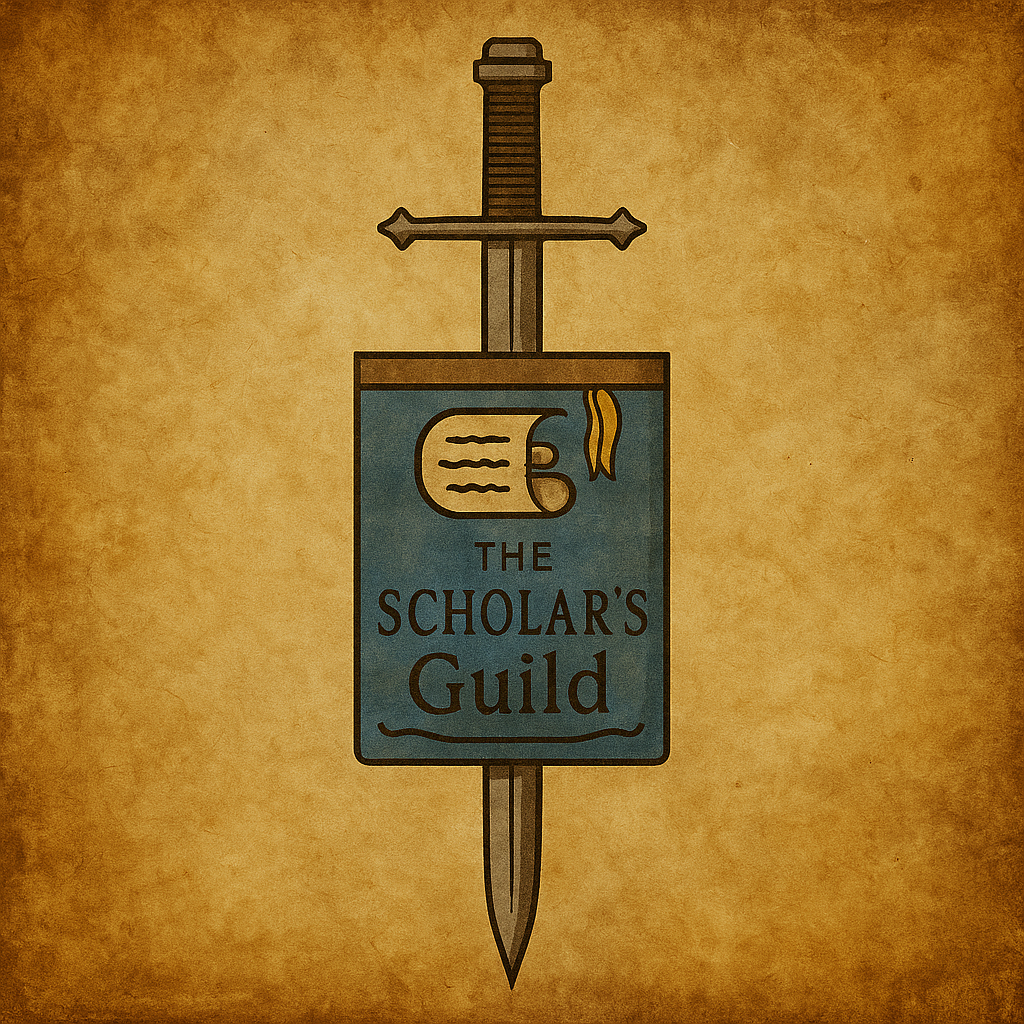
The Guild utilizes a vast array of scholarly instruments, including ancient texts, magical artifacts, and advanced technologies. Their emblem, a silver dagger used as a bookmark, symbolizes the duality of knowledge and power.
Materials
Their resources encompass extensive libraries, rare manuscripts, alchemical substances, and relics from bygone eras. They also possess knowledge of 'lost' technologies, such as gunpowder and combustion engines, which they choose to withhold from the public, believing society isn't prepared for their widespread use.
Workplace
Colleges are not mere schools. Beneath their lecture halls lie sealed wings known as “deep stacks,” libraries-within-libraries where knowledge deemed too dangerous for public eyes festers under dust. Scholars whisper of vaults that hold functioning devices from the Lost Ages: rustless guns, glass screens that glow with phantom colors, and jars of black powder that burns hotter than any fire. Few admit to seeing them. Fewer still return unchanged.
Provided Services
- Education in various disciplines.
- Consultation and advisory roles for political figures.
- Preservation and archiving of historical records.
- Research and development in magical and technological fields.
- Maintenance of libraries and museums accessible to the public.
Dangers & Hazards
The Guild’s greatest hazard may not be assassination or suppression, but knowing too much. There are records of scholars going mad after glimpsing forbidden manuscripts, muttering equations that bend the mind or histories that gnaw at reality’s seams. Savants call this “inkrot,” an illness of the spirit brought on by truths mortals were never meant to shoulder. Whether real or metaphor, it keeps apprentices cautious, and their tongues carefully tied.
Alternative Names
'The Learned Lords ', 'Whisperers of the Quill', 'The Other Crown'.
Demand
The Scholar’s Guild is indispensable. Every kingdom requires its scribes, mapmakers, teachers, and intellectuals. Every lord needs a lorekeeper to verify ancestral claims, track taxes, or decode ancient writs.
Legality
Fully legal and protected under the Grand Compact of Knowledge, an Everwealthy law passed in 77 CA that grants the Guild autonomy from all kingdoms and militaries unless it is found violating its own doctrines. The Compact also criminalizes impersonating a Guild Savant, destroying Guild texts, or attempting to coerce a Guild member into revealing restricted lore.

Comments