
Golems
"A blade dulls, a wall crumbles, a soldier dies. A golem does none of these, until it is told to." -Magister Erav, 'On the Shaping of Servants'.
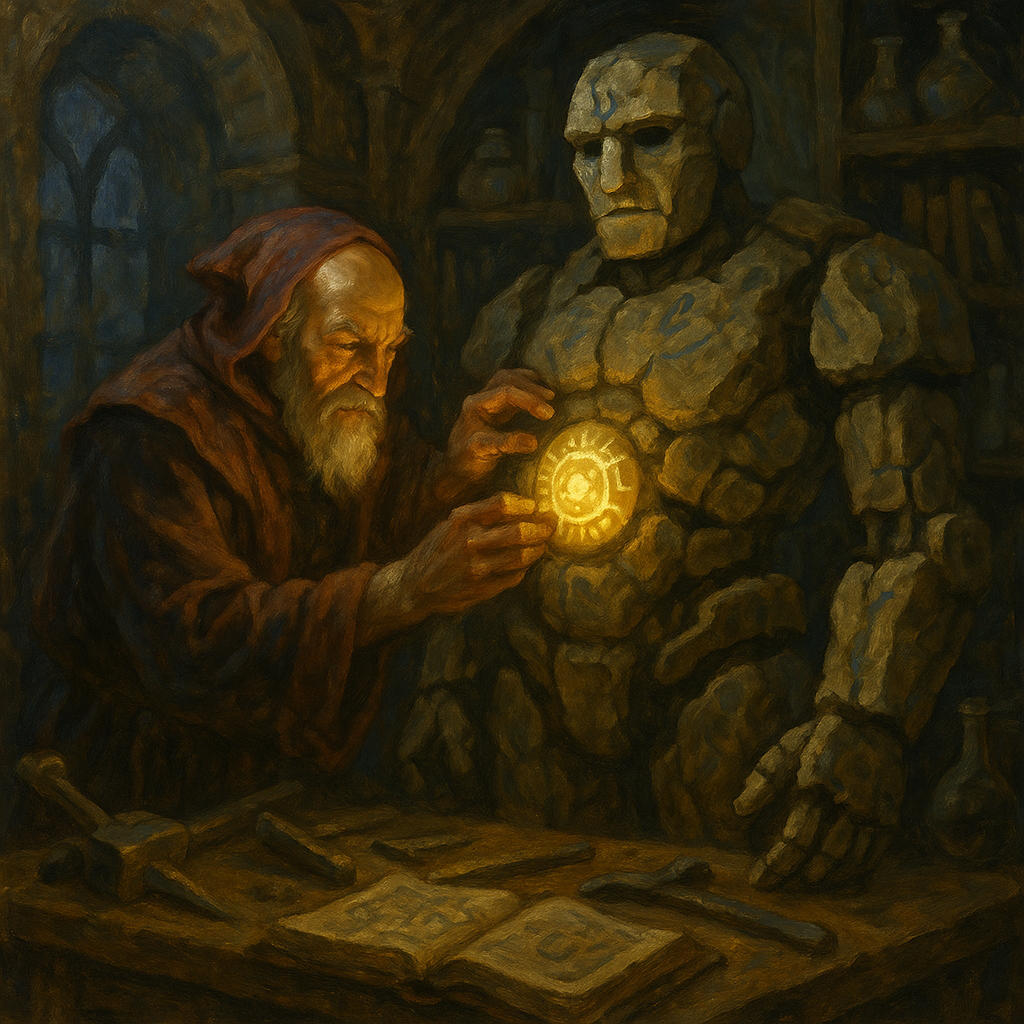
The Golem stands as one of the most enduring legacies of alchemy, a marriage of stone, metal, and magickal force that produces tireless, unyielding guardians and workers. While many modern artificers attempt the craft, true golem-making is a dying art, its greatest works lost to The Great Schism or sealed within the bunkers, forges, and vaults buried beneath The Grandgleam Forest. These ancient machines of war and labor are the prize of every scavenger-lord, though few return with anything more than broken limbs or dented heads. At its heart, a golem is a purpose-built construct. Its form, be it a towering sentinel of granite, a bronze-limbed miner with auger-hands, or a lean marble courier whose legs never tire, is dictated entirely by its intended task. Limbs may be fitted with complex mechanisms, gear-driven claws for excavation, telescoping limbs for wall-scaling, hammer-fists for siege. Each is carved or forged with meticulous precision before being bound with glyphs and core-runes, into which a magickal power source is sealed. Unlike homunculi, which are forever tethered to their creator’s will, a golem’s soul-spark, a concentrated magickal core, grants it a measure of independence. In its active state, the golem is bound directly to a master’s commands, its will entirely subsumed.
But when that master dies, a properly prepared core unbinds, allowing the golem to continue operating under its last directive. In rare cases, such as with the Automaton race, this unbinding becomes sentience, the golem awakening with a self-directed purpose shaped by the echoes of its old tasks. Such awakened golems may wander for centuries, no longer slaves, but creatures of stone and metal with wills of their own. Many ruins from before The Schism still echo with the tireless clamor of ancient golems, too underpowered to think, yet too durable to stop. These relics toil endlessly at abandoned labors, defending tombs, patrolling gardens, or standing eternal watch over gates that no longer open. Their once-perfect forms are now cracked, rusted, and moss-clad, but they endure. Among the most feared are the Elfese Jade Soldiers, armored sentinels built in the height of the Elfese Empire. Crafted to patrol the deep woodlands and strike down any foe not of Elfese blood, they survived the Empire’s fall and now roam the forests of Everwealth in the Empire's place, their detection glyphs still active, their strength still lethal; Hunters speak of hearing the clink of their jade plates in the night, followed by a silence that means death is near.
Basic Information
Anatomy
Golems vary dramatically in form and scale. Most are bipedal or quadrupedal, built for stability, with stone, bronze, steel, or even precious metals forming their bodies. Their joints are magickally reinforced, allowing surprisingly fluid movement despite their mass. Core runes are typically engraved in hidden cavities, protected by reinforced plates. Weapon-limbs are common, though ancient ceremonial golems often bore decorative arms instead.
Genetics and Reproduction
Forging a golem requires three essential elements, a body of stone or metal shaped to purpose; a runic lattice to bind movement, strength, and task; and a magickal core to serve as both heart and mind. Pre-Schism cores, often soul-crystals or “arcane hearts”, are vastly superior to modern or likewise ancient limitations, capable of self-repair and limited thought.
Growth Rate & Stages
Golems emerge fully formed, never growing or healing in a natural sense. Maintenance and repair must be conducted manually, though some ancient designs possess self-mending enchantments. Without upkeep, a golem slowly degrades, joints locking and runes fading until the construct becomes inert.
Ecology and Habitats
Artificial beings, golems have no native habitat. They remain where deployed unless commanded otherwise. In the wild, ancient ones are often found in ruins, vaults, or forgotten battlefields. Those freed from service may take up strange residencies, standing as silent guardians over places only they deem worthy.
Dietary Needs and Habits
Golems do not eat or drink, but their cores require magickal sustenance. Some absorb ambient energy, while others must be periodically recharged via rituals or rare reagents. A depleted core causes sluggish movement, weakened strength, and eventual shutdown.
Biological Cycle
The lifespan of a golem is theoretically infinite if maintained. However, most succumb to physical wear or rune-rot within a few centuries. Certain “awakened” golems, especially those with self-sustaining cores, have persisted for over a thousand years.
Behaviour
Bound golems obey commands with absolute precision, devoid of hesitation or creativity. Awakened golems seem to think and want like any other folk would, though do routinely develop behaviors patterned after their original roles, an ancient miner might still dig aimlessly, a former palace guard might salute passersby. Despite their rigidity, some awakened golems exhibit flashes of problem-solving or even personality, suggesting the line between construct and creature is thinner than many admit.
Additional Information
Perception and Sensory Capabilities
Golems are often equipped with arrays of sensory runes specific to the golem's designated purpose. Heat detection for guard units, seismic sensing for mining, or aetheric vision for spotting magickal anomalies. These senses are purely functional, though awakened golems sometimes adapt them in surprising ways.
Scientific Name
Automaton magis animatus.
Origin/Ancestry
First forged in the height of the Lost Ages, refined in the forges of the Elfese Empire, and perfected in the century before the Schism.
Conservation Status
No formal efforts exist to preserve golems; they are claimed, dismantled, or destroyed for parts. Pre-Schism cores fetch astronomical prices, especially those capable of awakening.

Comments