
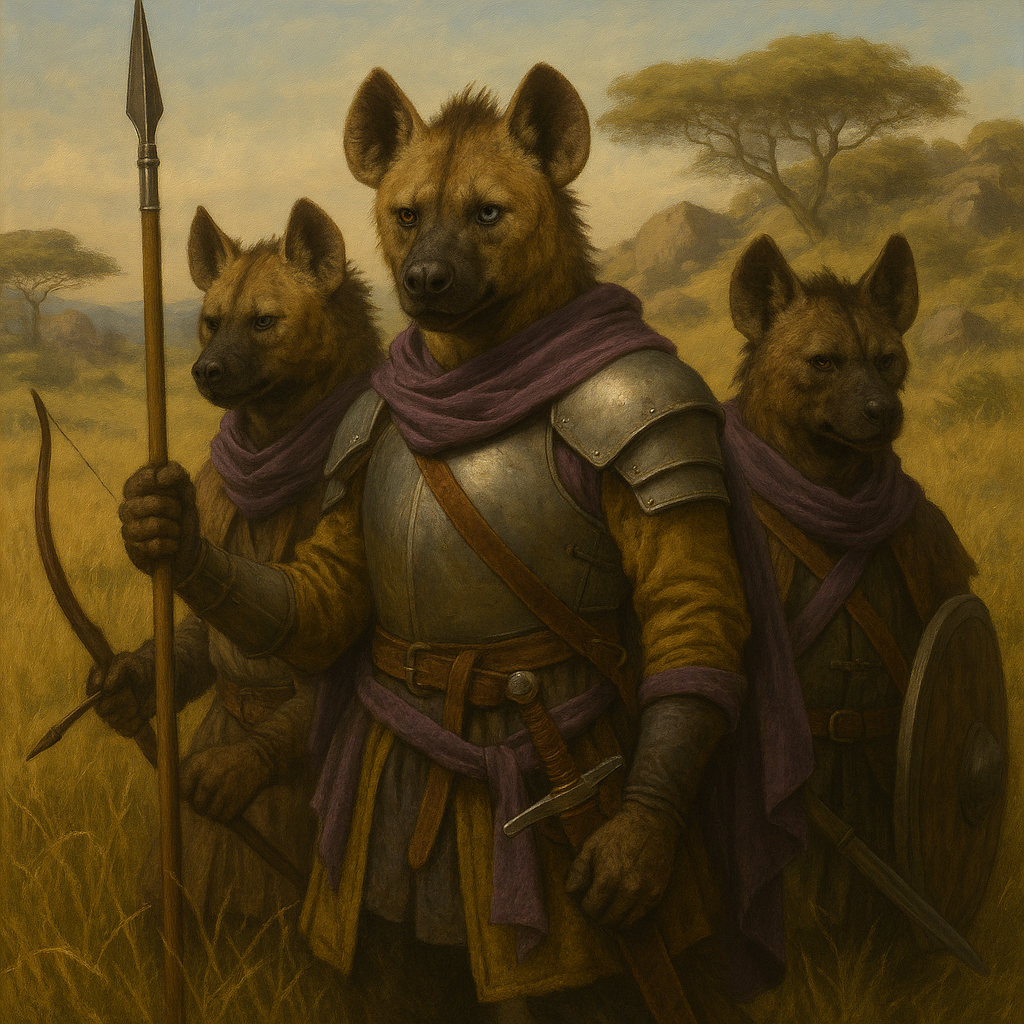
Canid
"We don't fetch, we finish."
The Canid are a people of sinew, breath, and burden, resilient, restless, and unwilling to leave a trail half-walked. Descended from nomads of the Katharan windsweeps, their fur marks them as kin to the storm and the road, lean, sun-burnished coats in the south, heavy snow-pelts and stocky frames in the north. Their lives are brief by human measure, but fiercely lived, carried on in numbers and in loyalty. They do not fade quietly. They work, they howl, they endure. Though their ancestors once aided the Orcish in tearing the Dwarfish from their mountain halls once scattered across Kathar's western reaches, the blood of that conquest is long cooled. Still, the memory lingers, an old growl in the back of Dwarfish throats whenever a Canid passes. Yet most know the modern Canid not as usurpers, but as unshakable allies and tireless shoulders bent beneath burdens no one else will carry. Among the rarer folk of Everwealth, they nonetheless are found wherever the work is heaviest, their packs and kin-clans knitting broken things whole. Canids live by memory, not monuments. Their culture is not bound to stone, but to firelight, song, and muscle-memory, each craft and tale stitched into the next generation. To the Canid, strength is not isolation but coordination. They take in strays, both orphan and outcast, and weave them into their circles. While they rarely worship gods in temples, their reverence is animist: hearth-flames that never die, ancestor bones buried shallow so voices may be heard, road-spirits marked with stones and ash. They are not a people of empires but of trails. And yet, when pressed, they can raise cities, for their paws know how to build as well as wander.
Naming Traditions
Feminine names
- Lusha.
- Orza.
- Mirin.
- Vekka.
Masculine names
- Drev.
- Kolven.
- Rashan.
- Turo.
Unisex names
- Yera.
- Bran.
- Savo.
- Kell.
Family names
Often occupational or descriptive in nature. Examples:
- Stonebite.
- Redhowl.
- Wicknose.
- Broadpaw.
Culture
Major language groups and dialects
Canids commonly speak Ravvik, a barked, rhythmic language with sharp consonants and repeated syllables. In mixed regions, it is often peppered with local slang and gesture. Examples:
- “Tcho-vra!” Hold fast!
- “Yel’drassa” I give you my trail. (A vow of loyalty.)
- “Varu’tin” Quiet now. Listen.
Culture and cultural heritage
The Canid culture is defined by movement, memory, and mutual reliance. Historically nomadic, their traditions are carried not in books but in songs, crafts, and the muscle memory of repeated labor. Canids do not build monuments to themselves; they mend roofs, feed towns, and keep watch through the night. Their kin-clans often take in strays, both literal and figurative, and see strength not in isolation but in coordinated survival. While not typically religious, most Canids follow animist beliefs rooted in hearth-flames, ancestor bones, and road-spirits.
Shared customary codes and values
- "Every step counts." (No labor is beneath dignity.)
- "Leave no one behind, unless they bite first."
- "Work earns rest, not the other way around."
- Betrayal is met not with fury, but with permanent exclusion.
Average technological level
Canid inventions focus on practicality: collapsible tools, durable leathers, weatherproof fabrics, and simple signaling systems. While they rarely invent, they excel at refinement, turning half-finished Orcish designs or Dwarfish relics into something sturdier, lighter, and easier to repair. Their architecture, when not nomadic, favors wooden latticework, bright accents, and central fire pits.
Common Etiquette rules
- Eye contact is respectful but brief.
- One does not speak during chewing.
- Offers of food or warmth should not be refused without cause.
- Never touch another Canid’s ears or tail without invitation.
Common Dress code
Clothing is heavily regional. Warmland Canids wear bright sashes, open vests, and light trousers. Coldborn Canids wrap themselves in dense furs, felted wraps, and thick boots. Most Canids, regardless of region, wear at least one item passed down through kin, an old belt, a scarf, or a charm, a testament to their people's widespread reverence of their ancestors regardless of tribal differences.
Art & Architecture
Canid art is less ornamental and more emotive. They favor storytelling tapestries, clan-marked ceramics, and carved walking staves passed from hand to hand. Their architecture, where permanent, often uses sloped roofs, communal sleeping halls, and arched stone ovens. Colors lean toward deep reds, ochres, and slate-blues, meant to both resist wear and feel grounded in all seasons.
Foods & Cuisine
Canid cuisine is filling, simple, and often spicy. Meats are slow-roasted or cured; vegetables are pickled, mashed, or turned into stews. Broths are thick and fragrant, often with garlic, roots, and regional game. A favorite street food is grishk, a pan-fried dumpling stuffed with cheese or meat. Sweets are rare, but honeyed nuts or spice-breads mark special occasions.
Common Customs, traditions and rituals
- The Pack Circle: A communal meal held during major transitions, births, deaths, new homes.
- Stonegiving: On birthdays, a Canid gives a shaped stone or charm to someone who helped them that year.
- First Howl: Young Canids are taken on a night hunt or journey and return howling as a declaration of maturity.
- Trailfire Festival: A seasonal festival where stories are traded over bonfires, and wrongs are ritually "burned away" through symbolic offerings.
Birth & Baptismal Rites
Newborns are wrapped in old pack-cloth and anointed with ash from the hearth fire. Their name is not spoken aloud until they’ve survived their first season.
Coming of Age Rites
At around 13-15, a Canid must complete a Lone Trail, a week alone in wilderness, trade route, or labor camp, returning with a tale, a scar, or a token.
Funerary and Memorial customs
The dead are buried in shallow earth beds, curled like sleeping pups, often with a tool or charm they cherished. Stones are placed atop the grave, each one a memory from a living kin. When possible, ashes are mingled with bark resin and burned in clan fires.
Common Taboos
- Abandoning a packmate or charge.
- Killing for pride or revenge.
- Letting a fire die out without cause.
- Wearing another’s scent markings without permission.
- Barking without purpose, reserved for alarm or celebration.
Common Myths and Legends
- The Iron-Tailed One: A legendary Canid who fought with a tail forged of chain, said to never break a vow.
- Redflank’s Leap: A story of a Canid who leapt an impossible canyon to warn a village of floodwaters.
- The Starbone: A fabled relic said to pulse with the heartbeat of the first pack.
- The Songless Hunt: A dark tale of a Canid who hunted alone too long and forgot how to speak.
- Warm-Fang: A mythic mother-figure said to have birthed the first clans in a den of fire and salt.
Historical figures
- Orza Telfane: A Canid scout instrumental in the Orcish campaigns against the Dwarfish at the start of the Schism, both reviled and revered.
- Drev of the Grey Kiln: Credited with teaching Everwealth miners new shaft-reinforcement methods.
- Kell Barklight: A poet whose trail-songs are still sung in labor camps across the southern provinces.
Ideals
Beauty Ideals
Scent, grooming, and vitality matter most. A clean coat, bright eyes, and a confident gait are signs of pride. Ornamentation is minimal, simple braids, charms, or stitched sigils.
Gender Ideals
Gender is fluid but often associated with roles: trail-guardians, hearth-keepers, and voice-callers. Expectations are social, not biological, and vary wildly across kin-clans.
Courtship Ideals
Bonding begins with shared tasks, guard duty, hunting, or repairs. Gifts are practical: a meal, a sharpened blade, a warm coat. Howling duets often signal deepening affection.
Relationship Ideals
Partnerships are built on effort and trust. Long-term mates usually cohabitate but often maintain separate tasks or trails. Raising young is communal. Betrayal is cause for exile.
Major organizations
Clan Sunhide - The most storied of all Canid kin, the Sunmane were rewarded by Orcish warlords after the Schism with dominion over a port city of staggering design. Layered rings of walls rise like rippling stone waves, each tier home to markets, shrines, and barracks. At its heart burns a great fire known as 'The Great Torch', a beacon to all Canid kind that here, there is bastion for their people; A fire fed by the fire of trade, a massive harbor the city holds, its navy boasting a fleet more than one-third the size of the entire Orcish armada, rivaling even the Tuskites across their borders with much more land along the sea to call their own. Here the Sunhides thrive as shipwrights, sailors, and smiths of unrivaled refinement. Their craftsman’s touch is legend, practical, ingenious, and enduring. What Orcs wrought in raw iron, the Sunmane perfected in steel. What Dwarfs abandoned in exile, they adapted and made serviceable. The Sunmane port is both crossroads and fortress, a city of aged grandeur where Canid culture stands tallest, defying those who still call them scavengers.
Other Clans - Countless kin-clans roam or root themselves in smaller numbers:
Other Clans - Countless kin-clans roam or root themselves in smaller numbers:
- Clan Grey Kiln - Miners and refiners, known for reforging broken steel into weapons of lasting bite.
- Clan Redhowl - Famed mercenary-clans, whose howls have broken enemy morale on more than one battlefield; And who's elders allegedly hide a dark secret.
- Clan Wicknose - Caravaneers and scouts who leave no road untraveled, their ancestors are accredited with the invention of the candle according to many myths, but this is unproven.
- Clan Broadpaw -Builders of communal halls and architects of ovens said to feed hundreds at a time. Canids of modest renown, but a benevolent one all-the-same
- Clan Mosshide - A roving clan of Canid historians and revelers; Lives led carefree, some say the happiest among all the clans, joyous, jubilant in their knowledge and appreciation of life as a Canid. None among their ranks wanting for food or shelter, paying reverence to their kind with their every song, dance, and vibrant accessory decorating their famed lengthy hair.
Interesting Facts & Folklore:
Idioms and Metaphors:
- Fire-Touched Fur: Some Canids born with reddish coats are said to have luck or prophetic dreams.
- Kinscent Trails: Trails are sometimes marked with braided fur tufts or scent-oils, readable by Canids for days.
- The Bone Chest: Many carry small boxes containing tokens of family or former packmates, updated yearly.
- Tail-Tapping: A silent form of group communication, especially in noisy environments.
- Packshadowing: A Canid ritual where one follows an elder silently for a day to learn from their habits.
- “Don’t chase your own tail.” Wasting time or effort.
- “His nose is full of smoke.” He’s distracted or chasing a false lead.
- “Bark quiet, bite clean.” Don’t boast, just act.
- “She’s pack-bitten.” Loyal to a fault, even when it hurts.
- “Mark the trail, not the tree.” Focus on the path ahead, not the ego behind.

Comments