
Dwarfish
"If the mountain had a voice, it would sound like a Dwarf after his fifth ale and a hard climb home."
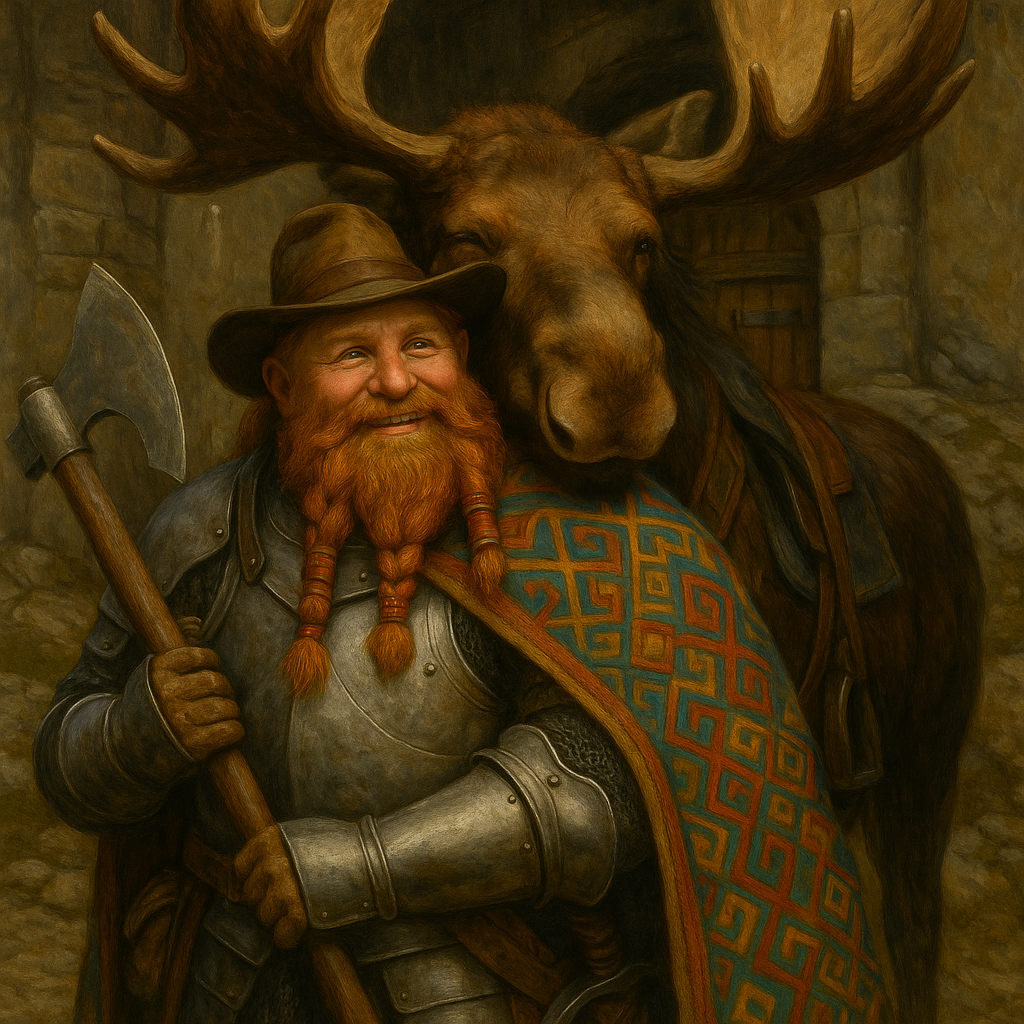
The Dwarfish people, known to themselves as the Songbeards and to the world as the First Travelers, are a people born from motion and memory, hardened by exile, and tempered by song. Once, they rode the open plains of Kathar beneath a red sun, their mounts great scaled beasts that thundered like drums across the horizon. Now, they dwell among moss and stone, in the high cold spines of The Cloudrend Mountains, their steeds the moose and rams of Everwealth, their laughter echoing through the passes like a challenge to the silence. They have lost much, lands, songs, and blood, but have never once surrendered their will to endure. To live as a Dwarf is to shoulder the weight of a vanished world and still find the strength to laugh beneath it. The Dwarfish do not build for eternity anymore, only for tomorrow. Their forges hum through the night not for kings, but for those who ride the dawn. Their craft bears scars of their history, rifles etched with prayers to the fallen, axes balanced to cut through wind as much as flesh, saddles reinforced with steel filigree from the old Katharan plains. Every piece they make carries the mark of a personal hand, never a factory’s. They shape not monuments, but tools and keepsakes, objects meant to serve and outlast grief. The Ironclad Republic, their last great refuge amid the Cloudrend cliffs, clings to the mountainside in webs of rope bridges and lantern-lit towers.
It is not the kingdom they lost, but it is the home they earned. Its peaks ring with hammerfall, and at night the songs of riders drift down the slopes like sparks from dying fires. Their myths say they were born of the bones of Gaiatia herself, pressed into shape by the weight of the world until they could no longer be broken. They were not sculpted by gods or spoken into being, but ground into form by the slow patience of stone and flame. The Dwarfish claim they were never meant to bow, only to bend when the wind demanded it and to rise again once it passed. Yet even they know stone remembers. Beneath their songs lies sorrow, and beneath their laughter a silence that once was home. They are a people who drink to remember as much as to forget, who fight not for conquest but to keep the names of their dead from fading. Their humor is rough and dark as mountain ale, their loyalty absolute, their rage volcanic when betrayed. They will curse the gods, mock their misfortunes, and toast to their own defeats, but they do not lie, and they do not yield. A Songbeard’s word is iron, his promise carved deep enough to outlast his bones. In the frozen world they’ve inherited, that is the truest measure of faith left to them.
Naming Traditions
Feminine names
- Lila.
- Persephone.
- Emerald.
Masculine names
- Oison.
- Gregor.
- Steel.
Unisex names
- Kelly.
- Leslie.
Family names
Dwarfs typically are only referred to by one name, in-place of any last name or family name being 'son or daughter of so-and-so', or sometimes 'descendant of'' followed by a particularly accomplished descendant of theirs i.e. 'Jace, descendent of Cameron' if they choose to carry this title at-all.
Other names
'Stoneborn' for their mythic origin, 'Grumblebeards' for their rough affection, 'Ironclads' for their endurance, 'Forgefolk' for their artistry, 'Capriders' for their mounted patrols, and 'Brassbeards' for their pride in craft and ornament.
Culture
Major language groups and dialects
The Dwarfish folk speak, easily enough to remember, Dwarfish atop Everwealth common. Some examples;
- Fàilte: Means "welcome"
- Tapadh leat: Means "thank you"
- 'Se do bheatha: Means "you're welcome"
Culture and cultural heritage
The Dwarfish culture grew from movement and song. Their ancestors roamed the savannahs of Kathar, riding colossal beasts across endless plains. Exile drove them north, where they learned to survive by their hands and wits. Their modern attire reflects both heritages, fur-lined coats and leather jerkins against the cold, kilts and oilskin hats for travel, broad belts for tools, and high boots to grip the mountain paths. Their hair and beards are symbols of identity, braided and decorated with copper, silver, and carved stone beads that tell their personal story. Every braid is a verse, every ornament an achievement or oath. Their cuisine is hearty and sharp, crafted for endurance rather than delicacy. Moose stew thick with spice, syrup-cured meats, and bread blackened with malt are staples. Dwarfs drink with the same reverence others give to prayer, raising their flagons to family, to failure, and to the next attempt. Their festivals are legendary, full of clattering hooves, stomping boots, and choirs that shake the rafters.
Shared customary codes and values
A real Dwarf never lies to another Dwarf, never steals from another Dwarf, and certainly never kills another Dwarf. The other races are open season in all respects, though.
Average technological level
Before the Great Schism, the Dwarfish stood at the height of invention. They were among the first to master alcohol distillation, hot-air travel, and early firearms, working alongside the Canid engineers who helped them build the first Aeroplanes. Though much of this knowledge was lost, echoes of it remain in scavenged manuals and musical instruments. In the present day, their craft is a blend of mechanical practicality and artistry. Every rifle is engraved, every saddle tooled, every clock or compass a keepsake meant to survive its owner.
Common Etiquette rules
When entering a home, a guest must bring something made by hand, no matter how small. It need not be valuable, only honest. Dwarfs despise insincerity more than insult. When drinking, they practice a rite known as the long round, a challenge of endurance in which companions match one another drink for drink until one yields. To lose is no shame, only proof that you tried.
Common Dress code
A Dwarf is never unprepared for weather or work. Most wear thick canvas or flannel shirts, moosehide jerkins, and long coats lined with fur. In colder regions, they favor layered wool and bear pelts, and in warmer months lighter linens tucked into tall boots. Jewelry is everywhere, usually handmade, often etched with runes marking hunts, crafts, or oaths. Hair and beard braids are as important as armor, each knot a badge of life. Whether it be their clothes, armor, beads, even something like a wooden spoon; The dwarfs will often paint or text or symbols onto it about the itemsshared history with the Dwarf. Personalizing and connecting them with their every piece of equipment almost like a wieldable storybook.
Art & Architecture
The Dwarfish no longer carve their cities beneath the ground. Their settlements climb the cliffs instead, a harmony of stone, timber, and rope. The Ironclad Republic’s great cities hang from the Cloudrend Mountains like lanterns, each level linked by swinging bridges and stairwells of hewn pine and iron chain. Towers rise from ledges, smoke curling upward from open forges. Their art follows the same pattern as their lives, meant to move, meant to last.
Foods & Cuisine
Their dishes are made for endurance and company. Stews thick enough to stand a spoon in, torchtongue steaks dusted in powdered ember root, and syrup-smoked meat that keeps through a winter storm. Ale and liquor are central to their lives, said to warm the heart and steady the hand. Every drink carries a name and a story.
Common Customs, traditions and rituals
The tumbling at birth remains a sacred rite. A newborn’s gray skin is bathed in mineral water to reveal their living color, symbolizing emergence from the stone. Coming of age is marked by The First Craft or The First Hunt, a proof of self-sufficiency, either through artistry or conquest. In death, they do not burn or bury. The Dwarfish turn to stone, their bodies hardening into statues in the final moment. These stone forms are placed in open gardens, sitting among the living as family still. It is said their eyes sometimes glint under starlight, as if they are listening to the songs sung for them.
Birth & Baptismal Rites
When born, Dwarfish folk are welcomed into the world with 'the tumbling' where the infant who's skin is often stone-gray as a byproduct of the birth, will be soaked in a purified mineral water to wash away this coloration, 'tumbling the stone' to clean it and revealing their true pale pinkish complexions.
Coming of Age Rites
The mark of a Dwarfish youth's maturity is usually determined by a feat of creation or conquest. The two most recognized rites include:
- The First Craft: Typically an artisanal piece such as a piece of jewelry, a forged tool, or a carved statue. It must be made without aid, and judged by a senior artisan.
- The First Hunt: Slaying a great beast (a moose, bear, or worse) and returning with proof, antlers, hide, or claw, symbolizes readiness for adulthood.
- Many clans celebrate these rites with a modest feast, and the individual is then granted the right to wear their family’s sigil or smith their own tools.
Funerary and Memorial customs
When a Dwarf dies, their body does not decay. Instead: They turn to stone, solidifying in the final pose they held before death, often seated or lying peacefully. These statues are placed in stone cemeteries, graveyards that resemble grand sculpture gardens, each figure a memorial. Families will visit these statues as if visiting their ancestors in person, cleaning them, decorating them with garlands or metal offerings, and speaking with them as if they still lived. If the individual died in battle or disgrace, their statue may be exiled to the outer edge of the cemetery, facing away from the others in silent penance.
Common Taboos
- Murder is a capital offense among the Dwarfish and is considered the ultimate betrayal. Their close-knit societal structure makes this the only crime punishable by execution.
- Dishonoring kin, whether by public shame, betrayal, or cowardice, is viewed as a stain that affects not only the individual but the entire bloodline.
- Lying to another Dwarf is not just rude, it's sacrilegious; truth among kin is held as sacred as stone.
- Stealing from fellow Dwarfs is met with harsh social exile. Most communities will refuse trade or aid to the thief.
- Turning one's back on tradition, such as refusing the tumbling ceremony, pub crawls, or a forging rite, is regarded with deep suspicion, even among more progressive clans.
Common Myths and Legends
- Knocking on Stone: A Dwarf must knock on stone when boasting or speaking of good fortune to avoid tempting fate.
- The Mirror Curse: Breaking a mirror invites seven years of misfortune, not just upon the individual, but upon their descendants.
- The Black Cat Omen: Should a black-furred beast cross your path, your ancestors are warning you not to proceed.
- The Living Forge: It's whispered that somewhere in the world exists a forge that can breathe and feel, built from the soul of a Dwarfish king, any weapon made there is a blade of destiny.
- The Statue That Watches: Some say the oldest stone-cursed Dwarfs can still move, but only when no one is watching.
Historical figures
No Dwarf is a stranger to 'Ailill and Cú' the twin sons of the last king of the Dwarfish people before the Schism, who rallied their scattered and broken peoples from across many nations on a tireless campaign against extinction; Winning the day, both dying arm-in-arm looking on in-pride at the construction of their new capital of Newforge. The brother's stone visages affixed now at the highest point in the city, so that they may continue to watch their kin rise further from the ashes by the day.
Ideals
Beauty Ideals
For Dwarfish women, strength is key, physically and emotionally. They are expected to be fierce protectors, not passive caretakers. For men, strength comes with wisdom, and they are expected to be great teachers.
Gender Ideals
Unlike many other cultures, the Dwarfish have no clearly defined gender roles. Both women and men are expected to excel in whatever role they choose, be it crafting, war, or family leadership. While traditionally women were the primary artisans, men are often skilled in the same trades, creating a more fluid system of responsibilities than is common in other societies.
Courtship Ideals
Courtship among Dwarfs is based on merit, where a Dwarf demonstrates their skills and virtues over the course of an entire day to prove their worth to a potential mate. The "rite of matrimony" is a day-long ritual where one offers the other the opportunity to display their virtues. The bonding process culminates in the exchange of "wedding brands," a painful but meaningful act where both partners receive marks on their ring fingers as a sign of their commitment.
Relationship Ideals
Relationships among Dwarfs are based on loyalty, mutual respect, and patience. They expect their partners to be as capable and committed to the family and community as they are themselves. Trust is paramount, and betrayal is seen as the greatest dishonor.
Major organizations
Interesting Facts & Folklore:
Metaphors & Idioms:
- Stone-Bonding: Dwarfish bodies are said to turn to stone upon death, a transformation believed to bind their souls to the earth for eternity, allowing them to watch over their kin from beyond the grave.
- Pub Crawls: Dwarfish pub crawls are a popular pastime where participants compete to see who can endure the most drinks across the city’s taverns. It's considered a test of both endurance and skill.
- The Tumbling Ceremony: At birth, Dwarfs undergo a ritual where their stone-gray skin is washed away with purified mineral water, a process known as “tumbling the stone,” marking the beginning of their true life.
- The Forging of Great Works: Dwarfish folk believe that a truly skilled craftsman can imbue part of their soul into their work. The finest items, such as jewelry and weaponry, are said to be blessed with the maker’s spirit, bringing good fortune to their owners.
Related Items
- "Hard as stone": Used to describe someone unyielding or incredibly resilient, often in the face of adversity.
- "A stone in your path": Refers to an obstacle that is both hard to overcome and seemingly permanent; something that must be accepted or dealt with in a way that takes immense effort.
- "Grumble before you strike": A metaphor meaning to plan ahead and grumble or complain first, but take decisive action afterward, reflecting the Dwarfish tendency to complain about difficulties before tackling them head-on.
- "Like fire on cold steel": Describes a challenging situation where one thing is out of place in another; it can be used to describe an unbalanced situation or a clash of ideas, reflecting the intensity of Dwarfish work ethics and traditions.
- "Shine like gold, but stay grounded like stone": An idiom that highlights the Dwarfish respect for humility and craftsmanship. It suggests that one should aspire to greatness but never forget their roots.

Comments