Thousand Seas
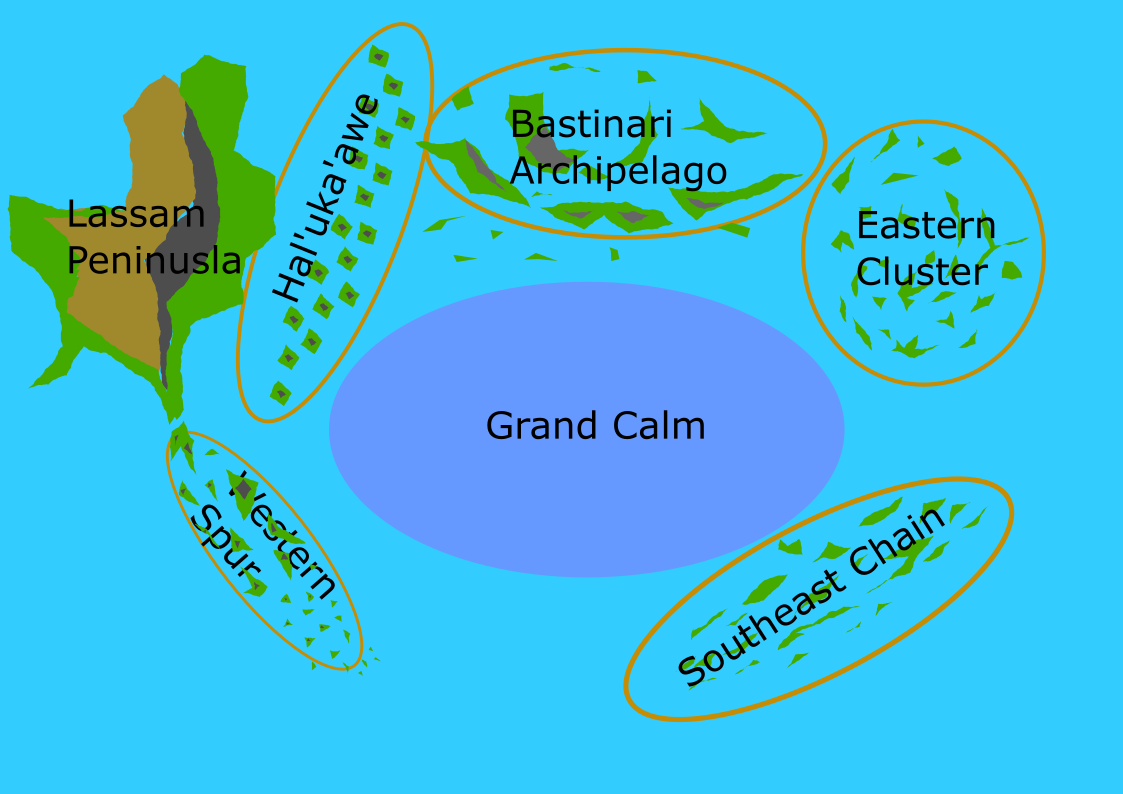
Thousands upon thousands of islands are scattered across the Thousands Seas fighting the ever rising tide. Under the Curse of the Sea, ships ply the waves hopping from island to island around the Grand Calm carrying people, culture, and cargo. Its politics shaped by a war that never came, ancient rivalries, and charismatic ambition the islands are under constant tension between alliances.
Regions
There are roughly six areas of culturally differentiated societies within the trade routes between the two Golden Paths. They are interrelated in culture, language, and trade but each has their own language and history.
Eastern Cluster
Volcanic islands to the east contains the Golden Paths to Nexus. The center of the Protectorate, the island nations were sparsely populated and the first to come under Durnati Imperial control, both by political machination and violence. The population is split between the native Tuvain and Duranti Colonists. They exist in a delicate detente, as the Tuvain work to reclaim what was theirs and the Duranti Colonists attempt to maintain their hold on territory.
Grand Calm
In the center of the Thousand Seas is a large area without strong winds or islands. Avoiding the Grand Calm pushes trade to sail counterclockwise from the Eastern Cluster, across the Northern Archipelago, south to the Western Spur, east to the Southeast Chain, back north to the Eastern Cluster.
Bastinari Archipelago
Stretching from the Lassam Peninsulas to the Eastern Cluster the five main islands of the archipelago surrounded by over a hundred islands of varying sizes. The river valleys of the main island are the breadbasket of the Thousand Seas. Over the past century, the Protectorate has had success in expanding into the islands of the Archipelago. But the nations of the main islands have resisted both Protectorate and Sultanate expansion for now.
Hal'uka'awe - The Western Independents
The series of islands that stretch north to south between the Lassam Peninsulas and the rest of the Bastinari Archipelago made up of independent island kingdoms. Their allegiances are at the center of the conflict between the Sultanate and the Protectorate.
Lassam
Dotting the Thousand Seas are Fonts of varying power to the Elemental Planes. Elementals can be summoned through the portals, or may pass through on their own. Study of the fonts revealed truths about the structure of the planes that are unknown to other cultures. Because of this Elemental Wizardry is a potent force in the Lassam Peninsulas.
Raised out of the ocean by the Raee Philosopher Saints during the Isolation, three archipelagos became the Lassam. However much of the land is still barren as it is in the rain shadow of the Core Range. United under the Sultanate, the peninsulas are known for their elemental fonts that dot the barren landscape that also contains the Golden Path to the Broken Plains.
Western Spur
A cluster of active volcanic islands off the southeast of Lassam, the islands have a fierce independent streak and are home to the Dwarven Iconoclast colonies. The Sultanate has expressed little interest in them as they are more focused on Protectorate expansion. The islands have been able to parlay their independence into favorable trade with the Sultanate. Their unique silks and spices typically travel through the Sultanate and across the Broken Plains to Nexus.
Southeast Chain
What was once an archipelago that sank beneath the waves. Known for its shallow seas and straights, the Southeast Chain is the source of many unique spices. Most of the islands joined the Protectorate after the Nexus Accords to protect themselves from piracy and gain tariff free trade with Nexus.
History
Sinking of the Dragon Tyrannies
Thousand Seas held six Dragon Tyrannies, each one encompassing an Elemental Font to supplement the Tyrant's power. However, the rising seas swallowed most of them well before the Grand Rebellion. Abandoned by their Tyrants the people were forced out to found societies on higher ground.
The Isolation
Generally keeping to their original islands for two centuries, the people grew their cultures in isolation within their geographic area. Their seafaring technology was limited to rafts and simple canoes allowing limited island hopping. Their focus was on taming their islands and developing stable crops.
The Outward Rush
It is believed that the first double hulled ship was created in the Eastern Cluster to carry entire societies from island to island as part of their nomadic lifestyle. As the ship technology spread west, other islands took it and refined it. For the next three centuries virtually all the the islands around the Grand Calm were occupied or claimed.
Raising of Lassam
The as the last of the Tyrannies were submerged, those in what would become Lassam slipped beneath the waves after the Grand Rebellion. As such, the people of that Tyranny had access to Pactmage. With access to Elemental Fonts and Pacts with Elemental Spirits the Rahee developed Wizardry early. As the the Core Range began slip beneath the waves one of the first Rahee Philosopher Saint unlocked the Earth and Fire Elemental Fonts and was able to raise Lassam from the waves. The expansion era on Lassam was dominated by expanding across the new land, not to surrounding islands.
Nexus Contact
Duranti explorers discovered the Golden Path from Nexus to Thousand Seas. They expanded outward similarly to how they did on Nexus, annexing empty islands, conquering others, or trading with island kingdoms who were capable of repelling them. In all cases they would move Duranti settlers to settle and administer. At this point their influence was limited to the Eastern Cluster.
The Iconoclast Colonies
As Truehold was unified under the Volkstahl, those Dwarves that were Proscribed to the Ice discovered the Golden Path to Thousand Seas in the Western Spur. Those Dwarves became the Dwarven Iconoclasts and learned to live alongside the people of the islands. Both cultures were able to live alongside each other as each settled different areas of the same islands, Dwarves on the mountainsides, Islanders on the coastline. With the influx of Dwarven technology the Southern Spur developed quickly to become a source of metallurgy and manufactured goods.
Imperial Era
As the Duranti Empire expanded their reach on Thousand Spheres, they heard rumors of Dwarves to the southwest. Fear of Dwarves pouring through the Thousand Seas' Golden Path opening another front in the heart of the Duranti Empire's territory on Nexus led them to change their strategy. Instead of colonizing and trading throughout the east of the Thousand Seas, they went into diplomatic overdrive, developing the Protectorate and bringing island nations onboard through diplomacy, bribery, and promises of protection from piracy. Not seeing the the threat of the Dwarves, the Islander Client states were able to extract promises of protection, free trade, and independent governance from the Protectorate, under the Protectorate Treaties. Expecting to face the unstoppable advance of the Dwarves, the Emperor commissioned the Imperial Navy. Imperial Wizards created the seven Fortress Islands, mobile floating fortresses that acted as command center, arsenal, and dry-dock for Imperial ships. Hundreds of ships were built in the Nexus style, with deep and long hulls, bearing three to five masts. And mounted on each ship were Spellstones granting lesser wizards the ability to cast high tier spells through them. But the war never came.
The Protectorate Era
When the Nexus Accords cut off the collapsing Duranti Empire from Thousand Seas, the Protectorate had become integrated into the politics and trade of the Eastern half of Thousand Seas. Instead of collapsing along with the empire, the client nations and colonies took control of it. It was easy to do because the Protectorate Council was mostly made up of representatives from the client nations and colonies.The Imperial Navy was a larger problem. Because they were commissioned under the Emperor and independent of the Protectorate, the Admiralty refused to serve under the Protectorate Council. But the alternative was scuttling the fleet, which would collapse the ability for the Protectorate to enforce the accords. By this time the majority of the sailors, captains, and even some of the Admiralty were islanders and not willing to end the Imperial Navy. So a deal was made, the Imperial Navy would remain independent under the Admiralty, but hired by the Protectorate to enforce the Accords. Ostensibly, the Protectorate provides sailors and materiel support in exchange for the Imperial Navy to enforce the Accords.
The Clash
As the Protectorate expanded the Sultanate began to expand to meet the perceived threat. Armed with Elementals and Wizardry they have been able to annex neighboring island kingdoms.
The cost of supporting the Imperial Navy is more than the Protectorate clients are able to support, so the Protectorate is continually expanding. But the Imperial Navy is being stretched to its limits as the territory it is charged to protect expands.
Many kingdoms do not want to be subsumed by the Protectorate or be conquered by the Sultanate. Slowly but surely, an Alliance of Independent Islands is forming between the Protectorate and the Sultanate territories.
Government
Independent Kingdoms
Kings hold dominion over their island, or immediate group of islands. Some leaders are Pactmages who's connection to the ancestors or local spirits grants them their authority, others are charismatic leaders who can draw people to their banner, and others are hereditary monarchs with ties to legendary founders of their cultures, still others are elected through some form of democratic process.
Protectorate
Led by the Protectorate Council who's power is dictated by the Protectorate Treaties, the Protectorate focuses on managing trade, inter-nation conflicts, and bringing in new client states. They are allied with the Imperial Navy who enforces the Treaties and the Council's policies.
Client Nations
While ostensibly still internally independent to govern their people how they see fit, the Client Nation's external relationships are dictated by the Protectorate. They have become reliant on the protection of the Imperial Navy and trade within the Protectorate. With the policy of free travel within the Protectorate, many cultures have begun to mix with their neighbors becoming cultural pastiches. Nexus Mercantile has started to replace the local languages and Ancestry centered faiths are falling by the wayside in favor of revering local or imported Divinities.
Duranti Colonies
Remnants of the Duranti Empire's expansion into the Thousand Seas, these islands are the most developed within the Protectorate. They are led by governors who are representatives in the Protectorate Council. Since the withdrawal of the Empire, the Governorship is granted by local councils of Oligarchs or Duranti hereditary nobility.
Sultanate
Currently led by the 5th Khalahsam Sultanate, the leadership is passed down hereditary lines from warlords who were able to conquer the Peninsulas. To prevent weakness and maintain their hereditary line's control of the peninsulas, the Sultans tend to have many children whom they pit against each other to determine who will inherit the throne. This leads to periodic civil war when a Sultan dies or abdicates. As well, charismatic leaders from cultures under Sultanate rule periodically rise to take the throne. All territory is controlled by governors (Muvalis) within related to but not in the hereditary line of Sultans, or the children of the current Sultan.
Dwarven Iconoclasts
These immigrants to Thousand Seas have taken to life on the ocean with gusto. Their iconic boxdraught haulers with their spinning bladed masts are regularly seen in every port. While not a cohesive political force in the overall conflicts of the Thousand Seas, they do maintain a low level presence everywhere.
Religion
Each island has their own relationship with Divinity tied to their culture.
Ancestor Worship
Most Islanders participate in some form of Ancestor Worship. Remarkable and founding individuals are revered and power is drawn from in the service of the people. Because of shared histories and cultural intermingling, islands may worship whole pantheons of ancestors not only of their own people but of their neighbors. This worship is not incompatible with worship of Genius Loci, and ancestors may be included in pantheons of Genius Loci.
Elementals
Because of the common existence of Elemental Fonts, powerful Elementals can garner worshipers on the mortal plane, elevating them to Spirithood or even Godhood. While most commonly worshiped in the Sultanate, many islands near Elemental Fonts will worship Elementals.
Foreign Gods
Contact with Nexus brought the Gods of Duranti (and to a lesser extend Baeon) to the Thousand Seas. While revered by the Duranti Colonies, with expanding trade many of the Duranti Gods have been synchronized into local pantheons.
Genius Loci
Genius Loci are Gods and Spirits who spring from a locality worshiped by the people of that locality. Gods of islands and weather are common. As are spirits of mountains, rivers, jungles, animals, and elements are common. Most exist in a local pantheon worshiped by the people local to that God or Spirit's origin.
Philosopher Saints
Worshiped exclusively in the Sultanate, the Philosopher Saints are elevated individuals who expanded the knowledge of the elemental plains, mathematics, and magic. These remarkable individuals discovered some aspect of the nature of reality. While generally masters of Elemental Wizardry, other remarkable intellects or highly charismatic individuals have also been raised to Sainthood.
Golden Paths: Broken Plains, Nexus, Truehold
Languages:
Basri (Bastinari Archipelago), Ka’awe (Hal'uka'awe), Vainuanta (Eastern Cluster), Nexus Mercantile, Southeastern Islander, Sabatan (Lassam), Fulthrik
Demographics
Dominant: HumansEnclave: Beastfolk, Dwarves, Seafolk, Pactborn Groups: Elves, Halfuns

Comments