

Aesersia (Ay-SEER-see-ah)
"The Aesersia of today is an illusion, painstakingly wrought by those who once believed they ruled the whole world, and now, having lost the certainty of sovereignty, strive, with equal measures of brilliance and desperation, to prove that they still deserve that crown. It is a magnificent deception; elegant, extensive, enduring, though ultimately self-destructive."- Aleibirietti Madielleine, Faellyeni Ambassador to the Union
The Crown of the World
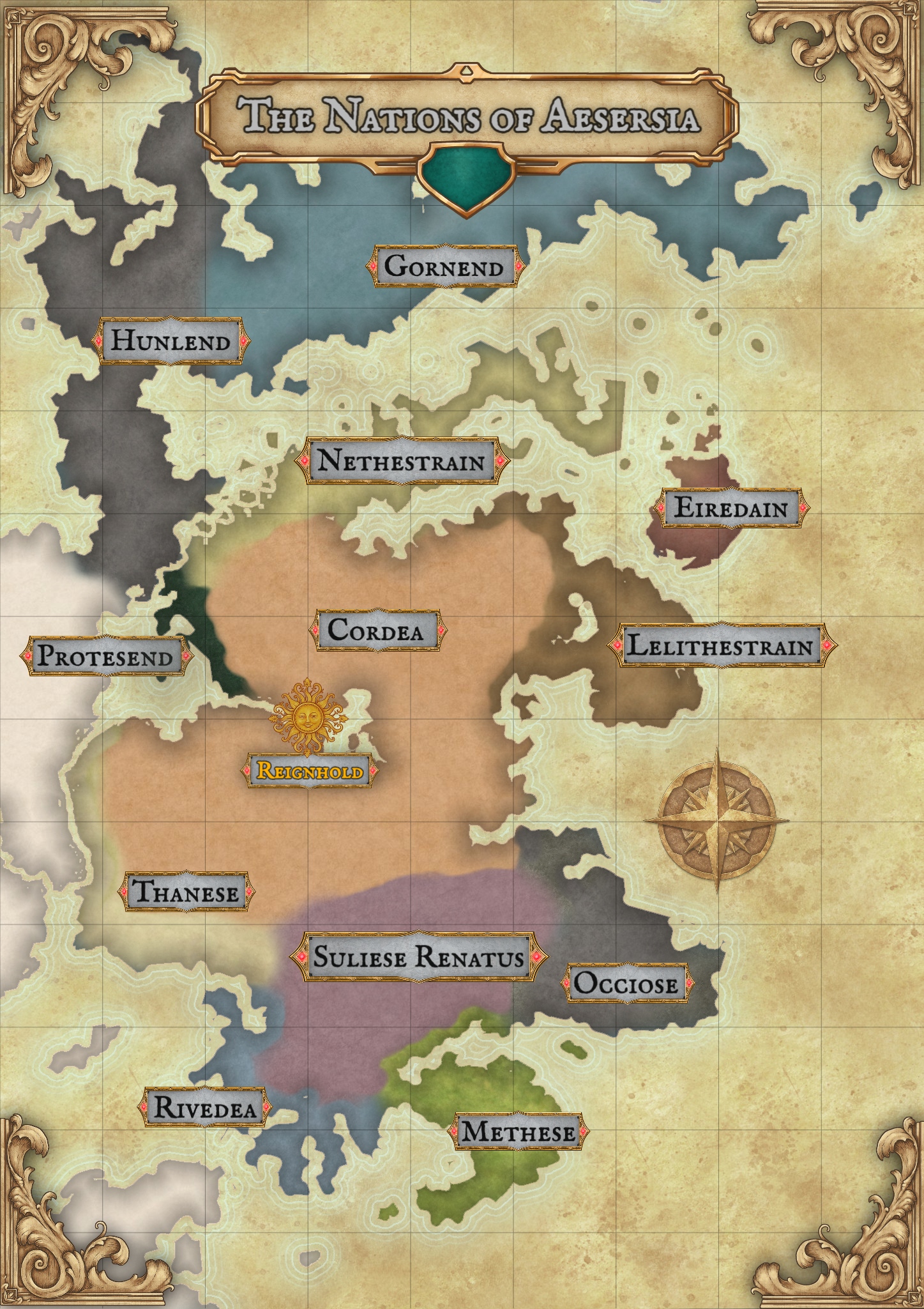
The eastern central continent of Aesersia is, in many ways, the heart of Acarcia. Aesersia is based on Aeser, which was the Glossa term for the region. Aeser means "Crown of the World". Original home and center of the Dorian Empire of Acarcia or simply The Empire, which dominated the majority of Acarcia through shrewd alliances with the other continents. Following the Long War, Aeseria is now home to the crippled remnants of the Empire known as the United Alliance of Terran Nations or The Union. Though the Union has lost its unquestionable authority over the whole of Acarcia, its people still see themselves as the pinnacle of Terran society and culture. Its residents are commonly known as Imperials, although they prefer to call themselves Unionites or simply Aesersians.
The geography of Aesersia is wide and diverse. Among its many features, none are more significant that the Roslaine. As Aeseria's major river, the Roslaine is fed by northern glacial melt and seasonal rainfall. The Roslaine has been central to the development of ancient trade that defines Aesersian culture. In the heart of Aesersia rests the majestic Aemasedis Falls, also known as the "Throne of the World". This enormous series of waterfalls, fed by the Roslaine itself, are home to the city of Reignhold, capital of the Union and ancient seat of power for terrans throughout Acarcia for the past two thousand years.
Generally inspired by Renaissance, Revolution/Imperial, and Industrial Europe both in culture and geography.
The Reignhold Alliance of the Thirteen Nations of Aesersia
"With the signing of Reignhold Treaty, we end a shameful era of constant bloodshed and enter a new glorious age of unity. Today, we show Acarcia the true strength of Aesersia is not found in our martial prowess, but in our ability to move beyond our weaknesses and embrace peace."The continent is Aesersia is loosely unified by a coalition of territories known as the Reignhold Alliance, which is the core of the Union itself. Reminiscent of the ancient Dorian Empire in structure, the Reignhold Alliance of the Thirteen Nations of Aesersia enables the Terrans of the continent to act as one force, share resources, and resist foreign influence. However, unlike the Empire of old, the Reignhold Alliance is not a cohesive organization. The nations that make up the alliance possess a degree of autonomy their former principalities never had. Most of the Aesersian nations seek to strengthen their individual power and weaken their political rivals. The wounds of the Long War have not yet healed, and the festering anger of old grievences simmer just beneath the polished, superficial facade of the Union. Only time will tell if the tense cooperation of the Reignhold Alliance endures its own weaknesses.- Weldrue d'Wels-Sonne, Architect of the Reignhold Alliance
Cordea, the Golden Republic
Cordea is the largest nation in Aesersia and is former capitol principality of the Empire. It is also the birthplace of the egalitarian philosophies that led to the establishment of the powerful alliance of nations known as the Union. Former heartland of the Dorian Empire, known then as the Golden Province of Cordoria. Residents are known either as Cordeans, Cordians, or the Kore. The native terrans were known as the Kjor and their lands were known as Kjorlend. Even today, Cordea is referred to by some rural terrans as Koreike or Correich.
Reignhold, Ivory Throne of Aesersia
Once the capital of the Dorian Empire, Reignhold and its sister city, Reigngate, now form a sovereign city-state within the Union. Though the empire has faded, Reignhold endures as the Unionem Sedes—the administrative heart of the Union—where legacy and law intertwine beneath marble spires. Residents are known as Reinians or Reignfolk.
Gornend, the Bitter Earldoms
A loose confederation of rival territories of clans and corsair fleets, Gornend is a brutal land as unforgiving as the people who inhabit it. Formerly known as the Province of Gornoria during the Imperial Era, Gornend was the first province to renounce the reign of the Bleak Sovereign and rebel against Empire. Residents are known as Gornians or simply the Gorn. Gornend is divided into nine regions known as Earldoms, ruled by fierce warlords and reaver captains known as Earls. The ancient terran tribe native to the region was known as the Gjorn and their lands were known as Gjornlend.
Hunend, the Stoic Earldoms
The near-impenetrable border province of Hunend, formerly known as the province of Hunoria during the age of the Empire, protects the rest of Aesersia from the worst of Aestidesia and northern Arcesia. Residents are known as Hunians. The native terrans were once known as the Hunne and their lands were called Reikehunne.
Protesend, the Shattered Province
Prior to the Day of Agony, the province was known as the Prothinoria however much of what constitutes the territory was lost in the Shattering, either to the catastrophe itself or from their warring neighbors in the ensuing chaos. The devastated realm is now called Protesend, a cruel play on "Proth's End". Residents were collectively known as Prothians, based on the native terran tribes, the Prout who ruled the ancient forests of Proutlend.
Lelithestrain, the Regal Kingdom
Known as the Kingdom of the Swan and the Falcon. Formerly known as the Province of Lelithestria during the Imperial Era. Residents are known as Lelitheans. The ancient terran tribes native to the eastern coast were known as the Lechlath, and their lands were known as Lechlathlain.
Nethestrain, the Valiant Kingdom
Known as the Kingdom of the Griffin and the Grail. Formerly known as the Province of Nethestria during the Imperial Era. Residents are known as Netheans. The ancient terran tribes native to the eastern coast were known as the Knecht, and their lands were known as Knechtlain.
Eiredain, the Noble Island
The Island of Eiredain was once a County of the Province of Nethestria during the Imperial Era. Residents are known as Eirefolk, but refer to themselves by the ancient term Eirelt.
Methese, the Stalwart Admiralty
Forever loyal to the imperial dream of a lost era, the Salt Wine Admiralty of Methese is a stalwart defender of all Aesersia from enemies within or abroad. Formerly known as the Province of Mithisoria during the Imperial Era, the Salt Wine Admiralty is now a defacto Military Dictatorship, ruled by the Grand Admiral and his naval officers. While most the original noble houses from the Imperial Era are extinct, those that endured have long been integrated into the structure of the Mithean Navy. The few stubborn families who resisted were hung from the masts of the fleet's flagships as traitors to the cause. Residents are known as Mitheans. The native terrans were known as the Methe and their ancient kingdom was known as Methsis, originally part of the Sophic Empire.
Occiose, the Macabre Commonwealth
Formerly known as the Province of Occiosoria during the Imperial Era. Residents are collectively known as Occioseans, with those in the north also being referred to as the Occens and those in the south being referred to as the Osens. The native terrans were known as the Occe and the Ose. Their respective kingdoms were known as Occis and Osis, and both were originally part of the Sophic Empire.
Suliese Renatus, the August Republic
The August Republic of Suliese Renatus is an plutocratic republic that rules over southern Aesersia. As a nation, Suliese Renatus prides itself on its independence, a tradition which dates back millennia. Though the region has been annexed, conquered, or incorporated into other governments, Sulien identity has always remained defiant. They see themselves as the true expression of Terran culture, and have influenced others since the Sophic Empire. Even during the Imperial Era, the proud province remained fiercely independent, refusing to fully adopt the naming convention of the Imperial Edicts— instead choosing Sulinoria as their national moniker. This act was to remind the entire continent that Corrin never conquered the pridelands, and thus did not earn the right to force his name on them. The residents of the August Republic are known as Suliens. This region was formerly known as the Province of Sulinoria during the Imperial Era. The native Terran and their former kingdom were known as the Dictatorum Sulie, though they were originally part of the Sophic Empire as the kingdom of Sulesis.
Rivedea, the Defiant Federation
The vast coastal wetlands of Rivedea was once a County of the Province of Sulinoria during the Imperial Era. Residents are known as Riveans or Riverfolk.
Thanese, the Morose Theocracy
The austere badlands of the Doninite Theocracy of Thanese are inhospitable to the unfaithful, and barely better to those who follow the Eightfold Faith. Formerly known as the Province of Thanisoria during the Imperial Era, the zealous houses of Thanese declared the Empire in apostasy and seceded early during the Long War. Residents are known as Thaneans. The native terrans were known as the Thanes and their ancient kingdom was known as Tansis, originally part of the Sophic Empire.

Comments