
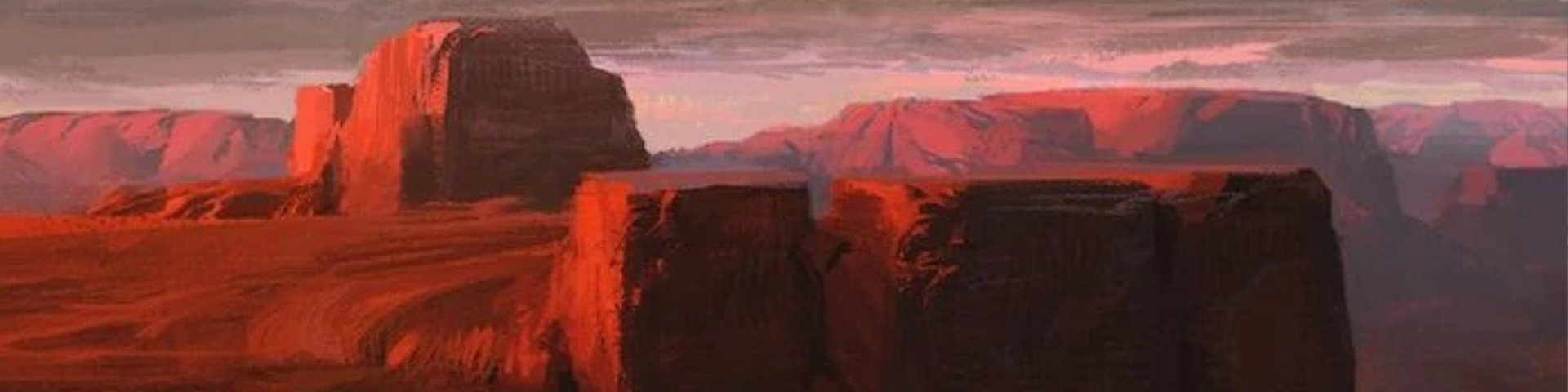
Arcesia (Ar-SEH-see-ah)
“Arcesia is alive. Its mountains are its bones, its rivers its blood, and every storm its breath. We endure because we listen to that ancient voice, honor its wisdom, and walk the paths it carved for us before the world had a name.”- Ah'taush, Duom’keth of Vhooz'ne
The Continent of Bows
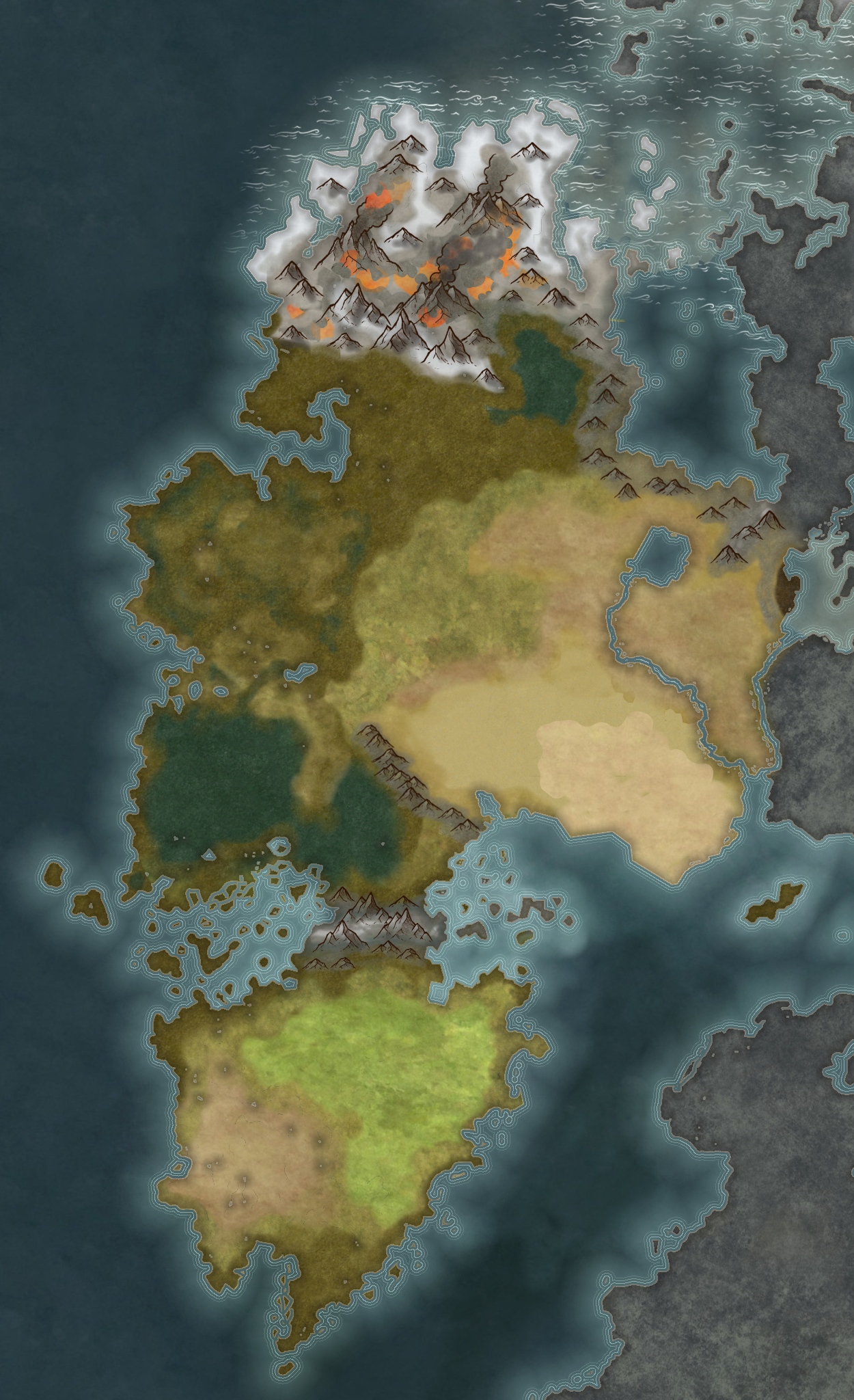
Arcesia is a land defined by extremes, and its dominions reflect the full spectrum of Orcish life shaped by those conditions. In the north, fire-split tundras, volcanic highlands, and vast boreal forests forge clans hardened by cold, scarcity, and the ceaseless presence of prowling megafauna. The central heartlands offer a rare balance of rivers, plains, marshes, and dense forests that support Arcesia’s greatest concentrations of culture, trade, and governance, though even here the land is alive with towering herbivorous saurians and predatory drakes. Farther south, the continent breaks into rolling prairies, cracked steppes, jagged cliffs and coastal wetlands, as well as a sea of blazing sand dunes where survival depends on endurance, adaptability, and communal strength against hostile climates and monstrous beasts. Together, these regions form a single truth: the Orcs of Arcesia are inseparable from the land that shapes them, and every clan, whether born in frost, forest, mire, or desert, stands as part of a unified civilization bound by hardship, honor, and the enduring guidance of The Words of Wisdom.
Known as Urkh Mhe’daal in Urkh'suanet, the continent is understood by its people as both homeland and proving ground. The native Orcs to themselves as Urkh’kar, a term that roughly translates to "We are Warriors", reflecting a collective identity shaped by hardship, discipline, and the land’s uncompromising demands. Among Imperial cartographers they are labeled Orcus Arcsae, and in Vulgar speech simply War Orcs, a title born from centuries of conflict with Terran powers. The few Terran lineages that survived Orcish reclamation are known as Arcesians, a displaced native population who now live in the shadow of a world remade by Urkh’kar hands.
The Imperial designation Arcesia comes from Aerce, the ancient Glossa term for the region meaning "Bow of the World", a reference to the continent’s sweeping curvature and its role as a natural barrier across western Acarcia. The land more than earns the title. Its geography stretches in a vast arc of extremes, beginning with deserts and wandering dune seas that give way to rugged steppes, hardy shrublands, and endless grass-plains teeming with life and conflict. Farther north and east, the terrain rises into imposing mountain ranges draped in dense alpine forests, while the coasts fracture into rocky cliffs, storm-worn headlands, and rare, tranquil oases treasured by travelers. Together, these features form one of the most diverse and demanding landscapes in the known world, a continent shaped by fire, wind, and time.
While located on the eastern edge of Acarcia, the truth is Arcesia stands at the heart of a volatile geopolitical battlefield. The continent is bordered to the northeast by the titanic unyielding peaks and bloody lowlands of Aestidesia. Across the roaring Ghan'fuort, the "King of Rivers" that divides eastern Acarcia from the west, lie the imperious center of all Terran civilization, Aesersia. Further southeast, distant Arthesia sends countless corsairs across the Pugnausean Sea to raid Arcesia's southern shores and island strongholds, while the twin continental empires of Aegesia and Aquilesia press ever-eastward against the wartorn western frontiers. The foreign Terran powers that dominate much of Acarcia continue their centuries-long struggle to reclaim Arcesia from the War Orcs, aided by the nomadic Urchal and Topen tribes who still roam their ancestral homeland, forever resisting the ruthless diaspora forced upon their ancestors. Meanwhile, degenerate Ogre raiding parties rush from the southern Aestidesian lowlands like a vicious mudslide into the Arcesian heartland to seize captives for their infamous carnivals of blood. Lastly, the frigid Unseelie Fey of Shaenunllyenez hold the continent's deepest and wildest northeastern forests as one of their Feygate Sanctuaries, the infamous Wicked Watch. This region remains unclaimed by either the War Orcs of Shaad’engar or the Giantkin of Aestidesia. These alien and brutal fey maintain a wary, conditional "peace" with the War Orcs, bound only by their mutual and unyielding hatred of the Terrans and Giantkin of eastern Acarcia.
Arcesia is inspired by the Levant and Middle East during the early Ottoman Empire.
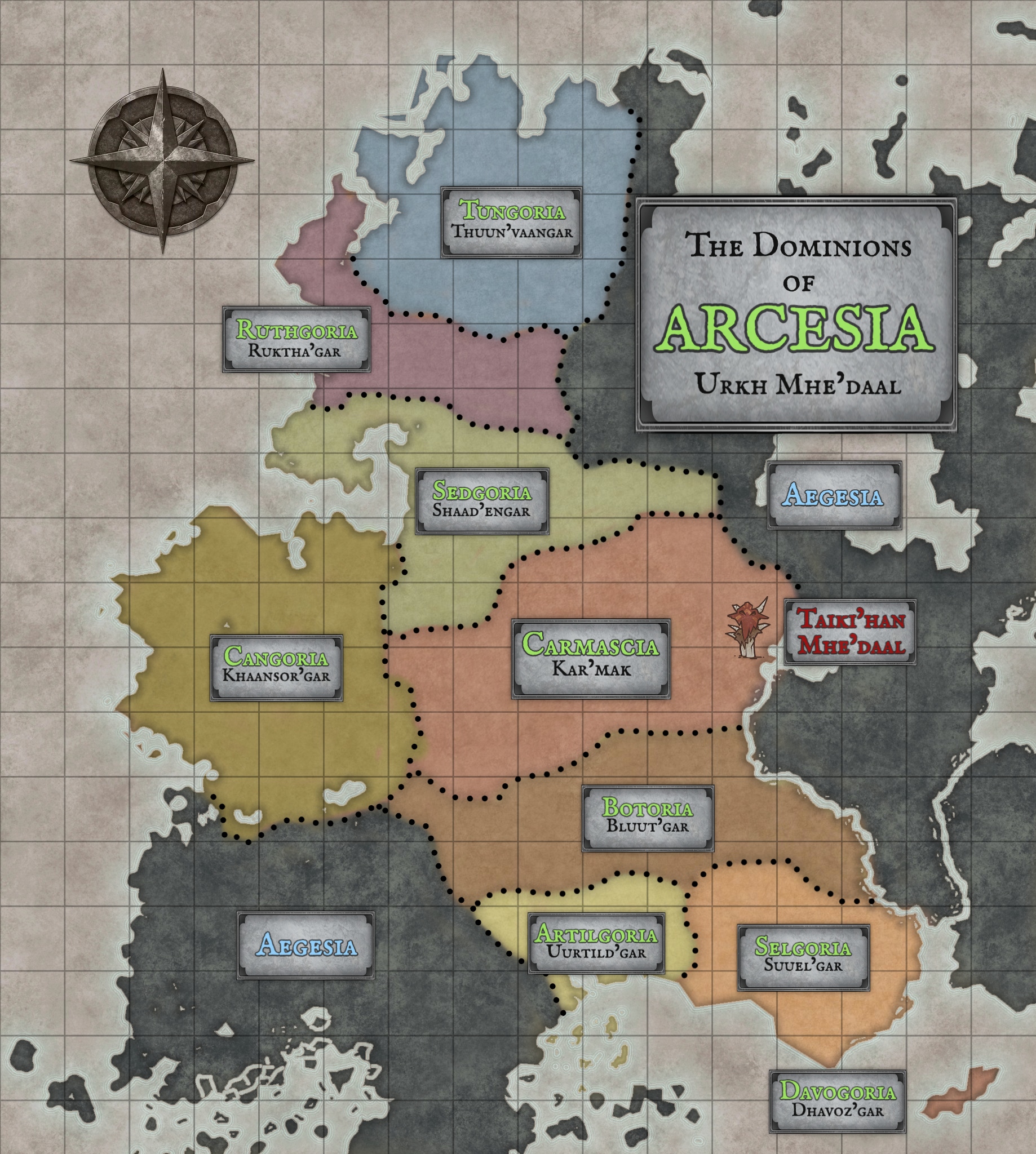
The Nine Dominions of Urkh Mhe'daal
“The has'gar is not just land. It is the uildekh that shapes the taitomor of your han. The thuur that forges its will, the fuor that tempers its resolve, and the alkh that proves its worth. Without our has'gar, we are rough tomor'vud. With them, we are Urkh'kar.”- Uena Tomor'ruktha, Uildekh'keth of Kar'makThe Dominions of Arcesia, also known as the Has'gar garal-Urkh Mhe'daal in Urkh'suanet, divide the continent into nine vast cultural regions, each shaped by its own unforgiving landscape and bound together by the enduring philosophy of The Words of Wisdom. From the volcanic tundras and boreal highlands of the north to the fertile heartlands, storm-struck coasts, jungle depths, and sun-blasted deserts farther south, these dominions reflect the full diversity of Orcish life and the many trials that have forged their people. Though each dominion maintains its own customs, dialects, and traditions, all stand united by a shared heritage of struggle, resilience, and honor.
Thuun’vaangar, the Dominion of Ash
Thuun’vaangar rises as a harsh and haunted expanse of boreal forest-steppe and ice-capped volcanic ranges, a land where ash drifts across the snow like blackened petals and the earth trembles with the rumble of living mountains. It stands as the northernmost and most isolated of all Arcesian dominions, touching only the rugged frontiers of Ruktha’gar, and its people have adapted to this solitude with fierce pride. The locals call themselves Thuun’enhan, the "People in the Ash", heirs to a culture shaped by fire, frost, and unbroken horizons. The name of the dominion, Thuun’vaangar, itself means "Ash-Covered Land" in Urkh’suanet, though Imperial cartographers record it as Tungoria and refer to its inhabitants as Tungians. The dominion’s defining marvel is its chain of perpetually erupting volcanoes, known as Tai'than Thuur un'Aet'huun, or the "Ancestors of Flame and Smoke". These bellowing colossal fire-spires ceaseless fury is known to shakes the ground, reshapes the forests, and casts a constant pall of ember and smoke across the skies of Thuun'vaangar.
Thuun’vaangar is inspired by the forest steppes and alpine mountains of Kazakhstan and the Thuun’enhan is inspired by the Kazakh Khanate of Kazakhstan. Ruktha’gar, the Dominion of Honor
Ruktha’gar rises as a realm of sheer mountain walls and wind-scoured highlands, a narrow dominion pressed between the ashbound wastes of Thuun’vaangar to the north and the shadowed jungles of Shaad’engar to the south. Its people call themselves Ruktha’han, the "Clan of Honor", a title earned through generations of endurance, discipline, and devotion to the ancestral code. The name Ruktha’gar translates to "Land of the Honorable" in Urkh’suanet, and the dominion stands as the spiritual heart of the Words of Wisdom. Imperial historians label the region Ruthgoria and its people Ruthians. Ruktha'gar's countless summit-temples carve into the very sky above Arcesia, forming the holiest sites in the Orcish faith. Foremost among them is the vast summit temple complex of Luuvki’has garal’Burghan, one of eight sacred sites all devout Ogokh’khun must visit during the course of their eight separate Boutsakh pilgrimages. However, no construct can compare to the dominion’s most wondrous feature: the Vhaal’ghan-muon’uurn, the "Great Wall of Mountains". This titanic range severs Ruktha’gar and Thuun’vaangar from the rest of Aemaphia. Their barren peaks rise so high they rival the famed Tzacualli of Aquilesia and the colossal Ostyak of Aestidesia, perhaps even surpassing them as the tallest mountains in all of Acarcia.
Ruktha’gar is inspired by the various terrains of Afghanistan, specifically the valleys and Kush Mountains, and the Ruktha’han is inspired by the Durrani Empire of Afghanistan. Shaad’engar, the Darkened Dominion
Shaad’engar unfolds as a vast and shadow-drenched rainforest, its endless canopy swallowing the sun and earning the dominion its name, the "Land in Darkness". The region stretches from the sheer mountain walls of Ruktha’gar in the north to the steaming swamps of Khaansor’gar in the southwest, with the fertile might of Kar’mak pressing against its southern frontier. Its people call themselves Shaad’enhan, the "People in the Dark", a title that reflects not only the dim jungle depths they inhabit but also their affinity for the mysteries that lurk within. Imperial records label the region Sedgoria and its inhabitants Sedgians, though such terms do little justice to a land shaped by ancient magic. Shaad’engar’s vast jungles lie unnervingly close to the Feygate Sanctuary of Shaenunllyenez, and the entire dominion hums with wild Fey energy; strange creatures prowl its depths, and the very air seems to shimmer with unseen watchers. This proximity has made the Shaad’enhan renowned as Warlocks, Sorcerers, and drum-wielding Bards, their spellcraft woven from pacts, instincts, and the whispering magic of the "green shadow". Their alliance with the druidic Unseelie Fey has further pulled many of their Rangers, Hunters, and Templars away from strict Words of Wisdom doctrine and toward the verdant traditions of The Primal Laws. This druidic influence is strengthened by the region’s many boreal Beastfolk tribes, Dryad enclaves, and ancient Treant sages, all of whom treat Shaad’engar as a living temple of root, shadow, and untamed power.
Shaad’engar is inspired by the inexplicable jungle rainforest of Salalah in the Eastern Arabian Peninsula. The Shaad’enhan is inspired by the Omani Empire of Oman. Kar’mak, the Heart of War
The dominion of Kar’mak unfolds as a land of rare abundance, a fertile and sprawling dominion that serves as the beating center of Arcesia. The shadowed forests of Shaad’engar press against its northern frontier and the sweeping plains of Bluut’gar cradle its southern reach. To the west lie the marshlands and wilds of Khaansor’gar, while to the east the enormous Tai’fourn, the "Great Lake of Arcesia", stretches toward the rest of eastern Acarcia. From the Tai’fourn flows the mighty, perpetually surging river Ghan’fuort, a vast waterway revered as the "King of Rivers", which cuts across eastern Acarcia before surrendering its waters to the Pugnausean Sea. Along the shores of the Ghan'fuort, dense marshlands allow for year-round agricultural yields. The temperate climate and mineral-rich soil create a vast central basin, known as Tarikh'sav-gazaar. At the heart of this fruitful dominion rises Taiki’han Mhe’daal, the greatest metropolis on the continent and the uncontested seat of the Daal’ghan who rules over all territories of Arcesia. The city serves as one of the few places where foreigners, including Terrans, may walk without open hostility, protected by ancient laws of hospitality and the ever-watchful guard of the Mak’han, the "People of the Heart". The name Kar’mak translates to "War Heart" in Urkh’suanet, a fitting title for a dominion that blends abundance with martial strength. Imperial scholars refer to the region as Carmascia and its people as Carmascians, but such titles cannot fully grasp the dominion’s role as the living core of Arcesian power.
Kar’mak is inspired by the diverse biomes and geographies of Iraq, including the arid highlands, marshlands surrounding enormous Tigris and Euphrates Rivers, and Fertile Crescent. The Mak’han is inspired by the Medieval Ottoman Empire of Iraq. Khaansor’gar, the Blighted Dominion
Khaansor’gar sprawls as a vast expanse of miring swamps and reeking boglands, a blighted dominion where the earth sinks underfoot and the air hangs heavy with rot and storm-water. Its long eastern border presses against three great territories, touching the shadowed jungles of Shaad’engar in the northeast, the fertile basin of Kar’mak to the east, and the blood-soaked plains of Bluut’gar to the southeast. Its people call themselves Khaansor’han, the "Blighted People", a title that speaks to both the land they inhabit and the grim resilience it demands. The name Khaansor’gar translates to "Blighted Land" in Urkh’suanet, though Imperial records reduce it to Cangoria and its residents to Cangians. The dominion is shaped by a relentless cycle of storm and flood. Perpetual coastal hurricanes crash along its western shorelines and drown the entire region in endless lagoons, mires, and marsh flats. Within these sodden wilds, territorial reptilian Beastfolk battle for scarce resources. The strange, hive-minded Myconid enclaves weave quiet influence over the Khaansor’han. The southern swamps are further choked with vast populations of Gobkin who proliferate in the wet decay. Deeper in the feculent bogs, an ancient and powerful magic corrupts the very land, silently spreading madness through the brackish waterways of Khaansor'gar. All these forces combine to make Khaansor’gar one of the most hostile and uncanny regions in Arcesia, a dominion defined by endurance, adaptation, and the constant struggle against a land determined to swallow all who walk upon it.
Khaansor’gar is inspired by the lagoons, salt marshes, and alluvial forests of Turkey and the Khaansor’han is inspired by the Safavid Empire of Persia. Bluut’gar, the Dominion of Blood
Bluut’gar spreads across vast, open plains blessed with rich soil, rushing rivers, and an abundance of natural resources, a land that should have become one of Arcesia’s great centers of prosperity. Instead, it stands as a dominion defined by bloodshed. Where Kar’mak transforms abundance into stability, Bluut’gar turns plenty into provocation, its fertile prairies consumed by near-constant violence. Rival clans clash endlessly for prestige and dominance, while raiding parties from neighboring dominions both near and far harass the native Orcs. Sadistic Ogre marauders descend from beyond Arcesia’s borders to harvest captives for their carnivals. Terran horselords roam the plains in pursuit of vengeance and lost claims, and hardened Kinder nomads range across the grasslands as they always have, defiant of the Orcs. Each party seeks fleeting control of its wealth-rich routes.
The land itself mirrors this brutality. Lumbering herds of colossal dinosaurs trample the plains, vast megafauna roam in constant motion to escape predation or pursue prey, and winged drakes plunge from the skies to strike without warning. Unlike most regions where conflict is driven by hunger or scarcity, the wars of Bluut’gar are fueled by the more corrosive union of abundance and greed. The dominion borders Kar’mak along its northern crown, the sodden wilds of Khaansor’gar to the west, the bellicose highlands of Uurtild’gar to the southwest, and the blistering desert of Suuel’gar to the southeast, leaving it exposed on all sides. Its people aptly call themselves Bluutc’han, the "Bloodied People", and the name of the dominion translates literally to "Blood Lands". Imperial records refer to the region as Botoria and its inhabitants as Botorians, although, as usual, such terms fail to capture what Bluut'gar is. A place where wealth flows freely and blood flows faster.
Bluut’gar is inspired by the expansive fertile plains and rushing rivers of Pakistan and the Bluut’han is inspired by the Mughal Empire of Pakistan. Uurtild’gar, the Dominion of Long Swords
Uurtild’gar stands as a dominion of stark contrasts, where craggy highlands rise abruptly above calm coastal lowlands and every horizon promises conflict. Though smaller than many of its neighbors, the territory sits beneath relentless pressure. Bluut’gar looms along its northern frontier, while the blistering deserts of Suuel’gar press against its eastern reaches, turning the region into a crucible of external threats. Unlike Suuel’gar, whose harsh sands shield it from seaborne invasion, Uurtild’gar lies exposed along the coast, making it a frequent target for Aquilesian incursions and the predations of Arthesian corsairs. A narrow mountain range to the west limits large-scale invasions from Aegesia, yet the badlands beyond still shelter roaming Topen lion-riders who test the borders whenever weakness is sensed.
The land itself offers little mercy. Proud Felinae Beastfolk and demonic Gnolls stalk the arid highlands, while the coastal lowlands are plagued by dangers rising from the sea. Sharkfolk press inland through hidden waterways, and massive aquatic predators hunt the shores and estuaries. Lacking the vast resources that sustain Bluut’gar, the Orcs of Uurtild’gar survive through necessity and aggression, launching relentless raids against neighboring dominions to secure food, weapons, and tribute. These raids invite swift retaliation, trapping the region in a cycle of border wars that has hardened its people for generations. The inhabitants call themselves Uurtild’han, the "People of Long Swords", a name earned through constant readiness for battle. Imperial chronicles record the region as Artilgoria and its people as Artilgians, failing to capture a dominion forged by blade, coastline, and unending siege.
Uurtild’gar is inspired by the jagged peaks and plateaus of Yemen, as well as the coastal shrublands of Oman and the Uurtild’han is inspired by the Tahirid Dynasty of Yemen. Suuel’gar, the Blistering Dominion
The desert of Suuel’gar stretches across a vast and punishing sea of sand, a dominion defined by rolling dunes, scattered rocky plateaus, and oases so rare they are fought over for generations. It marks the southeastern edge of Arcesia, with Bluut’gar looming along its northern approaches, Uurtild’gar pressed tightly against its western frontier, and distant Dhavoz’gar visible beyond the coast across the Pugnausean waters. True habitation is confined to the western reaches of the immense Amuor-Garal’fuornuil delta and the narrow coastal strip that clings to the shores of the Pugnaus, where water, trade, and survival briefly converge. Beyond these margins, the desert rules absolutely. Remnants of lost Ogre raiding parties endure the desert’s cruelty, their societies hardened into brutal survivorship. Elegant and fiercely independent Djinn sultanates lazily drift through the air, their masters drawn to Arcesia's desert from distant Foellyen for reasons unknown to all but them. The native Orc clans are among the most fragmented in all Arcesia, bound by no lasting unity and trained from birth to see everyone else as a threat to be outlasted rather than conquered. They call themselves Suuel’han, the "Blistered Clan", a name born of sun-scorched skin, flesh-flaying winds, and lives spent beneath a merciless sky. Known in Imperial records as Selgoria, this desert dominion is often mistaken by the rest of eastern Acarcia for the totality of both Arcesia and the War Orcs.
Suuel’gar is inspired by the vast sand deserts of the central Arabian Peninsula and the Suuel’han is inspired by Pre-Islamic nomadic Arabian societies. Dhavoz’gar, the Dominion of Salt
The naval stronghold of Dhavoz’gar rises from the Pugnausean Sea as a vast and windswept island, standing apart from the Arcesian mainland off the southern coast of Suuel’gar. Though barren and unforgiving, it is one of the most strategically vital dominions in all of Arcesia. Its people call themselves Dhavoz’han, the "Salt Clan", a name born of brine-soaked stone, salt-stung winds, and lives shaped by the sea’s cruelty. The land offers little mercy, forging some of the finest sailors, marines, and pirates known to the western seas. Dhavoz’gar serves as the maritime shield of Arcesia, a fleet phalanx between the continent and the hostile powers beyond. The great Arcesian naval fleet, the Dhaal-kar'bulaag zu'Fuork, is stationed and trained here, its crews sharpened by relentless drills, raiding voyages, and brutal sea combat. From Dhavoz’gar’s harbors, fishing fleets range far across the Pugnaus, providing sustenance for much of southern Arcesia and anchoring vital trade routes that link Orcish dominions to distant lands. Imperial records refer to the island as Davogoria and its people as Davogians, and these terms invoke begrudging respect from Terran sailors across Acarcia.
Dhavoz’gar is inspired by the Mediterranean island nation of Cyrus while the culture of the Dhavoz'han is itself modeled after the Barbary Corsairs of North Africa. Geography
"You may ask how He Who Led Us knew this land was our destined home. The answer is simple. From the moment we set foot upon it, it has tried to kill us. What better proof could there be?"- He Speaks Painful Truths, Duom’keth of Makhaansor Taiki'hasArcesia is a continent shaped by extremes, where brutal natural forces and lingering supernatural influences intertwine to forge a land of relentless motion and conflict. Vast deserts blister beneath merciless suns, fertile plains surge with life and bloodshed in equal measure, and swamp-choked lowlands rot beneath perpetual storms. The towering mountainous wall known as Vhaal’ghan-muon’uurn severs regions from one another, while volcanic highlands quake beneath ceaseless eruptions and ashfall. Ghan’fuort, the "King of Rivers", supplies countless waterways across the continent like a vital artery, fed by the unimaginably immense lake Tai’fourn, eventually flowing into marsh basins and trade routes before spilling into the hostile Pugnausean Sea. Along its coasts, jagged cliffs and storm-lashed shores give way to islands hardened by salt and war, while deep jungles and forests near the Feygate Sanctuary of Shaenunllyenez pulse with untamed magic, warped flora, and creatures born of primal or otherworldly influence. Across Arcesia, megafauna roam in herds or hunt from sky and sea, and ancient powers seep upward through soil and stone, reminding all who dwell there that the land itself is not merely inhabited, but awake, watchful, and unforgiving.
Khoed’garen, the Northlands
Northern Arcesia, known collectively as Khoed’garen, is a land of violent elevation and startling contrast, where fire, stone, and ancient flora exist in uneasy succession. In the far north, Thuun’vaangar stretches across wind-scoured forest steppes and alpine highlands reminiscent of endless horizons and cold skies, yet its surface is broken by a volatile geothermal heart. Its plains are fractured by ice-capped peaks, fumaroles, and chains of perpetually erupting volcanoes that shake the land with constant seismic unrest. Acidic lakes steam beneath sulfurous fog, geysers erupt without warning, and strange limestone chimneys rise from the earth like petrified sentinels, while labyrinthine caverns coil beneath the ground, warmed by magma and thick with mineral growth.
Southward, this geothermal abundance feeds into Ruktha’gar, where sheer mountain walls dominate the skyline but conceal narrow, fertile valleys tucked deep between peaks. These hidden corridors bloom with unexpected verdure, sheltered from the surrounding harshness and warmed by subterranean heat, creating isolated, almost mythical refuges that feel closer to paradise than survival ground. PProtecting these oases is the titanic mountain range of Vhaal’ghan-muon’uurn, a near-impassable barrier of stone, snow, and sacred summits that shapes weather, travel, and belief alike.
Beyond the southern ranges, the land descends into Shaad’engar, where the air grows heavier and warmer with every mile. Sparse forests thicken into dense jungle, and temperate woodland gives way to towering canopies and tangled undergrowth as the influence of the Feywoods asserts itself. Near the Feygate Sanctuary of Shaenunllyenez, the climate shifts so dramatically that it feels as though one has crossed into another world entirely, a rainforest of pulsing life, warped growth, and unnatural vitality. Together, these regions form Khoed’garen, a northern expanse defined by ascent and descent, where fire births stone, stone shelters life, and life is ultimately claimed by shadowed green and ancient magic. It is a land shaped by verticality, isolation, and supernatural intrusion, where geography itself enforces endurance, reverence, and a deep mistrust of the lowlands beyond the mountains.
Araalz'garen, the Pridelands
Central Arcesia, known as Araalz’garen, forms the broad and vital heart of the continent, a region where abundance blooms only to be gradually stripped away as the land slopes southward. In the north, Kar’mak spreads across a mosaic of arid highlands, reed-choked marshlands, and the vast fertile basin of Tarikh’sav-gazaar, fed by mighty rivers that serve as the lifeblood of the region. These volatile floodplains sustain agriculture, cities, and trade on an immense scale, before raging outward in seasonal floods that drown the very lands they once enriched. The soil here, as throughout much of Araalz’garen, is a deep rust-red, heavy with minerals and darkened further by generations of bloodshed, giving the land a bruised appearance. Westward, the terrain sinks into Khaansor’gar, where that same red earth dissolves into salt marshes, lagoons, and flooded forests. Along its coast, the Shuurga’ghanen rage without season, a vast supernatural storm system that batters the western shoreline with cyclonic winds and unending rain, transforming the region into a maze of bog, mire, and tidal forest.
Beyond the wetlands, the ground rises again into the sweeping plains of Bluut’gar, where wide grasslands, ancient sloping rocky hills, and fast-moving rivers support immense herds, megafauna, and ceaseless warfare born from excess rather than want. Rich in fertile soil and mineral deposits, Bluut’gar is an alluring prize that invites constant conquest. Yet even here, the abundance begins to thin as the land stretches southward into the harsher uplands of Uurtild’gar. There, jagged plateaus and arid highlands dominate the interior, while narrow coastal shrublands cling to life along the sea, sustained by salt air and stubborn roots. Wide chaparrals support a rugged diversity of flora and fauna, and the eroded foothills are rich in sedimentary resources, while the coasts sustain vast tidepools and unique shoreline cave systems. Taken together, Araalz’garen is a region of cursed abundance and inevitable diminishment, where fertile heartlands bleed into storm-drowned swamps, then into contested plains, and finally into hard coastal stone, reflecting the Orcish belief that plenty is fleeting and strength is proven as all else fades.
Omnoed'garen, the Southlands
Southern Arcesia, known as Omnoed’garen, is a land of relentless heat and trackless distance, a realm where survival is measured by the desperate control of water and shadow. At the heart of this brutal territory lies Suuel’gar, a vast and merciless desert defined by rolling dune seas, wind-carved plateaus, and oases so scarce they become generational battlegrounds. Life in the interior clings to these isolated waters, forming transient routes rather than permanent settlements, while the desert itself reshapes endlessly beneath flesh-flaying winds. True stability emerges only along its easternmost margins, made possible by the mythic Amuor-Garal’fuornuil delta, where surging river waters, swirling silt, and warm seas converge into a fanning ribbon of life-giving green. Here, marsh-fed channels and fertile floodlands defiantly tame the desert, allowing trade, agriculture, and permanent settlement to take root for those bold enough to claim them. Djinn-ruled floating sultanates take anchor among the reed-rich shores, hoarding the delta’s bounty before the sands reclaim their due. Beyond the delta, Suuel’gar’s narrow coastline follows the Pugnaus, sustaining sparse communities that live between surf and dune, always one storm or drought from extinction.
Off this hostile shore rises solitary Dhavoz’gar, a barren and windswept island fortress set within the Pugnausean Sea. Stripped of fertility and defined instead by igneous stone, biting salt, and relentless waves that crash against its shores, Dhavoz’gar endures as the maritime bulwark of Arcesia. Its harbors are carved into unforgiving rock, its coasts ringed with dense reefs and deep tidal caves, and its interior offers little beyond grit and discipline. From this desolation emerges strength. The island’s fleets dominate the surrounding waters, shielding the southern approaches to the continent while feeding Arcesia through vast fishing ranges and controlling the sea lanes that bind distant lands together. Together, Suuel’gar and Dhavoz’gar define Omnoed’garen as a region where land yields nothing freely and the sea is both lifeline and weapon, completing Arcesia’s south as a realm of endurance sharpened by sun and tide.
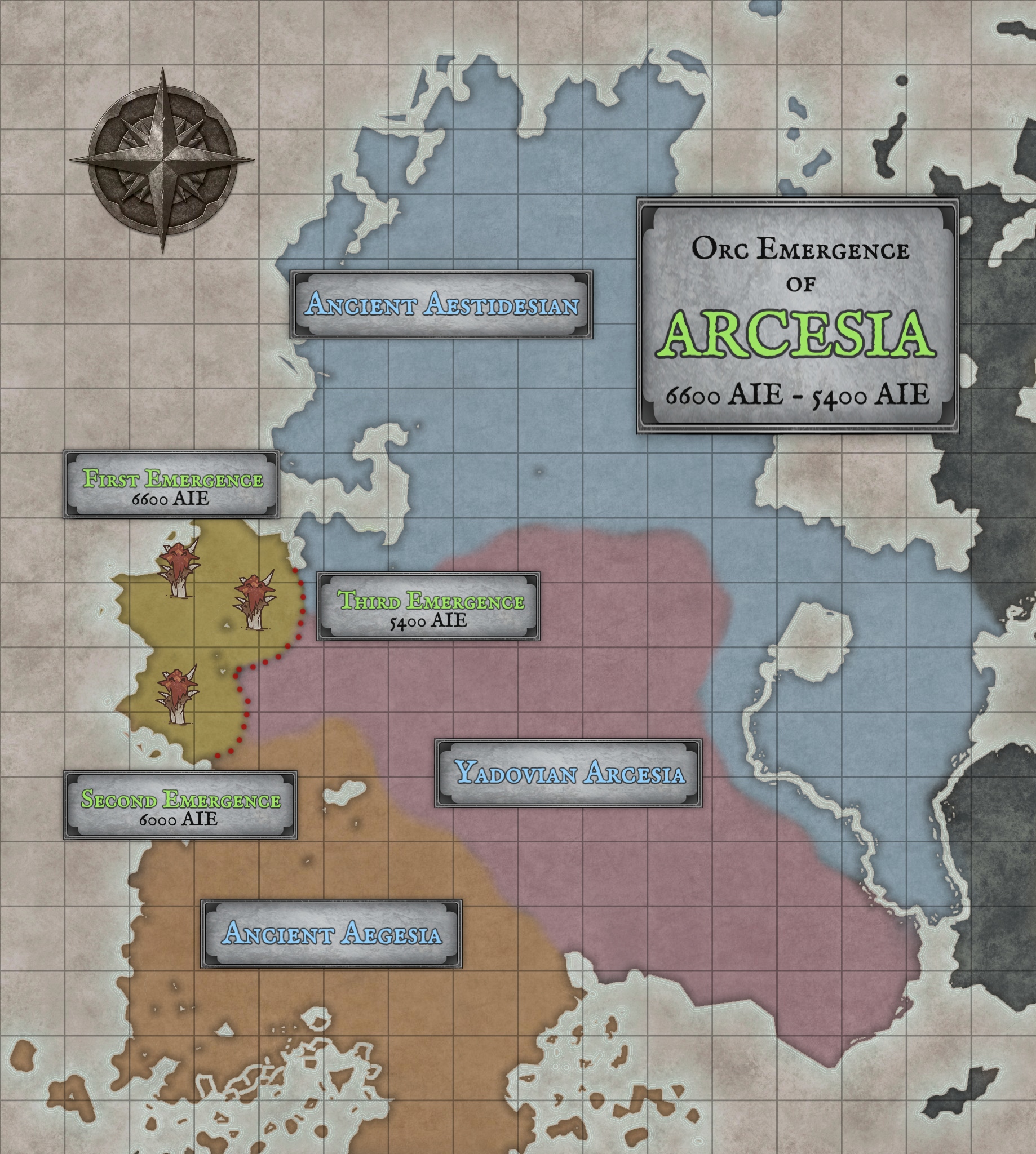
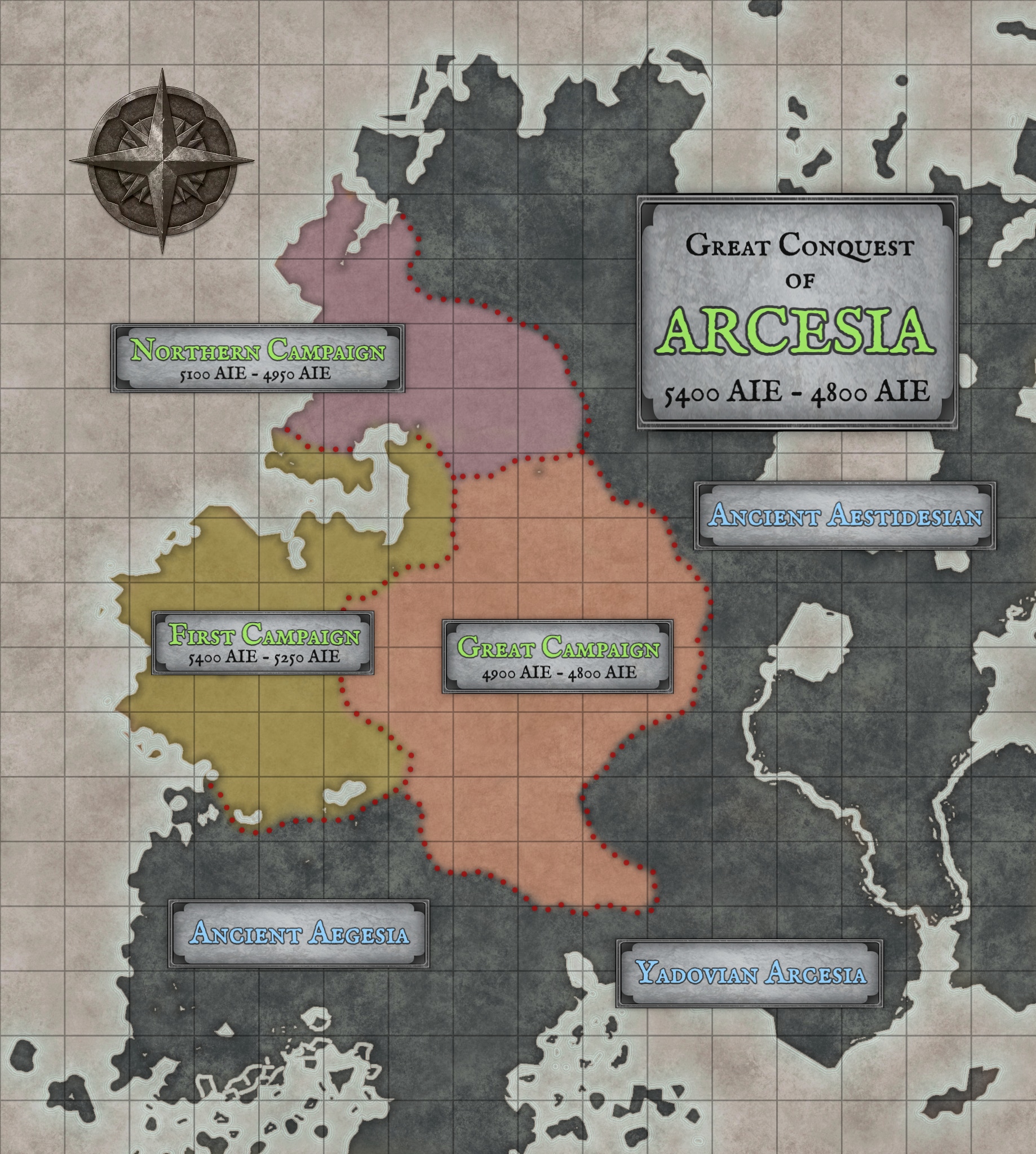
History

Comments