
Toresta
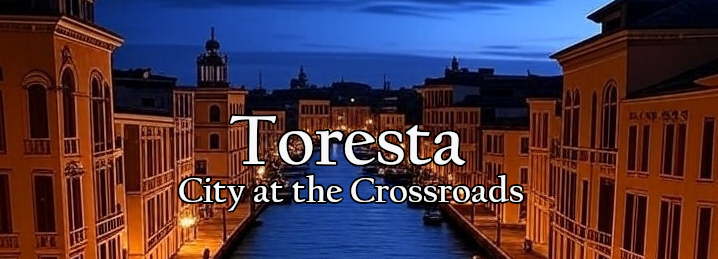
Toresta is built on the Monteplane Peninsula. The city spans 3.9 miles from east to west and 1.5 miles from its widest northern point to the southern entrance to the Great Canal. Many other canals, supplemented by streets between, allow travel throughout the city.
Demographics
The majority of the cities inhabitants are Humans of some type. Many come from families that have been in the city for centuries. A certain number of elfmarked humans live in the city among the others,
Dwarves are the next most populous group in Toresta. Many of the shops, forges and factories in the city are owned and operated by dwarves. Many dwarves live in the Dur'argo neighborhood in the northern part of the city, but dwarves of all social classes also live through the cities various neighborhoods. Dwarves have been resident in Toresta almost since the beginning
Halflings came to the city shortly after its founding, many overland through the Melazain Forest. There are still master wainwrights among the halflings, and many travelers swear they would not hazard any road except in a halfling made wagon. Halflings principally live in the Fourcorners neighborhood, though many also live in Backbank.
Goliaths came to the city more recently than its other inhabitants, only arriving after the Northern Wars at the turn of the last century. That makes most of them first generation citizens, though they have a rising population of second and third generation inhabitants. Most work in the factories doing the manual labor part of the manufacturing, though there are a notable few filling more cerebral positions, including as mage wrights or even mages. Many live in the Diorow Neighborhood next to the factories where they are employed.
Gnomes came with the original founding humans to the city in the first ships to settle there. As such they have always lived among their human companions and have never had segregated neighborhoods in the city. Most gnomes work in the trades or with magic. They are well known entertainers and storytellers, which also makes them prominent in the scholastic fields.
Elves arrived in Toresta shortly after the canal construction started. One of the best ways to disturb or redirect a leyline is to move earth and water. The layline through the Monteplane Peninsula was present before Toresta's first inhabitants arrived, but the construction of the Great Canal and its many connecting waterways strengthened the leylines in a manner that shocked the first elven visitors. Soon thereafter elves and other fey began to arrive on the fey roads aligned with the leylines. A varied population of elves most arriving unannounced and leaving the same way has ensured an unstable population of elves outside the count or control of Toresta's ruling elites, both aristocrat and upper middle class.
The total population of Toresta is supposed to be somewhere around 180,000. There is a sizable transient population who move through by ship, airship, and teleportation circle. The number who arrive and leave by the fey road is unknown, and they are not all eleves.
Government
Torestra is ruled by a Duke that is elected by the College of Electors. Elector positions are hereditary, possessed by the Founding Families. The Founding Families are human and gnome.
Defences
Toresta is defended by its vast trading fleets, both ocean going and air. Torestan privateers are famous for their skill and dogged pursuit of pirates and slavers.
The Entering Bridge separating the island-peninsula from the mainland provides a high level of security from land assault.
The city's isolation from nearby land based neighbors also adds to its defensive posture.
The Dividing Wall separates Outer Toresta, on the mainland from the wilds beyond. The Dividing Wall has arcane as well as physical protection, but is not meant to protect against military attack. The Dividing Gate penetrates the Wall and is staffed by the City Watch.
Industry & Trade
When Toresta was first settled it was from the sea by fleet sailors looking to establish a port for repair and resupply, and as a place to tranship cargos. When they found the strong leyline that passed through the peninsula they quickly attracted mages and other magic users interested in establishing permanent residences there.
With the advances in arcane fabrication techniques in the last century, and the experimentation in new and complex spellcrafting coming out of the Arcane Academy in Bayco, mage-artificers found fertile ground for the establishment of arcane factories in the city. Combined with the already existing transport infrastructure which was already provide a transportation hub to half the world the establishment of manufacturing in the city ensured prosperity for a large number of citizens.
Infrastructure
Toresta's most important resource is the Danilov Leyline. It makes possible the city's magic item manufacturing industry. Everywhere in Toresta is within a mile of a leyline. If not the well known Danilov Leyline, then the much less well known Deep Water Layline. Windmills provide mechanical power to enable the common manufacturing that provide the mundane blanks for the arcane factories.
Even more than the numerous factories the magical essence farms provide one of the city's most important exports. They tap the energy of the leyline and provide the magical medium that allows the rapid creating of a multitude of items.
Canals provide the main transport throughout city. Even the land that supports its many buildings are undercut by an extensive sewer system that often extends below the canals. This system is used mostly for rainwater redirection as compost toilets are the norm, with the night soil emptied and sold for industrial use. Likewise urine is collected and sold for the same.
The Depot is Toresta's main shipyard. Both ocean going and airships are constructed here.
Toresta relies on rainwater collected in cisterns located in public squares. These cisterns gather rainwater from rooftops and paved areas, filtered it through sand, and store it underground.
Districts
Dur'argo neighborhood. Primarily inhabited by dwarves this working class neighborhood is made up primarily of one and two story structures of stone. The canals here are full of pedal propelled paddleboats that usually seat from two to four passengers. Lots of cosy taverns, usually welcoming to visitors of suitably sensible working folk of all species, are located throughout the area. Shops and restaurants are likewise targeted at a clientele of similar class.
The Acropolis Precinct is the seat of government. It contains the Ducal Palace, The Hall of the Wise, where the College of Electors meet and have offices, the Tower of the Tides, where the Council of Captains meets, and Court of the Black Veil, the headquarters of the Council Ten.
Fourcorners. Halfling neighborhood.
Backbank. Halfling neighborhood.
Diorow Neighborhood. Goliath neighborhood located near the factories which are also located there.
Guilds and Factions
The Torestra guilds are very powerful. Not just the Artificers' Guild and the Smiths' Guild as might be expected, but also the Nightmens' Guild and the Boatmen. The political power of the guilds is often exercised through the Masters' Council.
The power of the guilds, located mostly in the middle class is often balanced against the power of the elites, held mostly by the Founding Families, as well as those members of the aristocracy who have bought their way into the nobility over the centuries.
Below the surface the rival thieves' guilds contend for power and influence.
History
In 1 ATC the original Founding Families arrived on the Monteplane Peninsula to establish the port of Toresta. Mages among them quickly discovered the Danilov Leyline, a lower end strong leyline.
The nature of the peninsula's marshy land impelled the settlers to establish canals to facilitate transport in an environment where roads were impractical. It quickly became apparent when the inhabitants attempted to deepen and expand the waterways the the construction was having a fortuitous effect on the leyline, causing it to strengthen markedly.
This was proven by the arrival of elves along the now existent fey road associate with the strengthened Danilov Leyline in 475 ATC.
The now highly stable and strong leyline lent itself to both the farming of magical essence and the support of arcane fabrication. This resulted in the rising star of Toresta as a manufacturing haven.
Points of interest
One of the largest structures in the city is the Aerodrome where airships are both constructed and serviced. Its location near the Depot provides easy access.
The Depot contains both the shipyards for the construction of shipping, and the commercial docks used for the transshipment of cargo. In its warehouse district, with its Street of Traders most of the deals that move goods from continent to continent are negotiated.
The Temple District contains more than one famous structure dedicated to the deities that are called on to protect Toresta's manufacturing and commerce.
The Acropolis Precinct housed the Ducal Palace as well as the Hall of Electors.
The Toresta Polyarcana Academy is well known throughout the wider world. Especially sought out is its Lenner Library, well known for its many volumes on arcana and magical engineering. Its study program for mages and artificers, to which only a small number of students are accepted each year, is world renowned and occupies Grendrey's Tower, a traditional wizard's tower writ large.
The Row is the band of the city that parallels the Great Canal where the Danilov Leyline passes through the city. It passes through the Depot, the Diorow Neighborhood surrounds it, and eventually runs through the campus of the Toresta Polyarcana Academy .
Tourism
Most visitors of Toresta come for mercantile or arcane purposes.
The city has a large transient population of sailors, aeronaughts, and merchants who are in the city to the facilitate the movement of goods.
Mages, artificers and students visit the city to use the facilities of the Toresta Polyarcana Academy, or to study or tap the Danilov Leyline, though there are very few available unoccupied structures along the Row to allow for that, without sanction from the city government.
Eleves travelling the fey road seldom ask for permission to enter or leave the city and their number is a mystery as is their purpose typically.
Architecture
Except in the Dur'argo neighborhood, where most of the architecture is made of imported stone, most of the city buildings are made primarily of brick. Red brick is common as it comes from the mud originally cleared from the canals when they were deepened and widened.
Buildings tend to be from one to four stories, with only major structures, such as Grendrey's Tower at the Toresta Polyarcana Academy or some of the structures in the Temple District taller. Even factories tend to be small affairs of less than four floors, though they may in actuality have only a single or double floor with high ceilings to support their specific manufacturing requirements.
Of course the Aerodrome is the largest structure in Toresta, dwarfing the municipal buildings in the Acropolis Precinct and even those in the Temple District.
Neighborhoods usually intermix mansions and insulae, as apartment buildings are called. Most residential buildings, both mansions and insulae have central courtyards, private in the case of mansions and semipublic in the case of insulae. Many buildings include shops or businesses on the ground floor, with living space above and it is quite common for proprietors to live above their shops in the same building.
Geography
Toresta is built on the Monteplane Peninsula. Technically Monteplane is no longer a Peninsula since a defensive moat was dug in 527 to make the city more defensible from the land side . A single road leaves the city across the Entering Bridge, which has a drawbridge section.
Fresh water is provided by cisterns into which run rainwater through the sewer runoff system. This is supplemented by a number of deep wells.
Located on the Great Eastern Ocean Torestra in located at the crossroads of many sea routes. Its central location between east and west also make it a hub for airship traffic.
The mainland across the Entering Bridge provides the majority of the city's food staples. This area, known as Outer Toresta, is protected from the wilds by the Dividing Wall. The Wall, not meant to defend against military attacks is lightly defended and primarily designed to prevent monster and beast incursion.
Areas in the mainland are wild for hundreds of miles, leaving Toresta fairly isolated as far as overland travel is concerned. That does not mean that the occasional wagon caravan does not enter the city, though that has become common only in the last fifty years or so.
Climate
The climate in Toresta is mild with warm winters and cool summers. Rain is common, particularly at night.
Natural Resources
The Danilov Leyline is Toresta's primary resource. Most mundane resources enter the city by ship. Very seldom a specific item might make its way to the city through the wilds. Food is grown in Outer Toresta.
