

Mire Point
Mire Point is the capital city of Clan Bogclutch, situated on a marshland peninsula directly adjacent to the Oak Trade Road. Founded during the late 87th Era of Enchantment, the settlement grew rapidly from an empty peninsula into one of the largest population centres in central Redstone Hold. Today, Mire Point functions as the political, economic, and cultural core of the Bogclutch domain under the authority of The Master
Government
Mire Point is ruled by the Lord Protector (the Master), with the Cat from Castle Veil acting as his principal guardian and enforcer. Day-to-day administration is divided among district heads, guard captains, and clan representatives.
Each district has 18 guardsmen fitted out in hard leather gambeson, copper iron chain mail, copper iron Barbute, copper iron kite shield, short bow and copper iron short swords. The guardsmen Captain has a copper iron heater shield.
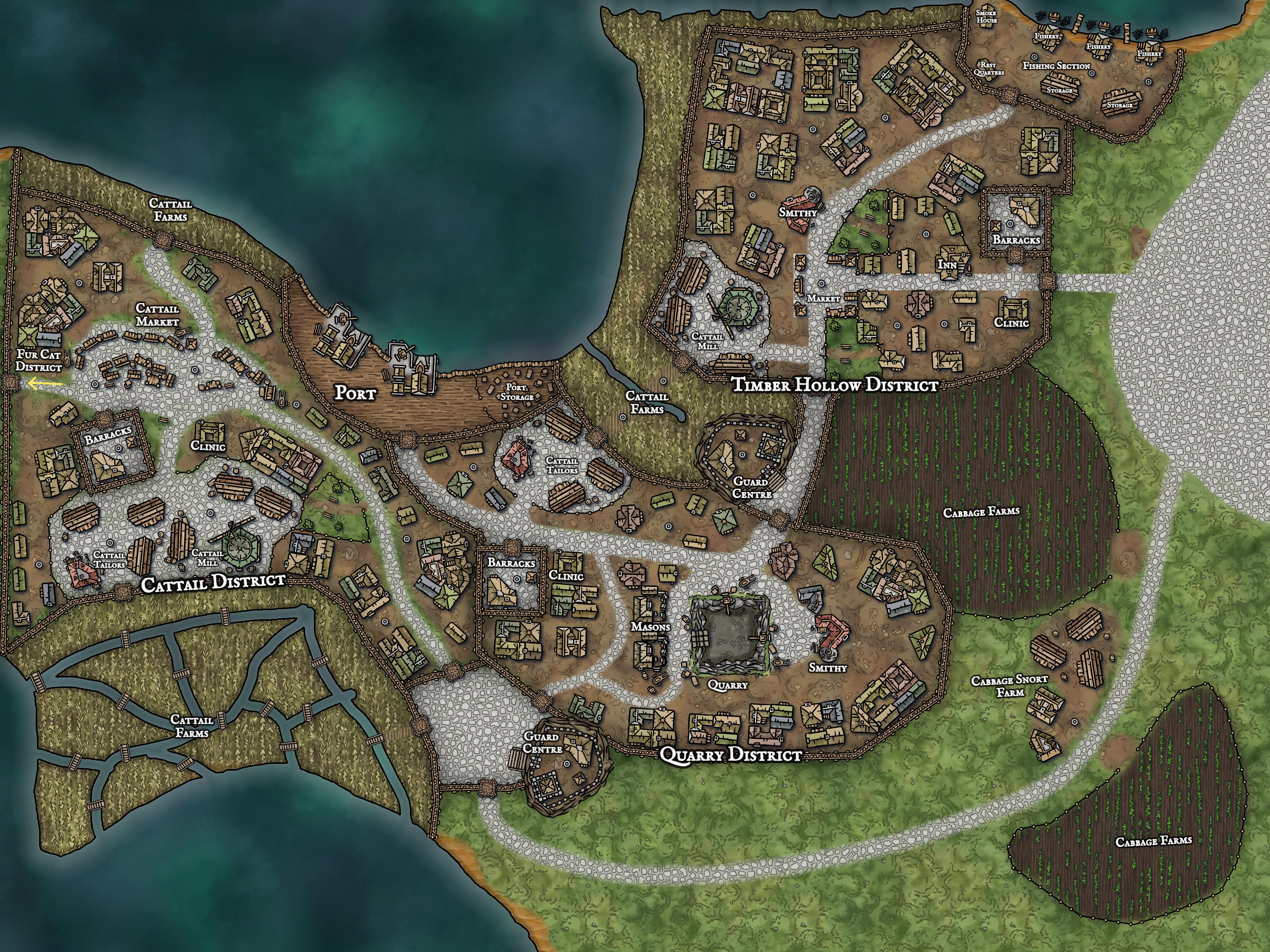
Above the rank of district is The District Law Captain which provides support to attached districts. Two guard centre's exist, one better Timber Hollow - Quarry and one between Quarry - Cattail, these guard centre's are on raised mottes and are supported by 18 guardsmen, a barracks along with a sandstone watchtower overseering each area. The guard centres also control the flow of movement between districts, cirectly controlling sealed off "airlocks".
Clan and District Commanders
The Veil Shadow.
Serepha Blacktallow is the overall district overseer
Commands Black Fang units and special operations
Timber Hollow District
Snagga Mirewretch, Goblin Clan Head.
Quarry District
Narka Grinstone, Goblin Clan Head
Cattail District
Lisette Ferrah, Catgirl Clan Head
Central Guard Houses
Grizza Bogsnout, Goblin Law Captain of Timber-Quarry
Grunna Mireclutch, Goblin Law Captain of Quarry-Cattail
Foreign District ( 12 militia and 15 Black Fang under Serepha Blacktallow)
Veileth Pontune, Alderian Pureblood Marshal
Royal Guard gresha Bogclutch, 38 Black Fang goblins control The Cat Fur District of western Mire Point.
The separation law in Mire Point was introduced during the city’s early expansion, after overcrowding and disease outbreaks made unregulated settlement patterns dangerous to both public health and social stability. As the population surged with waves of Bogclutch refugees and non goblin migrants, the Master’s administration implemented a structured residential system designed to prevent the chaos that had overwhelmed earlier marsh encampments. The law divided the population into clearly defined residential zones, each managed under strict civic and clan oversight, ensuring that housing, work, and resource distribution remained organised rather than devolving into uncontrolled sprawl.
Under the separation law, goblins were assigned to large communal clan complexes, each overseen by an officially recognised clan header. These compounds provided concentrated housing, labour coordination, and district level governance. Living together in close, organised groups allowed goblin clans to maintain traditional structures, reinforce communal labour practices, and support each other through shared work responsibilities and militia obligations. This arrangement also made it easier for the district law captains to manage legal enforcement, food distribution, and disease control within high density blocks.
Meanwhile, all non goblin residents were restricted to single family detached housing built outside the goblin clan complexes. Alderian, dwarf, gnome, catgirl, and elf households were placed in the Foreign District and on designated residential lines around the trade causeways. This system was not designed as a punishment but as a form of social management, reducing overcrowding, limiting cross clan disputes, and preventing the spread of mould and sickness among diverse groups with different living customs. Detached housing also provided stability for non goblin residents who preferred quieter, smaller homes rather than clan based communal living.
Defences
Mire Point is one of the most military heavy settlements within modern times.
Mire Point’s defensive system is one of the most intricate in the southern marshlands, shaped by necessity, geography, and the constant threat of mire beasts, raiders, and political instability across Redstone Hold. Rather than relying on a single outer wall, the city’s security is based on a layered, decentralised defence network that blends engineered fortifications with natural marsh barriers. The peninsula itself forms the first protective shield; waterlogged ground, shifting bog pockets, and reed thickets slow or funnel any advancing force into predictable approach lines. These natural obstacles are deliberately maintained by the marsh wardens, ensuring that no enemy can advance quickly or without exposing themselves to defenders stationed on raised platforms, causeways, and watchpoints.
The most visible man made component of Mire Point’s defence is its network of district palisades. Each major district is surrounded by timber walls reinforced with clay and stone footings, forming independent fortified blocks. This means that even if one district is breached, the others can continue fighting, holding, or evacuating without immediate collapse of the larger settlement. Gatehouses are narrow, angular constructions with overlapping fields of fire, allowing crossbow units to cover every angle of approach. Many gates are also built above drainage channels, forcing attackers to approach through muddy, difficult terrain while defenders maintain height advantage. Elevated patrol bridges between districts allow militia units to redeploy without touching open ground, maintaining mobility during sieges or marsh floods.
Beyond the inner walls, Mire Point employs a perimeter security zone along the causeways leading into the city. These access routes are designed as kill channels, long straight paths bordered by reeds, trenches, and concealed defences. Marsh trenches filled with stagnant blackwater run alongside some stretches, preventing flanking manoeuvres. Watchtowers line the approaches, operating both as warning posts and fire support stations. These towers are spaced to allow visual communication via lantern signals and horn codes, creating an early warning system that can wake the entire settlement in moments. At night, patrol skiffs operate in the surrounding marsh, using lantern shields and shallow hulls to silently monitor beast movement along the waterways.
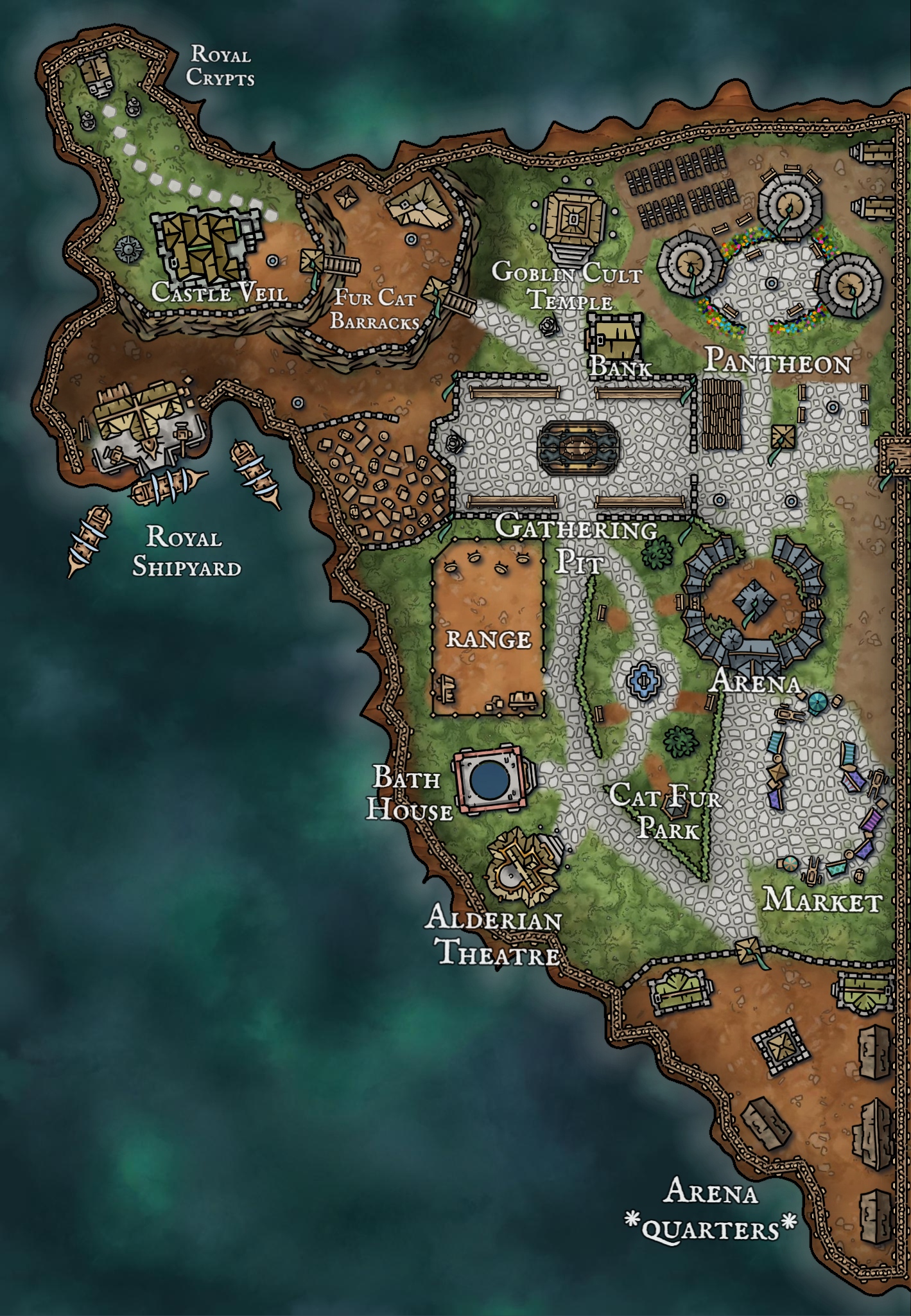
Castle Veil forms the final defensive anchor of the settlement. Its elevated position and reinforced palisades create a fallback redoubt capable of withstanding prolonged assault. The keep contains armouries, supply chambers, and a garrison of the Royal Guard, who remain ready to deploy at any hour. Adjacent to the keep are the Royal Shipyards, which maintain a fleet of patrol vessels used to secure the marsh channels around the capital. These craft are designed for rapid response, able to intercept threats long before they reach the edges of the settlement. The arena quarter also doubles as a rallying ground during emergencies, providing a central space for militia mustering and equipment distribution.
Together, these systems transform Mire Point into a settlement that cannot be taken by speed or brute force. Any enemy must first contend with the marsh itself, then survive the narrow causeways, then breach multiple fortified districts, each capable of independent resistance. The city’s defence is not built on a single wall but on layers of resilience, adaptability, and the strategic use of the marshlands that surround it.
Industry & Trade
Mire Point’s industry and trade system grew from the settlement’s early struggle for survival into a fully formed marshland economy that now supports one of the largest populations in southern Redstone Hold. Its industries are shaped by its geography: the abundance of cattails, reeds, fish, clay, sandstone, and marsh herbs created a production base that rewards adaptability over heavy industry. As a result, Mire Point’s commercial strength lies not in mass manufacturing but in a steady, dependable stream of marsh based goods that are traded along the Oak Trade Road and shipped through its small port. These goods allow the city to sustain itself, outfit its militias, and maintain regular trade contact with the Duskfen mines, Maw Mine, and smaller marsh settlements.
The heart of Mire Point’s economy is the cattail industry, which dominates the southern districts. Vast enclosed cattail fields provide the raw material for clothing, rope, mats, cloaks, padding, baskets, and waterproof textiles. Workshops in the Cattail District transform harvested stalks into woven cloth and trade goods that are exported throughout Bogclutch territory. Alongside cattails, reedcraft contributes significantly to daily life, producing everything from fishing nets to household goods. These marsh grown materials form the backbone of Mire Point’s low cost, high volume export market, feeding both internal trade and caravan exchange along the Oak Trade Road.
Fishing and marsh harvesting remain essential components of Mire Point’s trade network. The settlement’s controlled fishing bays yield steady catches of fish, eel, and mire creature meat, which are preserved in smokehouses and sent to outlying settlements. Marsh herb strips, cultivated along elevated ridges and shallow channels, produce medicinal plants used throughout Bogclutch clinics and sold to traders seeking treatments for rot, fever, and marshborne infections. These herbal goods, combined with cattail fibre products, give Mire Point a distinct niche in medicinal and survival gear trade.
Extractive industries also play a crucial role. The Quarry District supplies clay, sandstone, gravel, and timber, all of which support ongoing city construction and road maintenance. Clay is used extensively in drainage systems and pipework, while sandstone blocks reinforce causeways and district palisades. Timber, harvested from controlled patches of marsh woodland, fuels both building and shipyard production. These materials are exported in modest quantities to settlements along the Oak Trade Road, providing a reliable exchange base for goods Mire Point cannot easily produce.
Trade flows steadily through the city via both land and water. Caravans arriving along the Oak Trade Road bring refined iron and copper from Duskfen and speciality drinks such as mushroom tea from Maw Mine. Mire Point does not produce refined metals on its own but uses these imports to craft tools, fittings, and weapons for local use. The small but active trade port, enclosed behind walls to prevent mould contamination, handles barge loads of cattail goods, fish, leatherwork, and raw materials destined for other marsh communities and for merchant groups travelling westward.
Overall, Mire Point’s industry and trade system operates as a balanced marsh economy built on the city’s natural resources. Its strength lies not in wealth or luxury but in self sufficiency, steady production, and the ability to supply the essentials needed for life and defence in the wetland frontier.
Infrastructure
Mire Point’s infrastructure reflects the unique demands of a vast marshland capital built almost entirely from nothing during the late 87th Era. The settlement is arranged across raised earthworks, timber platforms, and natural islets bound together with reinforced walkways and causeways. Movement through the city follows elevated wooden paths and compacted dirt lanes that remain usable even as seasonal flooding swallows the surrounding wetlands. A wide spur of the Oak Trade Road feeds directly into the city’s main causeway, while secondary routes wind through the district complexes and farming zones. Beneath the walkways lies an extensive drainage system of reed packed trenches, retention ponds, and clay lined channels that siphon stagnant marsh water away from living quarters. This water management remains essential to controlling mould, rot, and disease.
District fortification is a central feature of Mire Point’s design. Each of the major districts, including Timber Hollow, Quarry, Cattail, and the Foreign District, is independently walled with timber palisades and guarded gates. The Royal Quarter surrounding Castle Veil uses heavier stone reinforced palisades and iron gateworks to protect the administrative and command centre of the city. The housing infrastructure is deliberately separated: goblins live in large communal clan blocks supervised by their respective clan headers, while all non goblin residents occupy single family timber dwellings raised on stilts outside the clan complexes. These homes are positioned along safer ground where the drainage systems keep mould and flooding manageable. The earliest refugee encampments form the Old Quarter, now repurposed into narrow residential streets and emergency storage areas.
The public buildings of Mire Point are practical and numerous, including district barracks complexes for militia deployment, district clinics built to manage marshborne ailments, a central inn for traders, and specialist market halls such as the Cattail Market. Resource infrastructure spreads outward toward the marsh edge, where large enclosed cattail farms provide fibre for clothing, rope, insulation, mats, and export goods. Fishing bays with reed filtered nets provide fish and eel harvests, while clay and sandstone quarries in the Quarry District supply building material for both maintenance and expansion. Marsh herb strips run between the islets, providing medicinal plants heavily relied upon by the city’s clinics.
Transport and trade depend on both land and water. A canal system threading between districts allows goods to move on reed punts and flat bottom skiffs, ensuring year round transport regardless of flooding. A small, isolated trade port sits at the shoreline, walled off from the interior to prevent mould and disease spread. It handles barge loading, fish curing, and cattail fibre export. Military infrastructure forms the backbone of Mire Point’s authority: Castle Veil houses the Royal Guard, armouries, crypts, and strategy halls, while the arena quarter serves militia training and public contests. The nearby shipyards construct and repair patrol skiffs and marsh rafts used to secure the waterways.
Utility structures are scattered throughout the city, including reed filtration wells, coal and peat storage pits, smokehouses for preserved fish, timber drying racks, and public granaries. Together these networks of roads, canals, defences, workshops, farms, and clan housing blocks form a resilient infrastructure system capable of supporting one of the largest settlements in the southern marshlands.
Districts
Timber Hollow District
Timber Hollow is one of the oldest and busiest districts in Mire Point, having grown directly from the earliest refugee encampments that once surrounded the central causeway. As the population stabilised, the area evolved into a dense cluster of timber framed homes, market stalls, small guild workshops, and family run trade shops. The district became the primary commercial hub for day to day goods, especially those needed by workers, militia patrols, and travellers passing through from the Oak Trade Road. Timber Hollow’s layout follows the natural curve of the raised ground beneath it, creating a winding but compact network of streets that keep foot traffic flowing even during high water seasons. The district’s inn remains the largest non military lodging point in the city, and its market square forms a central gathering place for merchants, labourers, and residents who rely on its steady supply of food, tools, and basic marsh goods.
Cattail District
The Cattail District stands at the heart of Mire Point’s agricultural and industrial machinery, built around expansive enclosed cattail fields and reed processing yards. These fields produce the fibres that support much of the city’s clothing, ropework, matting, and waterproof textile industry. Workers live within the district’s walled perimeter in elevated timber homes that overlook the fields, allowing constant supervision during harvest seasons and protection from mire creatures. Processing sheds, weaving houses, and boiling pits line the main walkways where cattail stalks are transformed into thread, cloth, baskets, and marsh ready garments. The district’s central market handles both wholesale shipments heading toward the trade port and retail purchases for locals who depend on cattail goods for daily life. The air is often heavy with steam and plant scent, marking the district as a place of constant labour and production.
Quarry District
The Quarry District occupies the sturdiest ground in Mire Point, built atop patches of clay and sandstone that rise slightly above the surrounding wetlands. This elevated terrain made it ideal for establishing mining pits, brickworks, stone cutting platforms, and clay extraction trenches. The district produces much of the city’s construction material, supplying sandstone blocks for foundations, clay for walls and pipes, and gravel for reinforcing major roadways. Workers rotate through dry and wet seasons, adjusting production according to water levels. The quarry pits are surrounded by safety palisades and drainage channels that prevent collapse and allow carts to move freely across the district’s reinforced gravel roads. Labour housing sits nearby, separated from the pits by shallow channels that also double as fire breaks. The district’s importance lies in its continuous output of raw materials that keep the rapidly expanding capital stable and structurally sound.
Foreign District
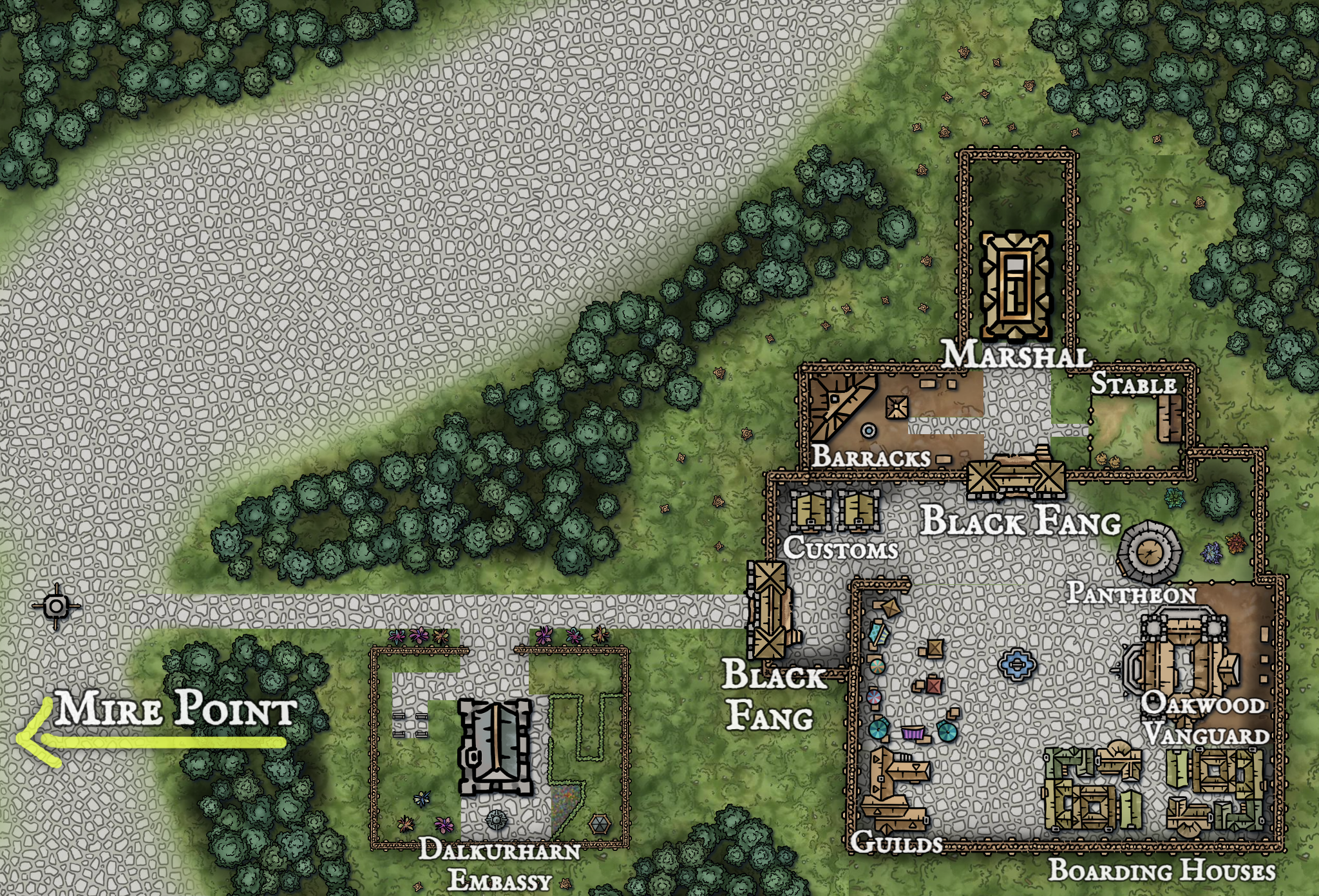
The Foreign District serves as the controlled residential and administrative zone for all non goblin inhabitants of Mire Point. Established under the settlement’s separation laws, the district provides detached single family homes to Alderian, dwarf, gnome, elf, and catgirl residents who were not permitted to live in the goblin clan blocks. The district maintains a more regulated and orderly layout than other areas, with wider roads and checkpoints manned by militia units under the command of Veileth Pontune. It hosts its own small market and trade houses to prevent overcrowding of the main districts and to keep foreign merchants, travellers, and settlers within an easily supervised zone. Despite its controlled nature, the district is a vital commercial and cultural interface between Mire Point and the outside world, serving as both a diplomatic space and a transitional area for newcomers entering Bogclutch territory.
CatFur District
The CatFur District forms the ceremonial, cultural, and martial heart of Mire Point, dominated by monumental structures, clan temples, and public gathering spaces. Built on higher ground at the western end of the settlement, the district hosts the Gathering Pit, the arena and its warrior quarters, the theatre, and a large market square used during festivals and public addresses. The bath house and various pantheons, including those dedicated to Tyr, Bane, the Cat Lord, and the ancestral graves, give the district its strong spiritual presence. The Goblin Cult Temple stands as one of its most influential landmarks, reinforcing the clan’s religious authority. Nearby, the Fur Cat Barracks house elite fighters, while Castle Veil rises above the district as the seat of government and centre of royal administration. The Royal Crypts lie beneath, and the Royal Shipyards sit at the district’s edge, where patrol vessels and marsh skiffs are constructed to defend the waterways. The CatFur District functions as both the symbolic and operational centre of Bogclutch power.
Guilds and Factions
Mire Point’s guilds and factions form a layered social and administrative structure built upon the city’s rapid expansion and the Master’s governance reforms. The most influential groups are the goblin clans, each of which controls a major district and operates as both a civic body and a labour guild. These clans, known collectively as the district clans, manage everything from resource extraction to internal housing and local militia organisation. Each clan functions from a central compound within its district, where leadership oversees work rotations, production quotas, dispute resolution, and the enforcement of district regulations. Their authority is balanced by the district law captains, who operate as the Master’s legal representatives. These captains maintain order, supervise guards, and ensure that clan powers remain tied to law rather than personal ambition. Together, the district clan heads and law captains create a hybrid system where civic, labour, and legal oversight are interwoven throughout each district.
Beyond the dominant goblin clan structure, Mire Point hosts a collection of non goblin factions centred primarily in the Foreign District. This area operates as a neutral commercial and residential zone for all Alderian, dwarf, gnome, elf, and catgirl inhabitants who fall outside the goblin clan system. Here, the Oakwood Vanguard maintains a small presence, acting as a formal military liaison and external security partner, ensuring stable relations between Mire Point and the broader Oak Trade Road network. Their presence also serves as a deterrent against external threats and a symbol of the agreements that bind the marsh capital to regional mercantile interests.
The Foreign District also contains several merchant and trade guilds that manage commercial activity, caravan passage, and specialised crafts not commonly practised among the goblin clans. These guilds include travelling trader coalitions, leatherworkers, cattail cloth brokers, fishmongers, and a number of mixed species craft circles. Their role is to facilitate regulated trade, negotiate caravan tariffs, oversee quality standards for export goods, and maintain networks with other settlements. Their operations are carefully supervised by the district marshal, ensuring that foreign traders and artisans contribute to the city’s economy without disrupting its internal balance.
Together, the goblin clan compounds, district law captains, Oakwood Vanguard representatives, and foreign merchant guilds form a multi layered factional landscape that keeps Mire Point functional, organised, and resilient. Each group plays a role in maintaining stability, distributing labour, enforcing law, and connecting the marsh capital to the wider world.
Founding Date
87 Era Enchantment
Founders
Type
City
Population
around 15,000
Included Locations
Owner/Ruler
Owning Organization
Characters in Location

Comments