

Catgirl
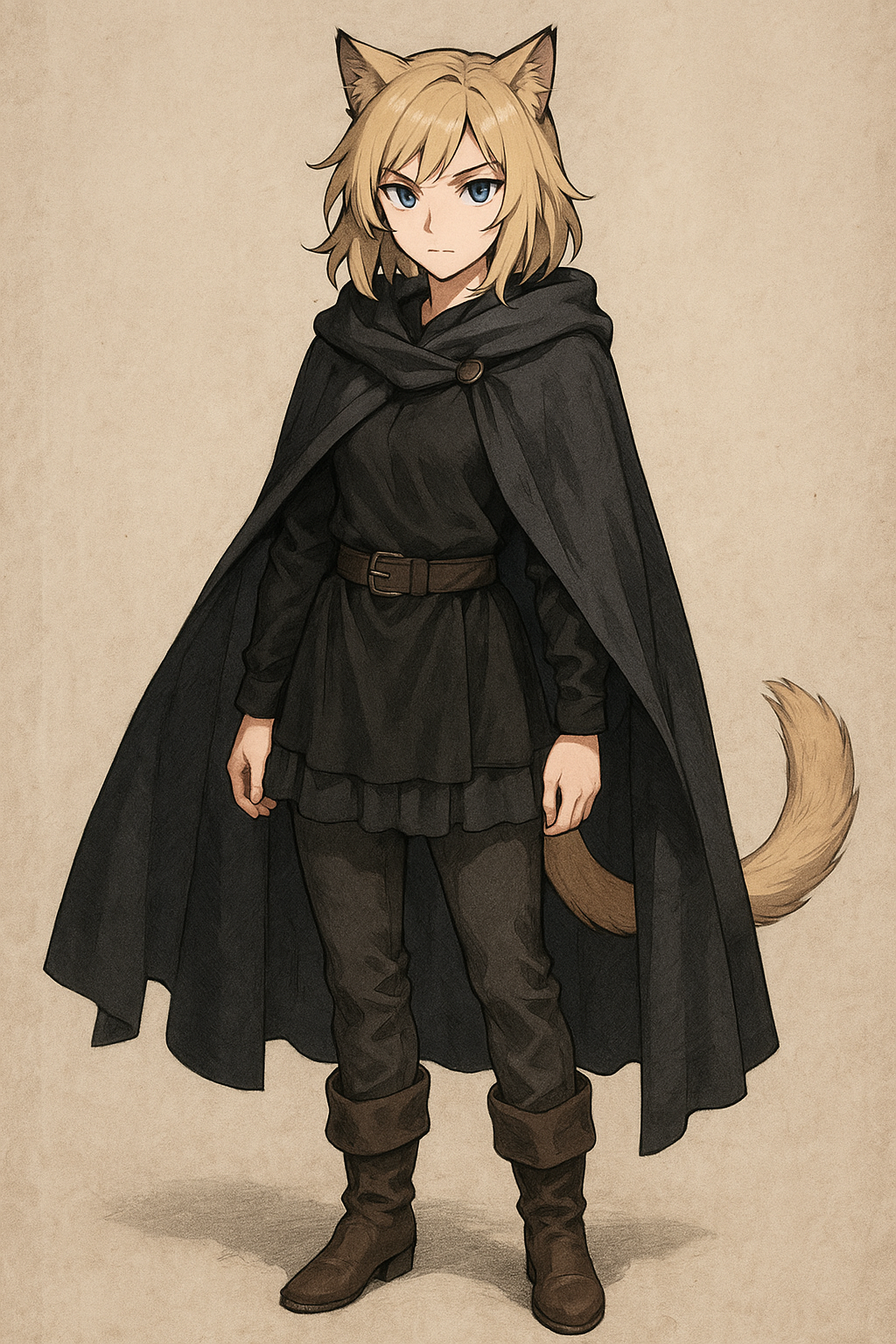
Catgirls are a highly uncommon sub race consisting of 90%+ Alderian and 10% cat genetics.
The race is largely consisted a pet race by the majority of Alderians which is only reinforced by their sole reproduction mates of Alderians.
The race is largely consisted a pet race by the majority of Alderians which is only reinforced by their sole reproduction mates of Alderians.
Basic Information
Anatomy
Catgirls are humanoid in structure with distinct feline features, including cat-like ears, a functional tail, and enhanced musculature for agility and balance. Their bodies are typically lean and flexible, with fast-twitch muscle development supporting climbing, sprinting, and rapid directional movement. Hands and feet remain humanoid, but reflexes and joint flexibility are notably superior to Alderians. Their eyes are forward-facing with slightly enlarged pupils, enabling strong low-light vision.
Biological Traits
+2 on climbing race advantage, reflexes / running checks due to being steadfast
-1 on speech checks due to being seen as pets rather than equals.
average food intake is 5000 kcal daily
saving throws required for all caffeine / alcohol intake
saving thows required when hit with water or their negative smell gives disadvantage on all stealth and speech checks
Genetics and Reproduction
Catgirls originated from a stabilized hybrid line between feline beastfolk and Alderians. They are an all-female species. Reproduction is possible only through partnership with an Alderian parent; they cannot interbreed with beastfolk or other hybrid species without genetic failure. Offspring are always female catgirls. Their lineage requires periodic Alderian genetic input for long-term viability, making their existence biologically tied to Alderian reproduction.
Growth Rate & Stages
Catgirls mature slightly faster than Alderians. Childhood lasts approximately eight years, followed by accelerated adolescence, with full physical and cognitive maturity reached by early teens. While mentally mature, many cultural behaviors develop socially rather than biologically. Lifespan generally aligns with Alderians, though heightened metabolism can shorten life expectancy in resource-scarce environments.
Ecology and Habitats
Catgirls are highly adaptable but excel in environments offering vertical space, dense cover, or complex terrain — forests, cliffs, city rooftops, and layered underground structures. They rarely form independent nations due to historical and biological constraints, instead integrating into Alderian-majority territory or mixed communities. They prefer environments where stealth, climbing, and quiet movement offer advantage. Cold climates are tolerated, but wet environments are culturally and biologically avoided due to sensitivity to wet fur and associated scent vulnerability.
Dietary Needs and Habits
Catgirls are obligate-leaning omnivores with a strong carnivorous preference. They require higher caloric intake relative to body weight — typically twice that of an Alderian — driven by fast metabolism and physical energy demands. Diets rich in meat, high protein, and fats support optimal health. While capable of eating cooked food, fresh or lightly-prepared meat is culturally common and digestively effective. Hydration habits are cautious due to instinctive aversion to water exposure.
Behaviour
Catgirls display adaptive social behaviour shaped almost entirely by environment. They lack a single native culture or homeland, instead absorbing the customs, language, and hierarchy of whatever society raises them. This cultural mimicry functions as both survival instinct and identity framework. Among disciplined societies such as the Alderians, catgirls become orderly and deferential. Within tribal or martial groups, they adopt aggression, cunning, and assertiveness. Their behaviour, etiquette, and even moral outlook mirror those of their surroundings with striking precision.
Psychologically, catgirls are responsive and relational. Their sense of self is anchored in personal bonds rather than heritage or ideology. Loyalty forms quickly and intensely, often centring on an individual who provides structure or safety. This attachment can lead to devotion or dependence, depending on the stability of the relationship. Because they adapt to please and to belong, catgirls are seen by scholars as both socially flexible and emotionally volatile. In essence, they are a reflection of the culture they inhabit, embodying its virtues and flaws with equal ease.
Additional Information
Domestication
Catgirls are not domesticated, but historical and social perception often places them adjacent to domesticated status. Their origin as a hybrid species and their cultural associations with companionship, agility, and loyalty have led many Alderian societies to view them similarly to pets or bonded companions, despite their sapience and autonomy.
In practice, catgirls are free individuals and are not legally or structurally enslaved in most regions. They retain full mental independence, personal agency, and cultural identity. However, lingering historical bias—combined with their rarity and reproductive reliance on Alderians—results in widespread social assumptions labeling them as dependent, docile, or socially subordinate, regardless of individual reality.
Facial characteristics
Cat Ears
Perception and Sensory Capabilities
Catgirls possess heightened senses compared to Alderians. Their hearing is sharper, capable of detecting higher frequencies and distant movement. Their sense of smell is more acute, allowing environmental awareness and identification of familiar individuals. Vision is adapted for both light and shadow, granting excellent night vision but mild sensitivity to bright glare. Tactile sensitivity, especially in the tail and ears, is pronounced.
Civilization and Culture
Naming Traditions
Catgirl surnames are functional rather than hereditary. They do not signify lineage, ancestry, or clan, but instead commemorate an event, trait, or deed that defines the individual. A catgirl’s last name often arises from public recognition, personal achievement, or reputation within the culture she inhabits. Names such as Everguard, Devil Eye, or Ashstep mark identity through meaning rather than blood.
Beauty Ideals
Catgirl beauty ideals vary depending on the culture they inhabit, mirroring their adaptive nature. There is no single standard of appearance across their species, only patterns shaped by the societies around them. In Alderian regions, beauty is defined by cleanliness, composure, and obedience. Smooth fur, neat grooming, and subdued colouration are prized as signs of refinement and domestication. Among goblins or frontier settlements, strength and vitality hold greater appeal, with scarred hides, wild eyes, and muscular form celebrated as marks of survival.
Despite these variations, one near universal trait exists: expressiveness. Catgirls are valued for their eyes, ears, and tails, which convey emotion more vividly than words. Grace of movement and awareness of presence are seen as essential elements of beauty, as is the ability to draw attention without overt display. Many cultures regard a catgirl’s ability to perform composure and allure at once as the height of charm. Their beauty, much like their identity, is shaped by imitation and adaptation, an evolving reflection of the world that owns or welcomes them.
Gender Ideals
Catgirl gender ideals are inseparable from their biology and cultural fluidity. As an all-female species, they exist outside the binary frameworks of most societies and instead interpret gender through the lens of role and relation. Femininity for catgirls is defined not by softness or submission, but by purpose. In Alderian cities, they are expected to embody grace, obedience, and composure, reflecting the ideals of the society that shelters them. In freer or harsher lands, such as goblin or mercenary territories, they often represent feral strength, cunning, and self-possession.
Because their culture is derivative rather than inherited, catgirls frequently internalise the gender norms of others while reshaping them into their own survival tools. They can play the role of servant, soldier, or seductress with equal conviction, shifting between them as context demands. Across societies, they are simultaneously symbols of devotion and independence, defined less by what they are born as and more by how they adapt. In essence, a catgirl’s gender ideal is not fixed; it is the art of becoming exactly what the world expects, while quietly ensuring that expectation serves her survival.
Courtship Ideals
Catgirl courtship ideals are rooted in dependency and hierarchy, reflecting their long history within Alderian society where the master-pet relationship is both social norm and survival mechanism. Bonds form not through equality but through protection, structure, and emotional recognition. The catgirl seeks stability and identity in a partner’s authority, while the Alderian finds devotion and loyalty in her attachment. What begins as ownership often evolves into mutual reliance, where affection is expressed through obedience, service, and the quiet assurance of belonging.
Courtship itself is rarely ceremonial. It unfolds through proximity and behaviour: grooming, service, and loyalty tests that prove endurance rather than romance. The forming of a bond is considered both emotional and psychological, often described as imprinting. Once chosen, a partner becomes the centre of a catgirl’s social and emotional world, and separation is viewed as unnatural.
Relationship Ideals
Catgirl relationship ideals are defined by devotion, stability, and emotional fusion rather than equality. The bond between a catgirl and her chosen partner, most often an Alderian master, is expected to be lifelong and absolute. Loyalty and service are considered the highest expressions of affection, while protection and recognition are the partner’s reciprocation.
Independence within such relationships is rare and often seen as a sign of mistrust or instability. The ideal partnership balances dominance and care, where authority is accepted as security and obedience as devotion.
Common Etiquette Rules
Catgirl etiquette is shaped entirely by the culture in which they live, but certain behavioural constants persist across regions. They are expected to show deference, composure, and attentiveness in social interaction, with particular emphasis on reading the emotional state of others. Silence, posture, and controlled movement often speak louder than words. Direct confrontation or loud disagreement is considered improper, especially in the presence of authority figures or potential masters.
In Alderian society, proper conduct includes kneeling or bowing when addressed by superiors, maintaining steady eye contact only when spoken to, and keeping ears and tail still as a sign of discipline. Among less formal communities, gestures of respect may instead take the form of shared grooming, gift-giving, or mimicry of tone and body language. Across all contexts, etiquette serves the same purpose: to demonstrate awareness of hierarchy and to ensure social harmony.
Interspecies Relations and Assumptions
Catgirls are a stabilized hybrid species. They can reproduce only with Alderians, and cannot produce viable offspring with beastfolk or other mixed lineages due to genetic dilution resulting in 90% of their DNA being from Alderians. Their female-only biology and dependency on Alderian reproduction create a unique genetic cycle, tying their survival to proximity and interaction with Alderian populations while maintaining distinct traits.
Genetic Ancestor(s)
Origin/Ancestry
The Alder
Lifespan
85
Average Height
5'0" to 5'8"
Average Weight
45–65 kg

Comments