

Castle Veil
Castle Veil serves as the administrative and ceremonial heart of Mire Point, rising from the western district as both a fortress and a functioning seat of government. Built on the highest stable ground in the marsh peninsula, the castle was designed not as a grand royal palace but as a fortified command complex capable of coordinating the defence, governance, and daily operations of a rapidly expanding marshland capital. Its construction reflects The Master pragmatic leadership philosophy: engineered durability, efficient room layout, and controlled access rather than ornamental excess. The castle’s stonework incorporates sandstone from the Quarry District, heavy marsh timber, and clay packed foundations, giving it resilience against moisture, mire beast incursions, and siege conditions.
Purpose / Function
Castle Veil’s purpose is rooted in the circumstances of Mire Point’s creation: a rapidly expanding marshland capital that needed stability, order, and central authority in a region defined by danger, migration, and political fragmentation. Rather than a palatial symbol of luxury, Castle Veil was built to serve as the nerve centre of Clan Bogclutch’s government, military command, and civic administration. Every room and floor exists to fulfil a specific role in holding the city together.
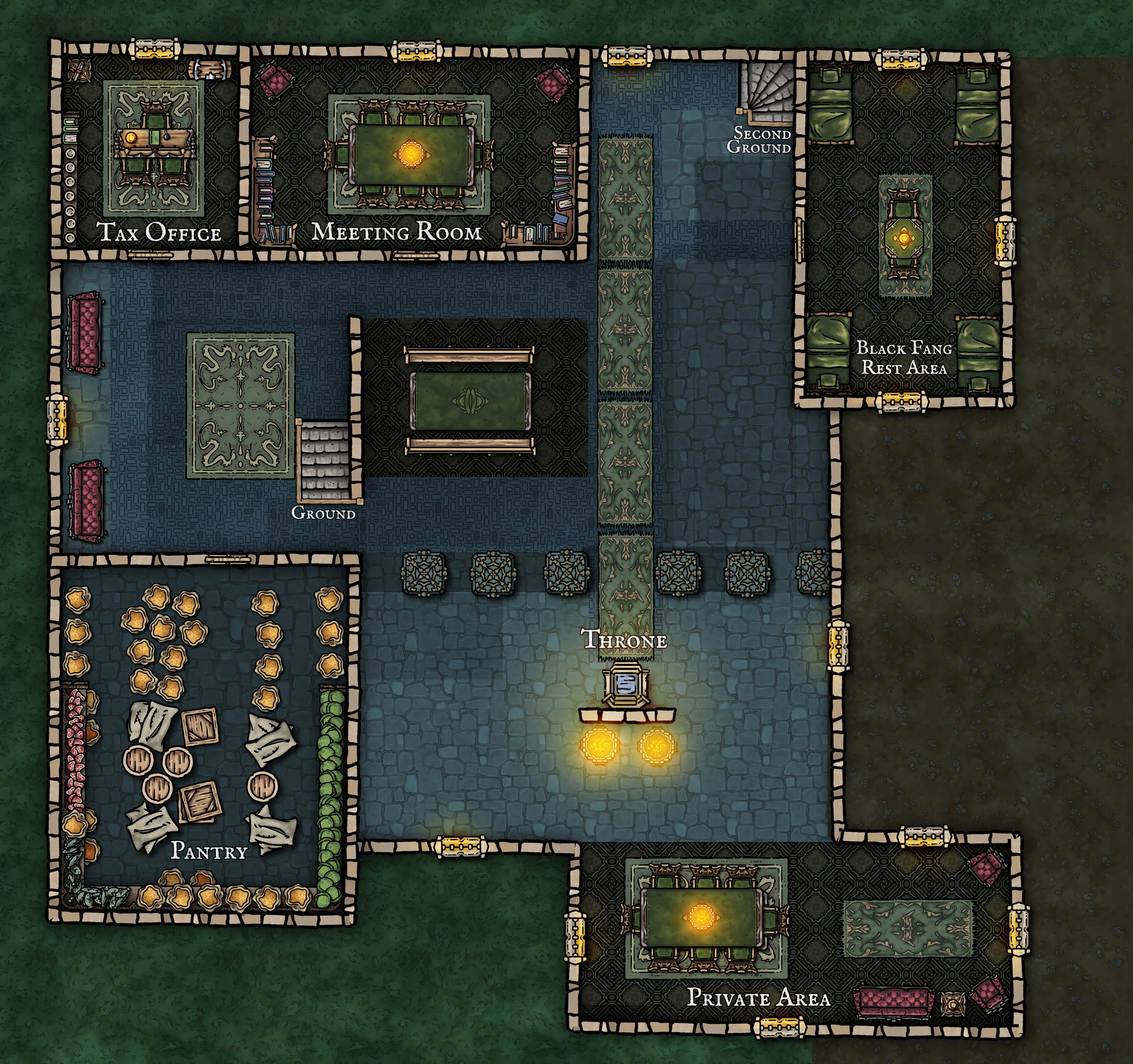
At its most fundamental level, Castle Veil acts as the seat of the Lord Protector, where the Master exercises governance over the clan, the districts, and all associated territories. The throne chamber on the upper floor allows the Master to issue decrees, settle disputes, receive foreign envoys, and conduct high level negotiations that shape the direction of the capital. This makes the castle the political anchor of the marshlands, without which the diverse and rapidly shifting population of Mire Point would lack a cohesive centre of authority.
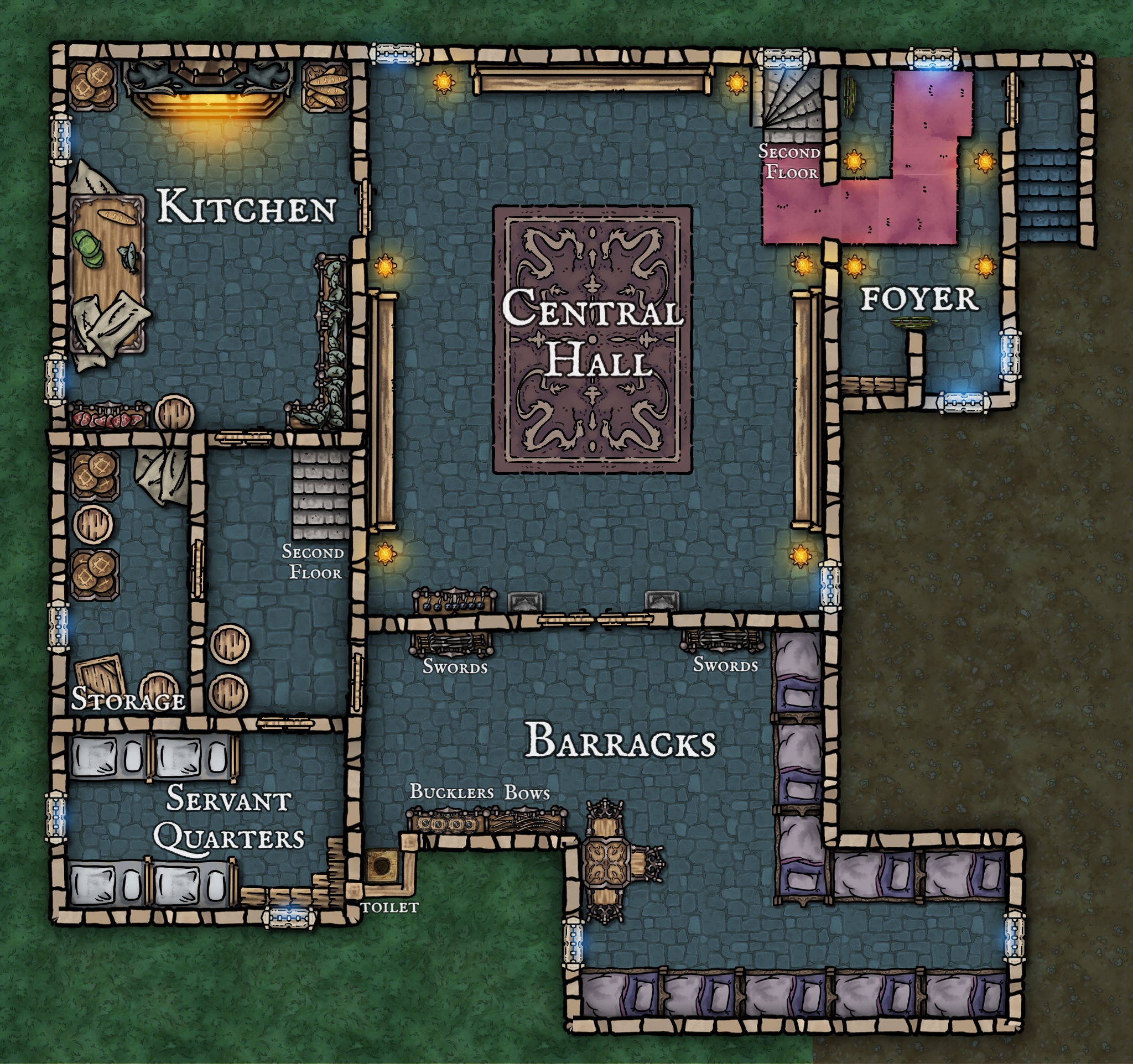
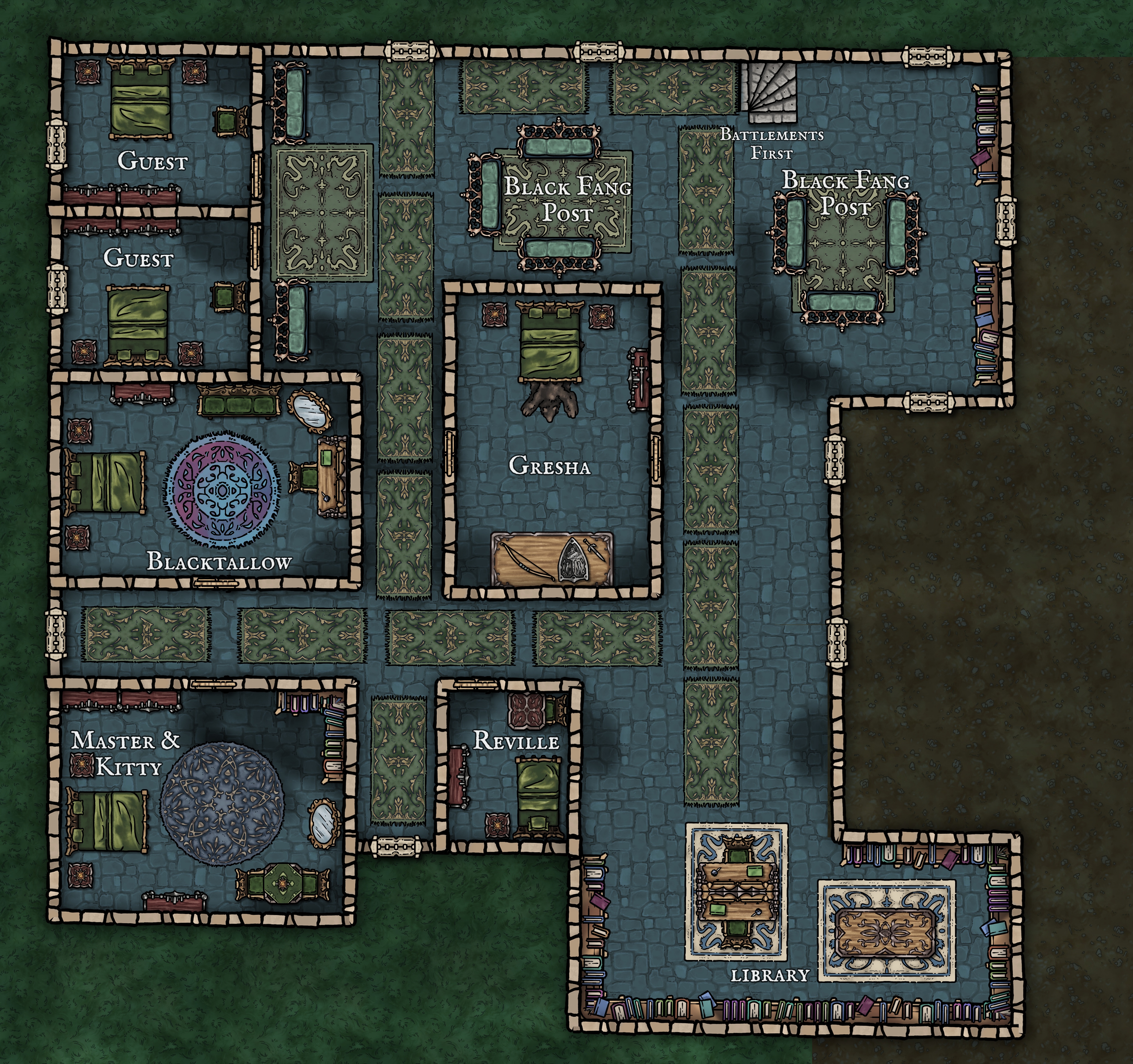
The castle’s second purpose is military. Positioned in the heart of the western district, Castle Veil stands as a command fortress capable of withstanding attack and coordinating the defence of the entire settlement. The presence of the Black Fang, the Royal Guard, extensive barracks, and battlement access ensures that defenders can mobilise instantly in the event of mire beast swarms, raids, or uprisings. The arrangement of armouries, rest areas, and strategic rooms allows the castle to function as a permanent wartime headquarters, ensuring that the Master’s orders reach every part of the militia structure without delay.
Castle Veil also serves as the administrative engine that sustains Mire Point. The tax office, pantry, meeting chambers, and library form the bureaucratic infrastructure required to run a population of nearly twelve thousand. These rooms allow the city to collect resources, manage trade, record laws, regulate guilds, and maintain steady distribution of food, materials, and labour across all districts. Without this administrative centre, the fragile marsh economy would collapse into disorganisation, repeating the failures that plagued earlier settlements in the region.
Finally, Castle Veil holds a cultural and symbolic purpose. As the first true stone and timber fortress in Bogclutch history, it represents the evolution of the clan from a scattered, survival driven populace into a functioning political state. Its presence establishes legitimacy, broadcasts stability to the districts, and provides a physical embodiment of Bogclutch identity. For many residents, especially goblin clans who once lived on the margins of greater powers, Castle Veil stands as proof that they now possess a homeland worth defending.
Architecture
Castle Veil’s architecture follows the functional, imposing logic of early Norman keeps, adapted to the unstable terrain of Mire Point’s marshlands. Like the fortresses built by Norman lords across England and Normandy, Castle Veil emphasises compact strength, internal defensibility, and vertical command of the surrounding landscape, though here the surrounding terrain is marsh rather than open farmland. Its design prioritises endurance over beauty, clarity of layout over ornamentation, and layered protection over sprawling decoration.
The outer form resembles a marsh adapted Norman hall keep. Its walls are built with thick sandstone blocks quarried from the nearest dry ridges, packed with clay to resist the constant moisture of the wetlands. These walls are deliberately high and plain, lacking unnecessary carvings or embellishments. Their purpose is to project authority and to provide an unbroken defensive shell that can withstand both beast incursions and human assault. Small, deep set windows reduce weak points and resemble the arrow slits of early keep fortifications. Reinforced wooden shutters hinged with iron allow the interior to be sealed during storms or threats, echoing the defensive pragmatism of Norman stone castles.
Inside, Castle Veil follows the classic Norman arrangement of clearly tiered floors. The ground level is heavily militarised, much like the lower floors of Norman keeps that housed garrisons and stores. Here lie the barracks, armour racks, food stores, and service rooms, all arranged in strong rectangular chambers with thick interior walls. These spaces are deliberately austere, built for rapid movement of soldiers, easy defence, and minimal fire risk. The stone floors and tightly fitted beams mirror the rugged simplicity of 11th century fortress construction.
What distinguishes Castle Veil from a traditional Norman keep is its adaptation to the marsh. Instead of standing atop a dry motte, it rises from reinforced earthworks engineered to hold its weight in a wet environment. Stone foundations are layered with clay and timber pilings to prevent sinking. Drainage channels surround the keep to divert water away from its base, while the shipyards and canals integrate the castle into the marsh itself, blending fortress and waterbound infrastructure into a cohesive whole.
Tourism
Most visitors are official envoys. These include district representatives, clan headers, and foreign delegates from allied or neighbouring settlements who require direct audience with the Master or the administrative council. Their visits involve diplomatic negotiation, tax settlements, trade agreements, or military coordination. They are escorted at all times, confined to meeting rooms, the throne chamber, or designated waiting halls.
A second group consists of merchants with special licencing, typically those handling high volume or high value goods. These traders may require confirmation of tariffs, export approvals, or formal documentation signed within the tax office. Their interaction with Castle Veil remains practical and brief, often restricted to the administrative wing of the upper floor.
Occasional military officers from the Oakwood Vanguard or distant Bogclutch outposts appear at Castle Veil to report on external conflicts or request reinforcements. These visits are always purposeful and are processed through the castle’s military chambers, never through public areas.
A small number of clerics, record-keepers, and scholars also enter the castle, usually on matters related to census work, archive copying, or clerical advisories. Their access is limited to the library and associated workrooms and does not extend into the private or residential sections.
Beyond these groups, very few people ever enter Castle Veil. Ordinary citizens, pilgrims, merchants, and travellers have no reason, and no permission, to step inside. The building remains an active fortress and administrative headquarters, not a public monument. Thus the castle receives only the visitors its function demands: envoys, officials, licensed merchants, military personnel, and authorised scholars.
Founding Date
Era of Enchantment
Parent Location
Owner
Owning Organization

Comments