

Novaium
“All roads within the Empire bend, in time, toward Novaium.”
Novaium stands as the administrative and civic heart of the Imperium, a city whose authority is felt long before its walls are sighted. Founded at the moment of the Rift and expanded across centuries of measured growth, it has evolved from a fortified provincial centre into a vast, ordered capital, drawing trade, learning, faith, and power into a single, enduring urban whole. Where other cities boast wealth or spectacle, Novaium offers something rarer: continuity.
The city is defined as much by its restraint as by its scale. Its ancient core, enclosed within the old inner wall, preserves the original civic heart formed in the earliest days of imperial settlement. Here stand the principal institutions of governance, arranged around broad plazas and processional ways that speak to deliberate design rather than organic sprawl. From this centre, Novaium has grown outward in successive layers, each expansion marked by new districts, new walls, and new accommodations for the people and industries that sustain an imperial capital.
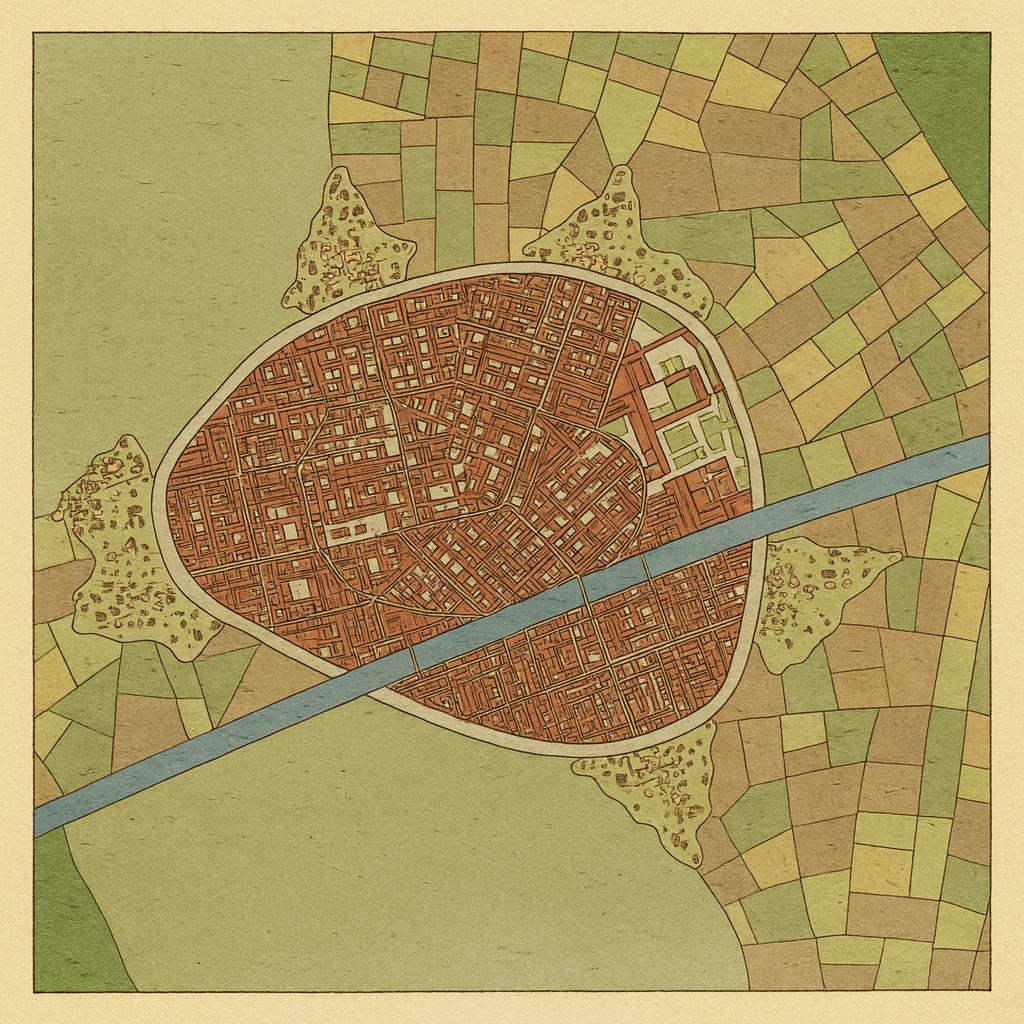
A wide river cuts through the city, shaping both its geography and its character. Unwalled along much of its length, the riverbanks serve as arteries of commerce and ceremony alike, linking markets, docks, and sacred spaces in a continuous flow of activity. Bridges of stone and timber bind the northern and southern halves of Novaium together, while quays and warehouses crowd the water’s edge, bearing the weight of trade from across the realm. To the south, terraced heights rise above the river, their gardens and villas offering cooler air and quieter streets to those of means and standing.
Novaium is governed not by the personal hand of the Emperor, but by imperial law made present through administration. Day-to-day authority rests with the Praefectus Urbi Novaii, Lucius Varius Corvinus, whose office oversees the city’s courts, finances, infrastructure, and public order. His jurisdiction is civic rather than imperial, yet within the walls it is absolute, tempered only by statute, custom, and the constant presence of the Senate and the Collegium Arcanum. This layered governance ensures that power in Novaium is distributed, scrutinised, and slow to move—an inconvenience to some, a safeguard to many.
Despite its size, the city remains comprehensible to the visitor. Broad imperial roads divide Novaium into clearly defined districts, each shaped by function and history rather than accident. Residential quarters cluster near markets and workshops, diplomatic compounds lie close to the halls of power, temples command riverfront promenades, and the legion’s garrison is set apart within the outer wall, present but deliberately removed from the civic core. Beyond the gates, unplanned settlements gather where roads meet fields, a reminder that the city’s influence extends well past its formal boundaries.
To walk Novaium is to move through layers of empire. Old stone bears the marks of Rift-era construction beside newer marble and brick, while civic order overlays the noise of trade, faith, and daily life. Scholars come seeking archives, pilgrims follow processional routes along the river, merchants negotiate contracts beneath covered markets, and envoys measure every street by its distance from power. Few arrive unchanged, and fewer still leave unimpressed.
In all these things, Novaium fulfils its purpose. It is not merely the largest city of the Imperium, nor its richest, but its most enduring expression: a place built to govern, to remember, and to persist.
Demographics
Novaium’s population reflects both its role as the capital of the Imperium and the long reach of imperial authority. At the time of the most recent census, the city accounts for approximately fifty-five thousand permanent residents, a figure that swells considerably during festival seasons, diplomatic summits, and periods of heightened trade. These transient populations, though ever-present, are not counted among the citizenry and are instead regulated through licensing, lodging registries, and gate tallies.
The overwhelming majority of Novaium’s inhabitants are human, descended from the original Rift-borne settlers and their successors. Over generations, this population has diversified along lines of profession, status, and civic role rather than ethnicity alone, with identity shaped more strongly by district and occupation than by distant ancestry. Citizenship remains a meaningful distinction within the city, carrying legal privileges, property rights, and obligations to the state.
Non-human residents are present in smaller but visible numbers, almost entirely concentrated within specific districts and professions. Dwarrow are most commonly found among sanctioned artisans, engineers, and diplomatic staff, particularly those attached to the embassy quarter or contracted for large-scale civic works. Elven residents are fewer still, most often scholars, envoys, or religious figures, and tend to maintain a measured distance from the city’s more crowded quarters. Permanent Centaur residents are exceedingly rare, as the dense streets and enclosed spaces of Novaium are ill-suited to their way of life. Likewise, inhabitants of the Brass Cities are represented primarily by envoys, merchants, and specialised craftsmen, with only a handful maintaining long-term residence within the walls.
Social stratification within Novaium is pronounced but orderly. The civic elite—senators, high magistrates, senior clergy, and accredited scholars—occupy the inner districts and elevated quarters, particularly along the southern heights. Beneath them lies a broad class of clerks, merchants, artisans, and skilled labourers who form the administrative and economic backbone of the city. The largest share of the population consists of labourers, dockworkers, apprentices, and service workers, many of whom reside in dense insulae near markets, workshops, and the riverfront. Poverty exists, but it is managed through regulation, patronage, and, when necessary, removal beyond the walls.
Occupationally, Novaium is dominated by administration, trade, and services rather than production alone. A significant portion of the population is directly or indirectly employed by the machinery of governance: clerks, scribes, messengers, guards, inspectors, and their dependents. Trade and logistics account for another substantial segment, supported by the river docks, markets, and imperial roads. Religious service, education, and regulated magical practice form smaller but influential demographic groups, each closely supervised by their respective institutions.
Though crowded, Novaium is not a city of unchecked chaos. Its population is closely monitored, its movements recorded, and its composition periodically reviewed through census and registry. To live in the capital is to be seen, counted, and known—an arrangement that many accept as the price of proximity to power, and which the Empire regards as one of Novaium’s greatest strengths.
Government
Governance in Novaium is deliberate, layered, and conspicuously impersonal. The city is not ruled by decree or spectacle, but by procedure—an accretion of offices, statutes, and jurisdictions designed to endure long after any single officeholder has passed from record. Authority here is exercised in the Emperor’s name, but never by his direct hand.
Day-to-day administration rests with the Praefectus Urbi Novaii, Lucius Varius Corvinus, whose office is charged with the maintenance of order, the enforcement of law, and the steady operation of the civic machine. From the Praetorium Imperiale within the old city, the Praefectus oversees taxation, public works, judicial proceedings, census administration, and the regulation of trade and residency. His authority is broad within the walls and immediate environs of the capital, constrained less by rival powers than by precedent, statute, and the constant scrutiny of imperial institutions.
Legislative authority remains the province of the Senate, whose sessions are held in the Curia Nova at the heart of the civic core. Senators do not govern the city directly, yet their influence is pervasive: through law, budgetary control, commissions, and inquiry, they shape the boundaries within which the Praefectus operates. The relationship between Senate and prefecture is one of formal cooperation tempered by habitual tension, a balance long regarded by imperial jurists as healthy.
The Collegium Arcanum constitutes a third pillar of governance, neither civil nor military, but regulatory. All sanctioned magical practice within Novaium falls under its authority, and its representatives advise both the courts and the Praefectus on matters where law and arcane risk intersect. Though outwardly collegial, the Collegium’s autonomy is carefully circumscribed, its privileges granted by statute and revocable by the Senate.
Military power within the city is intentionally constrained. Castrum Primus, seat of Legio I, lies within the outer wall yet apart from the civic core. The legion’s commander answers to imperial military command, but in matters of urban security, logistics, and emergency response, the garrison operates in coordination with the Praefectus Urbi. This separation—soldiers present but politically distant—is regarded as one of the city’s oldest safeguards against instability.
Below these institutions operates a dense bureaucracy of magistrates, clerks, inspectors, and ward officials. Their presence is felt everywhere: in stamped documents, posted notices, toll records, and the quiet authority of the civic watch. To residents and visitors alike, government in Novaium is rarely dramatic, but always present, shaping daily life through regulation rather than force.
In this way, Novaium governs itself as the Empire intends the Empire to be governed: slowly, visibly, and with the confidence that comes from systems designed not for brilliance, but for survival.
Defences
The defences of Novaium reflect its dual nature as both an ancient civic heart and a living imperial capital. They are not merely martial works, but statements of order, authority, and continuity, layered over centuries to answer changing needs without erasing the past.
At the city’s core stands the inner wall, enclosing the old city and the original civic precinct formed in the aftermath of the Rift. This wall is the oldest defensive structure in Novaium and, though reinforced and repaired many times, still follows its original lines. Its gates face west, north, and north-east, deliberately oriented toward the earliest imperial roads and approaches. The riverbank, by contrast, is left unwalled along much of its length, a conscious decision that favours commerce and ceremonial access over absolute fortification. Within the inner wall lie the principal institutions of governance, their protection entrusted as much to proximity and oversight as to stone.
Encircling the expanded city is the outer wall, a later construction raised as Novaium grew beyond its original bounds. Thicker, taller, and more overtly military in character, it incorporates towers, gatehouses, and controlled approaches aligned with the major imperial highways. The principal gates correspond to long-established extramural settlements and shanty towns, allowing the flow of goods and labour to be regulated rather than resisted. In times of unrest or siege, these gates can be sealed, transforming the outer wall into a formidable barrier without severing the city’s internal cohesion.
The river itself serves as both conduit and defence. Its breadth and current complicate any hostile crossing, while bridges are few, well-maintained, and closely watched. Two major stone bridges connect the old city directly to the southern bank, while smaller crossings serve the newer districts. Each bridge is designed as a defensible choke point, with guard posts and inspection stations that can be reinforced at short notice.
The military backbone of the city’s defence lies with Castrum Primus, the legionary garrison situated within the outer wall but deliberately apart from the civic core. Home to Legio I, the castrum is a complete and self-sufficient fortress, capable of independent action if required. While the legion does not police the city in ordinary circumstances, its presence acts as a powerful deterrent, and its rapid deployment capacity ensures that external threats, large-scale disorder, or natural disasters can be met decisively.
Supplementing the legion is the civic watch, a professional force responsible for patrols, gate control, and internal security. Drawn from the city’s citizenry and overseen by magistrates answerable to the Praefectus Urbi, the watch maintains order within the districts and coordinates closely with military authorities during emergencies.
Taken together, these layers of defence ensure that Novaium is difficult to assail, slower still to destabilise, and exceptionally resilient. The city does not rely on a single wall or force, but on a system of controlled access, visible authority, and readiness—a defensive philosophy as measured and enduring as the Empire it protects.
Industry & Trade
Novaium’s prosperity rests not on a single trade or resource, but on its position as the Empire’s primary point of convergence. Goods, people, information, and authority all pass through the city in regulated currents, making commerce here as much an administrative act as an economic one. Trade is not merely tolerated in Novaium; it is measured, taxed, recorded, and directed.
The river is the city’s most vital commercial artery. Barges and rivercraft arrive daily bearing grain, timber, stone, ore, and finished goods from across the interior, while outbound traffic carries imperial coinage, processed materials, legal charters, and sanctioned exports to the provinces. The riverbanks within the walls are lined with quays, warehouses, fisheries, and markets, each operating under strict licensing regimes enforced by civic officials. The distinction between the older harbour and the newer industrial docks reflects the city’s growth: traditional trade and food supply are concentrated upstream, while heavier industry and bulk handling have been deliberately pushed outward.
Overland trade is equally significant. Major imperial roads enter Novaium through well-established gates, linking the capital to frontier settlements, mining regions, and allied territories. Caravan traffic brings textiles, livestock, luxury goods, and foreign wares, much of which is exchanged in covered markets or routed through guild-controlled depots before entering circulation. Inns, stables, and caravan yards cluster near these approaches, forming an ecosystem of services that supports constant movement without allowing it to overwhelm the city.
Manufacturing within Novaium is substantial but carefully regulated. Artisan guilds dominate the production of tools, arms, armour fittings, textiles, and civic materials, operating from designated commercial districts where fire, noise, and waste can be managed. Heavy industry—foundries, shipyards, and large-scale workshops—is confined to the industrial docks, where access to water and distance from the civic core reduce risk. Certain crafts, particularly those related to arms and infrastructure, operate under direct imperial contract, tying their fortunes closely to the needs of the state.
Administration itself is one of the city’s defining industries. Thousands are employed as clerks, scribes, inspectors, couriers, and legal functionaries, supporting the bureaucratic apparatus that governs not only Novaium but much of the Empire beyond its walls. Documents produced here—laws, decrees, licenses, and judgments—circulate outward with an authority that few other cities can claim. In this sense, Novaium exports order as much as it exports goods.
Foreign trade is present but controlled. Merchants and envoys from allied and rival powers are permitted to operate within designated quarters, their activities monitored through treaties, tariffs, and inspection. Exotic goods from distant cultures appear in the markets of Novaium, but rarely without first passing through official channels. This balance allows the city to benefit from foreign commerce without surrendering economic leverage.
Taken together, these systems ensure that Novaium remains prosperous without becoming dependent on any single industry. Trade flows through the city as through a lock on a great canal—guided, constrained, and immensely productive. The result is a capital whose wealth is steady rather than spectacular, and whose economic strength mirrors the Empire’s preference for endurance over excess.
Infrastructure
The infrastructure of Novaium is the quiet achievement upon which all else depends. Though rarely celebrated in inscription or ceremony, it is this web of roads, bridges, walls, and utilities that allows the capital to function with a reliability expected of the Empire’s seat. Much of it has been rebuilt, reinforced, or expanded over the centuries, yet its foundations remain rooted in the original Rift-era plan.
The city’s road network is both deliberate and adaptive. Broad imperial avenues cut through Novaium along established axes, linking gates, bridges, and civic centres with measured regularity. These principal roads are paved, drained, and kept clear by civic ordinance, forming the backbone of administration and commerce. Between them, narrower streets follow older lines, bending to terrain, riverbanks, and long-established property boundaries. Together, these layers produce a city that is navigable without being uniform, ordered without appearing artificial.
Bridges are few and carefully maintained. The major stone crossings, built to carry heavy traffic and ceremonial processions alike, bind the northern and southern banks into a single urban body. Smaller bridges and foot crossings serve local movement, while ferries continue to operate along unwalled stretches of the river, particularly where trade or daily labour demands flexibility. Each crossing point is regulated, inspected, and recorded, reflecting the city’s preference for control over congestion.
Water management is among Novaium’s most important civic concerns. Fresh water is supplied through a combination of aqueducts, wells, and cisterns, with distribution prioritised to public fountains, baths, and administrative complexes. Wastewater and runoff are channelled through an extensive system of sewers and culverts, some dating back to the earliest days of settlement and others added as districts expanded. Though unseen, these systems are inspected regularly, their maintenance regarded as a matter of public health and imperial dignity.
The riverfront is heavily engineered. Quays, steps, and retaining walls stabilise the banks, while docks and landing stages provide controlled access for trade and ceremony. Warehouses and granaries are positioned close to the water, allowing goods to be moved efficiently under supervision. In several districts, riverside promenades double as processional routes, reinforcing the river’s dual role as economic lifeline and symbolic boundary.
Public buildings are supported by courtyards, colonnades, and open spaces designed to manage crowds and climate alike. Markets are covered to protect goods and patrons from weather, while forums and plazas are proportioned to accommodate assemblies without overwhelming their surroundings. In the southern heights, terracing and retaining walls transform steep ground into usable space, allowing gardens, villas, and temples to rise above the river without threatening stability below.
Beyond the walls, roads extend outward into farmland and satellite settlements, maintained at imperial expense to ensure uninterrupted supply. Though these outer works fall outside the city’s formal boundary, they are treated as integral to Novaium’s functioning, inspected by the same officials and repaired with the same materials as those within.
Taken as a whole, Novaium’s infrastructure reveals the Empire’s priorities with uncommon clarity. Nothing is built for spectacle alone. Everything is designed to last, to be repaired, and to be governed. The result is a city that moves steadily, absorbs growth without collapse, and continues to serve its purpose long after the labour that created it has faded from record.
Districts
Novaium is divided not by accident, but by function, history, and the steady guidance of its roads and walls. Each district has emerged from the demands placed upon it, shaped as much by proximity to power and trade as by the city’s gradual expansion beyond its original bounds. To the visitor, these divisions are readily apparent; to the resident, they are simply the way the city works.
At the heart of Novaium lies the Praesidium Imperii, the Government District, enclosed within the ancient inner wall. This is the oldest part of the city and the seat of its civic authority, where the Triumvirate Plaza and the principal institutions of governance stand amid broad courts and carefully controlled approaches. Movement here is deliberate, regulated, and visibly overseen, lending the district an atmosphere of quiet gravity distinct from the rest of the capital.
Immediately adjoining it is the Domus Legatorum, a district of embassies and elite residences. Here, senatorial villas and foreign compounds stand behind guarded walls and cultivated gardens, close enough to the centres of power to remain influential, yet removed from the administrative core itself. Diplomacy, negotiation, and discreet hospitality define the character of this quarter, which is among the most orderly and closely monitored in the city.
Beyond these inner precincts stretch the dense residential districts that house the majority of Novaium’s citizens. The Insulae Civium form a broad inner residential quarter of apartment blocks, modest homes, and small workshops, populated by clerks, artisans, and families whose livelihoods depend upon the functioning of the capital. Adjacent to the river, the Vicus Flumineus combines housing with small-scale commerce, its streets crowded with shops, taverns, and markets serving both locals and travellers. Where these districts meet, trade naturally concentrates, creating a lively commercial nexus known informally as the Forum Minor.
Along the northern bank of the river lies Portus Vetus, the old harbour district. Fisheries, docks, warehouses, and river markets dominate this area, which remains one of the most active and noisy parts of the city. Though utilitarian in character, it is vital to Novaium’s food supply and river trade. West of the harbour, the Mercatum Occidentis serves as the city’s principal artisan and commercial quarter, home to guild halls, workshops, and covered markets that supply both the populace and the state.
Approaching the northern gates, the Vicus Septentrionalis marks the point where the city meets the road. Inns, stables, caravan yards, and lodging houses cater to merchants and travellers entering Novaium, making this district many visitors’ first encounter with the capital. Its population is transient, its pace brisk, and its streets closely watched.
Set apart within the outer wall is Castrum Primus, the legionary garrison district. Purpose-built and orderly, it houses the troops, armouries, and training grounds of Legio I. Though an integral part of the city’s defence, it remains spatially and politically distinct from the civic districts, reinforcing the separation between military force and civil authority.
Further east along the river spreads Portus Magnus, the industrial docklands. Here, shipyards, foundries, and bulk warehouses handle heavy goods and large-scale manufacturing, their operations kept deliberately distant from the old city. Smoke, noise, and labour define the district, which underpins Novaium’s material strength even as it remains largely unseen by those who govern.
On the southern bank, faith and ceremony take precedence in Sacra Ripa, the Temple District. Major temples, shrines, and sacred precincts line the riverfront, connected by the Processional Way of Ash and Light, a ceremonial road that hosts festivals, rites, and public observances. This district stands in deliberate balance with the civic heart across the water, linking spiritual authority to the rhythms of the city.
Rising above the southern riverbank are the Altae Velariae, the Velari Heights. Terraced and green, this elevated district is home to noble estates, senior clergy, and institutions of learning. Quieter and more spacious than the lower quarters, it offers distance from the crowds below and commands sweeping views across Novaium, a reminder that status here is measured as much in elevation as in proximity to power.
Together, these districts form a city that is legible without being rigid, complex without being chaotic. Each serves a distinct purpose, yet none stands alone, bound together by roads, river, and the steady governance that has allowed Novaium to endure as the Empire’s capital.
Assets
As the capital of the Imperium, Novaium holds assets whose value lies not merely in wealth, but in stability, continuity, and control. Many of these resources are invisible to the casual visitor, stored behind sealed doors and guarded by procedure rather than spectacle, yet they form the material foundation upon which imperial authority rests.
Foremost among these are the city’s extensive public granaries and food reserves, supplied by the surrounding farmlands and river trade. Maintained under civic oversight, these stores are intended not for profit, but for resilience, ensuring that Novaium can withstand poor harvests, disrupted trade, or temporary siege without immediate hardship. Grain, salt, and preserved foods are stockpiled in carefully regulated quantities, their movement tracked as diligently as coin.
The capital also houses significant treasuries and revenue vaults, where taxes, tariffs, and fines collected within the city and from surrounding regions are received, recorded, and redistributed. These holdings fluctuate constantly, yet the mechanisms that manage them are among the most sophisticated in the Empire. Coinage, bullion, and sealed contracts pass through Novaium in vast amounts, though only a fraction remains within its walls at any given time.
Equally important are the city’s archives and records. Legal charters, census rolls, property deeds, treaties, and imperial edicts are preserved in secured repositories within the civic core. Some of these documents date back to the earliest years following the Rift, and their authority underpins land claims, noble titles, and administrative precedent across the realm. In practical terms, the loss of these records would be as damaging to the Empire as the loss of an army.
Novaium maintains substantial armouries and logistical stores, concentrated within Castrum Primus and associated depots. Weapons, armour, siege equipment, and reserve supplies are held in readiness, not only for the defence of the city but for rapid deployment elsewhere if required. These stores are replenished under contract with approved guilds and monitored by both military and civic officials.
The riverfront districts contain large warehouse complexes, many under state lease or direct control, used to store trade goods, raw materials, and manufactured products awaiting redistribution. Timber, stone, metals, textiles, and finished wares move through these facilities in a constant flow, making Novaium a clearinghouse for the Empire’s economy as much as its political centre.
Finally, the city’s most enduring asset lies in its institutional capacity. The trained clerks, magistrates, engineers, scholars, and administrators who reside in Novaium constitute a resource that cannot be easily replicated elsewhere. Their collective knowledge, experience, and adherence to imperial systems allow the capital to absorb shocks, enforce policy, and project authority far beyond its walls.
Taken together, these assets ensure that Novaium is not merely wealthy, but prepared. The city’s strength lies less in accumulation than in organisation, and it is this quiet readiness that has allowed it to serve as the Empire’s anchor through centuries of change.
Guilds and Factions
Though Novaium is governed by law and office, its daily rhythm is shaped by a dense web of guilds, institutions, and interest groups whose influence is felt in markets, courts, and corridors alike. These bodies do not rule the city, yet few decisions of consequence are made without their knowledge, cooperation, or quiet resistance. In a capital of this scale, influence is exercised less through open power than through presence and persistence.
Foremost among these are the artisan and trade guilds, whose halls are concentrated in the commercial districts and docklands. Collectively organised under the Collegia Artificum, these guilds regulate apprenticeship, wages, standards of workmanship, and the lawful practice of their crafts. Smiths, masons, carpenters, tanners, shipwrights, and many others operate within tightly defined charters, their cooperation essential to public works, military supply, and the maintenance of infrastructure. While rarely unified in purpose, the guilds wield considerable leverage through their ability to slow, redirect, or prioritise labour.
The merchant associations of Novaium form a looser, more competitive network. Operating from market quarters and riverfront warehouses, these groups control trade routes, caravan schedules, and access to storage and transport. Some are local in scope, others tied to provincial or foreign interests, particularly those linked to the Brass Cities. Though officially subordinate to civic authority, merchant factions are adept at navigating regulation, and their support is often quietly courted by administrators seeking to ensure uninterrupted supply.
Religious life within the city is overseen by the Civic Priesthood of the Phoenix, whose authority extends across the Temple District and into public rites observed throughout Novaium. While doctrinal matters remain secondary to civic order, the priesthood plays an important role in festivals, funerary practices, and state ceremonies, lending spiritual legitimacy to imperial observance. Alongside them operate sanctioned shrines maintained by elven and dwarrow traditions, integrated by treaty and custom rather than conquest, and watched closely by both civic and arcane authorities.
The Collegium Arcanum stands apart from other factions, neither guild nor priesthood, but a regulatory body charged with overseeing all lawful magical practice within the capital. Its members advise courts, inspect practitioners, and maintain sealed archives whose contents are rarely discussed outside their walls. Though outwardly deferential to civic authority, the Collegium’s expertise grants it a quiet influence disproportionate to its size, particularly in matters of security and precedent.
Within the civic structure itself, informal factions emerge among magistrates, clerks, and inspectors. Senior officials cultivate networks of patronage and loyalty that can shape how laws are enforced and resources allocated, especially in matters that fall short of senatorial attention. These bureaucratic alignments are rarely acknowledged openly, yet they are widely understood by those who work within the system.
Finally, the Legionary presence constitutes a faction by omission rather than assertion. Legio I, stationed at Castrum Primus, does not engage in city politics, nor is it permitted to do so. Nevertheless, its commanders’ opinions carry weight in matters of defence, logistics, and emergency planning, and their cooperation is essential in times of crisis. The legion’s restraint is as significant as its strength, reinforcing the civic nature of governance in Novaium.
Together, these guilds and factions form a balancing network that supports the city’s stability. None are permitted to dominate, all are subject to oversight, and each understands that influence in Novaium is most effective when exercised quietly. In this equilibrium, the Empire finds not harmony, but durability—an arrangement well suited to a capital built to endure.
History
The history of Novaium begins not with gradual settlement, but with sudden arrival. The city was founded in the immediate aftermath of the Rift, when an imperial population—institutions intact but context violently altered—found itself transposed into an unfamiliar world. The earliest years were defined by consolidation rather than expansion. Defensive works were raised around a compact civic core, authority was formalised, and the machinery of law and record was preserved with an urgency that speaks to the founders’ understanding of what had been lost—and what could not be allowed to vanish again.
In this initial phase, Novaium served as a fortified provincial centre, combining military necessity with administrative survival. The inner wall, still standing, dates from this era, enclosing the first civic precinct and the institutions that would later be recognised as the pillars of imperial governance. Trade was limited, diplomacy tentative, and expansion restrained, as the city learned its environment and measured its neighbours.
Stability brought confidence. As surrounding lands were secured and routes established, Novaium entered a period of deliberate growth. Roads were formalised, river trade expanded, and the city began to draw artisans, merchants, and scholars from beyond its walls. New districts emerged along the riverbanks, followed by the first diplomatic compounds and temples. This was also the period in which the Senate’s authority was fully reasserted and the Collegium Arcanum codified its role, embedding regulation into the city’s fabric rather than allowing power to concentrate unchecked.
The construction of the outer wall marked Novaium’s transition from provincial capital to imperial centre. Raised not in haste but by design, it enclosed broad new districts and incorporated Castrum Primus as a permanent garrison. With this expansion came increased population, intensified trade, and the formal separation of civic, military, religious, and industrial spaces—a spatial expression of the Empire’s evolving philosophy of governance.
In the centuries that followed, Novaium was reshaped less by catastrophe than by accumulation. Districts were rebuilt, streets widened or redirected, and infrastructure reinforced to meet the demands of a growing capital. The riverfront was engineered into a continuous economic and ceremonial corridor, while the southern heights were terraced and claimed by the elite. Though fires, floods, and political crises are recorded in the archives, none altered the city’s fundamental trajectory.
Throughout its history, Novaium has resisted reinvention. Rather than remaking itself with each generation, it has layered new purpose atop old stone, preserving continuity even as its role expanded. The city that governs today still bears the imprint of its founding moment, its streets and institutions shaped by the same priorities that guided its first builders: order over spectacle, endurance over excess, and governance as the highest civic good.
In this continuity lies Novaium’s greatest distinction. It is not merely a city that survived the Rift, but one that absorbed it into its identity, transforming disruption into foundation and uncertainty into permanence.
Points of interest
To the traveller, Novaium presents no single monument that defines it at a glance. Its importance lies instead in a constellation of sites whose collective presence expresses the city’s purpose. These places are not arranged for wonder alone, but for function, authority, and memory, and each rewards attention for what it reveals about how the capital understands itself.
At the heart of the old city stands the Forum Triumviralis, a broad civic plaza formed during the earliest years after the Rift. It remains the symbolic centre of Novaium, not through ornament, but through proximity. Opening onto this space are the three great institutions of imperial governance: the Palatium Novaii, seat of executive authority; the Curia Nova, where the Senate convenes; and the Collegium Arcanum, whose sealed halls regulate and contain sanctioned magical practice. Completing this civic ensemble is the Praetorium Imperiale, home to the city’s highest courts and administrative offices. Together, these buildings define the Government District and embody the layered nature of imperial power.
Along the northern bank of the river lies the Forum Minor, an informal yet indispensable commercial centre where markets, guildhouses, and counting rooms converge. Though lacking the grandeur of the civic core, it is here that much of the city’s daily business is conducted, contracts negotiated, and fortunes quietly adjusted. Nearby, the river quays and warehouses of Portus Vetus support fisheries, food markets, and river trade that sustain the capital’s population.
Across the water, the Temple District known as Sacra Ripa commands attention through ritual rather than scale. Its principal sanctuary, the Templum Phoenix Aeternae, serves as the focal point of civic religion, while adjacent shrines honour allied traditions integrated by treaty and custom. Running alongside the southern riverbank is the Processional Way of Ash and Light, a ceremonial road that hosts festivals, rites, and public observances, binding faith to the everyday life of the city.
To the east, set deliberately apart from the civic heart, rises Castrum Primus, the permanent garrison of Legio I. Its rectilinear form and ordered yards contrast sharply with the surrounding districts, serving as a reminder of military strength held in reserve rather than on display. Further along the river, the industrial docks of Portus Magnus house shipyards, foundries, and state warehouses, their activity essential yet largely invisible to those who govern from the inner city.
Above the southern bank, the terraced estates and institutions of the Altae Velariae offer a different perspective. Noble villas, academies, and quiet sanctuaries occupy the heights, commanding views across Novaium and providing space for reflection, study, and discreet influence removed from the noise below.
Taken together, these points of interest do not compete for attention. Each serves a defined role within the city’s structure, reinforcing Novaium’s identity as a place built to govern, to endure, and to integrate the many functions of empire into a coherent whole.
Tourism
Novaium is not a city that courts visitors, yet it receives them in great number. Those who come do so with purpose, drawn less by novelty than by necessity, ambition, or reverence. Tourism in the capital is therefore restrained in character, shaped by regulation and custom rather than indulgence, and woven quietly into the city’s daily life.
Scholars arrive from across the Imperium to consult the city’s archives, attend lectures, or seek admission—formal or otherwise—to its academies and learned institutions. They are most often found lodging in the northern districts or the quieter quarters of the southern heights, spending their days moving between libraries, courts, and private salons. For such visitors, Novaium offers not spectacle but access, and that alone is reason enough to endure its crowds and formality.
Pilgrims form another steady stream. The temples of Sacra Ripa, and particularly the great sanctuaries along the southern riverbank, draw worshippers throughout the year, their numbers swelling during major festivals and commemorations. Processions along the Way of Ash and Light are among the few occasions when the city openly embraces ceremony, and visitors are permitted—within bounds—to observe and participate. Lodging for pilgrims is modest but ample, supported by religious houses and licensed hostels near the Temple District.
Merchants and envoys constitute the most visible class of visitor. Trade delegations, caravan masters, and foreign representatives arrive daily through the city gates, their movements tracked and their stays regulated. Inns and guesthouses near the northern approaches cater to this population, offering comfort without excess and discretion without isolation. For diplomats, proximity to the Domus Legatorum and the civic core is often more valuable than luxury.
A smaller number of visitors come simply to see the capital itself. These are typically citizens of the provinces, officials on temporary assignment, or retired veterans returned to the city for petition or ceremony. Their experience of Novaium is shaped by its orderliness: the measured pace of its streets, the visibility of authority, and the sense that every building, however plain, has a defined place within a larger design.
Novaium does not advertise its wonders, nor does it embellish them for effect. Visitors are expected to adapt to the city, not the reverse. Those who do often depart with a lasting impression—not of splendour or excess, but of a city that functions, governs, and remembers. For many, that impression is enough to confirm Novaium’s reputation as the Empire’s true centre, whether or not it welcomes the title.
Architecture
The architecture of Novaium is defined by purpose first and ornament second. Though imposing in scale, the city avoids excess, favouring durability, legibility, and continuity over novelty. Its built form reflects centuries of layered construction, where new stone is laid with an awareness of what already stands, and where even ambitious projects are required to submit to the logic of the city rather than redefine it.
At the core, the old city preserves the earliest architectural language of the Rift era. Heavy masonry, broad foundations, and restrained façades dominate the civic precinct, their proportions governed by symmetry and axial alignment. Public buildings are set back from the street behind colonnades or open courts, creating controlled approaches that emphasise authority through space rather than height. Decorative elements are present—reliefs, inscriptions, statuary—but are employed sparingly, serving to record office, law, or dedication rather than to impress the eye.
Beyond the inner wall, later districts adopt a more pragmatic style. Residential insulae rise several storeys, their lower levels built of stone and brick, upper floors often timbered or rendered to reduce weight and cost. Streets are narrow where they must be, wider where commerce demands it, and buildings frequently incorporate workshops or shops at ground level. This mixed-use construction gives much of Novaium its dense, lived-in character, particularly in the river wards and market districts.
Along the riverfront, architecture becomes openly functional. Quays, warehouses, fisheries, and dock structures prioritise access, load-bearing capacity, and ease of supervision. Here, ornament is minimal, replaced by clear sightlines and durable materials resistant to water and wear. Bridges are solid and unadorned, their design intended to endure traffic and inspection rather than inspire admiration.
Religious architecture in Novaium balances reverence with civic discipline. Temples of Sacra Ripa are prominent but contained, their precincts clearly defined and integrated into the urban fabric rather than elevated above it. Processional routes, steps, and forecourts provide space for ceremony without disrupting daily movement, reinforcing the idea that faith, while visible, remains subordinate to order.
In contrast, the Velari Heights display a quieter refinement. Villas, academies, and sanctuaries here are arranged on terraced slopes, making use of gardens, retaining walls, and open loggias to command air and light. Materials are finer, proportions more generous, and decoration more personal, yet even these buildings adhere to established codes, ensuring that private status does not overwhelm public coherence.
Throughout Novaium, construction is governed by regulation. Building heights, materials, and street frontage are subject to civic approval, and alterations to older structures require formal sanction. This oversight has preserved a remarkable architectural continuity, allowing the city to grow without fracturing its identity. The result is a capital whose skyline is measured rather than dramatic, and whose buildings, taken together, express the Empire’s preference for endurance over display.
Geography
Novaium occupies a carefully chosen site where geography serves governance as much as settlement. The city straddles a broad river that flows across its southern reaches, shaping both its layout and its economy. This waterway divides the capital into northern and southern halves while binding them together through bridges, quays, and shared ceremonial space. Unwalled along much of its course, the river is treated not as a boundary to be feared, but as a controlled corridor of movement, trade, and ritual.
The northern bank rises gently from the water into relatively even ground, allowing the early city to establish its civic core on stable terrain. It is here that the old city took root, enclosed by its inner wall and later surrounded by successive layers of development. The land lends itself to ordered streets and broad public spaces, a quality that influenced the placement of government institutions and the primary imperial roads that converge on the capital.
South of the river, the terrain changes character. A prominent elevated ridge—the Velari Heights—rises above the southern bank, its slopes steep enough to command views across the city while remaining accessible through terracing and engineered approaches. This elevation provides cooler air, greater separation from the noise of the docks, and natural prominence, qualities that have long attracted elite residences, temples, and institutions of learning. Below the heights, flatter ground along the river supports dense settlement, religious precincts, and ceremonial routes aligned with the water.
Beyond the walls, the surrounding landscape opens into cultivated farmland and managed estates that supply the capital with grain, livestock, and raw materials. These lands are interlaced with roads, canals, and minor settlements whose existence is oriented toward the needs of the city. To the east and north-east, routes lead toward mineral-rich regions and allied territories, while western approaches connect Novaium to older trade corridors and river systems.
The overall geography of Novaium offers few natural extremes. There are no mountains pressing against its walls, nor marshes threatening its foundations. Instead, the site provides balance: defensible without isolation, fertile without dependency, elevated without inaccessibility. It is a geography that rewards planning and maintenance, and one that has allowed the city to expand steadily without outgrowing its surroundings.
In this setting, Novaium appears neither imposed upon the land nor shaped entirely by it. Rather, the city and its geography exist in measured accommodation, each reinforcing the other’s stability.
Climate
The climate of Novaium is temperate and broadly stable, shaped by its riverine setting and the gentle variations of the surrounding landscape. Seasonal change is distinct but rarely severe, allowing the city to function year-round without significant interruption to trade, administration, or daily life. This predictability has long been regarded as one of the capital’s quiet advantages.
Summers are warm without becoming oppressive, moderated by river breezes and the open spaces of plazas, quays, and terraced heights. The southern slopes of the Velari Heights are particularly prized during these months, offering cooler air and relief from the denser quarters below. Heat waves do occur, but are typically short-lived, and public fountains, shaded colonnades, and covered markets mitigate their effects.
Autumn brings increased rainfall, replenishing cisterns and supporting the agricultural lands beyond the walls. The river swells modestly during this season, occasionally requiring adjustments to docking schedules and river traffic, though serious flooding is rare due to long-established embankments and drainage works. The city’s infrastructure is designed with these seasonal fluctuations in mind, and disruptions are generally minor.
Winters are cool and damp rather than harsh. Frost is not uncommon, particularly at night, but snowfall is infrequent and rarely accumulates. The river remains navigable throughout the season, ensuring continued supply and communication. Public buildings and wealthier residences are constructed to retain heat, while fuel storage is regulated to prevent shortages during colder months.
Spring is marked by gradual warming and renewed activity along the river and roads. Markets expand, construction resumes, and religious festivals tied to renewal and remembrance draw increased crowds. The city emerges from winter with little visible strain, a testament to both its climate and its preparedness.
Overall, Novaium’s climate favours continuity over drama. It imposes no great hardship and demands no heroic adaptation, allowing the city’s fortunes to be shaped by policy and planning rather than weather. For an imperial capital built to endure, such moderation is not incidental, but ideal.
Natural Resources
Novaium’s strength is not derived from abundant resources within its walls, but from reliable access to those that surround it. The city sits at the centre of a productive hinterland, deliberately integrated into imperial supply systems that ensure steady provision rather than local excess. What Novaium lacks in raw abundance, it compensates for through organisation, storage, and control.
The lands beyond the city are dominated by cultivated farmland, worked intensively to support the capital’s population. Grain fields, orchards, and pasturelands stretch along the river valley and outward into the surrounding plains, their output channelled through regulated markets and state-managed granaries. Livestock—particularly sheep and cattle—provide meat, wool, and leather, much of which is processed in workshops within the city before being redistributed or stored for reserve.
Stone is quarried from nearby hills and river-cut escarpments, supplying the raw material for walls, bridges, and public buildings. These quarries have been worked for generations, their output closely monitored to ensure consistency in quality and availability. Timber is sourced from managed forests further afield, floated downriver or transported along imperial roads, and reserved primarily for construction, shipbuilding, and fuel.
To the north and east, mining regions provide metals essential to the city’s industry and defence. Iron and lesser ores arrive in bulk, feeding the foundries and armouries of the industrial docks. More valuable metals are rarer and more tightly controlled, entering the city under guard and often passing directly into state custody rather than private circulation.
The river itself remains Novaium’s most versatile natural resource. Beyond its role in transport and trade, it supplies fish to the city’s markets, water for industry and sanitation, and a regulated source of power for mills and mechanical works along its banks. Its predictable flow and long-established management make it a dependable asset rather than an unpredictable hazard.
Taken together, these resources form a network rather than a hoard. Novaium does not exploit its surroundings recklessly, nor does it rely on a single source of sustenance. Instead, it draws steadily from land, water, and labour, integrating each into systems designed to buffer scarcity and absorb disruption. In this measured relationship with its environment, the capital reflects the Empire’s broader approach to resource management: disciplined, sustainable, and prepared for the long term.
Maps
-
Novaium

Comments